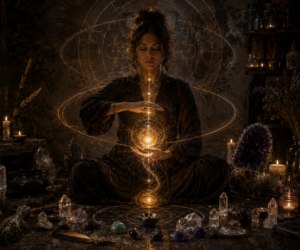
Developing Psychic Sensitivity for Spirit Work ~ A Practitioner’s Guide

Psychic sensitivity is not a gift you either have or you don’t.

It is a capacity, like strength, or flexibility, or the ability to hold a sustained note, that exists in everyone in some form and that develops through practice. The practitioner who seems to perceive things others miss has not been granted special access to the spirit world. They have simply been paying attention longer, in more disciplined ways, and they have developed the trust to act on what they perceive rather than explaining it away before it has a chance to become information.

This is for the practitioner who knows there is more happening around them than they can currently receive . Who feels the edge of perception without being able to cross it reliably, who has experiences that seem significant but cannot yet read them clearly, who wants to develop genuine sensitivity rather than perform it.

What follows is honest about what this development actually requires. It is not fast. It is not dramatic. It does not produce extraordinary abilities on a schedule. What it produces, over time and with consistent practice, is something more valuable than extraordinary: a reliable, grounded, trustworthy relationship with your own subtle perception.

Understanding What You Are Developing
Before working on developing psychic sensitivity, it helps to understand what sensitivity actually is. What you are trying to develop and why the development takes the form it does.

Belladonna ~ The Beautiful Lady of the Witch’s Garden

She grows at the edge of things.

In the dappled shadow at the forest margin, in the rubble of old ruins, in the disturbed earth beside crumbling walls – belladonna chooses her ground carefully. She is not a plant that invites herself into the tidy cultivated garden. She arrives where something has been disrupted, where the ground has been turned over, where the boundary between the managed world and the wild one has become uncertain.

This is appropriate. Belladonna has always lived at the edge.

Atropa belladonna, deadly nightshade, is one of the most famous and most feared plants in the Western magical tradition. She appears in the literature of witchcraft, in the pharmacopoeia of medieval herbalists, in the records of poisoners and physicians alike. She has killed people. She has healed people. She has, according to centuries of folk tradition, carried people between worlds.

She deserves to be understood properly.

The Names She Carries
The name belladonna is Italian, bella donna, beautiful lady, and its origin is usually explained by one of two stories, or both simultaneously. The first:

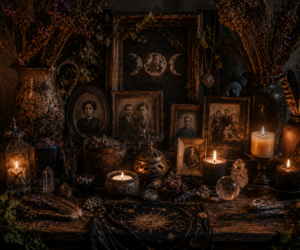
Building an Abundance Altar from Scratch

An altar is not a decoration.

It is not a collection of pretty things arranged on a shelf. It is not proof that you are a real witch or a serious practitioner. It does not need to be large, or expensive, or Instagrammable. It does not need to look like anyone else’s.

An altar is a point of focus. A place where your intention gathers, where you return again and again to do the quiet work of aligning your inner life with what you are calling into your outer one. It is a conversation you are having with the forces of abundance, conducted in the language of objects, light, and attention.

An abundance altar, specifically, is a place you build to anchor the energy of prosperity, growth, and more-than-enough in your physical space. It works because you return to it. Because you tend it. Because over time it becomes charged with the accumulated weight of your intention, your gratitude, your willingness to receive.

This guide will walk you through building one from scratch. From choosing the space through the gathering of the objects, the first incantation, and the journal work that makes the altar a living practice rather than a static object.

Before You Build ~ The Inner Work First

First of the Month ~ Rituals to Call In Abundance & Prosperity

There is something about the first of the month that feels like a door.

Not the grand threshold of a new year, or the charged turning of a solstice. Just a quiet, reliable door that opens on the first of every month, without ceremony, without fanfare. Most of us walk through it without noticing. We flip the calendar page, check our bills, maybe make a mental note about something we mean to do differently this month, and move on.

But in folk magic and practical witchcraft, the first of the month has long been recognized as one of the most accessible and potent times for abundance work. It is a threshold. And thresholds, if you know how to use them, are where magic lives.

This post is a collection of practices, some ancient, some folk, some contemporary, for using the first of the month deliberately. Not as a one-time ritual, but as a recurring practice that compounds over time. Because abundance magic, more than almost any other kind, is built on repetition. On showing up at the door, month after month, and saying: I am here. I am ready. Let it come.

Before You Begin ~ The Mindset That Makes It Work

Mercury in Retrograde ~ What It Actually Is, What It Actually Does, and Why Everyone Panics

Your flight gets cancelled. Your ex texts you out of nowhere. Your laptop dies in the middle of something important. Your words come out wrong in a meeting you had been dreading, and then your phone autocorrects a message to your boss in a way that requires three follow-up messages to clarify.

Someone in your life says: Mercury must be in retrograde.

And you either nod knowingly, or you roll your eyes, or – if you are like a lot of people, you do both simultaneously, because you are not entirely sure what it means but you have noticed that things do seem to go sideways in a particular way at particular times, and the phrase has become the closest shorthand we have for that particular quality of wrongness.

This post is going to be honest about Mercury retrograde. Honest about what it actually is, where the idea came from, what the evidence says, and what, if anything, you can actually do with it beyond blaming your technology.

What Mercury Retrograde Actually Is: The Astronomy
Mercury retrograde is a real astronomical phenomenon. That part is not in dispute.

Betony ~ The Forgotten Guardian of Witches

Stachys officinalis (formerly Betonica officinalis)
There are herbs that whisper their secrets, and then there’s Betony – an herb that practically shouts its power from the hedgerows and meadows where it grows. Once considered so magically potent that it could protect against both evil spirits and lightning strikes, Betony has been somewhat forgotten in modern herbalism. But for those who know, Betony remains one of the most powerful allies in a witch’s garden.

A Herb Steeped in Ancient Power
The Romans held Betony in such high regard that they wrote entire treatises about its virtues. The physician Antonius Musa, personal doctor to Emperor Augustus, listed 47 different ailments that Betony could cure. But it wasn’t just the Romans who revered this humble plant.

The Anglo-Saxons considered Betony one of their most sacred herbs, including it in the Lacnunga, an Old English collection of herbal remedies and charms. They believed it could protect against frightening nocturnal visions, shield against serpents, and guard against “monstrous nocturnal visitors.”

The Spell Your Ancestors Cast ~ Generational Curses, Cellular Memory, and When Magic Became Science

There’s a particular kind of magic that doesn’t announce itself with ritual or incantation. It whispers through bloodlines, encoded in the very marrow of who we are. We call them generational curses, ancestral patterns, or family karma. But what if these aren’t metaphors at all? What if the wounds and wisdom of our ancestors live within us in ways that blur the line between magic and biology?

What Science Once Called Impossible, Magic Always Knew
Our grandmothers knew things without being told. They felt storms in their bones, sensed pregnancy before tests could confirm it, and understood that trauma could be passed down like eye color or a family name. The scientific community dismissed these knowings as superstition, old wives’ tales, the foolishness of the uneducated.

And yet.

In recent decades, the field of epigenetics has revealed something witches have understood for millennia – our bodies remember what our minds have forgotten. Our cells carry the imprints of our ancestors’ experiences. Their traumas, their survival strategies, their hard-won wisdom.

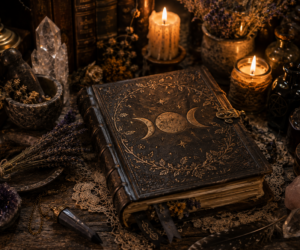
The Best Categories to Lay Out Your Book of Shadows

Your Book of Shadows is a deeply personal grimoire, but having a clear structure helps you find what you need when you need it. Here are some essential categories to consider:

Core Sections

Dedications & Beliefs

Start with your personal dedication, spiritual philosophy, and the ethical guidelines you follow in your practice. This grounds your entire book in intention.

Sabbats & Esbats*

Document the Wheel of the Year sabbats and moon phases, including rituals, correspondences, recipes, and personal observations for each celebration.

Spellwork

Your collection of spells organized by purpose (protection, love, prosperity, healing, banishing). Include ingredients, timing, results, and notes on what worked.

Divination

Tarot spreads, rune meanings, pendulum techniques, scrying methods, and records of your readings and their accuracy.

Where Spirit Meets Reality ~ Understanding Spirituality and Metaphysics

The Dance Between the Seen and Unseen
We live in a world that exists on multiple levels simultaneously. There’s the physical reality we navigate each day, the coffee cup in your hand, the ground beneath your feet, the people you encounter. And then there’s something else, something harder to define but just as real: the energy of a room when you walk in, the inexplicable knowing that precedes a phone call, the sense that consciousness extends beyond the boundaries of our skin.

This is where spirituality and metaphysics meet, in that liminal space where the material and immaterial dance together, where ancient wisdom and personal experience converge to reveal deeper truths about existence.

What Is Metaphysics?
Metaphysics, at its heart, is the study of what lies beyond the physical. The word itself comes from the Greek “meta” (beyond) and “physika” (physical things). It asks the fundamental questions that have haunted and inspired humanity since we first looked up at the stars:

Friday the 13th ~ Reclaiming the Magic of a Misunderstood Day

For centuries, Friday the 13th has been shrouded in superstition and fear. But what if I told you that this date holds powerful transformative energy that witches and spiritual seekers can harness for deep inner work and manifestation?

The Origins of Friday the 13th
The fear of Friday the 13th, known as paraskevidekatriaphobia, is a relatively modern phenomenon. Historically, both Fridays and the number 13 held sacred significance:

Friday was named after the Norse goddess Freya (or Frigg), the goddess of love, beauty, fertility, and magic. In many pagan traditions, Friday was considered an auspicious day for spellwork, particularly love magic.

The number 13 has long been associated with the divine feminine. There are 13 lunar cycles in a year, connecting this number to moon magic and the goddess. Many ancient cultures revered 13 as a number of completion and transformation.

The negative associations likely arose during the patriarchal shift in medieval Europe, when the Church sought to demonize pagan practices and feminine power. What was once sacred became “sinister.”

Reclaiming Friday the 13th Energy
Rather than fearing this day, we can embrace it as a portal for: