 Written by
 There is a version of ancestor work that looks clean from the outside.
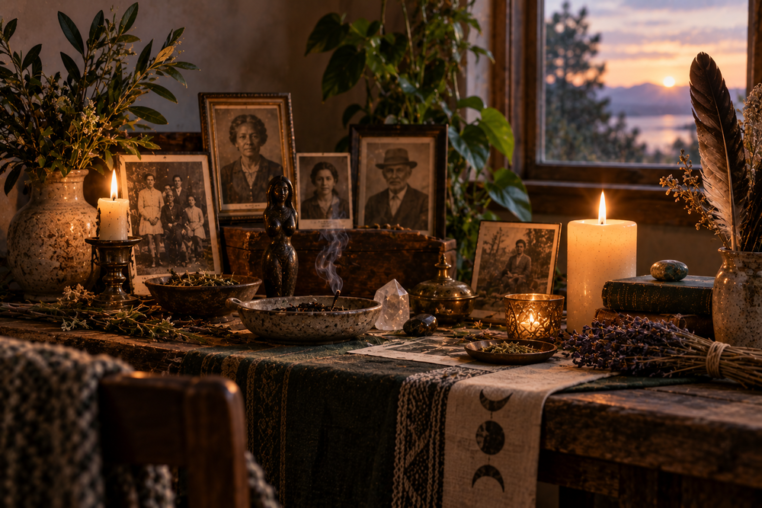
The altar is arranged. The photographs are placed with care. The candle burns for the grandmother who was wise, the grandfather who was steady, the great-aunt who knew things and passed them quietly forward. The relationship is devotional. The ancestors offer guidance and the practitioner receives it with gratitude.
This version is real. The relationships it describes are real. If you have ancestors like this, elevated, clear, genuinely supportive, working with them is one of the most sustaining things you can do in your practice.
But it is not the whole picture. And for many practitioners, it is not even the primary picture.
Most family lines carry both. Wisdom and wounds. Gifts and damage. The grandmother who knew things and the grandfather who hurt people. The line of quiet resilience running alongside the line of unprocessed rage. The gifts that came bundled with the conditions that made them necessary. The extraordinary capacity for self-sufficiency that grew from a childhood in which no one could be relied upon, the acute sensitivity that developed in an environment that required constant vigilance, the strength that is the other side of a long history of having to survive.
Family lines carry trauma as reliably as they carry gifts, and they carry it through the same mechanisms. Through behavior modeled and absorbed, through the way nervous systems are shaped in early childhood, through the stories told and the stories conspicuously not told, through the silences that are themselves a form of transmission.
Some of the most significant ancestor work is not devotional. It is reparative. It is the work of consciously engaging with what was damaged in the line, with the ancestors who were troubled or who caused harm, and with the patterns that have been moving through your family, unexamined, for longer than anyone currently living can remember.
This work is demanding. It is also, for many practitioners, among the most transformative things they will ever do.
Understanding Ancestral Trauma Transmission
The mechanisms through which trauma passes between generations are better understood now than at any previous point in history, and this understanding matters for practitioners because it grounds the work in something verifiable rather than leaving it entirely in the metaphysical.
Epigenetic research – the study of how experience changes gene expression without changing the underlying DNA, has established that the effects of severe trauma can be transmitted biologically. Studies of Holocaust survivors and their descendants, of the descendants of enslaved people, of communities that experienced famine or war or severe collective stress have found measurable physiological differences in the next and subsequent generations. Altered stress hormone patterns, different fear-response profiles, physiological signatures that correspond to the traumatic experience of ancestors who died before the affected individuals were born.
This is new science confirming very old knowledge. Every ancestor-working tradition that has taken the relationship between living and dead seriously has understood that what the dead carry continues to affect the living. Not metaphorically, not as mere cultural inheritance, but in some way that operates through the lineage itself.
The psychological transmission mechanisms are even more clearly established. Children absorb the emotional patterns of their caregivers before they have language. The parent who was never themselves held with adequate warmth struggles to hold their child adequately, not through lack of love but through genuine absence of the internal template. The grandparent whose survival required the suppression of all vulnerable emotion raises a parent who has no model for the expression of that emotion, who raises a child who has no permission for it either . And so on, until someone in the line reaches a point of crisis or consciousness sufficient to stop and ask what is actually happening here.
This is the moment that makes ancestral healing possible. The moment when someone in the lineage looks up from the pattern long enough to see it as a pattern.
If you are doing this work, you are probably that person in your line. That is not a small thing.
The Troubled Ancestor and the Harmful Ancestor
It is worth making a distinction here between two different kinds of difficult ancestor, because they call for somewhat different approaches.
The troubled ancestor was someone who suffered. Who carried damage they did not choose and could not adequately process, who was shaped by forces larger than their individual will, whose wounds became the conditions their children grew up in without anyone fully understanding what was happening. The parent who drank because they had no other available method of managing unbearable pain. The grandparent who was cold because warmth had been systematically knocked out of them. The great-grandparent who fled something unsurvivable and never, for the rest of their life, felt safe enough to put down what they had been carrying when they ran.
The troubled ancestor is not responsible for the conditions that shaped them. They are responsible, to some degree, for the choices they made within those conditions. Aand some of those choices caused real harm to the people around them. Both things are true simultaneously.
The harmful ancestor is the more difficult category. The person who caused deliberate harm, who held power over others and used it destructively, whose actions were not simply the overflow of their own unprocessed wounds but choices made with enough agency to constitute genuine wrongdoing. The abuser. The person who committed acts of violence or exploitation. The ancestor who caused damage that can be traced clearly through the generations since.
The harmful ancestor does not become innocent because they are dead. The harm they caused does not become acceptable because it is in the past. And your obligation to engage with them in ancestor work is not an obligation to excuse or to rehabilitate them.
What it is, potentially, is an obligation to see them clearly;. Which is to say, to see what they were and what they did and where they came from, all at once, without either the collapse into pure condemnation or the premature forgiveness that is really another form of looking away.
What Healing the Ancestral Line Actually Means
This phrase is used frequently in contemporary ancestor work, and it is worth being precise about what it means and what it does not mean.
It does not mean that you can, through your practice, change what happened. The past is fixed. The harm was caused. The people who were hurt were hurt. No amount of ritual changes that.
What can shift is the continuation of a pattern. The way a wound that was inflicted several generations ago continues to organize behavior, belief, and relationship in the present. This continuation is not inevitable. It persists because it has not been examined, because the people in the line have not had the conditions or the tools to see it clearly enough to choose differently.
Healing the ancestral line means, in the most concrete terms:
Becoming conscious of what you have inherited. This is the foundational work. Before anything else, you need to see the pattern, to be able to name it, to trace its movement through the generations as clearly as you can, to understand how it lives in you specifically.
Breaking the transmission. Choosing, in your own life, not to pass forward what was passed to you. This sounds simple and is often the work of years. The nervous system patterns, the relational templates, the beliefs about what is safe and what is not, these are not changed by a single ritual. They are changed by sustained attention, by the often slow and non-linear work of choosing differently in situation after situation, supported by whatever combination of magical practice, therapeutic work, community, and deliberate cultivation of new patterns serves you.
Consciously engaging with the ancestors who carried the wound. In magical terms, this means developing a practice of deliberate relationship with the difficult ancestors. Not to invite them in as advisers, but to acknowledge them, to hold the complexity of what they were, and to direct intention toward their elevation and toward the release of the pattern from the living lineage.
Restoring what was lost. Ancestral wounding often involves the loss of something that should have been transmitted but wasn’t. A capacity for joy, an ability to trust, a relationship with the body, a sense of belonging. Part of healing the line is identifying what was lost and actively rebuilding it. Not retrieving it from the ancestors who couldn’t transmit it, but growing it fresh, in yourself, and passing it forward.
Approaching the Difficult Ancestor in Practice
The first requirement of this work is honest acknowledgement. Not the performance of ancestral reverence, not the diplomatic softening of what is actually there, but clear-eyed recognition of what this ancestor was and what they did.
This can be done in writing before any ritual engagement. Writing the honest account of the person and the pattern, as clearly as you can see it. What did they do? What damage can you trace? What were the conditions that shaped them, as far as you can see? Where does your understanding run out?
Hold both the person and the pattern. The ancestor who caused harm is both the individual who made choices and the person produced by conditions they did not choose. Both are true. Holding both is harder than collapsing into either condemnation or excuse, and it is the position from which genuine reparative work becomes possible.
Work with clear boundaries. The difficult ancestor is not someone to invite into your sacred space as a guide. The distinction here is crucial. You can acknowledge someone, hold intention for their elevation, and work consciously with the pattern they carried, all without inviting their influence into your life or your practice. These are different things.
At your altar or in your working space, be explicit about this distinction. Something like: I am acknowledging you. I am not asking for your guidance. I am holding intention toward your healing and toward the release of this pattern from those of us who came after you.
Work with the lineage’s elevated ancestors as support. Even in the most damaged lineages, there are usually ancestors who were different. Who held something good, who chose differently than those around them, who carried light in the dark places of the family history. These elevated ancestors are the allies in this work. Call on them explicitly. Ask them to be present as you engage with the more difficult figures in the line.
Understand that this work takes time. Patterns that have been in a lineage for three or four generations do not shift in a single ritual. They shift through sustained practice, through the accumulation of conscious choices over time, through the slow development of new patterns to replace the old ones. The ritual marks an intention and a beginning. The actual work happens in the dailiness of how you live.
The Body in Ancestral Healing
Because ancestral patterns are transmitted through the body as well as through story and behaviour, the body needs to be part of the healing process.
The nervous system patterns inherited from a lineage of trauma are held in the tissues, in the chronic tension, the postural habits, the physiological readiness for threat that has no current source. These do not shift through cognitive understanding alone. They shift through the body.
Whatever practices help you come into genuine safety in your own body. whether that is movement, somatic therapy, breathwork, time in nature, physical ritual, or the slow rebuilding of a relationship with embodied pleasure, are as much a part of ancestral healing as any work done at the altar. The two are not separate practices. They are the same work approached from different directions.
When you soothe your own nervous system, you are doing something your ancestors could not do. When you learn to feel safe in your own body, you are building something that was not available in the generations before you. This is not a small act of self-care. It is a reparative act that affects the living lineage going forward.
A Note on Professional Support
Ancestral healing work can move difficult material. It can surface grief, anger, and the particular distress of recognising damage that runs through your family and through you more clearly than you had previously seen it.
If this work moves material that feels beyond what magical practice alone can support – if it activates trauma responses, if it produces levels of distress that do not resolve, if it surfaces memories or realisations that need more than ritual to integrate – please reach out to a qualified therapist or counsellor, ideally one with experience in trauma and in intergenerational work.
Magical practice and psychological support are not in competition. They serve the same work from different angles. For the most significant ancestral healing, both are often needed.
🪄 A Practice: Sitting with the Difficult Ancestor
This practice is for conscious engagement with a specific troubled or harmful ancestor. Take it slowly. Have something grounding available – food, water, a stone to hold.
Prepare your space.
Ground yourself thoroughly first – roots to the earth, steady breath, clear intention. Call on the elevated ancestors of your line to be present and to hold the space with you.
Write the honest account.
Before you begin any ritual engagement, write clearly: who this ancestor was, what they did, what the pattern looks like as it has moved through the generations. Write until you feel you have said what is true.
Acknowledge, with clear language. Speak aloud:
“I acknowledge you. I know what you carried. I know what you did with it. I am not asking you to be other than you were. I am asking to see you clearly. I am holding intention toward your healing and toward the release of this pattern from those of us in the living line. I do this with clear eyes and clear boundaries. I am not inviting your influence. I am acknowledging your existence and doing what I can, from here, toward the healing of what you could not heal in your lifetime.”
Sit quietly.
Notice what arises – images, emotions, physical sensations, a quality of presence or of absence. Write it down afterward.
Close clearly.
Thank the elevated ancestors for holding the space. Ground again. Return to ordinary consciousness deliberately – eat something, drink water, go outside if you can.
Return to this practice regularly, not once. The relationship with the difficult ancestor changes over time as you bring sustained honest attention to it. What begins as confrontation often becomes something more complex. Not forgiveness exactly, but a clearer and more spacious understanding of what was there.
~ What pattern in my family line do I most clearly recognise as an ancestral transmission rather than a personal failing?
~ Who in my lineage do I understand to have been at the origin or centre of that pattern. And what do I know about what shaped them?
~ What has been lost in my lineage, what capacity, quality, or way of being, that I am working to rebuild in myself?
~ What would it mean to be the person in the line in whom this pattern ends?
~ What do I want the next generation, biological or chosen, to receive from me that was not available to me?
The most important thing to hold in this work is this: the pattern ending with you is not failure. It is not evidence that your ancestors were uniquely damaged or that your line is beyond repair.
It is the ordinary miracle of consciousness applied to what was previously unconscious. Someone looked up. Someone saw the pattern. Someone decided to do the work that the generations before them did not have the conditions, the tools, or the safety to do.
That someone is you.
The lineage is already different because you are doing this.