 Written by
 Magic is not random. Beneath the mystery, beneath the wonder, beneath the shiver of power that runs through a working that has truly taken hold – there is structure. There are principles. There are laws, as certain as gravity, as elegant as mathematics, as old as the stars.
Why Principles Matter
Every tradition of magical practice, however different in outward form, operates according to underlying principles. Foundational truths about how energy moves, how intent shapes reality, how the practitioner stands in relationship to the world around them.
Understanding these principles is not an academic exercise. It is practical magic. When you understand why a spell works the way it does, you can work it more skillfully, troubleshoot when things go sideways, and adapt techniques intelligently rather than following recipes blindly.
These are the principles that form the bedrock of most Western magical practice.
The Threefold Law
Whatever energy you send into the world returns to you threefold.
This is perhaps the most discussed principle in modern Wiccan and witchcraft practice, and one of the most nuanced. At its simplest, it is a statement about magical consequence: the energy you put into your workings does not disappear once the spell is cast. It creates ripples. And those ripples find their way home.
The literal interpretation suggests that harm sent to another will bring three times that harm back to the sender. Good magic, similarly, magnifies in its return. This view keeps practitioners cautious about baneful magic and generous with blessing magic.
The metaphorical interpretation is perhaps more sophisticated: the energetic pattern you invest your magic in becomes the pattern you inhabit. If you spend your magical life in resentment and harm-wishing, your consciousness is shaped by resentment. If you spend it in gratitude and healing, your consciousness is shaped accordingly.
Both interpretations carry wisdom. What the Threefold Law ultimately asks is: what energy are you willing to live inside of? Because you will live inside whatever you put out.
Intent, Will, and Manifestation
These three – intent, will, and manifestation – form the engine of all magical working.
Intent is the direction: the clear, specific understanding of what you are working toward. Fuzzy intent produces fuzzy results. The practitioner who wants “more happiness” will get very different results than the one who intends “greater ease and joy in my creative work.” Clarity is kindness to your magic.
Will is the fuel: the focused, directed energy that drives the intent from possibility into actuality. Will is not force. It does not work through aggression or desperation. It works through commitment, concentration, and the willingness to stay aligned with your intention even when doubt arises.
Manifestation is the result: but the word “manifestation” carries a subtlety worth noting. Magic manifests through available pathways, which often means through mundane action, coincidence, and opportunity as much as through dramatic, inexplicable events. The practitioner who casts a career spell and then waits at home for a job to appear has misunderstood manifestation. Magic and action work together.
The Elements ~ Earth, Air, Fire, Water, Spirit
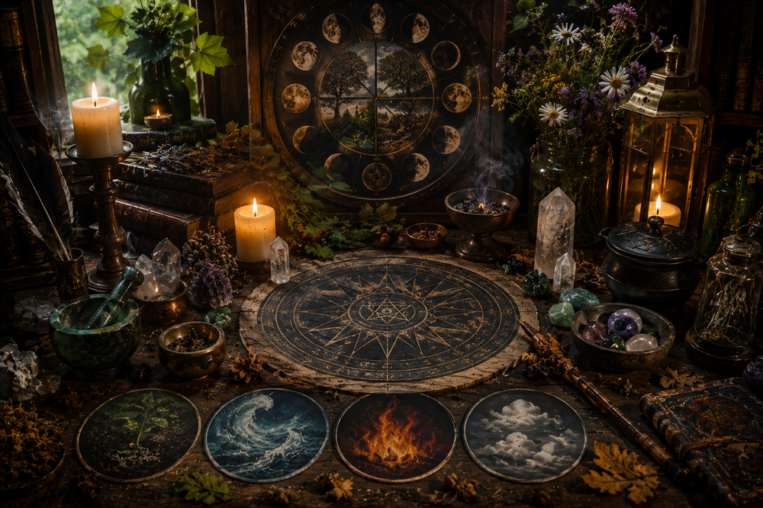
The five elements form one of the most fundamental frameworks in Western magical tradition, providing a symbolic language for understanding all of reality.
Earth
The element of foundation, stability, physicality, abundance, and embodiment. Earth governs material concerns – money, health, home, the body, the practical world. It is the element of patience and of deep, slow wisdom.
~ Its direction is North;
~ its season is Winter;
~ its time is Midnight.
To work with Earth is to work with groundedness. To honor the physical world, to acknowledge that we are embodied beings, to root your magic in practical reality rather than abstract aspiration.
Air
The element of thought, communication, intellect, inspiration, and change. Air governs the mind, the written and spoken word, learning, and the invisible movement of ideas. It is quick, changeable, capable of great clarity and great disruption.
~ Its direction is East;
~ its season is Spring;
~ its time is Dawn.
To work with Air is to sharpen your thinking, clarify your intentions, communicate with precision, and remain open to new insight.
Fire
The element of passion, transformation, courage, will, and action. Fire governs creative energy, desire, ambition, purification, and the force of change. It is the element of both the candle flame and the wildfire.
~ Its direction is South;
~ its season is Summer;
~ its time is Noon.
To work with Fire is to bring heat to your intentions. To move from contemplation to action, to let what no longer serves you burn away, to ignite the will that transforms aspiration into reality.
Water
The element of emotion, intuition, the subconscious, healing, and flow. Water governs dreams, psychic ability, love, relationships, and the mysterious depths of feeling. It is the element of the womb and the ocean.
~ Its direction is West;
~ its season is Autumn;
~ its time is Dusk.
To work with Water is to open to your emotional truth, trust your intuition, allow healing to move through you, and let go of what you have been holding too tightly.
Spirit (Aether)
The fifth element, sometimes called Aether or Akasha, is the element that contains and permeates all others. The living presence that animates existence itself. It is sometimes associated with the self, the divine spark, or the fabric of consciousness through which all magical work ultimately moves.
Working with Spirit is working with the deepest level of reality – the recognition that beneath all apparent form, everything is one continuous field of awareness.
Polarity and Balance
Magic works with polarity – the recognition that reality expresses itself through pairs of complementary opposites. Dark and light. Masculine and feminine. Waxing and waning. The seen and unseen. Summer and winter. Healing and harm.
These are not opposites at war, but partners in a dance. Each contains and requires the other. There is no light without shadow to define it, no summer without the winter that gave it meaning.
For the practitioner, understanding polarity means recognizing that balance is not the elimination of one pole in favor of the other. It is the dynamic tension between them, held with wisdom and awareness. A healer who cannot acknowledge the existence of harm is not fully awake. A warrior who cannot access gentleness is not fully powerful.
In ritual, polarity often manifests as the pairing of masculine and feminine divine principles. The God and Goddess of Wiccan practice, or the pairing of the High Priest and High Priestess in coven ceremony. But polarity is also present in the structure of spell work itself: in the tension between what is and what you are working to bring about, between the self that is casting and the self that will receive the result.
The Wheel of the Year
The Wheel of the Year is the annual cycle of eight solar festivals. Four fixed quarter days marking the solstices and equinoxes, and four cross-quarter days falling between them. Together, they create a calendar of magical and spiritual observance that ties the practitioner into the living rhythms of the Earth.
Samhain (October 31 / November 1) ~ The beginning of the Celtic year, when the veil between worlds thins and the ancestors draw close. A festival of death, transformation, and the wisdom that comes from endings.
Yule (Winter Solstice, ~December 21) ~ The longest night and the return of the light. A festival of hope, rebirth, and the sacred promise that darkness always gives way to dawn.
Imbolc (February 1) ~ The first stirring of spring within the frozen earth. A festival of purification, new beginnings, and the goddess Brigid’s sacred flame.
Ostara (Spring Equinox, ~March 21) ~ Balance of light and dark, the world waking to new growth. A festival of fertility, possibility, and the planting of intentions.
Beltane (May 1) ~ The height of spring’s passion, the world in full flower. A festival of fire, union, creativity, and the life force at its most exuberant.
Litha (Summer Solstice, ~June 21) ~ The peak of the sun’s power, the longest day. A festival of abundance, achievement, and the celebration of what has been grown.
Lughnasadh / Lammas (August 1) ~ The first harvest, the beginning of the inward turn. A festival of gratitude, skill, and the bittersweet recognition that the light is beginning to fade.
Mabon (Autumn Equinox, ~September 21) ~ The second balance point, the great harvest, the preparation for the dark half of the year. A festival of reflection, release, and the gathering in of what is precious.
Together, the Sabbats trace the mythic cycle of the year: the death and rebirth of the God, the transformations of the Goddess, the endlessly turning spiral of growth and decay, planting and harvest, light and dark.
Moon Phases and Lunar Magic
If the Wheel of the Year is the annual rhythm of magical practice, the moon provides the monthly heartbeat. The lunar cycle moves through eight distinct phases in approximately twenty-nine and a half days, each with its own energy, its own invitation, its own magical applications.
New Moon ~ The dark moon, the blank page. A time for new beginnings, setting intentions, planting seeds. What do you want to call into your life? This is the moment to name it.
Waxing Crescent ~ The first breath of growth. Energy is building; this is a time for taking first steps, making plans, gathering resources.
First Quarter ~ The moment of commitment. Challenges may arise; this is when you decide whether you are truly dedicated to what you set in motion at the new moon.
Waxing Gibbous ~ Refinement and adjustment. The energy continues to build; this is a time for fine-tuning intentions, addressing obstacles, and sustaining momentum.
Full Moon ~ Peak power. The veil between worlds thins. Magic worked at the full moon carries the greatest charge. This is the time for manifestation, divination, charging tools, and drawing down the moon’s energy.
Waning Gibbous ~ The beginning of release. Gratitude practices, reflection, beginning to let go of what has been accomplished.
Third Quarter ~ Active releasing. What needs to be released, forgiven, or cleared? This is the time to work that magic.
Waning Crescent (Dark Moon) ~ Rest, retreat, and deep intuitive work. The dark moon is a time for connecting with what is hidden, for shadow work, for deep rest before the next cycle begins.
Working consciously with the moon phases brings a rhythm to magical practice that many practitioners find profoundly grounding. The regular pulse of a living cosmic cycle, always available, always turning.
Bringing It All Together
These principles – the Threefold Law, the elements, polarity, the Wheel of the Year, the lunar cycle – are not separate systems to be learned in isolation. They are facets of a single integrated understanding.
When you cast a circle, you are calling on the elements. When you time your spells with the moon, you are working with natural cycles. When you celebrate the Sabbats, you are entering the turning story of the year. When you consider the consequences of your magic, you are honoring the Threefold Law.
Every ritual, every spell, every moment of magical practice lives within this web of principles. The more deeply you understand them, the more naturally they inform your work. Until eventually you don’t think about them consciously at all. They have simply become the way you move through the world.
That is mastery: not the accumulation of knowledge, but the embodiment of understanding.
Magic is the art of working knowingly within the laws of an ensouled universe. The laws do not constrain you. They are the very mechanism through which your power flows.