The Witch’s Energy Body ~ Understanding Depletion, Replenishment, and the Art of Energetic Sovereignty

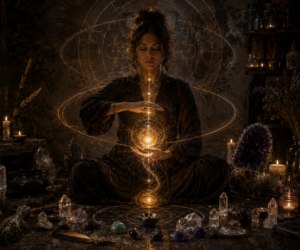
You did the work. The ritual was real, the intention was clear, the circle held. And now you are lying on the floor staring at the ceiling with nothing left, wondering if something went wrong. Nothing went wrong. You moved energy. Energy was moved through you. And your body, which is both the instrument and the practitioner, is registering exactly what happened. This is one of the things no one tells you when you begin – magical work costs something. Not in the dramatic sense of sacrifice or payment to dark powers. In the entirely ordinary, physical, energetic sense that every act of focused will, every opening of perception, every moment of genuine contact with something larger than the everyday self, draws on a resource that is real and finite and needs to be replenished. Understanding your energy body, how it works, how it depletes, how it recovers, and how to develop the kind of energetic sovereignty that makes sustainable practice possible, is not an advanced topic. It is foundational. Everything else you do in your practice depends on it. What Is the Energy Body? Before we can talk about how to manage your energetic resources, we need to establish what we mean by them. Every major magical and spiritual tradition that has taken the body seriously has understood it to have layers. A physical structure that is visible and measurable, and subtler bodies that interpenetrate it and extend beyond it. These are called different things in different traditions. The aura in Western esoteric practice. The kosha system in Vedic philosophy. The qi or chi fields of Chinese medicine and Taoist practice. The ka and ba of ancient Egyptian understanding. The subtle body of Tibetan Buddhism. The etheric body of Theosophy. These are not identical systems. Each arises from a specific cultural and philosophical context, and collapsing them into a single model does a disservice to all of them. But across the differences, certain consistencies emerge that point to something real. The energy body is the field of vital force that animates the physical body, processes experience, and mediates the relationship between the individual and the wider energetic environment. It is the medium through which we receive and transmit. It is what picks up the room when you walk in. It is what feels heavy after a difficult conversation and light after time in nature. It is what contracts when you are afraid and expands when you are fully yourself. In magical practice, the energy body is the primary working instrument. When you cast a circle, you are establishing and sensing a boundary in the energy field. When you raise power, you are drawing from and channelling through the energy body. When you work with the dead, or the fair folk, or the gods, or the ancestors, contact happens at the level of the energy field first. The body registers it as goosebumps, or heat, or pressure, or an altered quality of attention. The energy body is already sensing before the conscious mind catches up. How Magical Work Depletes There are several distinct mechanisms by which magical work draws down energetic resources. Understanding which is operating helps you choose the right recovery. Concentration and sustained focus. The simplest and most universal form of magical depletion. Any state of intense, held attention – holding a circle, maintaining a trance, performing a long ritual, doing deep divination – draws on the nervous system’s capacity for sustained arousal. This is the same resource that depletes when you study intensively, or perform surgery, or have a difficult conversation for three hours. It is metabolic… …

Membership Required

You must be a member to access this content.

View Membership Levels

Already a member? Log in here

Your Body is a Compass ~ Trusting the Wisdom of Intuition

Your body knows things your mind hasn’t figured out yet. It tightens in your chest when someone lies. It lightens in your belly when you’re on the right path. It pulls you toward certain people and repels you from others before you consciously understand why. Your shoulders rise when danger approaches. Your heart opens when love is near. Your gut churns when betrayal lurks unseen. This isn’t random, this is navigation. Your body is a finely tuned instrument for reading reality, a compass that always points toward truth, a divination tool you carry with you constantly. We live in a culture that privileges mind over body, logic over feeling, thinking over sensing. We’re taught to ignore what our bodies tell us, to override physical knowing with rational analysis, to trust experts and data over our own felt experience. This is a profound error. Your body has access to information your conscious mind cannot perceive. Subtle energies, quantum fluctuations, morphic fields, the collective unconscious, spiritual presences, and patterns too complex for cognitive processing but perfectly readable by your nervous system. Magic practitioners have always known this. Dowsers feel water through rods that amplify their body’s knowing. Mediums sense spirits through goosebumps and temperature changes. Energy workers track chi through tingling in their palms. Witches know when they’re being watched by the prickling on the backs of their necks. Every magical tradition recognizes the body as a perceptive instrument more sophisticated than any technology we’ve created. When you learn to read your body’s signals as the navigation system they are, you gain access to a form of knowing that never lies, that cannot be fooled by appearances, that reads truth beneath surface presentations. Your body is your compass. Learning to follow it is learning to trust the deepest, truest form of knowing available to you. The Science of Somatic Knowing Modern science is beginning to catch up with what magic has always known. The body knows before the mind does. The Gut-Brain Connection Your gut contains approximately 100 million neurons, more than your spinal cord. This “second brain” (the enteric nervous system) communicates constantly with your cranial brain via the vagus nerve, but it also processes information independently. “Gut feelings” are literal. Your gut is thinking, sensing, and knowing. It responds to situations before your conscious mind has time to analyze them. Heart Intelligence The heart generates an electromagnetic field 60 times greater in amplitude than the brain’s field and can be detected several feet away from the body. The HeartMath Institute has documented that the heart receives and processes information before the brain does. The heart literally knows first. When you “feel it in your heart,” you’re accessing real intelligence. Interoception This is your body’s ability to sense its internal state. Not just hunger and thirst, but subtle shifts in emotional state, energy levels, and response to environment. People with strong interoceptive awareness are better at reading emotions, making decisions, and detecting deception. You can develop this ability through practice. Mirror Neurons Your nervous system contains neurons that fire both when you perform an action and when you watch someone else perform it. This is why you can “feel” others’ emotions, why you physically recoil when you see someone hurt, why you sense when someone’s angry even if they’re smiling. Your body is literally mirroring and reading others’ states. Micro-Expressions Your body reads micro-expressions, facial movements lasting less than a second, that your conscious mind doesn’t register. Your body knows someone is lying before your mind catches up. That “off” feeling you get? Your body detected signals too fast for conscious… …

Membership Required

You must be a member to access this content.

View Membership Levels

Already a member? Log in here

Removing the Evil Eye ~ Protection and Cleansing Practices Across Cultures

The evil eye is one of the most universal spiritual concepts, recognized across Mediterranean, Middle Eastern, Latin American, and South Asian cultures. It’s the belief that envy, jealousy, or ill will from another person can cause harm, bad luck, or illness. If you’ve been feeling unusually drained, experiencing a string of bad luck, or sensing that something is energetically off, you might be dealing with the effects of the evil eye. Recognizing the Evil Eye The symptoms of the evil eye vary, but common signs include sudden and unexplained fatigue, a series of unfortunate events happening in quick succession, persistent headaches or body aches with no medical cause, disturbed sleep or nightmares, and a general feeling of heaviness or being watched. Children and babies are considered especially vulnerable, often becoming unusually fussy or ill. In many traditions, certain people are more susceptible to casting the evil eye, often without meaning to. Someone who praises you excessively without genuine warmth, who seems envious of your success or happiness, or who has a particularly intense gaze might inadvertently direct harmful energy your way. The Egg Cleansing Ritual One of the most widespread methods for removing the evil eye is the egg cleansing, known as limpia de huevo in Latin American traditions. This practice is simple but powerful. Take a raw egg, still in its shell, and slowly roll it over your entire body while praying or setting the intention to absorb any negative energy. Start at the crown of your head and work your way down, paying special attention to areas that feel heavy or painful. Some practitioners make the sign of the cross over major energy points. Others recite specific prayers like the Lord’s Prayer or Psalm 23. Once you’ve covered your whole body, crack the egg into a clear glass of water. The way the egg looks tells you what you’re dealing with. If the water remains clear and the yolk intact, you likely didn’t have the evil eye. If you see cloudy water, strings rising from the yolk, or unusual shapes, that indicates negative energy was present and has now been absorbed by the egg. Dispose of the egg by flushing it down the toilet or burying it far from your home, never in the trash. Water and Salt Cleansing Salt has been used for spiritual purification across countless cultures. For evil eye removal, fill a bowl with water and add sea salt or kosher salt. As the salt dissolves, visualize it breaking apart any negative attachments or energy directed at you. Wash your face, hands, and feet with this water while stating your intention to be cleansed. Some traditions have you stand in the bathtub and pour the salt water over your head, letting it cascade down your body. Others suggest sprinkling the salt water around your home’s entrances. After the cleansing, dispose of the water by throwing it into running water if possible, or pouring it down the drain while running the tap. The Oil and Water Divination This Italian and Greek method both diagnoses and treats the evil eye. Fill a plate or bowl with water. Add three drops of olive oil. If the oil spreads out and dissipates quickly, the evil eye is present. If it holds together in droplets, you’re clear. To remove it, the practitioner (often an elder family member who knows the traditional prayers) continues adding oil while reciting specific prayers or invocations. The process is repeated until the oil finally stays together in droplets, indicating the evil eye has been lifted. Each culture has its own prayers for this ritual, often… …
Membership Required

You must be a member to access this content.

View Membership Levels

Already a member? Log in here

Honoring Your Body, Instincts, and Cycles as Sacred Growth: A Path to Embodied Wisdom

A Path to Embodied Wisdom In our culture of constant productivity and mind-over-matter thinking, we often disconnect from the profound wisdom that lives within our physical being. Yet our bodies, instincts, and natural cycles contain ancient intelligence that can guide us toward authentic growth and spiritual development. Learning to honor these aspects of ourselves as sacred represents a return to wholeness and embodied living. Understanding Sacred Embodiment Sacred embodiment is the recognition that our physical form is not merely a vessel for consciousness, but rather an intelligent, wise teacher that holds keys to our deepest growth and transformation. This perspective shifts us from seeing the body as something to control or transcend, to honoring it as a sacred temple of wisdom. What It Means to Honor Your Body Honoring your body means recognizing it as: ~ A source of wisdom: Your body constantly provides information about your needs, boundaries, and authentic desires~ A spiritual teacher: Physical sensations, illnesses, and changes often carry deeper messages about your life path~ A sacred vessel: Your body is the vehicle through which you experience life and express your soul’s purpose~ An intelligent system: Your body knows how to heal, when to rest, and what it needs to thrive This honor extends beyond basic self-care to viewing your body as a partner in your spiritual and personal development. The Wisdom of Instincts Instincts are our primal, immediate responses to situations that arise from deep biological and spiritual wisdom. Unlike emotions or thoughts, instincts operate below conscious awareness, providing guidance that has been refined over millennia of human evolution. Understanding Instinctual Wisdom Our instincts manifest in various ways: Survival Instincts: The immediate knowing of safety or danger, often felt as gut reactions or sudden physical responses. These instincts help us navigate challenging situations and protect our well-being. Creative Instincts: The spontaneous urge to create, express, or bring something new into being. These impulses often arise without logical explanation but carry deep creative wisdom. Relational Instincts: The immediate sense of connection, trust, or wariness when meeting someone new. These instincts help us navigate relationships and social situations. Spiritual Instincts: The pull toward certain practices, places, or experiences that feel spiritually nourishing, even when we can’t explain why. How Instincts Guide Growth Instincts serve as internal compasses that guide us toward experiences and choices that support our highest good. They often bypass mental analysis, providing immediate wisdom about: ~ Authentic choices: What truly aligns with our deepest values and purpose~ Boundary setting: When to say yes or no to opportunities and relationships~ Timing: When to act and when to wait~ Direction: Which path to take when facing important decisions The Sacred Nature of Cycles All life moves in cycles. From the rotation of planets to the rhythm of our heartbeat. Our bodies and lives are governed by numerous cycles that, when honored, can become powerful allies in our growth and transformation. Types of Cycles to Honor Daily Cycles: The natural rhythm of energy throughout the day, including when we feel most creative, focused, or need rest. Working with these cycles rather than against them enhances both productivity and well~being. Monthly Cycles: For those who menstruate, the menstrual cycle offers profound wisdom about creativity, introspection, and renewal. Even those without menstrual cycles can attune to monthly lunar rhythms. Seasonal Cycles: The natural progression of seasons mirrors internal cycles of growth, harvest, release, and renewal. Aligning with seasonal energy supports natural rhythms of expansion and contraction. Life Cycles: The larger cycles of birth, growth, maturity, decline, and renewal that occur throughout our lives. Recognizing and honoring these cycles helps us… …

Membership Required

You must be a member to access this content.

View Membership Levels

Already a member? Log in here

Lucid Journeying: Conscious Travel Through Inner Realms

Lucid journeying is the practice of entering altered states of consciousness with full awareness and intention, allowing you to explore spiritual realms, connect with guides and allies, and gather wisdom from beyond ordinary reality. Unlike dreams, which often occur spontaneously and with limited conscious control, lucid journeying is a deliberate spiritual practice where you maintain awareness and can direct your experience. This ancient shamanic technique involves entering a trance-like state while remaining conscious, enabling you to travel through what many traditions call the “otherworld” or “spirit realm.” During these journeys, practitioners can seek guidance, perform healing work, retrieve lost soul parts, communicate with spiritual beings, and explore dimensions of reality normally hidden from everyday consciousness. The Difference Between Lucid Journeying and Dreaming While both involve altered states of consciousness, lucid journeying and dreaming are fundamentally different practices: Dreams: The Unconscious Mind’s Expression Characteristics of Dreams:~ Occur naturally during sleep cycles~ Often symbolic and metaphorical~ Limited conscious control over content~ Memory may be fragmented or unclear~ Processing subconscious material and daily experiences~ Can be prophetic or healing, but not intentionally directed Purpose of Dreams:~ Emotional processing and integration~ Subconscious communication~ Memory consolidation~ Psychological healing~ Natural spiritual connection Lucid Journeying: Conscious Spiritual Travel Characteristics of Lucid Journeying:~ Deliberately induced altered state~ Full conscious awareness maintained~ Intentional direction and purpose~ Clear memory of the entire experience~ Active interaction with spiritual realms~ Specific goals and questions guide the journey Purpose of Lucid Journeying: ~ Seeking specific guidance or answers~ Healing work for self or others~ Connecting with spirit guides and allies~ Retrieving lost soul parts or power~ Exploring spiritual dimensions~ Gathering wisdom for life challenges The Key Distinctions Aspect Dreams Lucid Journeying Consciousness Unconscious/subconscious Fully conscious Control Limited or none Full intentional direction Purpose Natural processing Specific spiritual work Initiation Spontaneous Deliberately induced Memory Often fragmented Complete and clear Interaction Passive observation Active participation Duration Variable, often hours Typically 15-30 minutes The Three Worlds of Shamanic Journeying Traditional shamanic practice recognizes three primary realms accessible through lucid journeying: The Lower World Characteristics:~ Accessed by going down through the earth~ Realm of power animals and nature spirits~ Often appears as natural landscapes~ Source of personal power and grounding Common Experiences:~ Meeting animal guides and totems~ Connecting with elemental forces~ Retrieving lost power or energy~ Grounding and earthing work The Middle World Characteristics:~ The spiritual layer of our physical reality~ Parallel to our ordinary world but in spiritual form~ Where souls of the living and places exist~ Can be used for healing work and communication Common Experiences:~ Spiritual healing for others~ Connecting with the spirits of places~ Long-distance spiritual communication~ Working with the energy of physical locations The Upper World Characteristics:~ Accessed by going up through the sky~ Realm of spiritual teachers and enlightened beings~ Often appears as celestial or ethereal landscapes~ Source of wisdom and higher guidance Common Experiences:~ Meeting spiritual teachers and guides~ Receiving wisdom and higher knowledge~ Accessing cosmic consciousness~ Spiritual initiation and transformation How Lucid Journeying Works The Neurological Perspective Lucid journeying induces a specific brainwave state called the “theta state” (4-8 Hz), which is associated with:~ Deep relaxation and meditation~ Enhanced creativity and intuition~ Access to subconscious information~ Reduced activity in the brain’s default mode network~ Increased connectivity between brain regions The Spiritual Perspective From a spiritual standpoint, lucid journeying allows consciousness to:~ Separate from ordinary physical awareness~ Access non-ordinary reality and spiritual dimensions~ Connect with spiritual beings and guides~ Gather information from beyond the physical realm~ Perform healing work on energetic levels The Altered State Process Phase 1: Preparation and Intention Setting~ Create sacred space and set clear intentions~ Enter… …

Membership Required

You must be a member to access this content.

View Membership Levels

Already a member? Log in here

Meditation and Mindfulness for Spiritual Growth: A Path to Inner Transformation

In our fast-paced, constantly connected world, many people are seeking deeper meaning and connection beyond the material realm. Two ancient practices that have gained renewed attention for their profound impact on spiritual development are meditation and mindfulness. While often mentioned together, these practices offer distinct yet complementary pathways to spiritual growth and self-discovery. Understanding Meditation Meditation is a practice of focused attention and awareness that has been cultivated across cultures and spiritual traditions for thousands of years. At its core, meditation involves training the mind to achieve states of clarity, peace, and heightened consciousness that can facilitate profound spiritual insights and transformation. What Meditation Is Meditation is much more than simply sitting quietly with closed eyes. It’s an active practice of directing consciousness toward specific objects of focus while cultivating qualities such as: ~ Present-moment awareness: Anchoring attention in the here and now~ Non-judgmental observation: Witnessing thoughts and experiences without immediately reacting~ Inner stillness: Creating space between thoughts and emotions~ Expanded consciousness: Opening to broader perspectives and deeper truths The practice creates a bridge between ordinary waking consciousness and subtler states of awareness that many traditions consider essential for spiritual development. How Meditation Works for Spiritual Growth Meditation facilitates spiritual growth through several interconnected mechanisms: Quieting the Mental Chatter: By learning to observe thoughts without being carried away by them, practitioners create space for deeper wisdom and insight to emerge. This mental stillness allows access to subtler levels of consciousness often obscured by everyday mental activity. Dissolving the Ego’s Grip: Regular meditation practice helps practitioners recognize the constructed nature of the ego-mind, creating opportunities for experiencing identity beyond personality and social roles. This dissolution can lead to profound experiences of unity and interconnectedness. Accessing Inner Guidance: In states of deep meditation, many practitioners report receiving insights, guidance, or understanding that feels beyond their ordinary thinking mind. This inner knowing often provides direction for spiritual development and life decisions. Cultivating Witness Consciousness: Meditation develops the ability to observe one’s own mental and emotional processes with detachment. This witness consciousness is considered by many spiritual traditions to be closer to one’s true nature. Understanding Mindfulness Mindfulness, while related to meditation, is the practice of maintaining moment-to-moment awareness of thoughts, feelings, bodily sensations, and surrounding environment with openness and acceptance. Unlike meditation, which typically involves dedicated practice periods, mindfulness can be cultivated throughout daily activities. What Mindfulness Is Mindfulness involves several key elements: ~ Present-moment focus: Directing attention to what’s happening right now~ Non-judgmental awareness: Observing experiences without labeling them as good or bad~ Acceptance: Allowing experiences to be as they are without trying to change them~ Curious attention: Approaching each moment with fresh interest and openness This practice transforms ordinary activities into opportunities for spiritual awareness and growth. How Mindfulness Works for Spiritual Growth Mindfulness contributes to spiritual development in several ways: Sacred Ordinary: By bringing full awareness to everyday activities, like eating, walking and working. Mindfulness reveals the sacred nature of ordinary experience. This recognition that the divine or transcendent can be found in the mundane is a cornerstone of many spiritual paths. Emotional Wisdom: Mindful awareness of emotions allows practitioners to experience feelings fully without being overwhelmed by them. This emotional intelligence often leads to greater compassion and understanding of the human condition. Interconnectedness Recognition: Mindful attention to the present moment often reveals the interconnected nature of all experience. Practitioners may begin to see how their thoughts, emotions, and actions are connected to the broader web of existence. Breaking Automatic Patterns: Mindfulness interrupts habitual reactions and unconscious behaviors, creating space for more conscious, spiritually aligned choices. The Synergy of Meditation… …

Membership Required

You must be a member to access this content.

View Membership Levels

Already a member? Log in here

Understanding Channeling, Clairvoyance, and Inner Knowing: A Guide to Intuitive Practices

In our modern world, there’s a growing interest in exploring the depths of human consciousness and our capacity for intuitive understanding. Three practices that often capture people’s attention are channeling, clairvoyance, and inner knowing. While these concepts are sometimes used interchangeably, they represent distinct approaches to accessing information beyond our ordinary five senses. What is Channeling? Channeling is the practice of serving as a conduit for information, energy, or communication from sources beyond one’s ordinary conscious awareness. Practitioners believe they can receive and transmit messages from spiritual guides, deceased individuals, higher consciousness, or universal wisdom. How Channeling Works The channeling process typically involves the practitioner entering an altered state of consciousness, often through meditation, relaxation, or other preparatory practices. In this state, they report receiving information that feels distinct from their own thoughts and knowledge. This information may come through various forms: ~ Verbal channeling: Speaking or writing messages that seem to come from an external source~ Automatic writing: Writing that flows without conscious direction~ Trance channeling: Deeper states where the channeler may feel their consciousness steps aside~ Conscious channeling: Maintaining awareness while receiving and transmitting information Channelers often describe the experience as feeling like a flowing stream of information, words, or images that they translate into understandable messages for themselves or others. What is Clairvoyance? Clairvoyance, literally meaning “clear seeing,” refers to the claimed ability to perceive information about people, places, events, or objects without using the conventional five senses. This practice is often categorized as a form of extrasensory perception (ESP). How Clairvoyance Works Clairvoyants report receiving visual information in various ways: ~ Mental images: Seeing pictures, symbols, or scenes in their mind’s eye~ Symbolic visions: Receiving metaphorical images that require interpretation~ Prophetic visions: Glimpses of potential future events or outcomes~ Remote viewing: Perceiving distant locations or events The clairvoyant process often involves quieting the analytical mind and becoming receptive to subtle impressions. Many practitioners describe it as similar to daydreaming or visualization, but with information that feels like it’s coming from an external source rather than their imagination. What is Inner Knowing? Inner knowing, also called intuition or gut feeling, represents our innate ability to understand or sense something without conscious reasoning. Unlike channeling or clairvoyance, inner knowing is generally considered a natural human capacity that everyone possesses to some degree. How Inner Knowing Works Inner knowing manifests through various channels: ~ Gut feelings: Physical sensations in the stomach or chest area~ Sudden insights: Spontaneous understanding or clarity about situations~ Energetic awareness: Sensing the emotional or energetic atmosphere around people or places~ Instinctive responses: Immediate knowing of what feels right or wrong This form of knowing often bypasses logical analysis and emerges as a felt sense of truth or direction. Many people experience it as a quiet voice within, a sense of resonance, or simply “knowing” something without being able to explain how they know it. Key Differences Between the Three Practices While these practices share some common ground, they differ in several important ways: Source of Information Channeling typically involves receiving information from external sources. Whether spiritual guides, universal consciousness, or other entities. The channeler acts as a translator or conduit. Clairvoyance involves accessing information through extrasensory perception, often described as “seeing” beyond normal sight. The information may come from various sources but is received through the clairvoyant’s own perceptual abilities. Inner knowing draws from one’s own intuitive wisdom and connection to deeper understanding. It’s considered an internal compass rather than reception from external sources. Level of Conscious Involvement Channeling can range from highly conscious to trance-like states, depending on the type practiced. Some channelers maintain… …

Membership Required

You must be a member to access this content.

View Membership Levels

Already a member? Log in here

The Sacred Art of Emotional Alchemy: Transforming Pain into Power

Emotional alchemy is the sacred practice of consciously transforming difficult emotions into sources of wisdom, strength, and spiritual power. Just as medieval alchemists sought to transmute base metals into gold, emotional alchemy teaches us to work with our feelings as raw material for profound personal transformation. This ancient art recognizes that our emotions, even the most challenging ones, carry valuable messages and potent energy. Rather than suppressing or avoiding difficult feelings, emotional alchemy invites us to engage with them skillfully, extracting their hidden gifts while releasing their hold over us. The Alchemical Process of Emotion The Four Stages of Emotional Transformation 1. Nigredo (The Blackening) – Acknowledgment This is the stage of honest recognition. We stop running from our emotions and turn to face them directly. Whether it’s grief, anger, fear, or disappointment, we acknowledge what we’re truly feeling without judgment or the need to immediately fix it. Practice: Sit quietly and ask yourself “What am I really feeling right now?” Name the emotion without trying to change it. 2. Albedo (The Whitening) – Purification In this stage, we begin to separate the emotion from the stories we tell ourselves about it. We observe the feeling as energy moving through us rather than identifying completely with it. This creates space for clarity and understanding. Practice: Breathe deeply and imagine the emotion as a color or shape. Watch it move through your body without resistance. 3. Citrinitas (The Yellowing) – Illumination Here, we begin to understand the message or lesson the emotion carries. We ask what it’s trying to teach us, what boundary it’s asking us to set, or what aspect of our life needs attention. Practice: Ask your emotion, “What do you need me to know? What are you trying to protect or heal?” 4. Rubedo (The Reddening) – Integration The final stage involves integrating the wisdom gained and allowing it to transform us. We emerge from the process with new understanding, strength, and often a deeper capacity for compassion. Practice: Consider how this emotional experience has changed you. What new strength or wisdom do you now carry? Working with Specific Emotions Transforming Anger into Boundaries Anger often signals that our boundaries have been crossed or that we need to protect something valuable. Through emotional alchemy, we can transform anger’s raw energy into: ~ Clear communication of our needs~ Healthy boundary setting~ Motivation for positive change~ Protection for ourselves and others Alchemical Practice: When feeling angry, pause and ask: “What boundary is being violated here? What do I need to protect or honor?” Transmuting Grief into Compassion Grief, while painful, carries the seeds of profound compassion and connection. Through alchemical work, grief can become: ~ Deep empathy for others’ suffering~ Appreciation for life’s precious moments~ Connection to the cycles of existence~ Expanded capacity for love Alchemical Practice: Honor your grief by creating a ritual space. Light a candle and speak to your loss, thanking it for teaching you about love’s depth. Converting Fear into Wisdom Fear often arises to protect us or signal that we’re approaching something important. Alchemically, fear can transform into: ~ Heightened awareness and intuition~ Courage to face necessary challenges~ Wisdom about potential risks~ Energy for preparation and planning Alchemical Practice: When fear arises, breathe deeply and ask: “What is this fear trying to protect? What wisdom does it carry?” Distilling Shame into Authenticity Shame, perhaps the most challenging emotion to work with, often points to areas where we’ve disconnected from our authentic self. Through alchemy, shame can become: ~ Deeper self-compassion~ Commitment to authentic living~ Understanding of our shared humanity~ Motivation for healing and growth Alchemical… …

Membership Required

You must be a member to access this content.

View Membership Levels

Already a member? Log in here