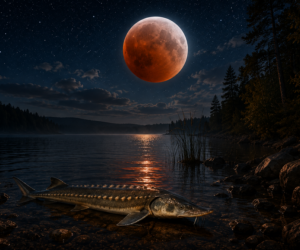
August’s full moon reaches peak illumination late on the evening of August 27 across the western half of North America, and just after midnight on August 28 along the East Coasta good reminder that “the same moon” rarely means “the same date” once you account for time zones.
 Written by Keeper
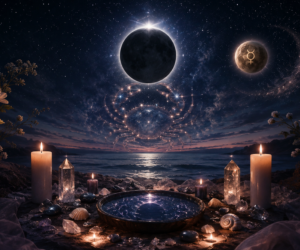
On July 14, 2026, the sky hands us something rare: a New Moon in Cancer that’s also a supermoon, arriving while Mercury spins retrograde in the very same sign. If the last few weeks have felt like everything soft in you needed a place to land, this is that place. The Basics ~ When: July 14, 2026, at 5:43 AM EDT (2:44 AM PDT)~ Where: 22° Cancer~ What makes it “super”: The Moon reaches this new phase close to perigee, its nearest point to Earth, making it one of several super new moons in 2026. You won’t see it (new moons are always invisible), but its pull on tides, and on us, is a little stronger than usual.~ The twist: Mercury is retrograde in Cancer and sitting right on top of this New Moon, which changes the whole assignment. Why This One Feels Different Cancer is the Moon’s home sign, so a New Moon here is the lunar cycle’s version of coming home. It’s the first New Moon of summer, landing just weeks after the solstice sent the Sun into Cancer too. Normally, a New Moon is a green light. Plant something new, set an intention, move forward. But with Mercury retrograde layered on top, the energy turns inward instead. This is less about launching and more about finishing what got left half-said. An apology you didn’t send, a conversation you keep replaying, a room in your home or your heart that’s still in boxes. What to Focus On ~ Home and sanctuary. Cancer rules the literal and emotional idea of home. Small, tangible changes to your space count as real intention-setting right now.~ Family and roots. Old dynamics, inherited patterns, and unfinished conversations with family are likely to surface. The invitation is to notice them, not necessarily to resolve everything at once.~ Emotional security. Ask yourself plainly: what actually makes you feel safe? Not impressive, not productive – safe.~ Revisiting, not restarting. Because of the Mercury retrograde overlap, this is a better moment to reopen an old project, relationship, or idea than to start something brand new. A Simple Ritual You don’t need anything elaborate for this one: 1. Dim the lights and light a candle if you have one.2. Write down one thing from the past that you’re ready to release, and one feeling of “home” you want more of.3. Sit with both for a few minutes before you do anything else with them. No fixing, just noticing. For Cardinal Signs Especially Aries, Cancer, Libra, and Capricorn – particularly anyone with planets around 18–26 degrees of these signs – will likely feel this one most strongly, since cardinal energy responds fastest to lunar shifts. Cancer placements get a personal new-year feeling. The other three cardinal signs may feel a quieter nudge toward unfinished business in partnerships, career, or home life. Curious how this lands for your own chart? A close look at your Moon sign and any planets near 18–26° of Aries, Cancer, Libra, or Capricorn will tell you exactly where this energy is landing for you. Read More Mercury in Retrograde ~ What It Actually Is, What It Actually Does, and Why Everyone Panics Mercury in Retrograde: Navigating the Cosmic Tides
 Written by Keeper
There is a particular quality to the light in late June.
It lingers. The days are long past their longest point, the summer solstice falls on June 21st this year, but the warmth still feels unhurried, unrushed, as though summer has just arrived and has not yet begun counting the days until it leaves. The earth is in full production. Things are ripening. The green has deepened from the tentative brightness of spring into something more substantial, more settled.
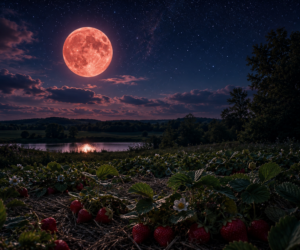
And on Monday, June 29th, the Strawberry Moon rises.
The Strawberry Moon is the first full moon of summer, following soon after the June 21st solstice. The name comes from a number of North American native tribes. Among them the Algonquin, Ojibwe, Dakota, Lakota, Chippewa, and Sioux. Who used it to mark the moment when wild strawberries reach peak ripeness and are ready to be gathered. The name is not about what the moon looks like. It is about what the land is doing when the moon rises.
Because the June full moon stays low on the horizon in the Northern Hemisphere, its light passes through a thicker layer of the Earth’s atmosphere, causing it to glow with a golden or reddish tint. So it does, in fact, look a little like a strawberry, deep, warm, close to the earth. But the name came first from the harvest, from the act of going out into the fields and finding what was ready.
That is the energy of this moon: ripeness. The recognition of what is ready. The act of gathering.
 Written by Keeper
Your flight gets cancelled. Your ex texts you out of nowhere. Your laptop dies in the middle of something important. Your words come out wrong in a meeting you had been dreading, and then your phone autocorrects a message to your boss in a way that requires three follow-up messages to clarify.
Someone in your life says: Mercury must be in retrograde.
And you either nod knowingly, or you roll your eyes, or – if you are like a lot of people, you do both simultaneously, because you are not entirely sure what it means but you have noticed that things do seem to go sideways in a particular way at particular times, and the phrase has become the closest shorthand we have for that particular quality of wrongness.
This post is going to be honest about Mercury retrograde. Honest about what it actually is, where the idea came from, what the evidence says, and what, if anything, you can actually do with it beyond blaming your technology.
What Mercury Retrograde Actually Is: The Astronomy
Mercury retrograde is a real astronomical phenomenon. That part is not in dispute.
 Written by Keeper
When Winter’s Stillness Meets Leo’s Fire
Full Moon Peak Sunday, February 1, 2026, at 509 PM ET / 209 PM PT
Astrological Sign Leo (13°03′)
Traditional Name Snow Moon
The first full moon of February 2026 arrives with unique timing and potent energy. Not only does it fall on the very first day of the month, but it also coincides with Imbolc, the Celtic festival marking the midpoint between winter solstice and spring equinox. This convergence creates a powerful portal – winter’s contemplative stillness meeting Leo’s bold, fiery expression.
This isn’t your typical quiet winter moon. The Snow Moon in Leo asks you to find your inner fire even when the world outside is frozen, to remember your light when everything feels dormant, and to prepare to step into visibility as spring approaches.
 Written by Keeper
The new moon arrives like a blank page in the night sky – invisible yet potent with possibility. This lunar phase, when the moon sits between Earth and the sun, has long been honored as a sacred time for planting seeds of intention and turning inward to contemplate what we want to call into our lives.
In the darkness of the new moon, we’re invited to pause, reset, and dream. While the full moon illuminates and reveals, the new moon asks us to trust what we cannot yet see. It’s a reminder that all growth begins in darkness – seeds beneath soil, ideas before manifestation, potential before form.
What Makes This New Moon Significant
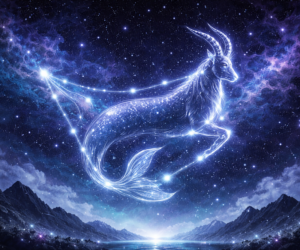
The new moon on January 18, 2026, at 250 p.m. EST, occurs at 28 degrees Capricorn, marking the first new moon of the year and arriving with particularly potent energy for anyone ready to get serious about their goals. This isn’t just any lunar reset. It’s the foundation-laying new moon of 2026.
 Written by Keeper
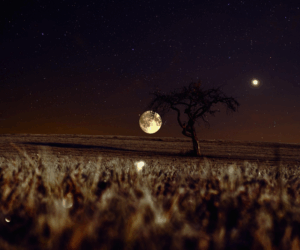
As we step into 2026, the cosmos gifts us with a spectacular celestial welcome. The first full moon of the year, January’s Wolf Moon, will be a supermoon, appearing larger and brighter because it will be at or near its closest point to Earth in its elliptical orbit. But what makes this supermoon particularly special is its timing. It’s the last supermoon we’ll see until November 2026.
What Makes This Wolf Moon Special
The Full Wolf Moon rises on Saturday, January 3, 2026, reaching peak illumination at 10:03 GMT (5:03 AM EST). This isn’t just any full moon. The January Supermoon will be 362,312 km (225,130 miles) from Earth, appearing 6% bigger and 13% brighter than an average full moon.
It will be the last of four consecutive supermoons in 2025–2026, creating a powerful closing chapter to an extraordinary lunar sequence. After this moon wanes, we’ll enter what some are calling a “supermoon drought”, nearly eleven months before the next one graces our night sky.
Why We Call It the Wolf Moon
 Written by Keeper
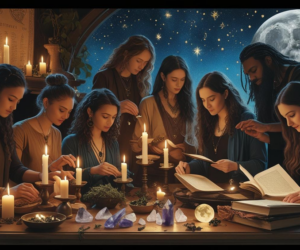
The moon doesn’t care whether you notice her. She’ll keep waxing and waning, pulling the tides, marking time in her ancient rhythm whether you’re paying attention or not. But when you do start paying attention, when you begin to align your intentions with her phases, something shifts. You stop fighting against natural rhythms and start flowing with them.
Each phase of the moon carries its own energy, its own invitation. Working with these phases isn’t about rigid rules or complicated ceremonies. It’s about recognizing where the moon is in her cycle and asking yourself: what does this energy support? What am I ready to plant, grow, release, or rest with?
Here’s how to work with each moon phase, complete with rituals you can adapt to your own practice.
New Moon ~ The Dark Beginning
Energy: New beginnings, intention-setting, planting seeds, rest, introspection, the void, potential
What’s Happening: The moon sits between Earth and the sun, invisible to us. This is the darkest night, the blank page, the moment before creation.
 Written by Keeper
Long before we had smartphones buzzing with notifications and digital calendars syncing across devices, humans tracked time by watching the moon. The lunar cycle, that reliable 29.5-day journey from new moon to full and back again, provided our ancestors with a natural clock, a planting guide, and a sacred rhythm that shaped everything from festivals to fishing expeditions.
Even now, when we’re surrounded by artificial light and climate-controlled environments, something in us still responds to the moon. We feel the pull toward introspection during the dark moon, the surge of energy as she waxes full. Whether you’re setting intentions, making moon water, planning rituals, or simply trying to understand why you feel restless on certain nights, understanding the moon calendar can help you work with these natural rhythms instead of against them.
Understanding the Lunar Cycle
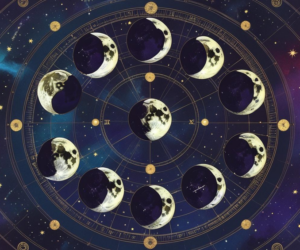
The moon doesn’t produce her own light, she reflects the sun’s. As she orbits Earth every 29.5 days, the angle of sunlight hitting her surface changes, creating the phases we observe from down here. This cycle, called a synodic or lunar month, has eight distinct phases:
New Moon
 Written by Keeper
On Sunday, December 21, 2025, at 10:03 AM EST, the Northern Hemisphere will experience the winter solstice. That’s the instant when the Sun reaches its southernmost point in the sky, marking the official beginning of astronomical winter and when daylight hours are at their minimum before they start lengthening again. Also known as the shortest day and longest night of the year. This astronomical event has captivated humanity for millennia, inspiring celebrations, rituals, and traditions that continue to resonate in our modern world.
What Is the Winter Solstice?
The winter solstice occurs when the northern half of the Earth is tilted its farthest away from the sun, causing the sun to reach its lowest point in the sky. While many think of it as an entire day, the solstice actually lasts just a moment. A precise astronomical alignment that marks the official beginning of winter.
The word “solstice” comes from the Latin words meaning “sun” and “still,” reflecting how the sun appears to pause in its southward journey before reversing direction. After December 21st, the days gradually begin to lengthen again, offering the promise of returning light and the eventual arrival of spring.