 Written by
 Across every tradition that has ever taken magic seriously, the enchanted object holds a special place. Here is what they all agree on – and how to do it yourself.
There is a knife in the British Museum that is over three thousand years old. It is made of flint, its edges still sharp, and carved into its handle are the names of protective spirits in a script that took scholars decades to decipher. It was not made to cut anything. It was made to be powerful. To carry a charge of intention into the world and hold it there, in the material of the object itself.
The enchanted object is one of the oldest ideas in human culture. From the amulets of ancient Egypt to the blessed medals of Catholic devotion, from the talismans of Renaissance ceremonial magic to the lucky coin in a grandmother’s pocket, the notion that power can be sealed into a physical thing is as close to universal as human belief gets. The details vary enormously. The core idea does not.
This is a guide to enchanting an object . Drawn from the traditions that have thought most carefully about the subject, with some honest commentary on what those traditions actually share beneath their different vocabularies.
What Does It Mean to Enchant Something?
Before the how, the what. To enchant an object is to establish a relationship between the object and an intention. Or, in more traditional language, between the object and a force, a spirit, a quality, a god. The object becomes a kind of container. What it contains depends on the tradition doing the enchanting, but the structure is always the same: something is put in, and the object holds it.
That something might be:
~ An intention ~ the desire for protection, healing, love, prosperity, courage
~ A correspondence ~ a connection to a planet, element, deity, or quality that carries the desired energy
~ A spirit or presence ~ in the more animist traditions, an actual inhabiting intelligence
~ A link ~ a connection to a specific person or place, so that what happens to the object has an effect elsewhere
The traditions disagree on which of these is most accurate. What they agree on is the process. And the process is surprisingly consistent across cultures and centuries.
Step One: Choose the Right Object
The object matters. Not every tradition agrees on why, but they all agree that some objects are more suitable for enchantment than others.
The most fundamental principle is correspondence. The physical qualities of the object should match the intention you are embedding in it. This is not mere symbolism. In the logic of sympathetic magic, like calls to like, and an object whose nature already tends toward your intention is far easier to charge than one working against it.
Material correspondences are the foundation of almost every talisman tradition:
~ Iron and steel ~ protection, strength, the warding off of malevolent forces. Iron was considered hostile to faeries and spirits in Celtic and Germanic traditions precisely because of its implacable physical qualities. A nail, a horseshoe, a key.
~ Silver ~ the moon, feminine energy, intuition, psychic sensitivity, healing. In almost every tradition that uses metals magically, silver is lunar and reflective.
~ Gold ~ solar energy, authority, wealth, permanence. The Hermetic and alchemical traditions associated gold with the sun and with the highest spiritual principles.
~ Copper ~ Venus, love, harmony, pleasure, connection. Roman soldiers buried offerings of copper to the goddess of love. Renaissance magicians cast copper talismans under Venus’s astrological influence.
~ Wood ~ the choice of wood carries its own set of correspondences, inherited from European tree-lore and the folk magic of the forest cultures. Oak for strength and endurance. Rowan for protection against enchantment (the tree that breaks other spells). Elder for transformation and the threshold between worlds. Hawthorn for love and the fairy realm. The wrong wood is not just unhelpful. In some traditions, it actively works against the intention.
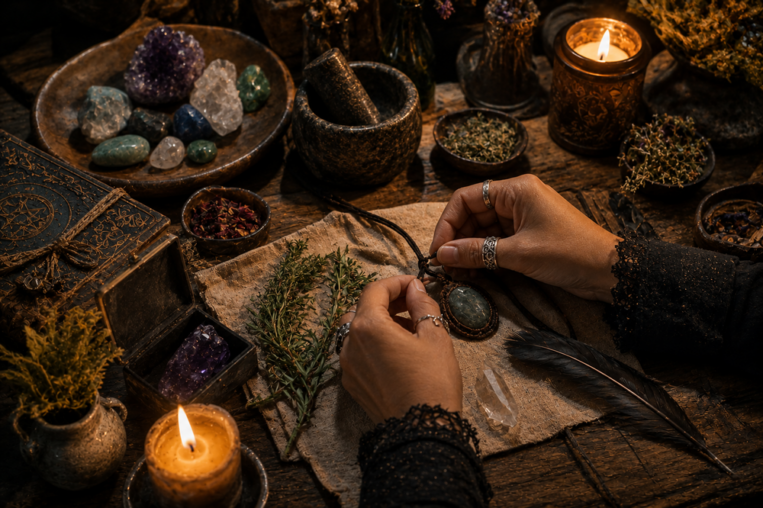
~ Stone ~ crystals and semi-precious stones carry some of the most detailed correspondence systems in the Western tradition. Amethyst for calm and spiritual clarity. Obsidian for protection and truth. Rose quartz for love. Citrine for confidence and abundance. Green aventurine for luck and opportunity. Whatever you think of the metaphysics, the system is internally consistent and thousands of years old.
Beyond material, consider form. A ring that encircles the finger is a natural vessel for binding enchantments. It encloses and contains. A pendant that hangs at the heart is natural for anything relating to love or emotion. A coin that passes from hand to hand carries a different energy from a stone that sits in one place. An object with a point or an edge has different qualities than one with a rounded form.
And consider origin. Found objects – a stone picked up at a crossroads, a feather discovered at a significant moment, a coin found face-up on an auspicious day – carry a quality of serendipity that many practitioners find more potent than deliberately purchased materials. The tradition of carrying lucky pennies is old precisely because the finding was the omen; the coin merely holds it.
~Step Two: Cleansing
Before you put anything into an object, you must take everything else out.
Every serious talisman tradition includes some form of purification before the enchantment proper begins. The reasoning is consistent: an object that has passed through the world has accumulated impressions, associations, the residue of every hand that has touched it and every place it has been. These need to be cleared away so that the enchantment has a clean surface to work on.
Methods vary by tradition, but the core approaches are:
Salt is the most universal purifying agent in Western magic. It has been used to break enchantments, ward off spirits, and cleanse ritual objects since ancient times. Leave an object buried in salt, or a bowl of saltwater, for anywhere from a night to a full lunar cycle. Sea salt is preferred for its wild, unprocessed quality; rock salt for its age and depth.
Smoke ~ fumigation ~ is nearly as universal. Frankincense has been used to purify sacred objects in temple traditions from Egypt to medieval Europe. Sage, particularly white sage, is central to many Indigenous North American purification practices. It has been adopted so widely by contemporary Western practitioners that the cultural borrowing has become a subject of legitimate debate. Cedar, sandalwood, and juniper are alternatives with deep roots in their respective traditions. Pass the object through the smoke slowly and with attention, turning it so that the smoke reaches every surface.
Running water ~ a stream or a river ~ is the great cleanser in many folk traditions. Water that moves naturally is considered to carry away what it touches, dissolving accumulated energies back into the earth. Some objects should not be submerged (wood may warp, certain metals may corrode, some stones dissolve in water) – know your materials.
Moonlight and sunlight each have purifying and charging properties in different traditions. The light of the full moon is considered particularly effective for objects intended for lunar or intuitive purposes. A night left on a windowsill in clear moonlight is one of the simplest and oldest purification methods.
Intention alone is the preferred method of some practitioners who regard the whole matter as primarily psychological. Hold the object, breathe slowly, and with clear mental focus, envision all prior associations falling away like dust. This requires greater concentration than the physical methods but is always available.
Step Three: Align with the Correspondences
Here the traditions diverge most, but the underlying logic is the same. The enchantment will be more powerful if it is performed at a time and in conditions that match the intention.
Astrological timing was central to Renaissance ceremonial magic and remains important in many contemporary traditions. The simplest version involves the days of the week, which are each governed by a planet and carry the qualities of that planet:
| Day | Planet | Qualities |
|---|---|---|
| Sunday | Sun | Success, authority, confidence, health |
| Monday | Moon | Intuition, memory, dreams, emotional matters |
| Tuesday | Mars | Courage, energy, conflict, protection |
| Wednesday | Mercury | Communication, travel, intellect, commerce |
| Thursday | Jupiter | Abundance, expansion, luck, wisdom |
| Friday | Venus | Love, beauty, harmony, relationships |
| Saturday | Saturn | Discipline, boundaries, binding, endings |
The traditional magician would not merely choose the right day, but also the right hour. Each hour of the day being governed in turn by a planetary sequence. And the right phase of the moon. A talisman for new beginnings would ideally be made at the new moon. One for protection or binding at the full moon or the waning moon. One for release and banishment at the dark of the moon.
The four elements provide another set of correspondences. Fire for will, passion, and transformation; Water for emotion, intuition, and love; Air for intellect, communication, and clarity; Earth for stability, prosperity, and physical health. Some practitioners align their enchantments to an element by performing the work near an open flame, beside a body of water, outdoors in wind, or on bare earth.
Step Four: The Enchantment Itself
This is the heart of the matter, and it is both simpler and more demanding than it might appear.
The enchantment is an act of focused attention in which the intention is transferred into the object. Every tradition accomplishes this through some combination of the following:
Words ~ spoken aloud. The naming of the intention matters. Vague wishes produce vague enchantments; specific, clearly stated intentions produce specific, clearly working ones. In ceremonial magic, these are formal invocations, often in Latin or Hebrew, calling on specific divine or angelic names. In folk magic, they are rhyming charms, often in the vernacular. In contemporary practice, they may be personal statements composed by the practitioner. What matters is not the language but the clarity and the speaking aloud. The passage of the intention from inside the mind into the external world via breath and sound.
The formula ~ “I charge this [object] to [intention]” is as simple and serviceable as any. More elaborate is better only if the elaboration genuinely focuses your attention rather than dispersing it.
Breath ~ breathing onto the object while holding the intention in mind is one of the oldest and most primal methods of enchantment. Breath is life, and breathing into an object is a way of giving it a share of your vitality. In many traditions, this breath-gift is what distinguishes a charged object from a merely blessed one.
Touch ~ holding the object firmly in both hands, with closed eyes and concentrated intention, for a sustained period, at least several minutes, perhaps much longer. Warmth transfers. Some practitioners report a sensation of energy flowing down the arms and into the object. Others experience it as a deepening of inner quiet. Others simply do the work without sensation and trust the intention to carry.
Anointing ~ the application of oils is central to many traditions. Different oils carry different correspondences. Rose oil for love, frankincense for protection and spiritual elevation, cinnamon for prosperity, lavender for calm, patchouli for grounding. You apply the oil to the object while stating or concentrating on the intention, working from the center outward in many traditions, or from one end to the other depending on the specific magical system.
Symbols ~ engraving, drawing, or painting symbols onto the object connects it to the powers those symbols represent. This might mean carving runes into wood or bone, inscribing the seal of a planet from a grimoire onto metal, drawing a sigil you have personally constructed to represent your intention, or painting sacred geometry onto a stone. The act of making the symbol is itself part of the enchantment. You are not merely applying a sticker, but completing a circuit between the symbol’s meaning and the object’s nature.
Step Five: Seal and Activate
Once the intention has been placed in the object, it needs to be sealed . Made durable, set in place. And then activated into its purpose.
Sealing in many traditions involves a final declaration: “It is done,” or “So mote it be,” or “As I will it, so it is.” This is not mere dramatic flourish. It is a clear signal to the practitioner’s own mind that the work is complete, that the intention is no longer open for revision or doubt, that what has been done is done. Without some form of closing statement, the enchantment remains, in a psychological sense, unfinished – the mind continues to tinker with it.
Wrapping an enchanted object in cloth, traditionally silk, linen, or velvet, preserves its charge. Many traditions specify that the enchanted object should not be touched by anyone except its intended owner until it has been in use long enough to bind to their energy. This is why amulets are often given wrapped, and why finding a talisman in someone else’s possession is considered unlucky. You are getting their enchantment, not your own.
First use is the activation. An amulet worn for the first time completes the circuit between the enchanter’s intention and the wearer’s life. A charm placed in a home for the first time begins its work at the moment of placement. The object goes from charged to operative when it enters the context for which it was intended.
What the Traditions Agree On
Strip away the specific vocabularies – angelic names, planetary hours, runic alphabets, Hoodoo formulas, Shinto rituals, Vedic offerings – and the traditions share a core set of principles.
Attention is the operative force. Every tradition insists, in its own language, that the enchantment is only as powerful as the concentrated intention behind it. Distracted, half-hearted work produces distracted, half-hearted results. This is why elaborate rituals exist. Not because the ritual has power in itself, but because the ritual is a technology for focusing attention on something specific, for a sustained period, in a state of elevated significance.
The symbolic and the physical are not opposites. The choice of material, timing, and symbol are not arbitrary decoration. They are a discipline of alignment. Ensuring that every element of the work is pointing in the same direction. This is the logic of correspondence: when everything around you is in tune with your intention, the intention becomes easier to hold clearly and completely.
The enchanted object is a reminder as much as a vessel. Whatever the metaphysics, an amulet carried against the skin is a constant tactile reminder of its intention. A charm hung in a doorway is encountered each time the door is opened. The object works partly by continuously returning your attention to what you intend. And sustained attention, in most human endeavors, turns out to be most of the work.
A Simple Enchantment You Can Do Tonight
You need: one small stone, gathered from outdoors. A candle. Salt. A quiet hour.
Wash the stone in cold water. Leave it in a small bowl of salt for an hour while you prepare yourself. Think clearly about what you want this stone to carry. Protection? Calm? Confidence? Be specific. Not “I want to be happy” but “I want to feel grounded and unafraid when I walk into difficult situations.”
Light the candle. Hold the stone in both hands. Look at the flame. Breathe slowly until your mind quiets.
Say aloud, in your own words, what you are putting into the stone. Then breathe on it three times. Three slow, deliberate breaths, each carrying the intention.
Hold the stone until it is warm from your hands.
Say: “It is done.”
Carry it with you. Touch it when you need what it holds.
Whether the stone now contains something real or merely reminds you of what you are capable of… In the end, those two things may be closer than they appear.
The enchanted object is, at its oldest and deepest, a technology of attention. A way of placing a clear intention into a form that endures, that can be touched and felt and carried into the world. The traditions that have taken this most seriously are not credulous or naive. They understood something that the modern world is only now rediscovering: that where your attention goes, reality follows.