
Long before the written grimoire, there was the garden. Long before the spell book, there was the healer who knew which plant would ease fever and which would ease grief, which would call love and which would bind harm. The magical herbalist works at the oldest intersection of the human and the natural world.
 Written by Keeper
Not every plant wants to help you flourish.
Some of them want to strip things away. Some of them are drawn to what rots, what ends, what dissolves at the edges of ordinary life. Some of them grow precisely in the places that most people walk past quickly – the shadow of the wall, the disturbed earth at the margin, the place where something has recently died.
These are the dark botanicals, and they have been the companions of shadow work long before shadow work had a name.
In the contemporary practice of magic, plant work and inner work are often kept separate. Herbs for spells, therapy for the psyche. But in the older tradition, this division would have been incomprehensible. The plant you burned for clarity was also the plant that forced you to see what you had been avoiding. The herb you carried for protection was also the herb that showed you what you actually needed protecting from. The boundary between the inner and the outer was a working boundary, not a permanent wall.
The dark botanicals are the plants that dissolve that wall most effectively. They are the allies for going down.
 Written by Keeper
There is a reason witches have always kept company with birds.
Long before the cauldron and the broomstick became symbols of the craft, birds were already woven into the oldest layers of magical tradition. Soaring between the earthly realm and the spirit world, carrying omens on their wings, and serving as the eyes and voices of forces far older than human memory. In cultures spanning every continent, birds have been revered as messengers, oracles, and familiars: creatures that exist in two worlds at once, belonging fully to neither.
If you’ve felt drawn to a particular bird – if one keeps appearing in your dreams, at your window, or on your altar – it may be worth listening.
The Raven ~ Oracle of the Void
Of all birds associated with witchcraft, the raven may be the most universally recognized. Its ink-black plumage, uncanny intelligence, and eerie vocalizations have made it a figure of profound magical significance across Norse, Celtic, Native American, and Greco-Roman traditions alike.
 Written by Keeper
Hiding in plain sight.
On the windowsill of someone who has never cast a spell. In the terracotta pot beside the back door of a house where nobody believes in magic. At the edges of car parks and office courtyards, clipped into neat hedges by landscapers who think of it as hardy and low-maintenance. In the kitchen of every home that owns a roast chicken.
Rosemary is perhaps the most quietly powerful plant in the Western magical tradition. And it is powerful precisely because it never stopped being ordinary. While other sacred plants retreated into the esoteric, into the apothecary cabinet and the grimoire, rosemary stayed in the kitchen garden. Stayed accessible. Stayed common. And in doing so, kept its magic alive in the hands of people who might not have called it magic at all. Who called it cooking, or remembrance, or habit.
This plant has been with us for a very long time. And it knows things.
The Names It Carries
Rosmarinus officinalis, now reclassified by modern botanists as Salvia rosmarinus, though the old name refuses to die, means literally dew of the sea. From the Latin ros (dew) and marinus (of the sea). Rosemary grows wild on Mediterranean coastlines, its grey-green needles salt-tolerant and wind-hardened, its blue flowers visible from the cliff paths above the water. It smells, on a hot afternoon in the sun, like the distillation of everything the Mediterranean means: warmth, antiquity, something sacred hidden in the ordinary.
 Written by Keeper
She grows at the edge of things.
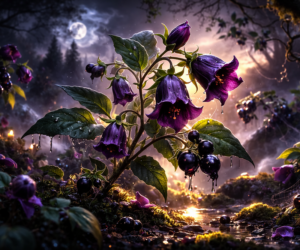
In the dappled shadow at the forest margin, in the rubble of old ruins, in the disturbed earth beside crumbling walls – belladonna chooses her ground carefully. She is not a plant that invites herself into the tidy cultivated garden. She arrives where something has been disrupted, where the ground has been turned over, where the boundary between the managed world and the wild one has become uncertain.
This is appropriate. Belladonna has always lived at the edge.
Atropa belladonna, deadly nightshade, is one of the most famous and most feared plants in the Western magical tradition. She appears in the literature of witchcraft, in the pharmacopoeia of medieval herbalists, in the records of poisoners and physicians alike. She has killed people. She has healed people. She has, according to centuries of folk tradition, carried people between worlds.
She deserves to be understood properly.
The Names She Carries
The name belladonna is Italian, bella donna, beautiful lady, and its origin is usually explained by one of two stories, or both simultaneously. The first:
 Written by Keeper
Stachys officinalis (formerly Betonica officinalis)
There are herbs that whisper their secrets, and then there’s Betony – an herb that practically shouts its power from the hedgerows and meadows where it grows. Once considered so magically potent that it could protect against both evil spirits and lightning strikes, Betony has been somewhat forgotten in modern herbalism. But for those who know, Betony remains one of the most powerful allies in a witch’s garden.
A Herb Steeped in Ancient Power
The Romans held Betony in such high regard that they wrote entire treatises about its virtues. The physician Antonius Musa, personal doctor to Emperor Augustus, listed 47 different ailments that Betony could cure. But it wasn’t just the Romans who revered this humble plant.
The Anglo-Saxons considered Betony one of their most sacred herbs, including it in the Lacnunga, an Old English collection of herbal remedies and charms. They believed it could protect against frightening nocturnal visions, shield against serpents, and guard against “monstrous nocturnal visitors.”
 Written by Keeper
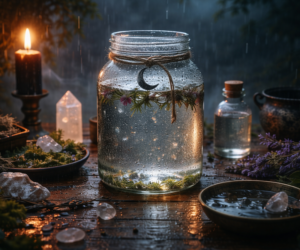
Pour a glass of water. Hold it in your hands. What you’re holding is not simply H₂O molecules arranged in liquid form. You’re holding memory, adaptability, receptivity, and potential. Water is the universe’s most perfect carrier. It flows into every space, takes every shape, touches everything, and remembers what it encounters. When you understand that water carries intention, you unlock one of magic’s most fundamental and powerful tools.
Water is not passive. It doesn’t merely exist. It responds, adapts, receives, and transmits. Scientists are beginning to discover what magical practitioners have always known water has memory. It holds information. It changes its structure based on what it encounters. Words spoken to it, emotions directed at it, energies it absorbs. Water is consciousness made liquid, intention given form that can flow anywhere, reach anything, penetrate everything.
This is why water appears in virtually every magical tradition. Holy water. Wishing wells. Water offerings. Ritual baths. Potion-making. Scrying bowls. Across every culture and time, humans have recognized water as the element that can carry prayers to gods, intentions to manifestation, healing to the sick, and blessings to the people. Water doesn’t just symbolize emotions and intuition, it literally carries intention from your mind into material reality.
The Science of Water’s Memory
 Written by Keeper
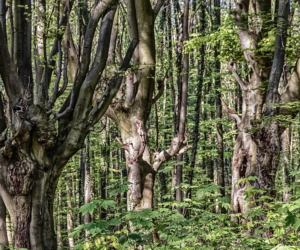
Stand beneath a beech tree and you’ll understand immediately why our ancestors revered it. The smooth, silvery bark seems to glow with its own light, even on cloudy days. The canopy spreads wide and generous, creating cathedral-like spaces beneath its branches. In autumn, copper leaves drift down like pages from ancient books. The beech has been called the tree of wisdom, the keeper of knowledge, the library of the forest. And for good reason.
The Nature and Spirit of Beech
The beech tree (Fagus) carries an energy distinct from other trees. Where oak is strength and willow is emotion, beech is intellect, memory, and the preservation of knowledge. This isn’t abstract. It’s rooted in the tree’s very nature and its relationship with humanity across millennia.
Beech bark is uniquely smooth and pale, making it ideal for carving. For thousands of years, humans have carved messages, symbols, and records into beech bark and wood.
 Written by Keeper
When: February 1-2 (traditional) or the astronomical midpoint between Winter Solstice and Spring Equinox (February 3-4)
Also Known As: Imbolg, Oimelc, Brigid’s Day, St. Brigid’s Day, Candlemas (Christian), Lá Fhéile Bríde (Irish)
Pronunciation: IM-olk, IM-bulk, or IM-bowlk
Season: Cross-quarter day between Winter Solstice and Spring Equinox
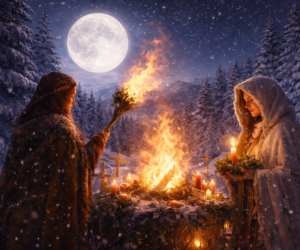
As February arrives with snow still blanketing the earth and cold winds howling, something shifts. The days have grown noticeably longer. The sun sits higher in the sky. Beneath the frozen ground, seeds begin to stir. Ewes heavy with lambs produce the first milk of the season. Life, dormant through the darkest months, begins its slow return.
This is Imbolc, the festival that celebrates the first stirrings of spring while winter still holds the land in its grip. It’s a holiday of contradictions and hope: fire in the snow, milk from barren fields, light growing in darkness. For the ancient Celts and modern practitioners alike, Imbolc marks a sacred turning point in the wheel of the year.
 Written by Keeper
A Word of Caution Before We Begin
I recently saw someone on TikTok claim that creating Devil’s Breath is as simple as mixing pepper and flour, or something similar. Let me be absolutely clear: please don’t believe everything you see on social media without confirming it. This kind of misinformation is not only false but potentially dangerous.
Devil’s Breath is real. It’s dangerous. And it’s definitely not a kitchen spice mix.
Devil’s Breath (scopolamine) is a serious alkaloid compound derived from specific plants, not a kitchen concoction. Spreading or believing such myths can lead to harmful experimentation or unnecessary panic. Always verify information, especially when it involves substances that could affect health and safety.
Let me give you the actual facts about what this substance is, how it works, what’s true about the sensationalized stories, and what’s been exaggerated by media panic and urban legends.
What Is Devil’s Breath?