
 Written by
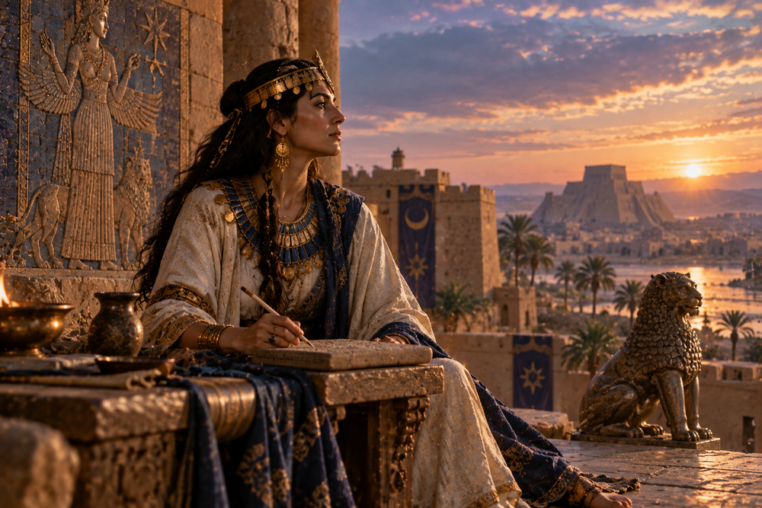
She lived four thousand three hundred years ago, in a city whose ruins now lie beneath the desert sands of southern Iraq. She held one of the most powerful religious offices in the ancient world. She wrote poems of such force and precision that they were copied by scribes for two thousand years after her death. And she signed her name to them, which is why we know who she was at all.
Her name was Enheduanna. And she is not merely the first named author in the history of Mesopotamia, or the first named author in the ancient Near East. She is the first named author in the recorded history of the human species.
Before Homer. Before the Hebrew prophets. Before Sappho or Virgil or any of the writers whose names we were taught to venerate as the origins of literature. There was a Sumerian priestess at the temple of the moon god in Ur, writing hymns to the goddess Inanna and inscribing her own name into them so that she could not be forgotten.
She should not be forgotten. And for most of recorded history, she almost was.
The World She Was Born Into
To understand Enheduanna, you have to understand what she was born into. Because she was, from the very beginning, a creature of enormous political as well as spiritual power, and the two were never fully separable in her life.
By the late twenty-fourth century BCE, the Akkadian king Sargon had unified the northern Akkadian and southern Sumerian city-states into what is now Iraq, creating one of the earliest empires in human history. It was a vast and unstable consolidation – two peoples, two languages, two sets of gods, pressed into a single political structure by military force and administrative will. The empire needed legitimacy. It needed not just conquest but coherence.
Sargon invested his daughter with the double office of high priestess of the moon god Nanna at Ur and of the sky god An at Uruk. This was not merely a religious appointment. It was a political masterstroke. Ur was the most important Sumerian city in the south. The center of Nanna’s worship, the seat of enormous religious prestige. By placing his daughter there as the highest religious authority, Sargon anchored Akkadian power in Sumerian sacred geography. The empire would be held together, in part, by a woman in a temple.
Enheduanna received her name, which means “high priestess, ornament of heaven” in Sumerian, upon her appointment to the temple. Her original Akkadian name is lost to us. The name we know her by is the Sumerian title she took when she came to Ur, the name of the office and the woman fused together into the identity she would carry through history. She chose to be known by her function. She chose to be known as the ornament of heaven.
She would hold that office for more than forty years.
The En-Priestess and Her Goddess
The role Enheduanna held, en-priestess, or entu in Akkadian, was the most senior religious position available to a woman in Mesopotamian society, and one of the most senior available to anyone. As high priestess, she lived in the giparu, which housed not only the temple but also her living quarters, dining area, kitchen, and a burial ground for former high priestesses. She was not merely a religious functionary. She was the symbolic consort of the moon god Nanna. The earthly embodiment of the divine feminine presence in the temple, the human woman through whom the god’s presence in the city was made real and continuous.
As high priestess, she had to make astronomical and mathematical predictions. The moon god’s domain was the lunar calendar, the ordering of time itself, and the woman who served him was expected to be his eyes in the world, reading the heavens on behalf of the city. Enheduanna was, in the fullest sense, a practitioner. A woman who combined deep religious authority, political function, scholarly knowledge, and creative power in a single sustained life.
But it is what she did with her pen that outlasted everything else.
Writing in Sumerian, in the Sumerian city of Ur, she used the name of the Sumerian queen of heaven, the goddess of sexual love and fecundity, Inanna, but essentially gave her the attributes of the formidable patron deity of the Akkadians, the goddess of war, Ishtar. This was theological work of the highest order. Enheduanna did not simply write devotional poetry. She actively reshaped the understanding of the divine, weaving two religious traditions into a single, more complex, more powerful vision of the goddess. A vision that served the empire’s need for unity while expressing something Enheduanna herself appears to have felt with genuine personal intensity.
Through her work, Enheduanna elevated Inanna from a local vegetative deity to the all-powerful Queen of Heaven. The goddess we know from the great Sumerian hymns. Fierce, multifaceted, the lady of war and love and the morning star, is, in significant part, Enheduanna’s creation. She did not simply describe Inanna. She made Inanna into who Inanna became.
The Exile and the Poem
Enheduanna’s life was not only theological and literary. It was political, and at least once it was dangerous.
A certain Lugal-Ane came to power in the city of Ur and demanded that Enheduanna, as high priestess and consort of the moon god, confirm his assumption of power. She refused, or was unable to comply, or was forcibly removed. The record is not entirely clear on the mechanism, only on the result. In exile, she composed the song Nin me šara, the Exaltation of Inanna, in which she called on the goddess to intervene on her behalf and restore the Akkadian empire’s legitimacy.
What makes this poem extraordinary is not only its political context but its voice. Enheduanna did not write in the third person, at a safe remove from events. She wrote in the first person, in immediate, raw, specific language, describing her own suffering and her own prayer with an intimacy that had never been attempted in writing before.
She named herself in the poem. She named her enemy. She named what had been done to her. And then she turned to Inanna, not with the formal language of temple liturgy, but with the directness of someone who believed, with every certainty she possessed, that the goddess was listening, and that the goddess cared, and that the goddess had the power to act.
Inanna apparently heard her prayer and, through divine intercession, Enheduanna was finally restored to her rightful place in the temple. Whether we understand that restoration as a literal divine intervention, or as the eventual military suppression of the Lugal-Ane rebellion by Enheduanna’s nephew Naram-Sin, the result was the same: she went back. She held the office for the rest of her life. And the poem she had written in exile became one of the most copied texts in Sumerian literary history.
The Exaltation of Inanna was included in the Decad, the canon of ten essential Sumerian literary texts used in scribal schools for centuries. Young scribes across Mesopotamia learned to write by copying Enheduanna’s words. Her voice became the standard. The first personal lyric in human literary history was also, for two thousand years, the model against which all other such writing was measured.
What She Left Behind
Enheduanna’s literary works include three powerful hymns to Inanna that helped homogenize Akkadian and Sumerian religious traditions, as well as forty-two shorter poems now known as the Sumerian Temple Hymns. Compositions reflecting personal frustrations and hopes, religious devotion, her response to war, and her feelings about the world she lived in.
She also left a physical object. A disc, inscribed with Enheduanna’s name, was found at the giparu (the residence of the high priestess of Nanna at Ur) and shows the high priestess flanked by three of her retainers. It is the oldest known portrait of a named individual in world history. An alabaster disc from the twenty-third century BCE, carved with the image of a woman in ritual dress, her name written beside her so that there would be no confusion about who she was.
That disc now sits in the Penn Museum in Philadelphia. You can look at her face, or what the sculptor believed her face to resemble, carved in the style of its time, and know that you are looking at the oldest named person whose image survives. The first author. The ornament of heaven. Standing in her temple with three attendants, doing what she had always done. Making herself visible, making herself known, insisting on the permanence of her name.
Why She Was Almost Forgotten
For most of Western cultural history, Enheduanna did not exist. Not in the popular imagination, not in the literary canon, not in the lists of ancient figures whose work we were told mattered.
She was rediscovered in the twentieth century, largely through the excavations at Ur conducted by Leonard Woolley between 1922 and 1934, and the subsequent work of Assyriologists who translated and studied her texts. The disc was unearthed. The cuneiform tablets were translated. The hymns were read again for the first time in two millennia.
What scholars found was a body of work of extraordinary sophistication and emotional depth. And a name, written into the poems themselves at lines 66 and 81 of the Exaltation, just in case anyone missed it. She had signed her work not once but repeatedly, as though she knew, across the forty centuries that would separate her from the people who would eventually read her again, that the signature was the thing that mattered.
The reason Enheduanna was absent from Western literary history for so long is not complicated. Her works were written in cuneiform, in a dead language, on clay tablets buried in a desert. They required specialist knowledge to recover. They came from a civilization that Western classical tradition had never incorporated into its own origin story. And she was a woman, which meant that even after recovery, the impulse in some scholarly quarters was to question whether she had really written what bore her name. Whether the signature was hers or a later attribution.
The objection to Enheduanna’s authorship has been challenged on the grounds that she names herself in a number of her works. Which is, when you think about it, exactly the kind of evidence that settles the question. She put her name in the poem. The poem has survived. She is the author.
For the Practitioner
Enheduanna sits at the intersection of several things that matter deeply to anyone working with devotional practice, deity relationship, or the transmission of spiritual knowledge through written form.
She was a woman who held enormous institutional power and used it to deepen, rather than merely perform, her relationship with the divine. The hymns she wrote to Inanna are not ceremonial formalities. They are the work of someone who genuinely knew the goddess. Who had encountered her, wrestled with her, called on her in genuine need and felt herself heard. The theological synthesis she accomplished – Inanna and Ishtar, Sumerian and Akkadian, local deity and Queen of Heaven – was not a political calculation dressed in religious language. It was, as far as we can read it, the expression of a genuine visionary intelligence working at the intersection of politics, religion, and art.
She also gives us something rare: a named individual at the very beginning of the written spiritual record. Most of what we know about ancient religious practice is anonymous. The customs of unnamed communities, the beliefs of unnamed priests, the prayers of unnamed worshippers. Enheduanna stepped out of that anonymity four thousand years ago and said: this is my name, this is my goddess, this is what I experienced and what I made from the experience.
That act of naming, the insistence on individual presence within the vast impersonal archive of history, is one of the most human things anyone has ever done. And the fact that it was done first, as far as we know, by a Sumerian high priestess writing hymns to a goddess in exile, is something the lineage of spiritual practice should hold with appropriate reverence.
She was the ornament of heaven. She signed her name. She has not, despite everything, been entirely forgotten.
Enheduanna, c.2285–2250 BCE. Akkadian princess, High Priestess of Nanna at Ur, devotee of Inanna, first named author in human history. Her hymns shaped the understanding of the divine feminine in the ancient world and were copied for two thousand years after her death.
References
Hallo, William W., and J. J. A. van Dijk. The Exaltation of Inanna. Yale Near Eastern Researches, vol. 3. Yale University Press, 1968. The foundational scholarly translation and study of Enheduanna’s most significant surviving work.
Meador, Betty de Shong. Princess, Priestess, Poet: The Sumerian Temple Hymns of Enheduanna. University of Texas Press, 2009. The most accessible full scholarly treatment of Enheduanna’s life and complete body of work.
Meador, Betty de Shong. Inanna, Lady of Largest Heart: Poems of the Sumerian High Priestess Enheduanna. University of Texas Press, 2000. Translations of the three major Inanna hymns with extensive commentary.
Mark, Joshua J. “Enheduanna.” World History Encyclopedia, 2014. worldhistory.org. Peer-reviewed overview drawing on primary Assyriological scholarship.
The Morgan Library & Museum. “She Who Wrote: Enheduanna and Women of Mesopotamia, ca. 3400–2000 BC.” Exhibition catalogue, 2022–2023. themorgan.org. Catalogue accompanying the major 2022 retrospective exhibition, incorporating current archaeological and literary scholarship.
Kriwaczek, Paul. Babylon: Mesopotamia and the Birth of Civilization. Atlantic Books, 2010. Contextual history of the Akkadian empire and the political role of Enheduanna’s appointment at Ur.
Penn Museum, Philadelphia. Disc of Enheduanna (object B16665), excavated at Ur by Leonard Woolley, 1925–1930. The primary archaeological artifact bearing Enheduanna’s name and image.