 Written by
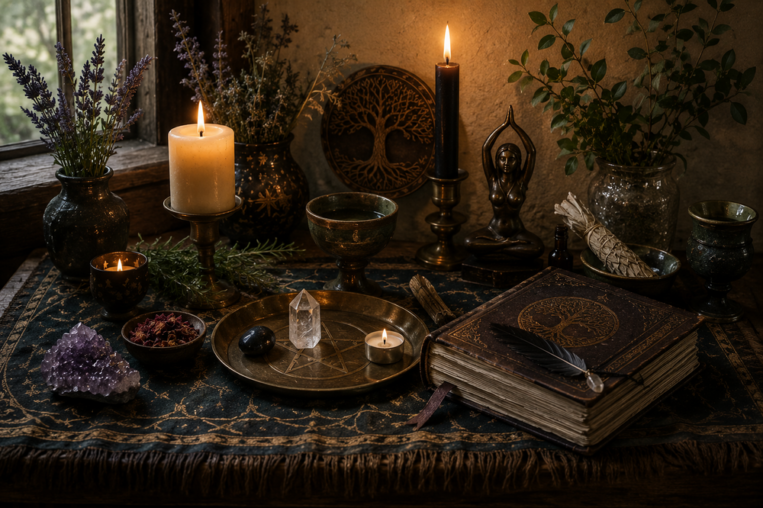
 The altar is where the visible world and the invisible one meet. It is the physical threshold of your practice. A place where intention becomes object, where the sacred takes up residence in ordinary space, where magic lives between workings, patient and waiting.
What an Altar Is – and Isn’t
An altar is not a decoration. It is not a display of how “witchy” you are, or a collection of beautiful objects arranged for aesthetic pleasure alone. While a well-tended altar is often beautiful, its beauty is a byproduct of its purpose – not the purpose itself.
An altar is a dedicated sacred space. A physical location that has been set apart from the ordinary world through intention, arrangement, and use. It is where your magical work is anchored in physical reality. It holds the tools and symbols of your practice, connects you to the deities or forces you work with, and accumulates magical charge with every working that takes place at or near it.
An altar is also deeply personal. The altar of a Wiccan witch working in the Celtic tradition will look quite different from that of a chaos magician, a Hoodoo practitioner, a devotional Buddhist with magical leanings, or an elemental witch who draws primarily from nature. All of these are valid. None of them are more “correct” than the others.
Your altar is a physical expression of your practice, your beliefs, and your relationships with the unseen world. Let it be authentically yours.
Setting Up Your First Altar
Choosing Your Space
Your altar can live almost anywhere. On a shelf, on a dresser, on a dedicated table or cabinet, on a mantelpiece, in a corner of your bedroom, or even on a windowsill. The key considerations are:
Accessibility: You will be using this space regularly. It should be easy to reach, light candles at, and sit or stand before comfortably.
Privacy: If you share your living space and your magical practice is not widely known, you may need to be thoughtful about visibility. A shelf in your bedroom, the top of a dresser, or a dedicated cabinet that can be closed ,offer more privacy than an obvious installation in the living room.
Stability: Altars involve candles. Candles involve fire. Your altar should be on a stable, non-flammable surface, away from curtains, paper, and anything else that could catch fire. This is both safety and common sense.
Facing and direction: Many traditions orient altars to specific directions. North for Earth-centered altars, East for altars focused on new beginnings, East for Air workings. This is worth considering but not essential when beginning. Place your altar where it makes practical sense, and adjust as your practice develops.
The Four Elemental Representations
A traditional altar usually includes representations of all four elements, creating energetic balance and inviting the participation of all elemental forces in your work:
Earth: A dish of salt, soil, or sand; a stone or crystal; a pentacle; plants or flowers.
Air: Incense or a feather; a bell; the athame (in some traditions).
Fire: A candle or candles; the athame or wand (in some traditions).
Water: A chalice or bowl of water; a seashell; water gathered from a meaningful source.
This four-element structure is a framework, not a mandate. As your practice develops, you will find the arrangement that resonates most deeply with how you work.
Deity Representations
If you work with specific deities, your altar will typically include representations of them: statues, imagery, items associated with them (specific flowers, animals, colors, stones). The altar is a physical meeting place. Somewhere the deity can be said to dwell, or at least to be reliably found when you show up.
A Goddess figure and a God figure are traditional on a Wiccan altar. Practitioners working with specific pantheons, Celtic, Norse, Egyptian, Greek, will choose imagery appropriate to their deities. Solo practitioners working with a single deity may keep that deity’s presence central.
If you don’t yet work with specific deities, simply represent the divine in whatever way resonates. A single white candle, an abstract symbol, a found natural object that feels sacred to you.
Tools and Other Elements
Your working tools, athame, wand, chalice, pentacle, live on the altar when not in use. Other elements that commonly appear:
~ Candles: A pair of deity candles (traditionally white/silver for the Goddess, gold/yellow for the God) and working candles for spells
~ Incense holder and incense
~ Small dishes for offerings, herbs, or salt
~ A small cauldron for burning and transforming
~ Crystals relevant to your current work
~ Seasonal decorations that change with the Wheel of the Year
~ Personal items that carry meaning. A photograph, a symbol, a found object
Seasonal Altar Decorations
One of the most beautiful practices in magical craft is allowing the altar to evolve with the turning year. Changing your altar decorations in alignment with each Sabbat connects your practice to the living rhythm of the seasons, making the altar a mirror of the world outside.
Samhain: Skull imagery, black candles, photographs of beloved dead, dried leaves, pumpkins, apples, crow feathers.
Yule: Holly, ivy, pine branches, red and gold candles, antlers, sun imagery, pine cones.
Imbolc: White candles, Brigid’s cross, snowdrops (or their image), flame imagery, milk and honey as offering.
Ostara: Eggs (decorated or natural), spring flowers, rabbits, pastel colors, new soil, seeds.
Beltane: Flowers, ribbons, rose petals, green and red candles, honey, symbols of passion and fertility.
Litha: Sun symbols, bright flowers, citrine, gold candles, oak imagery, herbs at their peak.
Lughnasadh: Grain, sunflowers, bread, harvest vegetables, golden candles, reaping tools.
Mabon: Autumn leaves, apples, blackberries, wine, burgundy and amber candles, harvest cornucopia.
Even small seasonal additions, a handful of seasonal flowers, a relevant stone, a seasonal candle color, bring the altar into living relationship with the year’s turning.
Portable and Discreet Altars
Not everyone has the luxury of a permanent, visible altar. Whether you share space with people who don’t understand your practice, travel frequently, or simply want a backup for working away from home, a portable altar is an invaluable option.
The altar box: A beautiful wooden box (a cigar box, a carved wooden chest, a hinged travel case) can hold a complete altar in miniature. A tea light candle, a small bottle of salt, a tiny stone, a folded cloth, a few herbs. Opened and arranged, it becomes a working altar in minutes. Closed, it is simply a box.
The travel altar bag: A drawstring pouch or small bag containing the essential elements. A candle stub, a stone, a small cloth, a tiny bottle of sacred water or oil. Can be set up anywhere.
The digital altar: For those who need maximum discretion, a digital altar on a phone or laptop. Images of deity, candle flames on screen, digital representations of the four elements. This may seem unorthodox but is entirely valid. Intent and attention make the altar, not the materials.
The natural altar: When outdoors, a stone, a fallen branch, a pool of water, a beam of sunlight – nature provides everything needed for a complete altar. Many practitioners do their most powerful work at outdoor altars created in the moment from what the land offers.
Creating Sacred Space
Beyond the altar, many practitioners work within formally created sacred space. A container that marks the working area as separate from ordinary reality and provides a protected, energetically charged environment for magical work.
The Concept of “Between the Worlds”
In Wiccan and witchcraft traditions, the circle is often described as being cast “between the worlds”. A liminal space that is neither fully in ordinary reality nor in the spirit world, but at the threshold between them. In this threshold space, the veil thins. Magic flows more freely. The practitioner is simultaneously present in physical reality and in the realm of possibility.
This is not merely metaphorical language. The subjective experience of working within a properly cast circle does feel different from working outside one. The energy is different. More concentrated, more charged, more alive.
Circle Casting Techniques
A circle is typically cast by walking clockwise (deosil, in the direction of the sun’s apparent movement) around the working area, marking the boundary with one or more of the following:
With the athame, wand, or finger: The practitioner walks the circle while extending the directing tool, visualizing a stream of light flowing from its tip and forming a glowing boundary in the air, on the floor, in every direction including above and below (the circle is actually a sphere).
With salt or a salt-water mixture: Physically marking the circle with salt creates a strong protective boundary (salt is among the most ancient and powerful purifying and protective substances in magical tradition).
With candles at the quarters: Lighting a candle at each of the four cardinal directions (North, East, South, West) as you cast the circle creates visible anchors for the elemental energies.
With visualization alone: For experienced practitioners, the circle can be cast entirely in visualization. A sphere of light built and sealed through focused intent.
Most circle-casting involves calling the elements and/or deities after the physical boundary is established:
I call to the East, element of Air, to witness and guard this circle. I call to the South, element of Fire, to witness and guard this circle. I call to the West, element of Water, to witness and guard this circle. I call to the North, element of Earth, to witness and guard this circle.
Or in whatever words feel true and alive to you.
Opening the Circle
When the working is complete, the circle must be opened. The energy grounded, the elements and any invoked powers thanked and dismissed, the space returned to ordinary reality. This is done by walking counter-clockwise (widdershins), consciously drawing the energy back and releasing it.
Failing to close a circle properly can leave the space in an unsettled state. The circle’s energy diffusing slowly and messily rather than being intentionally released. Take the opening as seriously as the casting.
Blessing and Consecrating Tools
Before working with a new tool, it is traditional to cleanse and consecrate it. Removing any energies it may have accumulated from its manufacturing, transport, or previous ownership, and dedicating it to your magical purpose.
Cleansing Methods
Pass the tool through incense smoke, visualizing any unwanted energy dissolving in the smoke. Bury it in salt or earth overnight. Place it in moonlight (full moon is traditional) for a night or more. Wash it in salt water if the material is appropriate. Hold it and simply breathe through it, consciously clearing any energy that is not yours.
Consecration
After cleansing, the consecration is the formal act of dedicating the tool to its purpose. Hold it in both hands. Ground and center. Connect with whatever divine forces you work with. Then speak, aloud, from the heart, your intention for this tool. What is it for? What do you ask it to become for you? What do you dedicate it to?
Finish by running it through each element. Through incense smoke for Air, through the flame of a candle for Fire, through water for Water, through salt or earth for Earth.
Your tool is now consecrated. Use it regularly. The more you work with it, the more charged it will become.
Your altar is the heart of your practice, and sacred space is the container that allows magic to do its deepest work. Tend them with love and intention, and they will hold you through every working, every season, every turning of the long spiral of your magical life.