
A magical library is not an accumulation of books. It is a curated conversation. A selection of voices, perspectives, and traditions that challenge, inform, and deepen your practice over a lifetime. Choose carefully. Read critically. Let the best books change you.
 Written by Keeper
The world is not empty. Beyond the range of ordinary perception, beyond the threshold of waking consciousness, there are presences – beings of many kinds, natures, and intentions, as real in their way as the solid earth beneath your feet. The practitioner who learns to navigate this world discovers that they have never truly been alone.
 Written by Keeper
He has been misunderstood, oversimplified, feared. The divine masculine in magical tradition is not the distant, punishing patriarch of monotheism – he is the wild stag, the dying and rising sun, the lover and the laughing stranger, the fire in the oak. He is as present in the turning seasons as the Goddess herself.
 Written by Keeper
She has been called by ten thousand names. She has been worshipped in caves and cathedrals, in forest clearings and city apartments, in every language and epoch and corner of the world. The Goddess is not a relic of the past. She is the oldest living presence in the human spiritual experience. And she is as immediate and vital as the moon rising tonight.
 Written by Keeper
Long before the written grimoire, there was the garden. Long before the spell book, there was the healer who knew which plant would ease fever and which would ease grief, which would call love and which would bind harm. The magical herbalist works at the oldest intersection of the human and the natural world.
 Written by Keeper
The magical world is not a single path but a vast and luminous forest – countless trails winding through the same ancient wood, each one revealing different wonders, each one leading, in its own way, toward the same shimmering truth.
 Written by Keeper
Magic did not begin in a dusty library or a candlelit circle. It began at the edge of a fire, beneath an open sky, in the mind of a human being who looked at the world and sensed, knew, that something more lay just beneath its surface.
 Written by Keeper
The altar is where the visible world and the invisible one meet. It is the physical threshold of your practice — a place where intention becomes object, where the sacred takes up residence in ordinary space, where magic lives between workings, patient and waiting.
 Written by Keeper
A tool does not make the magic. But in the hands of a practitioner who understands its purpose and has built a living relationship with it, a tool becomes an extension of will. A bridge between intention and manifestation, between the inner world and the outer one.
 Written by Keeper
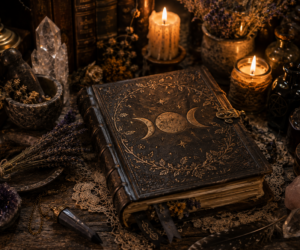
Step into any witchcraft tradition, any occult lineage, any corner of the magical world, and you will find it: a book. Not just any book, but the book – the one written in candlelight, filled with spells and symbols, secrets and ceremonies, the whispered knowledge of those who came before. This is the grimoire.
The word itself carries weight. Derived from the Old French grammaire, meaning grammar. The structured language of learning. The grimoire was once synonymous with any book of occult knowledge. Over centuries, it evolved into something far more intimate: a personal repository of magical practice, a map of one practitioner’s journey through the unseen world.
To hold a grimoire is to hold a record of transformation.