 Written by
 She was about forty-five years old when she died, which was old for her time. She had lived long enough to become someone her community could not easily replace. We know this because of the way they buried her.
Not the way they buried hunters, or warriors, or the politically powerful. Those burials have their own grammar: weapons, tools, the markers of a role that others could step into after the person was gone.
Her burial was different. Her burial was built around her specifically, around what she was and what she had done and what she continued to be, in some understanding her community held, after death.
She was buried twelve thousand years ago in a cave in northern Israel. And she may be the oldest known shaman in the archaeological record.
The Grave at Hilazon Tachtit
The site is called Hilazon Tachtit, in the Lower Galilee region of what is now northern Israel. The people buried there belonged to the Natufian culture. A semi-sedentary society that flourished in the eastern Mediterranean between roughly 15,000 and 11,500 years ago. The Natufians were transitional, not quite nomadic hunter-gatherers, not yet the settled agricultural communities that would follow. They were the people at the threshold of one of the largest transformations in human history.
Hundreds of Natufian graves have been excavated across Israel, Jordan, Syria, and Lebanon. They are well-documented. The archaeologists working at Hilazon Tachtit knew what a standard Natufian burial looked like.
This was not a standard Natufian burial.
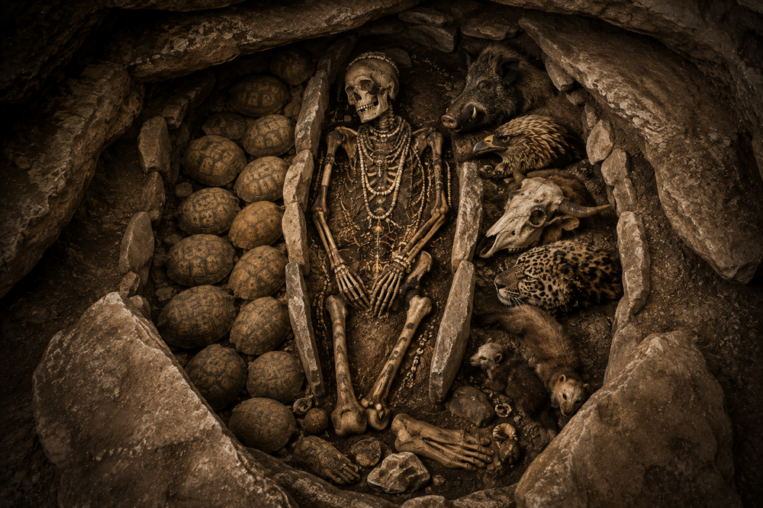
The grave was deliberately constructed. The pit was lined with mud plaster and surrounded with stone. She was placed inside and a large stone slab was laid over her. The grave goods, the objects placed with her, were arranged with evident care, with a precision that suggests not grief alone but ceremony. The performance of something that needed to be done correctly.
What was placed with her:
Fifty complete tortoise shells. Selected body parts of a wild boar, an eagle, a cow, a leopard, and two martens. A complete human foot that did not belong to her.
This is not a collection that makes sense in ordinary terms. These are not the tools or possessions of a daily life. Each element appears to have been chosen for its symbolic and energetic significance. For what it represented in the world the living could not enter and the dead were now navigating.
Reading the Grave Goods
The tortoise shells are immediately striking in their number. Fifty is not an incidental accumulation. It is a deliberate quantity, suggesting that these objects were gathered over time, held, perhaps used, and then interred with their owner.
In many shamanic traditions, the turtle or tortoise is a threshold creature. Belonging equally to water and land, to the surface world and what lies beneath it. The shell is armor, container, resonant surface. In Indigenous North American traditions, turtle shells are rattles; the sound they make is considered a voice from the other world.
Whether the Natufian understanding was precisely analogous is impossible to know. But the shells were placed there deliberately, and fifty of them suggests that they mattered deeply.
The eagle is significant across nearly every shamanic tradition on record. The eagle flies higher than any other creature. Cosest to whatever exists above the human world. And returns. In shamanic cosmology, the eagle is consistently associated with the upper world, with vision, with the capacity to travel between registers of reality. An eagle wing in a human grave is not a hunting trophy. It is a spiritual tool.
The leopard is a creature of the threshold in a different sense: a predator, a boundary animal, one that operates in the spaces between the human world and the wild. Its presence suggests a relationship, an alliance, a power that the buried woman had cultivated.
The human foot that was not hers is the detail that most resists easy interpretation, and which most clearly signals that this burial operated in a symbolic register we cannot fully decode at this distance. It meant something specific. It was placed there for a reason. What that reason was, we do not know.
What we know is that this woman was buried in a way that made her distinct from everyone else in the archaeological record of her culture. Her death was treated as a significant event. Not only a personal loss but a cosmological one. The community came together to do something specific with her remains and her objects, something that required preparation and care and knowledge of a ritual grammar they clearly shared.
She had a role. The grave preserves the shape of that role even after twelve thousand years of silence.
The Archaeology of the Spirit Worker
The Hilazon Tachtit burial is not alone. Across the Mesolithic and Neolithic periods, roughly 10,000 to 4,000 years ago, archaeologists have identified burials that share a recognisable grammar: unusual placement of the body, grave goods with clear zoomorphic and symbolic significance, evidence that the individual was distinguished from ordinary community members in life as well as death.
A burial in Bad Dürrenberg, Germany, around 9,000 years old, contained an adult woman with an infant placed at her head, surrounded by animal bones, shells, and a set of objects that suggest ritual equipment. She was buried in an unusual seated position. The assemblage has been interpreted as that of a shaman or ritual specialist.
The archaeological hallmarks of shamanic burial appear with consistency across enormous geographic and temporal ranges. The animal remains, especially birds of prey, large predators, and liminal creatures like snakes and frogs. The objects that suggest a working toolkit rather than personal possessions. The care given to the arrangement of the body. The frequent presence of physical anomalies or disabilities in the buried individual, which in many traditions marks the person as someone who crossed a threshold between ordinary and non-ordinary experience.
The shaman is often the person who was ill first. Who nearly died. Who lost something ordinary people keep, and gained in return the knowledge of where they had been.
Women and the Old Practice
One of the consistent findings across early shamanic burial archaeology is how often the spirit workers identified are women.
The Hilazon Tachtit shaman is a woman. The Bad Dürrenberg burial is a woman. Across the Mesolithic and Neolithic record, women appear repeatedly in the graves that suggest ritual specialisation. The familiar assumption, that spiritual authority in ancient cultures was predominantly male, does not survive contact with the evidence.
This is not surprising from within the tradition. Many shamanic cultures recognise that certain transitions and capacities associated with the spirit work – the crossing of thresholds, the holding of life and death simultaneously, the particular quality of attention that moves between the worlds – are associated with the feminine, or with individuals who occupy a fluid position in relation to gender.
The earliest known shaman was a forty-five-year-old woman buried in a cave with fifty tortoise shells and the wing of an eagle.
This is who began the recorded history of this work. Not a king, not a priest, not a warrior. Someone who knew how to move between worlds and was trusted, across the span of a community’s need, to do so on their behalf.
The Long Memory
What is most striking about the Hilazon Tachtit burial is not its age alone, but what its age implies.
If a community twelve thousand years ago had already developed a coherent understanding of spirit work. A symbolic grammar complex enough to produce a burial this deliberate, this specific, this clearly understood by those who performed it. Then the practice goes back further still. To when it was not yet fully formed. To its origins in something we cannot see from here.
The archaeology gives us a lower bound, not an upper one. Twelve thousand years is the oldest we have found, not the oldest there was.
The impulse that placed those fifty tortoise shells in the ground around a woman who could move between worlds is older than agriculture. Older than settled life. Older than any civilisation that has ever been named or remembered.
It is not a tradition that began. It is a tradition that was already ancient before anyone thought to mark it in a way that would survive.
When you sit at your altar in the dark and speak the names of the dead, you are continuing something she began. Or continued. Or simply was.