The Witch’s Energy Body ~ Understanding Depletion, Replenishment, and the Art of Energetic Sovereignty

You did the work. The ritual was real, the intention was clear, the circle held. And now you are lying on the floor staring at the ceiling with nothing left, wondering if something went wrong. Nothing went wrong. You moved energy. Energy was moved through you. And your body, which is both the instrument and the practitioner, is registering exactly what happened. This is one of the things no one tells you when you begin – magical work costs something. Not in the dramatic sense of sacrifice or payment to dark powers. In the entirely ordinary, physical, energetic sense that every act of focused will, every opening of perception, every moment of genuine contact with something larger than the everyday self, draws on a resource that is real and finite and needs to be replenished. Understanding your energy body, how it works, how it depletes, how it recovers, and how to develop the kind of energetic sovereignty that makes sustainable practice possible, is not an advanced topic. It is foundational. Everything else you do in your practice depends on it. What Is the Energy Body? Before we can talk about how to manage your energetic resources, we need to establish what we mean by them. Every major magical and spiritual tradition that has taken the body seriously has understood it to have layers. A physical structure that is visible and measurable, and subtler bodies that interpenetrate it and extend beyond it. These are called different things in different traditions. The aura in Western esoteric practice. The kosha system in Vedic philosophy. The qi or chi fields of Chinese medicine and Taoist practice. The ka and ba of ancient Egyptian understanding. The subtle body of Tibetan Buddhism. The etheric body of Theosophy. These are not identical systems. Each arises from a specific cultural and philosophical context, and collapsing them into a single model does a disservice to all of them. But across the differences, certain consistencies emerge that point to something real. The energy body is the field of vital force that animates the physical body, processes experience, and mediates the relationship between the individual and the wider energetic environment. It is the medium through which we receive and transmit. It is what picks up the room when you walk in. It is what feels heavy after a difficult conversation and light after time in nature. It is what contracts when you are afraid and expands when you are fully yourself. In magical practice, the energy body is the primary working instrument. When you cast a circle, you are establishing and sensing a boundary in the energy field. When you raise power, you are drawing from and channelling through the energy body. When you work with the dead, or the fair folk, or the gods, or the ancestors, contact happens at the level of the energy field first. The body registers it as goosebumps, or heat, or pressure, or an altered quality of attention. The energy body is already sensing before the conscious mind catches up. How Magical Work Depletes There are several distinct mechanisms by which magical work draws down energetic resources. Understanding which is operating helps you choose the right recovery. Concentration and sustained focus. The simplest and most universal form of magical depletion. Any state of intense, held attention – holding a circle, maintaining a trance, performing a long ritual, doing deep divination – draws on the nervous system’s capacity for sustained arousal. This is the same resource that depletes when you study intensively, or perform surgery, or have a difficult conversation for three hours. It is metabolic… …

Membership Required

You must be a member to access this content.

View Membership Levels

Already a member? Log in here

Why You Should Shower at Night ~ Water Clears More Than the Body

You may have already learned that water carries intention. And that different waters hold different energies, that storm water is fierce and moon water is soft, that river water moves things and well water holds them. So here is a question worth sitting with: What does your shower water carry? Every day, you move through the world and the world moves through you. Conversations that left a residue. The energy of a difficult meeting or a crowded shop floor. The low-grade static of other people’s moods. The news. The scroll. The relentless output of existing in proximity to other humans and their unprocessed emotions. By the time you reach the end of a day, your energetic body has absorbed considerably more than your physical one. Your skin picks up the literal. Water picks up the rest. The case for showering at night is not just about hygiene, though it is also about that. It is about understanding what water actually does when it moves over a body that has been out in the world all day. And why doing that work before you sleep changes the quality of everything that comes after. What You Bring Home In our Guide to Water Types, we talked about water as a conduit, a carrier, a cleanser, a threshold substance that bridges states. And in our piece on Water’s Fluid Memory, we explored how water responds to what it encounters: that it takes on the imprint of energy, emotion, and intention directed toward it. This works in both directions. You are mostly water. The human body is somewhere between 55 and 65 percent water, and that water is not inert. It is responsive. To your emotions, to your stress levels, to the energetic environment you spend your day in. When you move through a tense environment, your body registers it. When you absorb someone else’s grief or anger secondhand, your body registers that too. Not always consciously. Not always in ways you can name in the moment. But the registration happens. Think about how you feel when you walk in after a long or difficult day. Not just tired – there is often something else. A heaviness. A low buzz of anxiety that does not quite belong to anything specific. A residue of a mood that started in someone else’s office or car or conversation and somehow followed you home. That is not metaphor. That is your water body carrying what it encountered. The Threshold of the Night In almost every spiritual and magical tradition, the transition between day and night is a threshold. A liminal crossing that deserves marking. In Irish folk tradition, the threshold of the home and the threshold of darkness were both considered powerful and potentially dangerous crossing points. The cunning folk of early modern England understood that what you carried across a threshold came with you. In many indigenous traditions worldwide, the practice of ritual cleansing before sleep is ancient and ongoing. Not as obsessive hygiene but as a recognition that the unseen world becomes more accessible at night, and you want to arrive at that crossing clean. In Ayurvedic practice, the period before sleep is considered critical for what enters the dream state. Whatever you carry to bed with you, emotionally, energetically, physically, goes into the unconscious with you. The night is not a neutral pause. It is an active processing time. What you bring to it matters. If you have read on Dream Witches, you will know that the dream is not simply a byproduct of sleep but a genuine realm. And the quality of your crossing… …

Membership Required

You must be a member to access this content.

View Membership Levels

Already a member? Log in here

Folk Magic ~ The Everyday Craft That Never Needed a Book

Before there were grimoires, before there were covens, before anyone wrote a word about the Wiccan Rede or the Law of Threefold Return, there was folk magic. It lived in kitchens and doorsteps. In the hands of grandmothers who would not have called themselves witches. In gestures so ordinary they had stopped looking like magic centuries ago. The pinch of salt thrown over the left shoulder, the coin placed under the doormat, the way a particular family always hung something upside down and nobody quite remembered why anymore but everyone knew not to change it. Folk magic is the oldest living tradition in the world. It does not belong to any one culture, and it does not require initiation, tools, a moon phase, or a spiritual lineage. It requires only the knowledge of what works. Passed down, adapted, borrowed, worn smooth by generations of hands using it until it became instinct. Folk magic is endless, geographically specific, and still evolving.  The Logic Underneath All of It Folk magic does not operate on a single coherent theology. But it does operate on consistent underlying principles that appear across cultures and traditions worldwide: Like affects like. A thing that resembles another thing can be used to influence it. A poppet made in someone’s image, a written name, a photograph – these become the person in magical terms and can carry intention toward them. The part contains the whole. A lock of hair, a nail clipping, a worn piece of clothing, any part of a person or thing holds an energetic connection to the whole. Folk magic uses these as links. Words have power. The spoken word, especially in specific forms, the charm, the curse, the blessing, the sworn oath, carries force beyond its literal meaning. How something is named determines what it is. Reversal undoes. If something was done, it can be undone by doing the opposite. The logic of inversion, turning things backward, upside down, inside out, runs through folk magic across every tradition. Thresholds are powerful. Doorways, crossroads, the boundary between night and day, the edge of a body of water, these liminal spaces are charged with potential and are the natural location for folk magical practice. What you do at the beginning determines the whole. The first moment of any new thing, first day of the year, first customer of the day, first words spoken in the morning, carries disproportionate power and can be used to set the entire course. Hold these principles and most folk magic practices will make immediate sense. Protective Magic Turning Things Upside Down One of the most widespread and least understood folk practices: inverting an object to confuse, deflect, or reverse an unwanted influence. Shoes placed upside down on a doorstep in British and Appalachian tradition confused witches or ill-wishers trying to follow you home. An inverted shoe points in no useful direction. Bottles placed upside down in the garden (the witch bottle tradition, which we will come to) were turned to confuse and trap spirits. Brooms hung upside down at the door in multiple European and African-American folk traditions turned away evil and ill-wishers who could not cross the threshold while the broom was inverted. The logic is the logic of disorientation. A thing turned upside down has lost its orientation in the world. It cannot find its way. It cannot function. Applied to an unwanted influence, inversion makes it directionless and therefore harmless. You will still find this in practice: a broom bristles-up in the corner means company is not welcome to stay. A glass left upside down on the table in… …

Membership Required

You must be a member to access this content.

View Membership Levels

Already a member? Log in here

A Guide to the Many Paths of the Craft

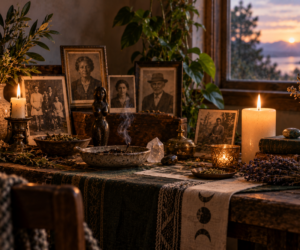
Witchcraft is not one thing. It never has been. Even within a single tradition, no two practitioners work the same way. But over centuries of folk practice and decades of modern revival, certain distinct types have emerged. Recognisable not by rigid rules or formal initiation, but by the energy they are drawn to, the tools they reach for, the part of the world (seen and unseen) they feel most at home in. What follows is not an exhaustive taxonomy. It is a field guide. Some witches will recognise themselves immediately in one entry. Others will find themselves scattered across five. Most practitioners are a blend, with one or two threads running stronger than the rest. Read with an open hand. Take what fits. Storm Witch The energy: wild, electric, threshold, force The Storm Witch works with weather. Not just as a metaphor, but as a living, responsive force. Thunder, lightning, wind, rain, fog, the pressure drop before a storm, are not backdrops. They are tools, allies, and teachers. Storm magic is one of the oldest attested forms of witchcraft. Fear of weather witches runs through the historical record from ancient Rome to early modern Scotland, where witches were tried for raising storms to sink ships. The folk tradition of knotting wind into cord, three knots, three speeds, appears across Scandinavian, Scottish, and Baltic coastal traditions. The Storm Witch feels the approach of weather in their body before it arrives. They may work magic most powerfully during a storm, using the charged atmosphere as a natural amplifier. Lightning strikes the earth and for a moment the boundary between worlds thins. They know this. They work in it. Storm witches are often solitary practitioners. Their practice does not lend itself easily to scheduled circle meetings. You cannot book a thunderstorm for the third Saturday of the month. What they believe: the natural world is not passive. Weather is not random. The wild forces of the atmosphere are conscious in their way and respond to relationship. The witch who walks out in a storm and is not afraid is already halfway to the work. Their tools: storm water, lightning-struck wood, feathers, wind-knotted cord, threshold spaces (the cliff edge, the open hilltop, the window in a storm), the sky itself. Bone Witch The energy: ancestral, chthonic, death-medicine, deep time The Bone Witch works with death. Not as morbidity, but as the deepest form of transformation available to us. Bones are what remains when everything temporary has gone. They are the architecture of a life, the last physical record of a body’s existence on earth. This practice has ancient roots in cultures that practised bone curation, relic veneration, and ancestral skull worship, from Neolithic skull burials to the bone-working traditions of cunning folk. The bone is not the death. It is the distillation of the life. Bone Witches collect bones ethically – roadkill, fallen creatures, gifts from the land. Each bone carries the energy of the animal it belonged to. Deer antler for sovereignty and the wild threshold. Crow bones for intelligence and the crossing between worlds. Snake vertebrae for transformation and shedding. They read bones (cleromancy), work with them on altars, and use them in spellwork as anchors of enduring energy. Many Bone Witches also work extensively with the ancestors. The beloved dead, the lineage dead, and the nameless dead of the land. Their altars often hold photographs, bones, earth from graves, and offerings of tobacco, whiskey, or milk. What they believe: death is not the opposite of life. It is part of the same cycle. The dead are not gone. They are changed…. …

Membership Required

You must be a member to access this content.

View Membership Levels

Already a member? Log in here

The Crooked Path by Kelden

The image depicted here is an AI-generated representation of The Crooked Path by Kelden. As I do not have permission to republish any image of the book and I honestly don’t need any copyright issues. The Crooked Path: An Introduction to Traditional Witchcraft by Kelden · Published by Llewellyn Worldwide, 2020 · ISBN 978-0738762036 · Available everywhere books are sold If you have spent any time in witchcraft spaces online, you have probably noticed a growing divide. On one side: Wicca and its many eclectic descendants, the tradition most people encounter first. On the other: Traditional Witchcraft. Older, thornier, less codified, and significantly harder to find a clear entry point into. Most of the serious books on the subject are either dense academic texts, obscure small-press publications, or written by British practitioners working from a very specific regional lineage that can feel remote to a newcomer. The Crooked Path by Kelden was written to close that gap. Published in 2020 by Llewellyn and introduced by Gemma Gary, author and co-founder of Troy Books, one of the most respected publishers in the Traditional Craft world. It is exactly what it says it is: an introduction. Not a grimoire, not an initiation manual, not a comprehensive theological treatise. A doorway. And as doorways go, it is a good one. Who Is Kelden? Kelden (who writes under a single name) is a practitioner based in Minnesota who has been working in Traditional Witchcraft for over a decade. He runs a blog called By Athame and Stang on the Patheos Pagan channel, and his writing has appeared in The Witch’s Altar, The New Aradia: A Witch’s Handbook to Magical Resistance, and This Witch magazine. He is also the co-creator of The Traditional Witch’s Deck and has since published The Witches’ Sabbath: An Exploration of History, Folklore, and Modern Practice and All Them Witches: Folktales and Rhymes. He comes across, both on the page and in his wider work, as someone who takes this seriously without taking himself too seriously. That matters in a genre that can slide easily into either pomposity or superficiality. What Is Traditional Witchcraft, and Why Does It Need Its Own Book? This is the question the first chapter addresses head-on, and it is worth understanding before you decide whether this book is for you. Traditional Witchcraft is not Wicca. That distinction is important, and Kelden makes it clearly without being dismissive of Wicca. Wicca is a mid-20th century religious tradition primarily developed by Gerald Gardner, with a specific theology (the God and Goddess, the Wiccan Rede, a particular ritual structure) and initiatory lineages. It is a genuine spiritual path. But it is relatively new. Traditional Witchcraft draws from something older and less tidy. The folk magic traditions, cunning craft, hedge-riding, and witch lore that existed in rural European communities for centuries before anyone wrote a handbook about it. It is rooted in the land, in animism, in the spirits of specific places and ancestral lines, in practices that were never meant to be systematised into a coherent religion. It does not have a fixed theology or a central authority. It does not necessarily involve worshipping a God and Goddess duality. And it is considerably less comfortable than the wellness-friendly version of witchcraft that dominates social media. What Kelden is doing in this book is offering a framework, not the framework, for beginning to engage with this territory. What the Book Covers The structure is logical and moves from foundation to practice. Kelden begins with the cosmological and philosophical underpinnings of Traditional Witchcraft, the nature of the witch, the role of… …

Membership Required

You must be a member to access this content.

View Membership Levels

Already a member? Log in here

How to Seal a Spell ~ Closing the Work and Locking It In

Most witches spend the majority of their energy on the beginning of a spell. The intention. The tools. The activation. The moment of casting feels like the whole thing. And then the spell just… trails off. The candle burns down, the mood dissolves, and the practitioner wanders off to make tea with the working half-open behind them. This is one of the most common reasons spells do not land the way they should. Sealing a spell is not a formality. It is the act that completes the circuit. Without it, the energy you raised does not fully release into its work. It lingers in the space around you, or it leaks back into your field, or it simply dissipates without direction. The seal is what tells the magic: this is done. Go do what you were sent to do. If you have read our How to build a real spell, you already know that closing is the final step in the structure. This post goes deeper. Into the different ways to seal, what each method does, and how to choose the right one for the work at hand. What Sealing Actually Does Think of a spell as a container you have been building throughout the working. You set your intention – that is the shape of the container. You gathered your elements and raised your energy – that is the contents. You activated it – that is the moment the contents became live. Sealing is putting the lid on. Without the seal, the container stays open. Energy is not static. It moves toward the path of least resistance, and an unsealed working will bleed. The intention diffuses. The raised energy dissipates into the ambient field of the room rather than being directed where you sent it. And because you remain in the space, still emotionally attached to the outcome, the energy can actually fold back toward you. Which keeps it stuck in your own field rather than moving outward to do its work. The seal does three things: It closes the container. The energy you raised is now held and directed, not leaking into the surrounding space. It releases the working. Once sealed, the spell leaves your hands. You are no longer responsible for carrying it. This is what creates the energetic separation between you and the outcome. The separation that allows magic to actually move. It signals completion to your own nervous system and subconscious mind. This matters more than people give it credit for. Your subconscious is one of the primary mechanisms through which magic operates. A clear, deliberate close tells your deeper self: this work is done. Stop interfering. Trust the process. The Methods of Sealing There is no single correct way to seal a spell. Different traditions use different methods, and different workings call for different approaches. What matters is that the method feels final, that it is done with full presence, and that you mean it. Words ~ the spoken seal The spoken word is the oldest and most universal sealing method. Language that carries the energy of completion, said aloud, with conviction, at the end of the working. Traditional closes you may already know: ~ So mote it be ~ from ceremonial and Wiccan tradition, meaning “so it must be” ~ an assertion of will~ It is done ~ simple, direct, final~ And so it is ~ affirmative, present tense, complete~ As I will it, so it shall be~ The work is sealed. The spell is free. The specific words matter less than the quality of presence behind them. You are not reciting a… …

Membership Required

You must be a member to access this content.

View Membership Levels

Already a member? Log in here

How to Build a Real Spell

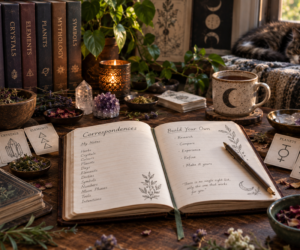
Most spell tutorials are either too vague to be useful or too theatrical to take seriously. This is neither. What follows is the actual structure of a working spell – the skeleton every effective working is built on, regardless of tradition. Step 1 ~ Intention: Know Exactly What You Want A spell without a clear intention is just atmosphere. Your intention is the engine. Everything else, the candles, the moon phase, the words, exists to serve it. Before you gather a single thing, you need to be able to state your goal in one sentence. Specific. Present tense. Positive framing (what you want, not what you want to avoid). Weak: I don’t want to be broke anymore.Strong: Money flows to me steadily and I meet my needs with ease. Write it down. Refine it until it feels true and you can say it without flinching. If you feel resistance when you say it out loud, that’s information. Work with it before you proceed. Questions to sharpen your intention: ~ What does success actually look like? What changes?~ Is this mine to ask for, or am I trying to influence someone else’s will?~ Am I ready for this if it arrives? Step 2 ~ Elements: Assemble What You Need Elements are the physical and symbolic anchors of the spell. They give the working weight in the material world and signal to your subconscious, and to whatever forces you work with, that something real is happening. Choose by correspondence Every element should map to your intention. Nothing is decorative. Element Name Examples Color Match the energy, not the aesthetic Green for abundance, black for banishing, red for strength Herbs & Plants Use what grows near you when possible; they’re more potent Rosemary for clarity, bay for manifestation, lavender for peace Stones Choose one or two – don’t overcrowd Citrine for abundance, obsidian for protection, rose quartz for love Candles Color + shape both matter A figure candle for person-specific work, pillar for ongoing work Symbol or Sigil Write or draw your intention into a single mark A hand-drawn sigil created from your goal statement Water, Fire, Earth, Air At least one classical element grounds the working A bowl of water, incense smoke, a dish of salt, an open flame Keep it lean. Three to five elements, each chosen deliberately, outperform a crowded altar every time. Step 3 ~ Channeling: Get Into the Right State This is the step most people skip and why most spells feel hollow. A spell is an act of directed energy. If your mind is scattered, distracted, or halfway convinced this won’t work, the energy is scattered too. Before you activate anything, you need to be fully present and internally aligned with your intention. Ways to channel and drop in ~ Breathwork ~ 4-7-8 breathing, box breathing, or simply taking ten slow deliberate breaths before you begin~ Meditation ~ even five minutes of stillness clears the noise~ Movement ~ some practitioners pace, sway, or drum to raise energy before working~ Sound ~ a specific song, a singing bowl, chanting your intention as a mantra~ Scent ~ smoke cleansing, incense, or anointing oil pulled through the space first~ Visualization ~ close your eyes and see the outcome as if it’s already happened. Feel it. Hold it until it’s vivid The test: do you feel the shift? There’s usually a physical cue. A deepening in the chest, a sense of stillness, heightened awareness. That’s the signal you’re ready. If you’re doing this in a specific tradition, this is also when you call in your guides, deities, ancestors, or allies. Step… …

Membership Required

You must be a member to access this content.

View Membership Levels

Already a member? Log in here

Before the Cross ~ The Pagan Roots of Easter

Every spring, millions of people hide decorated eggs, give baskets of chocolate, watch children chase a mythical rabbit, and celebrate the resurrection of a god. Half of these people would describe themselves as Christian. Most of them have no idea that the symbols they are using are thousands of years older than Christianity. This is not a conspiracy. It is how religious traditions have always worked. They absorb, adapt, and carry forward the seasonal wisdom of what came before. Understanding the pagan roots of Easter does not diminish the Christian meaning. It deepens the whole picture. Ostara ~ The Spring Equinox The festival that gave Easter most of its symbolic vocabulary is Ostara, the spring equinox celebration observed by Germanic and Norse peoples, falling on or around March 20–23 when day and night are briefly equal and light begins to win. The name comes from the goddess Eostre (also spelled Ostara). A goddess of spring, dawn, and fertility whose name, scholars believe, is linguistically connected to the words east (the direction of the rising sun) and estrogen. She is the goddess of the light that returns. Her season was marked by the lengthening of days, the thawing of the earth, the return of birdsong and blossom. The Venerable Bede, an 8th-century Christian monk and one of our primary sources for early English religious history, wrote that the month of April was called Eosturmonath, Eostre’s month, and that feasts were held in her honour. When Christian missionaries moved through Germanic territories, they followed the policy of Pope Gregory I: do not destroy the festivals. Repurpose them. Give the people the same sacred time with new meaning layered on top. Easter absorbed Ostara’s calendar, her symbols, and her essential theme – the death of winter and the resurrection of light. The Symbols The Egg The egg is one of the oldest sacred symbols on earth. Long before Easter, it represented the entire universe in miniature – potential, creation, the mystery of life emerging from apparent stillness. In ancient Egypt, the primordial egg was said to contain Ra, the sun god, before creation began. In Norse cosmology, the world itself emerged from an egg. The Orphic tradition of ancient Greece described a cosmic egg from which Phanes, the first god, the god of light, hatched at the beginning of time. For Ostara specifically, eggs represented the return of fertility after winter. The earth had been frozen, closed, seemingly dead. Now it cracked open. The egg was spring made physical, the miracle of something living breaking through a sealed surface into light. The tradition of decorating eggs predates Christianity by thousands of years. Decorated ostrich eggshells have been found in African graves dating back 60,000 years. The Ukrainian tradition of pysanky, intricately painted eggs used in spring ritual, traces its roots directly to pre-Christian practice. When Christianity adopted the egg, it reframed the symbolism: the sealed tomb, the stone rolled back, life emerging where death seemed final. The image works because the underlying truth is the same. Something breaks open. Something that appeared finished is not finished. The Hare and the Rabbit This one surprises people most. The Easter Bunny has no biblical origin whatsoever. The rabbit enters through Eostre directly. In Germanic and Celtic spring traditions, the hare was sacred to the goddess of the dawn and spring. Hares are creatures of the threshold. They are most active at dusk and dawn, the in-between times. They are associated with the moon, with fertility, with magic and transformation. The hare was Eostre’s companion animal, or in some tellings, her earthly form. One of the… …

Membership Required

You must be a member to access this content.

View Membership Levels

Already a member? Log in here

The Egyptian Book of the Dead ~ What It Is, What It Does, and How to Work With It

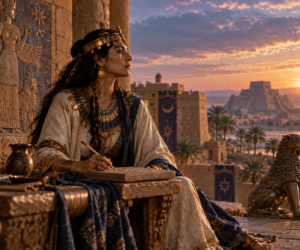
The image depicted here is an AI-generated representation of The Book of The Dead. It is not a book of death. It is a book of becoming. The title was coined by a German Egyptologist in 1842 – Das Todtenbuch – and it stuck, even though it misses the point entirely. The ancient Egyptians called it Reu Nu Peret Em Hru: “The Chapters of Coming Forth by Day.” A manual not for dying, but for moving through darkness and emerging on the other side transformed. That distinction matters. It shapes everything about how you read it. What It Is The Book of the Dead is a collection of spells, prayers, hymns, and ritual instructions used in ancient Egypt from roughly 1550 BCE through the first century BCE. A span of over 1,500 years. It is not one fixed text. It is a living tradition: a pool of around 200 spells from which individual copies were assembled, personalized, and commissioned for specific people. No two copies are identical. Some versions were painted on papyrus scrolls up to 40 metres long. Others were inscribed directly onto tomb walls, coffins, linen wrappings, and amulets placed against the body. The wealthiest Egyptians commissioned elaborate illustrated copies with their name written into every spell. The less wealthy got shorter versions, sometimes with the name left blank to be filled in. The equivalent of a spiritual template you customised yourself. It evolved from two older traditions: ~ The Pyramid Texts (c. 2400–2300 BCE) ~ the oldest religious writings in the world, carved into the walls of royal pyramids, reserved exclusively for pharaohs~ The Coffin Texts (c. 2100–1650 BCE) ~ adapted from the Pyramid Texts and extended to the nobility, written on the interior of wooden coffins By the New Kingdom period (1550 BCE onward), the tradition had democratised further. Any Egyptian who could afford it could commission their own Book of the Dead. The afterlife was no longer the exclusive property of kings. The Spells The word “spell” is a reasonable translation, though heka, the Egyptian concept of magic, carries far more weight than our modern understanding allows. Heka was not superstition. It was the fundamental creative force of the universe, present before the gods themselves. To speak heka was to participate in creation. Words, properly spoken, properly written, were not symbols of power. They were power. The spells of the Book of the Dead operate across several categories: Navigation and Protection Spells to guide the deceased through the Duat, the Egyptian underworld, safely. The Duat was not a simple place. It had gates guarded by serpents, lakes of fire, corridors that shifted, and beings who could destroy a soul entirely. These spells functioned as passwords, maps, and shields. Spell 125 requires the deceased to name each of 42 divine judges and declare their innocence before them. Knowing the name of something gave you power over it. One of the most consistent principles running through all Egyptian magic. Transformation Some of the most striking spells describe the deceased transforming into other forms – a falcon, a heron, a lotus flower, a crocodile, a swallow. Spell 77 allows transformation into a falcon of gold. Spell 83 transforms the soul into a phoenix (bennu bird). These were not metaphors. They described genuine metamorphosis, the soul learning to move through different states of being, gathering different kinds of power and perception. Preservation of the Body and Soul The Egyptians believed the soul had multiple components. The ba (personality and individual essence, often depicted as a human-headed bird) needed to be able to return to the body. The ka (life… …

Membership Required

You must be a member to access this content.

View Membership Levels

Already a member? Log in here

Pink Moon – Full Moon in Libra

April’s full moon is called the Pink Moon. Not because the moon turns pink, but because it rises alongside the first wild blooms of spring. Creeping phlox, also known as moss pink, carpets the ground in soft rose just as this moon swells full. It’s one of the oldest seasonal markers we have. Other names across cultures tell the same story of awakening: Tradition Name Algonquin Breaking Ice Moon Lakota Moon When the Ducks Come Back Cree Frog Moon Dakota Moon When the Geese Lay Eggs Traditional Egg Moon This particular Pink Moon is also the Paschal Moon, the first full moon after the spring equinox, which sets the date of Easter. It falls in Libra, the sign of balance, partnership, and beauty. “Spring is no longer a promise – it is a visible reality.” ✍️ Journal Prompts Libra asks us to look at our relationships ~ with others, and with ourselves. Use the fullness of this moon to reflect and release. 1. What in your life is in full bloom right now ~ and what is it finally time to release? 2. Where have you been out of balance? What would more equilibrium look and feel like? 3. Which relationships are nourishing you, and which ones are asking for more honesty? 4. What new beginning ~ however small ~ has quietly started since the new moon two weeks ago? 5. If this season of your life were a wildflower, what would it be? What conditions does it need to thrive? 6. What beauty have you been walking past without noticing? What deserves more of your attention? How to Mark This Moon ~ Go outside and just look up~ Light a candle~ Write down something you’re releasing, then burn it~ Arrange fresh flowers~ Keep rose quartz nearby~ Open a window and let the night air in… Membership Required You must be a member to access this content.View Membership LevelsAlready a member? Log in here...

Membership Required

You must be a member to access this content.

View Membership Levels

Already a member? Log in here