 Written by
 There are books that inform, and then there are books that transform. A grimoire is the latter – a living, breathing companion to your magical life, as unique and layered as the soul who writes it.
The Book That Holds Your Magic
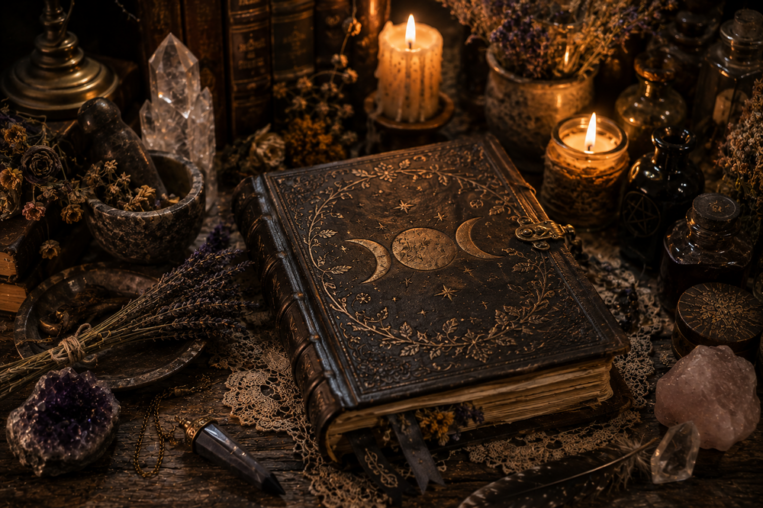
Step into any witchcraft tradition, any occult lineage, any corner of the magical world, and you will find it: a book. Not just any book, but the book. The one written in candlelight, filled with spells and symbols, secrets and ceremonies, the whispered knowledge of those who came before. This is the grimoire.
The word itself carries weight. Derived from the Old French grammaire, meaning grammar, the structured language of learning. The grimoire was once synonymous with any book of occult knowledge. Over centuries, it evolved into something far more intimate. A personal repository of magical practice, a map of one practitioner’s journey through the unseen world.
To hold a grimoire is to hold a record of transformation.
More Than a Spell Book
It would be easy, and entirely wrong, to mistake a grimoire for a simple collection of spells. While spells certainly have their place within its pages, the grimoire is so much more than a magical recipe book.
A true grimoire is a cosmology. A practitioner’s understanding of how the universe works, how energy moves, how the divine speaks. It holds the principles that underpin every working, the correspondences that give each ritual its meaning, the deities and spirits a witch has built relationships with, the seasonal cycles that shape the flow of power through the year.
It is also a journal of experience. A record of what worked and what didn’t. Notes scrawled beside a moon ritual: the energy felt different tonight, heavier, as though the veil had thinned before its time. A pressed herb between its pages. A sigil drawn in a moment of fierce intention. A dream recorded before dawn stole it away.
A grimoire is where theory meets practice, where tradition meets innovation, where the inherited meets the deeply personal.
What a Grimoire Contains
While every grimoire is as individual as its keeper, most contain some combination of the following:
~ Foundational beliefs and philosophy ~ the worldview that shapes all magical work
~ Correspondences ~ the relationships between herbs, colors, planets, days, moon phases, and magical intention
~ Spells and rituals ~ written in full, often with notes on outcomes
~ Deity and spirit work ~ records of relationships with the divine, invocations, prayers
~ Divination records ~ tarot readings, rune casts, scrying sessions, dream interpretations
~ Herbal and natural lore ~ properties of plants, preparations, seasonal foraging notes
~ Personal reflections ~ insights from practice, spiritual growth, magical experiences
~ Symbols and sigils ~ both traditional and personally crafted
Some practitioners keep a single unified grimoire. Others maintain separate volumes. One for spells, one for herbal knowledge, one for dreams. Some keep digital grimoires alongside physical ones. There is no wrong way.
The Difference Between a Grimoire and a Book of Shadows
These two terms are often used interchangeably, and while they overlap, there is a subtle distinction worth knowing.
A Book of Shadows is a term associated primarily with Wicca, made famous through the Gardnerian tradition. Originally, a coven would keep a single Book of Shadows from which initiates would hand-copy their own. It contained the coven’s rituals, laws, and practices. A shared sacred document.
A grimoire, in the broader historical and modern sense, leans more toward the personal and the encyclopedic. It may include traditional knowledge alongside entirely original work. It is your book. Not inherited from a tradition but built from one.
In contemporary practice, many witches use both terms for the same volume. What matters is not the name on the cover, but the intention behind every page.
Historical Grimoires That Shaped Magical Practice
The grimoire has a rich and storied history. Long before the age of printing, manuscripts containing magical knowledge were copied by hand – painstakingly, secretly, reverently. These ancient texts form the backbone of Western occultism.
The Key of Solomon (Clavicula Salomonis) ~ attributed, mythically, to the biblical King Solomon himself, is among the most famous. Dating to the medieval period, it contains detailed instructions for summoning and commanding spirits, along with the ritual preparations necessary to do so safely.
The Lesser Key of Solomon (Lemegeton) ~ expands on this, cataloguing demons and angels with their seals, powers, and the protocols for working with them. It remains a touchstone of ceremonial magic to this day.
The Book of Abramelin ~ describes an eighteen-month magical operation to contact one’s Holy Guardian Angel. A concept that would profoundly influence Aleister Crowley and the entire modern ceremonial tradition.
The Picatrix ~ originally written in Arabic as Ghāyat al-Ḥakīm (The Goal of the Wise), is a comprehensive astrological magic text that weaves astronomy, philosophy, and ritual into a seamless whole.
These historical grimoires remind us that magical knowledge has always been considered precious enough to preserve, to protect, and to pass on. Sometimes at great personal risk.
The Living Grimoire
What sets a personal grimoire apart from any other book is this: it is never finished.
A grimoire grows as its keeper grows. A spell written in the first year of practice might be crossed out, revised, or expanded ten years later. Deities encountered unexpectedly might require new pages. A healing technique learned from a teacher, a symbol received in meditation, a chant that arrived fully-formed in a dream. All of it belongs in the grimoire.
This is why so many practitioners speak of their grimoire with a kind of tenderness reserved for living things. It witnesses your practice. It holds your questions and your breakthroughs. It knows which spells made you weep and which ones made you laugh with the sheer electricity of magic working exactly as it should.
A grimoire is not merely a book about magic. It is, in some deep and irreducible way, an act of magic in itself.
Beginning Your Own
If you do not yet have a grimoire, know this: the perfect one does not exist in any shop. It exists only in the making.
You might begin with a beautiful leather-bound journal, a simple spiral notebook, a loose-leaf binder that lets you reorganize and expand. You might type your entries into a digital document, or print them out and paste them alongside handwritten notes. You might illustrate it, illuminate it, decorate its margins with ink drawings of herbs and moons.
What matters is that you begin. That you open the first page with intention. That you write the first words – perhaps your name, perhaps the date, perhaps simply: This is my book.
From that moment, you have a grimoire.
And from that moment, it begins to shape you just as surely as you shape it.
“A grimoire is not just a book of spells, but a living document of your magical journey. Let it grow with you, challenge you, and guide you toward your highest magical potential.”