Before there were gods, before there were temples or texts or traditions, before there was any organized religion at all, there was a way of being in the world that understood the world to be alive. Not alive in the way a potted plant is alive – passively, vegetatively, as background scenery to human events. Alive in the way you are alive. Inhabited. Intentional. Speaking. Responsive to being spoken to. Carrying its own form of awareness and its own form of purpose. This way of being is called animism, and it is not a primitive error that sophisticated modern people have left behind. It is the oldest and, many would argue, the most honest metaphysical position available to anyone who pays careful attention to the actual texture of their experience. It is also, whether they use the word or not, the implicit metaphysics of most practitioners of earth-based spirituality. When you speak to the land, you are an animist. When you listen to a tree, you are an animist. When you understand a river as a presence rather than a resource, when you ask the storm’s permission before you work with it, when you sense the specific personality of a stone you picked up at a crossroads – you are working within an animist frame. Understanding what animism actually is, where it comes from, and what it implies about the nature of reality can deepen your practice in ways that no amount of spell technique or ritual refinement can match. Because animism is not a collection of practices. It is a way of understanding what the world is. And that understanding changes everything. What Animism Actually Means The term comes from the Latin anima, soul, breath, life, and was introduced into academic discourse by the anthropologist Edward Tylor in his 1871 work Primitive Culture, where he used it (condescendingly, and with the assumption that it represented an early, undeveloped stage of religious thought that would inevitably be superseded by monotheism and then science) to describe the attribution of spiritual agency to natural phenomena. Tylor was wrong about the hierarchy. He was not entirely wrong about the description. Animism, at its most basic, is the understanding that the world is populated by persons. Not only human persons, but animal persons, plant persons, stone persons, river persons, mountain persons, weather persons, spirit persons. The human is one kind of being among many, each of which has its own form of subjectivity, its own perspective, its own way of knowing and being known, its own proper relationships and its own proper treatment. This is not metaphor. This is not the projected feeling-states of lonely humans onto inert matter. The animist understands the non-human world as genuinely inhabited by genuine presences. The oak tree is not an object to which you are projecting personhood. The oak tree is a person with whom you may, under the right conditions and with the right attention, enter into relationship. Contemporary scholars of religion, particularly Graham Harvey (whose work Animism: Respecting the Living World is essential reading on this subject) have rescued animism from Tylor’s evolutionary condescension and described it more accurately. Not as a belief about souls being inserted into things, but as a relational way of being in the world in which the central question is not what does the world consist of? But how should I relate to those I share the world with? This shift, from ontology to ethics, from description to relationship, is the heart of what animism offers that most Western metaphysical frameworks do not. The World That Responds The single most… …
She rides a beast with seven heads across a crimson sea. She holds a golden cup – and the cup is full. She is drunk on the blood of saints and the wine of fornication, robed in purple and scarlet, adorned with gold and precious stones, and on her forehead is written a name: Mystery. Babylon the Great. The Mother of Harlots and Abominations of the Earth. The Book of Revelation meant her as a horror. A warning. The ultimate symbol of spiritual corruption, worldly excess, and the empire that devoured the faithful. It did not work out quite as intended. Because the magicians got hold of her. The visionaries. The rebels and the heretics and the poets who understood that the things the church called most abominable were often the things it feared most . And that’s what power fears, power is telling you something important about it. Aleister Crowley looked at the Whore of Babylon and saw a goddess. Kenneth Grant built an entire cosmology around her. Marjorie Cameron painted her as a red-winged queen striding through fire. Jack Parsons, rocket scientist, occultist, and one of the strangest figures of the twentieth century, called her down into the California desert and believed, at least for a time, that she had arrived. Babalon is not a reclaimed demon. She is something stranger and more interesting than that. A figure born directly from the language of condemnation, who absorbed that condemnation and became something that transcends it entirely. She is the goddess who was built from a slur and became a crown. She is not for everyone. She is barely for anyone. But for those she calls, she calls with unmistakable force. Who is Babalon? Babalon, the spelling used in Thelemic tradition to distinguish her from the Biblical Babylon, is simultaneously one of the oldest and one of the newest figures in the Western magical tradition. She is ancient in her roots and modern in her articulation, and understanding both is essential to understanding her. The Biblical Whore of Babylon is her raw material. In the Book of Revelation, chapters 17 and 18, she appears as the great harlot seated upon many waters, with whom the kings of the earth have committed fornication. She is dressed in luxury, drunk on the blood of martyrs, and her destruction, at the hands of the beast she rides,is presented as a divine victory over corruption. Rome is the obvious political subtext. Spiritual decadence is the theological one. For the early Christian church, Babylon was everything that was wrong with the world. The Gnostic thread runs through her. The idea that the material world and its pleasures are not the enemy of the divine – that matter itself is sacred, that the body is not a cage but a temple – has been suppressed and persecuted throughout the history of Western religion but never extinguished. Babalon belongs to this thread. She is the goddess who does not apologise for being embodied. The Thelemic Babalon is the formal articulation, and it begins with Aleister Crowley and the reception of The Book of the Law in Cairo in April 1904. The text Crowley believed was dictated to him by a praeterhuman intelligence called Aiwass, which founded the religious and magical system he called Thelema. In the Thelemic cosmology, Babalon is not the enemy of divinity but one of its central expressions: the Great Mother, the goddess of understanding, the force of universal love so absolute that it destroys the ego entirely in its embrace. She is paired with Hadit, the infinitely contracted point of pure consciousness,… …
Maybe you were adopted. Maybe your family came through an experience – slavery, diaspora, forced migration, the systematic erasure of a culture – that severed the thread. Maybe you were raised in a religion you have since left, and everything before it feels like another country you have no map for. Maybe your ancestry is so thoroughly mixed that no single tradition claims you, and you do not fully claim any of them. Maybe you simply grew up in a family that had no spiritual tradition at all. No rituals, no stories, no sense that the world was inhabited by anything more than the practical. You come to the craft and you encounter a lot of talk about ancestral lineage, hereditary traditions, the wisdom of your forebears. You encounter traditions rooted in specific places and specific bloodlines. You encounter the question, sometimes asked with genuine curiosity, sometimes with the particular sharpness of gatekeeping, where does your practice come from? And you do not have an easy answer. The Myth of the Unbroken Line Let’s begin with something important. The vast majority of practitioners do not have an unbroken hereditary tradition. The hereditary witch who traces their lineage back through centuries of uninterrupted practice is, in most cases, a romanticised self-image rather than a historical fact. As scholars of witchcraft history have documented extensively, the witch trials of the early modern period, the suppression of folk practices by both Protestant and Catholic Christianity, and the disruptions of industrialisation, urbanisation, and two world wars broke most folk traditions in Europe to the point of reconstruction rather than continuity. What most European-heritage practitioners work with is a twentieth and twenty-first century reconstruction of older elements. Genuinely rooted in historical material, but assembled by people who were also, in various ways, starting from scratch. The idea that a legitimate spiritual practice requires a specific hereditary lineage is a recent and partly fictional gatekeeping construct. It was not always so. The cunning folk of historical England did not require you to prove your ancestry before they taught you a charm. The wise women of rural Ireland did not ask for credentials. The village practitioners of every pre-industrial European culture served whoever needed serving, and the knowledge passed to whoever was ready to receive it. The lineage that matters most in spiritual practice is not the biological one. It is the lineage of genuine transmission. Of real knowledge passed from someone who carried it to someone willing to carry it forward. That lineage is available to anyone who approaches it with seriousness, humility, and genuine intent. You are not starting from nothing. You are starting from exactly where you are. What You Actually Have When you feel that you have no tradition to draw from, it is worth taking stock of what you actually do have. Because it is usually more than you think. You have a body. And that body comes from somewhere, even if you do not know where. It has survived things. Not just in this life but across the generations that produced it. It carries instincts and sensitivities and an orientation toward the world that is not random. The practice of paying attention to what your body knows – what environments it seeks, what presences it recognizes, what makes it settle and what makes it uneasy, is itself a form of ancestral archaeology. You have a place. The land you actually live on has its own spiritual ecology, its own spirits of place, its own seasonal patterns, its own way of being inhabited by the sacred. This is true of every piece… …
A respectful note before we begin: Oyá is not a figure from dead mythology. She is an Orisha, a living, active divine presence in the Yoruba religion and its diaspora traditions of Candomblé, Santería, Trinidad Orisha, Umbanda, and Vodou. Traditions that have millions of active devotees worldwide. She has priests and priestesses, sacred initiations, and communities of practitioners who have honored her continuously for centuries. This post approaches her with the respect that living tradition deserves. If you feel genuinely called to Oyá, seek out initiated practitioners and teachers within these traditions. What follows is an introduction. Not a substitute for that deeper engagement. Before the storm breaks, there is a change in the air. Something electric. Something that sweeps through and tells every living thing, bird, tree, blade of grass, that what is coming cannot be stopped and should not be. That is Oyá. She is the wind before the lightning finds the earth. She is the wall of air that precedes the hurricane, the dust devil spinning in a dry field, the cold front that arrives in the night and leaves the world unrecognisable by morning. She is the force that clears the old away so entirely that new things have no choice but to grow. She is the oriṣa of winds, lightning, and storms, and she is the only oriṣa capable of controlling the Eégún. The spirits of the dead. That combination, storm and death, wind and the ancestors, is not coincidental. Both are forces of total transformation. Both sweep away what was and leave behind a changed world. Both move through you whether you are ready or not. In Yorùbá, the name Oyá is believed to derive from the phrase ọ ya, “she tore”, referring to her association with powerful winds. She does not nudge. She does not suggest. She tears. And when she has torn through, the ground is clear, the air is clean, and everything that survives is stronger for having stood in her path. Oyá Is Not a Goddess of Mythology Before going further, this distinction matters deeply. The Yoruba religion emerged among the Yoruba people of what is now Nigeria, Benin, and Togo. The orishas are divine spirits that play a key role in the Yoruba religion of West Africa and several religions of the African diaspora that derive from it, such as Haitian Vodou, Cuban Santería, and Brazilian Candomblé. Oyá is not an ancient deity whose worship has faded into legend. She is actively honoured today by millions of people. She has a priesthood. She has initiates who have dedicated their lives to her service. Through the horrors of the Atlantic Slave Trade, enslaved peoples brought the orisha to the Americas. Her survival is an act of profound cultural resistance. A sacred tradition kept alive through generations of suppression, forced conversion, and colonization. To approach Oyá with genuine respect means acknowledging this history. It means understanding that the Yoruba traditions and their diaspora cousins are living religions, not open-source spiritual material, and that deeper engagement properly involves learning from those within these traditions. Babalawos, initiated priests and priestesses, and the communities that carry this knowledge. With that foundation, let us meet her. Who is Oyá? Oyá lived on Earth as a human from the town of Ira, in present-day Kwara State, Nigeria, where she was a wife of the Alaafin of Oyo, Shango. In Yoruba understanding, the most powerful orishas were once human. Beings of such extraordinary force and virtue that at death they did not simply leave the world but became part of its governing spiritual fabric. Her name is… …
May arrives this year with something remarkable in its hands. On the 1st of May – May Day, Beltane, the ancient cross-quarter festival that marks the midpoint between the spring equinox and the summer solstice – the full moon rises. Not near Beltane. Not a few days after it. On it. The Flower Moon and the fire festival, the peak of the lunar cycle and the peak of the fertility wheel of the year, falling on the same night. This does not happen often. When it does, it means something. Not in the vague way that people say celestial events mean something, but in the specific, practical way that a practitioner who understands what both events carry can work with extraordinary clarity and extraordinary power. There is more. This full moon rises in Scorpio, with the sun sitting directly across the sky in Taurus. The most sensual, rooted, abundant earth sign face to face with the deepest, most transformative water sign. Flowers and depth. Abundance and truth. The sweetness of the world at full bloom pressed up against the force that asks what is underneath all this sweetness. What has been buried, what needs to be released, what the abundance is growing from. When a full moon lands in the fixed water sign of Scorpio, truths surface, secrets unravel, and what has expired must be released so something more honest can begin. On Beltane. When the world is in full flower. There is nothing coincidental about this. There is only the invitation, to bring the full brightness of the season into contact with the full depth of what Scorpio illuminates, and to let the combination do what it will. The Flower Moon ~ Her Many Names The May full moon is called the Flower Moon, and the name is the most obvious and most accurate thing about her. Celtic and Old English names for this full moon include the Mothers’ Moon, the Bright Moon, the Hare Moon, and the Grass Moon. In Europe she has been called the Milk Moon, a name that dates to medieval times when May was the month cows were moved to summer pastures, their milk rich and plentiful for feeding newborn calves. The Cree knew her as the Budding Moon and the Leaf Budding Moon, celebrating the awakening of local flora. The Dakota and Lakota called her the Planting Moon, marking the time when seeds should be started for the season ahead. The Abenaki called her the Field Maker Moon. The Kalapuya of the Pacific Northwest knew her as Camas Blooming Time, for the blue camas flowers that cover meadows throughout Oregon, eastern Washington, and northern Idaho. Everywhere: flowering, blooming, emerging, making. The world is doing what the world does in May, and the moon carries the fullness of it. But hold all of these names alongside the astrological sign she rises in this year: Scorpio. The sign associated with what is hidden beneath the surface. The sign of the detective and the depth-diver, the sign that refuses to accept the pleasant appearance as the whole story. The Flower Moon in Scorpio is asking: what is blooming that you haven’t looked at yet? What is it that has finally grown enough to be seen – if you are willing to look? Beltane and the Full Moon ~ A Once-in-Many-Years Convergence Beltane falls on May 1st each year, and the full moon reaches its peak on May 1st this year at 1:23 PM EDT. This full moon falls on May Day, which lies about midway between the March equinox and the June solstice. A cross-quarter day…. …
On the night of April 30th, something ancient stirs across northern and central Europe. Walpurgis Night, known in German as Walpurgisnacht, is a celebration that marks the midpoint between the spring equinox and the summer solstice. It is simultaneously the eve of the feast day of Saint Walpurga, an 8th-century English missionary canonized on May 1st, 870 CE, and the survival of something far older: pre-Christian Germanic and Celtic spring rites. The night sits on the edge of two worlds. In old folklore, the veil between the living and the spirit world thins, witches gather on mountaintops for their great sabbath, and chaos briefly reigns before summer takes hold. Think of it as the dark twin of Samhain. Both are liminal fire festivals at opposite ends of the year’s wheel. Walpurgis Night is sometimes called the “Witches’ Sabbath.” According to Germanic legend, witches and spirits convened at Brocken peak in the Harz Mountains, a tradition famously depicted in Goethe’s Faust. How it’s celebrated around the world Germany Bonfires light up villages, effigies of witches are burned to ward off evil, and people dress in costume. Towns in the Harz region draw thousands of revelers each year, particularly around the legendary Brocken peak. Sweden (Valborg) University students gather in city squares for outdoor choir singing, speeches, and champagne. A uniquely joyful, academic celebration of spring’s arrival. One of the most anticipated nights of the Swedish calendar. Finland (Vappu) One of Finland’s biggest holidays. Students don white graduation caps, picnic in parks, drink sparkling wine, and fill the streets with confetti and song. It is as much a civic celebration as a seasonal one. Czech Republic Bonfires are lit and effigies of witches burned to drive away evil spirits. Families gather outdoors to sing and mark the end of winter’s grip in a tradition that has continued for centuries. Pagan & witchcraft traditions Modern pagans and Wiccans celebrate Beltane on the same night . Lighting fires, dancing, leaving offerings, and honoring the earth’s fertility and abundance. The wheel of the year turns here toward its brightest point. The Harz Mountains The legendary epicenter of Walpurgis mythology. Villages like Thale and Schierke host massive festivals where thousands dress as witches and warlocks and dance through the night around the Brocken. The mythology behind the chaos The wild imagery of Walpurgis Night, witches astride broomsticks, demons at crossroads, storms summoned at mountaintops, has roots in a fascinating cultural collision. Early Christian missionaries in Germanic territories encountered deeply embedded spring rites. Unable to eradicate them, the Church overlaid the feast of Saint Walpurga atop April 30th. But the old beliefs persisted underneath, now charged with the transgressive energy of the forbidden. By the medieval period, the “witches’ sabbath” had become a projection of collective fear and fascination. Everything respectable society suppressed, feminine power, bodily freedom, knowledge outside clerical control, was imagined gathering on Brocken Mountain in a frenzy. Goethe captured this perfectly in the Walpurgisnacht scene of Faust, where chaos itself dances. What survives today is something more honest. A night that asks us to look at the wild, liminal, untameable parts of existence. And instead of fearing them, dance with them. — April 30 · Where winter ends and something brighter begins 🪄 Rituals for the night Whether you approach this night as folklore, spirituality, or simply seasonal ritual, there are meaningful ways to mark the threshold. These are drawn from both historical practice and modern pagan tradition. 1. Light a candle or bonfire Fire is the heart of Walpurgis. Even a single candle honors the tradition. Let it burn as you reflect on… …
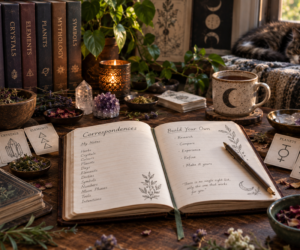
Every sabbat deserves a dedicated section in your grimoire. Not just a note of the date, but the full record of what the festival carries. Its mythology, its correspondences, its ritual structure, its specific magical applications, and the personal record of how you celebrated it and what it produced. This is the Beltane entry for yours. Use it as a reference, a starting point, and a template. Write your personal practice into the margins, the pages after, the sections you add over years of working with this festival. The grimoire that grows with your practice is always more valuable than the one that is perfectly complete before you begin. The Basics Date: May 1st (Northern Hemisphere) / November 1st (Southern Hemisphere) Position on the Wheel: Cross-quarter day, midpoint between the spring equinox and the summer solstice. The third sabbat of the wheel as counted from Samhain, or the fourth if counted from Yule Also known as: May Day, Cétsamain (Old Irish), Bealltainn (Scottish Gaelic), Calan Mai (Welsh), Walpurgisnacht (Germanic tradition, April 30th) Season: The opening of the summer half of the year. In the old Celtic two-season calendar, Beltane marked the beginning of samhradh (summer), as Samhain marked the beginning of geimhreadh (winter) Opposite on the wheel: Samhain (October 31st / November 1st) Preceded by: Ostara (spring equinox, March 20th/21st) Followed by: Litha (summer solstice, June 20th/21st) What Beltane Celebrates ~ The opening of the summer half of the year~ The peak of spring’s fertile energy before it transforms into summer~ The full flowering of what was seeded at Imbolc and began growing at Ostara~ The sacred union of earth and sun, of the Goddess and the God at full power~ The thinning of the veil between this world and the fairy realm~ The joy, desire, and abundance of the living world at its most exuberant~ Purification through fire before entering the season’s full abundance~ The creative fire at its annual peak Mythology and Historical Context The Irish tradition: Beltane was one of the four major festivals of the Gaelic calendar. The Sanas Cormaic (Cormac’s Glossary, 9th century) connects it to the god Bel or Belenus. Large communal fires were lit on hilltops, the tine Bhealltainn, the Beltane fires, and cattle were driven between two fires before being led to summer pastures, the fire purifying them of winter’s ills. The Beltane and the fairies: Beltane and Samhain are the two great liminal festivals in the Celtic calendar. The times when the sídhe (fairy mounds) were open and the Good People moved freely between worlds. The fairy dangers of Beltane were traditionally guarded against with rowan branches, offerings of milk, and the making of protective charms. The May Queen and the Green Man: In folk tradition across the British Isles and Europe, the May festival involved the selection of a May Queen, a young woman who embodied the goddess of spring, and the Green Man, the masculine face of the life force, his face wreathed in leaves. Their symbolic union was the fertility rite at the heart of the celebration. The Maypole: The great decorated pole danced with ribbons, its roots in the earth, its crown in the air, the ribbons weaving a visible pattern of the life force as the dancers moved around it. The Maypole appears across European May Day traditions and is understood in many contemporary practices as a symbol of the sacred masculine principle rooted in the sacred feminine earth. May Day dew: The dew of May Morning was traditionally considered magical. Particularly for beauty, health, and blessing. Women washed their faces in it, gathered it from… …
The fire festival at the height of spring. When the world tips toward abundance and the veil goes thin again. May Day has a problem with its reputation. Most people associate it with either bank holidays or Soviet parades. But underneath both of those is something far older and considerably more interesting . A fire festival that the Celts considered one of the four hinge points of the year, a night when the world cracked open between winter’s end and summer’s beginning, and everything felt possible and a little dangerous all at once. That festival is Beltane. And it deserves a proper introduction. What is Beltane? Beltane, from the Gaelic Bealtainn, possibly meaning “bright fire”, falls on May 1st, and it is one of the four great Celtic seasonal festivals alongside Samhain (October 31), Imbolc (February 1), and Lughnasadh (August 1). Together they mark the turning points of the agricultural year. If Samhain is the festival of endings and the dark half of the year, Beltane is its mirror: the festival of beginnings, abundance, and the light half. In the old Celtic calendar, the year was divided not into four seasons but into two halves: the dark half (winter, beginning at Samhain) and the light half (summer, beginning at Beltane). May 1st was not the middle of spring – it was summer’s first day. The warmth had won. Historically, Beltane was primarily observed in Ireland, Scotland, and the Isle of Man, with echoes across Wales and other Celtic regions. The earliest written references appear in Irish literature from the 10th century, but the practices described are clearly far older. Remnants of an oral tradition that predates Christianity by centuries. At its heart, Beltane is about three things: fire, fertility, and the threshold. The world is at its most alive. The veil between the human world and the otherworld, the realm of the Aos Sí, the fairy folk, is considered permeable again, just as it is at Samhain. The difference is that at Samhain the spirits are the dead. At Beltane they are something else entirely – older forces, not threatening exactly, but wild. The history and mythology The most famous mythological dimension of Beltane is the Sacred Marriage. The union of the May Queen and the Green Man (or the Goddess and the God in later pagan tradition). This isn’t just symbolic decoration. In the older layers of the mythology, the land’s fertility was directly linked to the fertility of its people and their ruler. The king’s union with the goddess of sovereignty was the act that caused crops to grow and cattle to prosper. It’s an idea so embedded in pre-Christian cosmology that it survived, heavily sanitized, into the maypole traditions that persist to this day. The Aos Sí, the spirits of the Irish otherworld, were believed to be particularly active at Beltane, crossing into the human world with unusual ease. People took precautions. They decorated their homes and doorways with yellow flowers (particularly rowan and gorse), which were thought to discourage unwanted supernatural attention. They drove their cattle between two bonfires before moving them to summer pasture, purifying the herd and protecting it for the season ahead. The need-fire, a fire ritually kindled from scratch, often by friction rather than a carried flame, was the centerpiece of the celebration. All household fires in a community might be extinguished and relit from the Beltane bonfire, symbolically renewing the warmth and protection of the home for the coming season. In Irish mythology, Beltane has a particular resonance. The Lebor Gabála Érenn, the medieval “Book of Invasions”, records that the mythological… …
There comes a point on almost every serious spiritual path where everything goes dark. Not dramatically. Not with thunder and revelation. Usually it arrives quietly, almost apologetically. You reach for the practice that has always worked and find nothing there. The altar feels like furniture. The words you have spoken a hundred times land in the air and dissolve into silence. The connection you had, the one you built with such care, seems to have slipped through your fingers while you were looking the other way. You light the candle. You say the words. And nothing happens. If you are on this path long enough, you will experience this. Most practitioners do. And most of them, when they are in the middle of it, believe it means the same thing: that they have lost their way. That they weren’t real enough. That something has been taken from them, or that they never truly had it to begin with. None of these things are true. What is happening is something older and more necessary than any of that. It has a name in the mystical traditions: the dark night of the soul. And understanding it, really understanding it, not as failure but as a phase of the path, may be one of the most important things you ever do for your practice. What the Dark Night Actually Is The term comes from St John of the Cross, the sixteenth-century Spanish mystic who wrote about the soul’s passage through spiritual desolation on its way toward deeper union with the divine. But the experience itself is not confined to Christian mysticism. Every tradition that has taken the inner life seriously has a name for the period when spiritual comfort withdraws and the practitioner is left in the dark. Sufi poets described it as the Beloved hiding his face. Buddhist traditions speak of the dissolution of the meditator’s reference points, the moment when the signposts that have guided practice stop making sense. Indigenous traditions often speak of a kind of spiritual death that precedes initiation into deeper knowing. The shamanic journey into the underworld, the descent, the dismemberment, the slow return, maps this territory exactly. What these traditions share is the understanding that the withdrawal of spiritual comfort is not punishment and not abandonment. It is the path asking something different of you than it has been asking before. The consolations of early practice, the vivid synchronicities, the felt presence of the gods, the clear signs and confirmed connections, the emotional intensity of ritual, are in many ways training wheels. They give the developing practitioner feedback, confirmation, the felt sense that the path is real and the practice is working. They are genuine. They matter. But they are not the destination. At some point the path withdraws those confirmations. Not because you did something wrong. Because it is asking you to develop something that cannot develop while you are receiving constant reassurance. The capacity to continue in the dark, to act from commitment rather than feeling, to know what you know without requiring it to be lit up and confirmed every time. This is how trust is built. Not by being given endless evidence, but by continuing without it. The Signs That You Are In It The dark night of the witch has a specific texture that is worth knowing, because it is easy to confuse it with other things. ~ The practice feels mechanical. You go through the motions, but the life has drained out of them. The words are the same words. The gestures are the same gestures. But the quality of… …
The mountains of Glencoe are not quiet. Even on a still day, when the sky sits low and grey above the valley floor and the River Coe moves in silence, there is something restless in the air. Locals will tell you it is the land remembering. And the land, in Glencoe, has much to remember. Two stories haunt this valley above all others. One a historical atrocity etched into the Scottish national conscience, the other a legend woven from folklore, fire, and the untameable spirit of a young woman who chose the mountains over the world of men. Together, they paint a portrait of a place where history and myth are almost impossible to separate. The Massacre of Glencoe ~ February 13, 1692 The Background: Oaths and Politics To understand the massacre, you must first understand the fractured politics of late seventeenth-century Scotland. When William III, William of Orange, took the British throne in 1689 following the Glorious Revolution, the Highland clans were required to swear an oath of allegiance to him by January 1, 1692. Failure to do so would bring consequences. Most clan chiefs complied. But Alasdair MacIain, the elderly chief of the MacDonalds of Glencoe, delayed. He had first gone to Fort William to swear his oath, only to be told he must travel to Inveraray instead. Beset by winter weather and administrative obstruction, he arrived several days past the deadline. The oath was taken, the paperwork submitted, but the late arrival had handed his enemies exactly the lever they needed. Those enemies were not hard to find. At the centre of the web sat John Dalrymple, the Master of Stair, Secretary of State for Scotland. Dalrymple despised the Highland clans, viewing them as a barbaric obstacle to civilised governance. MacIain’s late oath was precisely the excuse he needed to make an example of the MacDonalds of Glencoe, a small clan, isolated, with few powerful allies. The paperwork recording the oath was quietly suppressed. The Betrayal On the first of February 1692, a company of soldiers, approximately 120 men of the Earl of Argyll’s Regiment, arrived in Glencoe under the command of Captain Robert Campbell of Glenlyon. The MacDonalds, following the ancient Highland tradition of hospitality, took them in. For twelve days, soldiers and clanspeople lived side by side. They shared food, warmth, and drink. Campbell himself was a regular guest at MacIain’s table. The orders came down on the night of February 12th. They were chillingly explicit. Every MacDonald under the age of seventy was to be killed. The operation was to begin at five o’clock in the morning, before daylight could allow anyone to escape into the hills. What followed, in the pre-dawn darkness of February 13th, was not a battle. It was a murder. MacIain himself was shot in the back while dressing. His wife was stripped of her rings, the gold pulled from her fingers with soldiers’ teeth. Around thirty-eight men, women, and children were killed in the valley. Many more fled into a savage winter blizzard, and an unknown number perished in the mountains from cold and exposure. The Aftermath and the Phrase That Endures The massacre did not destroy the MacDonalds of Glencoe entirely, many escaped into the hills, but its impact on the Scottish psyche was seismic. What outraged the nation was not merely the killing, but the method. Murder under trust. The soldiers had eaten their victims’ food, slept beneath their roofs, accepted their hospitality, and then turned on them in the dark. The phrase “No MacGregor or Campbell shall sleep under my roof, share my table, or drink… …