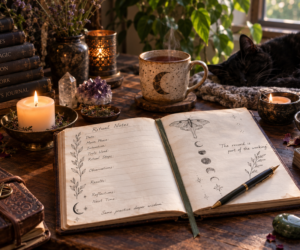

Your Book of Shadows is a deeply personal grimoire, but having a clear structure helps you find what you need when you need it. Here are some essential categories to consider: Core Sections Dedications & Beliefs Start with your personal dedication, spiritual philosophy, and the ethical guidelines you follow in your practice. This grounds your entire book in intention. Sabbats & Esbats* Document the Wheel of the Year sabbats and moon phases, including rituals, correspondences, recipes, and personal observations for each celebration. Spellwork Your collection of spells organized by purpose (protection, love, prosperity, healing, banishing). Include ingredients, timing, results, and notes on what worked. Divination Tarot spreads, rune meanings, pendulum techniques, scrying methods, and records of your readings and their accuracy. Correspondences Quick reference charts for herbs, crystals, colors, planetary hours, elemental associations, and deity attributes. Rituals & Ceremonies Circle casting methods, invocations, quarter calls, and ceremonial formats for different occasions. Deities & Spirits Information about gods, goddesses, ancestors, and spirit guides you work with, including offerings and experiences. Herbalism & Kitchen Witchery Magical recipes, herbal remedies, tea blends, and the properties of plants you use. Personal Reflections Dream journals, meditation experiences, magical successes and failures, and lessons learned. Remember Your Book of Shadows evolves with you. Start with what resonates, and let it grow organically. There’s no wrong way to organize your practice – only what serves you best. Blessed be! ✨ Book of Shadows Blessing By moon and star, by earth and flame, I consecrate this book by name. A sacred space for wisdom’s art, Where magic flows from mind and heart. Guard these pages, keep them true, Protect the old and welcome new. May ink and intention here combine, And every word hold power divine. As I will it, so shall it be, This book is blessed, so mote it be. **Esbats are celebrations or rituals held in honor of the full moon (and sometimes the new moon) in Wiccan and pagan practices. While Sabbats mark the eight seasonal festivals of the Wheel of the Year (like Samhain, Beltane, and the solstices), Esbats are the monthly lunar celebrations. Since there are typically 13 full moons in a year, practitioners observe about 13 Esbats annually. What happens during an Esbat ~ Moon magic and spellwork (the full moon is considered a powerful time for manifestation)~ Divination and scrying~ Charging crystals, tools, and moon water~ Honoring lunar deities (like Diana, Selene, or Hecate)~ Personal reflection and spiritual work~ Coven gatherings for ritual Full Moon vs. New Moon Esbats ~ Full Moon – Peak magical power, manifestation, gratitude, celebration ~ New Moon – New beginnings, setting intentions, shadow work, rest The word “Esbat” likely comes from Old French s’esbattre, meaning “to frolic or enjoy oneself,” reflecting the celebratory nature of these lunar gatherings. Many solitary practitioners and covens consider Esbats just as important as Sabbats, using them as regular touchpoints for their magical practice throughout the year…. Membership Required You must be a member to access this content.View Membership LevelsAlready a member? Log in here...
There’s a particular magic in the liminal space between one year and the next. The wheel turns, the darkness begins its slow retreat after the solstice, and we stand at a threshold looking both backward and forward. This isn’t just a calendar convention. It’s sacred time, the pause between breaths, the moment when we can see clearly what was and what might be. For witches, this transition holds power that goes deeper than resolutions and goal-setting. This is when we take stock of our practice, honor what we’ve learned, release what no longer serves, and set intentions that align with the deeper currents of our magic and lives. The Practice of Looking Back Most people rush through the end of the year without actually examining it. They’re already focused on the next thing, the fresh start, the new goals. They miss the wisdom that only comes from genuine reflection. Witches know better. We understand that you can’t move forward powerfully without first understanding where you’ve been. The past year holds lessons, patterns, growth, and sometimes warnings. Ignoring them doesn’t make them disappear, it just means you’ll repeat them. So before you think about the year ahead, look at the year behind. Really look at it. What did this year teach you? Not the lessons you expected to learn, but the ones that actually came. Sometimes the universe has a different curriculum than the one we signed up for. The job that didn’t work out taught you what you actually need in work. The relationship that ended showed you patterns you’d been repeating for years. The challenge you didn’t want revealed strength you didn’t know you had. Which of your practices deepened this year? Maybe you finally made meditation consistent, or your tarot readings became more accurate, or your connection with a particular deity grew richer. Notice what flourished, because that’s where your authentic practice is emerging. Which practices fell away? Not from laziness or failure, but because they weren’t actually serving you. Maybe you realized you were doing certain rituals out of obligation rather than genuine connection. Maybe a tradition you thought you needed to follow turned out to be someone else’s path, not yours. Let go without guilt. Your practice should evolve as you do. What patterns showed up repeatedly? The same kinds of conflicts with different people. The same opportunities appearing in various forms. The same obstacles manifesting in new situations. Patterns are how the universe gets persistent about teaching you something. If you don’t learn the lesson, you get the pattern again. Where did your magic work most powerfully? Which intentions manifested? Which rituals produced tangible results? Which moments of intuition proved accurate? Your effective magic reveals where your practice is aligned with your authentic will. Do more of that. Where did your magic feel blocked or ineffective? Were there intentions that never manifested despite clear work? Divination that felt murky? Rituals that felt hollow? These aren’t failures – they’re information. Sometimes we’re trying to magic something we’re not actually ready for. Sometimes we’re forcing what needs to happen naturally. Sometimes our will and our deeper knowing are misaligned. The Wisdom of What Didn’t Work We tend to focus on successes and try to replicate them. But there’s often more wisdom in what didn’t work. That spell that didn’t manifest might have been protecting you from something you couldn’t see. That door that wouldn’t open might have been redirecting you toward the right door. That intention that never gained traction might have been your ego wanting something your spirit knew wasn’t right. Or maybe your magic didn’t… …
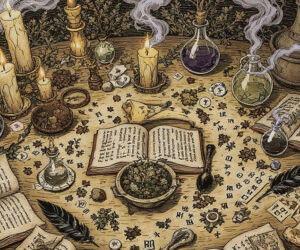
A comprehensive directory of miniature rituals, protection gestures, and subtle enchantments for the modern practitioner The Lost Art of Small Magic Before grimoires were bound in leather and spells required elaborate preparation, magic lived in the body. In gestures passed down through generations, in the instinctive movements we make when something feels wrong, in the small rituals that protect us from forces we sense but cannot name. These are pocket spells. Micro-enchantments. The magic you can perform standing in line at the grocery store, sitting in traffic, or lying awake at three in the morning when the air feels too thick and your thoughts won’t settle. This grimoire collects them. The whispered protections, the boundary markings, the release rituals that require nothing but your body and your intention. Part I: Protection & Psychic Defense The Knock of Refusal When to use: A name suddenly invades your thoughts and your stomach drops. That sinking recognition that someone is thinking about you, reaching toward you energetically, or trying to influence you from a distance. The gesture: Touch the nearest solid surface twice with your knuckles. Wood is best. Stone is stronger. Metal works in a pinch. The mechanism: This is an interruption spell. The knock disrupts the psychic thread attempting to connect to you. The second knock closes the door. You’re telling your ancestors, your guides, the universe itself: not now, not this, not today. Some practitioners say the double knock creates a mirror – whatever energy was being sent bounces back to its source. Others say it simply severs the connection. Either way, the intrusion stops. Variation: If no solid surface is available, knock twice against your own chest bone, just below the throat. Your body becomes the door. The Dust Release When to use: Your luck turns sour without explanation. Small things start going wrong in succession. You feel weighed down by invisible frustration. Something is clinging to you. The gesture: Open your hand flat, palm up, fingers spread. Blow across your palm as if you’re clearing dust from an old book or dandelion seeds from their stem. Watch the invisible particles scatter into nothing. The mechanism: This is a release spell, a banishment of accumulated bad energy. The breath carries intention. It’s the same force used in birthday wishes and blown kisses, but weaponized for cleansing. When you blow, you’re not just expelling air; you’re using the most ancient magic humans possess – the breath that separates the living from the dead. What you’re releasing could be the evil eye, ambient negativity you picked up from a crowded place, or simply the residue of a bad day that’s started to calcify around you. Enhancement: Visualize what you’re releasing as gray dust or dark smoke. Name it if you can: “I release frustration,” “I release judgment,” “I release whatever is not mine to carry.” The Boundary Line When to use: Your mood drops suddenly and without cause. One moment you’re fine; the next, you’re dragged into unexplained sadness, anxiety, or anger. Something has crossed into your space. The gesture: Drag your foot across the floor once, a single, deliberate line. Left to right feels most natural to most practitioners, but follow your instinct. Press down firmly enough that you feel the resistance of the ground. The mechanism: You are drawing a line the universe is not allowed to cross. This is boundary magic, protection magic, the same principle behind salt circles and threshold charms. The difference is you’re using your own body as the chalk. Your foot becomes the compass, your will becomes the barrier. The line says – this… …
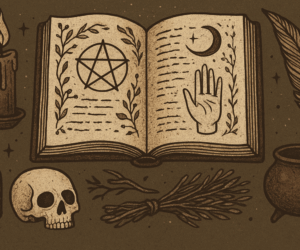
There’s something magical about opening a blank grimoire for the first time. All that potential, all those empty pages waiting to be filled with your wisdom and experience. But then reality hits: you’re staring at that first page, pen in hand, and your mind goes completely blank. What should you actually write in this thing? If you’ve ever felt stuck or overwhelmed about what to include in your grimoire, you’re not alone. While the traditional approach is to fill it with correspondence tables and spell recipes (and those are certainly valuable), your grimoire can be so much more than a magical cookbook. It’s a living document of your personal practice, a mirror of your spiritual growth, and a legacy you’re creating one page at a time. Let’s explore dozens of creative ideas to help you fill those pages with meaningful, practical, and deeply personal magical content. Getting Started: The Foundational Pages These are the entries that give your grimoire structure and make it uniquely yours: Your Magical Name and Origin Story If you’ve chosen a craft name, document why you chose it, what it means to you, and the story of how you discovered it. If you haven’t chosen one yet, write about the process of exploring options. Your Magical Ethics and Philosophy What are your personal beliefs about magic? Where do you draw ethical lines? How do you approach concepts like the Three-Fold Law, karma, or hexing? This becomes your moral compass. Your Dedication or Self-Initiation Whether you’ve performed a formal dedication ritual or simply committed to the path, document that moment. Include the date, what you said or promised, and how it felt. Your Patron Deities If you work with specific gods, goddesses, or spirits, create profile pages for them. Include their mythology, symbols, offerings they prefer, and your personal experiences with them. A “Why I Practice” Page Write about what drew you to magic and witchcraft. What are you seeking? What void are you filling? This reminds you of your purpose when things get difficult. Personal Experience Documentation Your grimoire should capture your actual magical life, not just theory: Spell Results Journal Create a template for documenting every spell you cast: date, moon phase, intent, method, materials used, and results. Track what works and what doesn’t. Dreams and Their Meanings Keep a section for significant dreams, especially those that feel prophetic or magical. Note symbols that repeat and what they might mean for you. Synchronicities and Signs Document meaningful coincidences, patterns you notice, and signs from the universe. Over time, you’ll see your own personal symbol language emerge. Deity Encounters and Messages Write about any profound experiences with divine energy, whether in meditation, ritual, or daily life. What did they teach you? Failed Magic and Lessons Learned This is crucial: document what didn’t work and why you think it failed. These “failures” are often your best teachers. Magical Milestones First successful spell, first time you felt real energy, first divination that came true. Celebrate and document these achievements. Your Energy Signature Describe what your personal energy feels like. How do you know when you’re properly grounded? What does raised energy feel like in your body? Correspondence Collections Yes, these are traditional, but make them personal: Personal Color Associations Standard color correspondences are a starting point, but what do colors mean to you? Create your own expanded color dictionary. Your Local Plants and Their Uses Instead of just copying herb lists from books, document the plants that grow in your area and your experiences working with them. Crystal Connections Beyond standard correspondences, note which crystals you feel drawn… …
The practice of maintaining written records of magical knowledge spans millennia, yet confusion often arises between two primary forms of magical documentation: grimoires and Books of Shadows. While both serve as repositories of esoteric wisdom, they differ significantly in purpose, structure, and application. Understanding these distinctions is essential for any practitioner seeking to create meaningful magical records. Historical Context and Origins Grimoires derive their name from the Old French “grammaire,” meaning grammar or learning. These texts emerged during medieval times as systematic compilations of magical knowledge, often attributed to legendary figures like King Solomon or written by learned scholars. Traditional grimoires such as the Key of Solomon, Goetia, and Book of Abramelin established the format of comprehensive magical manuals containing detailed instructions for rituals, invocations, and ceremonial practices. Books of Shadows, conversely, are a relatively modern concept popularized by Gerald Gardner in the mid-20th century within Wiccan traditions. The term itself suggests something hidden or secret, reflecting the personal and often private nature of these records. Unlike grimoires, which were often copied and distributed (albeit secretly), Books of Shadows were traditionally hand-copied by initiates and remained within specific covens or lineages. Fundamental Differences Purpose and Function Grimoires serve as comprehensive reference manuals. They function like magical textbooks, providing standardized procedures, formulas, and theoretical frameworks that practitioners can follow regardless of their personal magical style. A grimoire aims to preserve and transmit established magical traditions with consistency and precision. Books of Shadows operate as personal magical journals. They document individual spiritual journeys, recording personal experiences, modified rituals, intuitive insights, and the evolution of one’s magical practice. These books grow organically with the practitioner, becoming unique reflections of their spiritual development. Content Structure Grimoires typically contain:~ Systematic magical theories and correspondences~ Standardized ritual procedures and invocations~ Detailed instructions for creating magical tools~ Comprehensive lists of spirits, deities, or entities~ Formulaic approaches to spell construction~ Traditional magical calendars and timing systems Books of Shadows commonly include:~ Personal ritual experiences and outcomes~ Modified or original spells and ceremonies~ Reflections on magical workings and their effectiveness~ Personal correspondences and associations~ Dreams, visions, and spiritual insights~ Seasonal celebrations and their personal significance Authority and Transmission Grimoires derive authority from tradition, scholarly compilation, or claimed divine revelation. They present themselves as authoritative sources that transcend individual interpretation. Traditional grimoires were often attributed to ancient masters or received through spiritual revelation, lending them an air of absolute authority. Books of Shadows derive authority from personal experience and genuine spiritual connection. Their value lies not in external validation but in their authentic documentation of individual magical development. The authority comes from the practitioner’s lived experience rather than historical precedent. Why Maintain These Records? Benefits of Grimoires Creating or maintaining a grimoire serves several essential functions: Systematic Learning: Grimoires provide structured approaches to magical education, ensuring practitioners develop comprehensive understanding rather than fragmented knowledge. Preservation of Tradition: They maintain the continuity of magical practices across generations, preventing the loss of valuable techniques and insights. Reference and Consistency: Established procedures in grimoires allow practitioners to repeat successful workings and troubleshoot problems by comparing their methods to proven approaches. Foundation Building: For beginners, grimoires offer solid starting points, providing tested frameworks upon which to build personal practice. Benefits of Books of Shadows Personal Books of Shadows serve equally important but different purposes: Personal Growth Tracking: They document spiritual evolution, allowing practitioners to recognize patterns, growth, and areas needing attention. Customization and Innovation: Books of Shadows encourage the development of personalized magical practices that resonate with individual spiritual needs and cultural backgrounds. Experiential Learning: Recording personal experiences helps practitioners understand what works specifically for… …