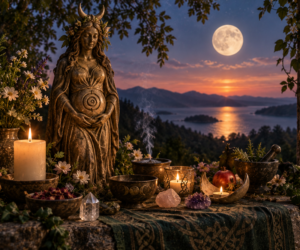
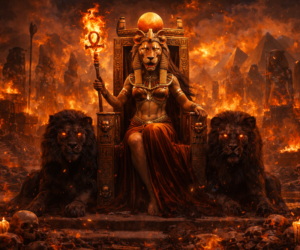
Hel ~ Daughter of Chaos ~ Queen of the Honored Dead

Half her face is living flesh. Warm, pink, the face of a woman in the fullness of her years. The other half is the blue-black of a corpse left in winter ground, or the pale grey of bone from which all warmth has long departed. She does not hide either side. She does not turn her living face toward you and keep the dead one in shadow. She stands before you whole, and she watches you with both sets of eyes, and she waits to see whether you will flinch. Most people flinch. Hel is the goddess of the dead in Norse tradition. Not the dramatic dead, not the glorious battle-slain who ride to Valhöll with their wounds still bleeding and their glory still fresh. Those belong to Odin. Hel receives everyone else. The ones who died in bed, shivering with fever. The ones who drowned at sea. The ones who grew old and slow and let go quietly in the dark. The ones who died by their own hand. The ones the world forgot before they were even cold. She receives them all. Without judgement. Without ceremony. Without the performance of heroism as a prerequisite for entry. Her hall is called Éljúðnir, the Damp One, the one sprayed with sleet. Her dish is Hunger. Her knife is Famine. Her threshold is Fallanda Forad, Stumbling Block. Her bed is Kor – Sick Bed. Every object in her home bears a name that speaks to what it is to be mortal and exhausted and done. And yet, in that terrible hall, there is something else. Something that the sources do not say directly but that every practitioner who has worked with her knows in their bones – she is kind. Hel is one of the kindest gods in the Norse pantheon. Not soft. Not comfortable. But genuinely, quietly, implacably kind. In the way that only someone who has received ten thousand years of suffering without turning away could be. She is waiting for all of us. She always has been. Who is Hel? Hel is the daughter of Loki. The great shape-shifter, the trickster, the agent of chaos who is simultaneously the gods’ most dangerous enemy and their most indispensable companion. And Angrboða, the giantess of the Iron Wood, whose name means She Who Offers Sorrow or the One Who Bodes Anguish. From her father she inherits liminality, the capacity to exist between categories that should exclude each other. From her mother she inherits the iron and the sorrow and the deep, patient endurance of the giant-kind who were old before the gods were young. She is one of three extraordinary children born to this union. Her brothers are Fenrir, the wolf whose jaws will swallow Odin at Ragnarök, and Jörmungandr, the World Serpent who encircles Midgard in the deep ocean and will rise at the end of days to drown the world. The gods of Ásgarðr, disturbed by prophecy, acted against all three. Fenrir was bound with the magical ribbon Gleipnir. Jörmungandr was thrown into the sea. And Hel was cast, kastaði is the Old Norse word, meaning thrown, hurled, into the realm of Niflheim, the world of mist and cold and primordial darkness, and given dominion over those who die of illness, age, and all causes other than battle. The Prose Edda of Snorri Sturluson, our most complete source for Norse mythology (written in Iceland in the thirteenth century, and treating the old myths with a mixture of preservation and Christian-era editorialising), describes her thus: half blue-black and half flesh-colored, by which she is easily recognized, and rather downcast… …

Membership Required

You must be a member to access this content.

View Membership Levels

Already a member? Log in here

Isobel Gowdie ~ The Witch of Auldearn ~ Scotland’s Most Extraordinary Confessor

On 13 April 1662, in the village of Auldearn in the Scottish Highlands, a woman walked in from her ordinary life, the milking, the bread-making, the weaving of yarn, and confessed to everything. She confessed to making a pact with the Devil at Auldearn Kirk, where he stood at the reader’s desk with a black book and baptised her in her own blood, giving her the new name Janet. She confessed to flying through the night sky on corn stalks, crying Horse and Hattock in the Devil’s name! She confessed to feasting in the halls of the Queen of Elfhame beneath the Downy Hills. She confessed to transforming herself into a hare, a crow, a cat. Slipping out of her human skin with a rhyme and returning to it with another. She confessed to making elf arrows, those sharp flint points whittled by elf-boys in the fairy world, and shooting them at the people of Auldearn. She confessed to all of it. Freely, in extraordinary detail, with eloquence and precision and a quality of narrative that scholars have been marvelling at and arguing over for more than three and a half centuries. No one knows why. That is the most haunting thing about Isobel Gowdie. Not what she said. Though what she said is extraordinary enough. But that she said it at all, apparently without being tortured into it. That she walked in and began to speak and did not stop for six weeks, filling the record with charms and visions and names and rhymes and the full, vivid, impossible architecture of a spiritual world that the prosecutors who recorded her words were hearing as diabolism and that we, centuries later, hear as something else entirely. She is the most famous witch in Scottish history. She is one of the most remarkable figures in the entire history of European witchcraft. And almost nothing about her – not why she spoke, not what she believed, not what happened to her in the end – is certain. Who Was Isobel Gowdie? The honest answer is: very little is known. The records give us almost nothing of her life before April 1662. Her birth date is unrecorded. Her maiden name is unknown. She is recorded as Isobel Gowdie rather than Isobel Gilbert because married women in Scotland retained their maiden names, but when and where she was born, who her parents were, what her childhood was like – these things have not survived. She was probably somewhere between her late twenties and her fifties at the time of her confession. She was childless. She could not read or write. She was the wife of John Gilbert, a cottar, a farm laborer who worked the land of the Laird of Park and Lochloy in return for a cottage and a small parcel of ground about two miles north of Auldearn, on the edge of what was then a larger sea loch surrounded by woodland, hills and sand dunes. The loch is now largely sand. In the years before Isobel’s confession, advancing dunes had begun covering the surrounding estate, an eerie slow catastrophe that she may well have interpreted as a sign of supernatural power at work in the landscape. Her daily life was the life of the very poor in seventeenth-century rural Scotland: milking, baking, weeding, spinning yarn, the endless cycle of subsistence labour with no margin for error and no protection from disaster. This was not a comfortable existence. The historian Emma Wilby, whose comprehensive study The Visions of Isobel Gowdie is the most serious scholarly engagement with her confessions, compares the material… …

Membership Required

You must be a member to access this content.

View Membership Levels

Already a member? Log in here

Brigid ~ The Exalted One ~ The Goddess of Fire, Poetry and the Sacred Flame

She arrives before the light does. In the deep, iron cold of January’s end, when the ground is still locked and the trees are still bare and it seems, as it always seems at this point in the year, that spring is a rumor rather than a promise. She comes. Not dramatically. Not with thunder or storm or the kind of announcement that the harder goddesses make when they arrive. She comes the way the first morning light comes – quietly, from the edge, a brightening that you notice is already happening before you can name the moment it began. The snowdrops are up. The ewes have milk. The days are longer, just barely, just enough to feel. Something is stirring in the ground that was frozen solid a month ago. Something is stirring in the creative self that went dormant in the dark. That is Brigid arriving. And she has been arriving at this moment, at this precise hinge point in the year between the deep winter and the first breath of spring, for as long as there has been anyone in the Celtic world to notice it and give the arriving a name. She is one of the oldest, most beloved, and most continuously honored presences in the Irish and broader Celtic tradition. A goddess who has survived every attempt to contain, convert, or suppress her, who travelled through the Christianization of Ireland not by being defeated but by being absorbed, who emerged on the other side as a saint with the same feast day, the same sacred fire, the same healing wells, the same domains of poetry and craft, and the same quality of warmth and light that she had always carried. She did not lose. She simply changed her robe. Who Is Brigid? Brigid, also written Brighid, Brigit, Brìd, Bride, Bríg, is one of the Tuatha Dé Danann, the divine race of Irish mythology, and the most beloved of their female figures. Her name derives from the Old Irish Breo-Saighead, meaning fiery power or fiery arrow, and from Brigh, meaning exalted one. Both names tell you what she is: fire, given personhood. Elevation, made present. She is the daughter of the Dagda, the great father god of the Tuatha Dé Danann, the lord of abundance and wisdom, whose name means good god, which places her at the very centre of the Irish divine family, a figure of central rather than peripheral importance. The 9th-century Cormac’s Glossary describes her directly: “The female seer, or woman of insight. The goddess whom poets used to worship, for her cult was very great and very splendid.” It goes on. She had two sisters, also called Brigid, one of healing, one of smithcraft, so that “from these sisters, all the Irish have a goddess called Brigid.” The implication is that Brigid is not just one goddess. She is the quality of a whole class of divine power. The power of the skilled, the inspired, the transformative. Her name may be more title than personal name. An indication of a whole category of sacred excellence. Her Triple Nature Brigid is typically understood as a triple goddess, not in the Maiden-Mother-Crone sense, but in the triple sense of her three domains: ~ Brigid of Poetry – goddess of inspiration, of the imbas (the fire of poetic knowledge), of sacred speech and the power of the well-made word. In the Irish tradition, poetry was not art for art’s sake. It was memory, prophecy, power, and praise. The filid, the poet-seers, were second only to the druids in social standing, because the person who controlled… …

Membership Required

You must be a member to access this content.

View Membership Levels

Already a member? Log in here

The Morrigan ~ Phantom Queen ~ The Dark Goddess of War, Fate and Sovereignty

She comes before the battle, not after it. She does not wait for the dead. She announces them. A crow settling on a warrior’s shoulder before the first sword is drawn. A washerwoman at the ford, scrubbing the armor of those who will not survive the day. A beautiful woman on a red horse, watching from a hillside with eyes that have already counted the cost. By the time you see the Morrigan, she has already seen you. She is one of the oldest and most formidable presences in the Celtic tradition. A goddess whose name translates as Phantom Queen or Great Queen, whose triple nature encompasses war, death, prophecy, and the deep sovereignty of the land itself. She is not a goddess you approach for comfort or gentle guidance. She is a goddess you approach when you are ready to stop lying to yourself about what you are, what is coming, and what it is going to cost. The Irish mythological tradition treats her with extraordinary complexity. She is simultaneously terrifying and magnificent. She does not choose sides in war . She chooses outcomes. She does not mourn the dead. She makes them. She does not offer prophecy as a gift. She offers it as a burden, and she gives it whether you want it or not. But she also grants victory. She also grants sovereignty. She also stands at the ford between life and death and holds the door for those she favours. And for the tradition’s greatest heroes, she is not an enemy but a test, the hardest and most honest test they will ever face. She is the Morrigan. And she has been waiting a very long time. Who is the Morrigan? The Morrigan, Mór Ríoghain in Old Irish, meaning Great Queen or Phantom Queen, is one of the Tuatha Dé Danann, the divine race of Irish mythology who inhabited Ireland before the coming of the Milesians and who retreated into the sídhe, the fairy mounds, when the human world took over. But she is older, in feeling and in function, than any written mythology can contain. She belongs to a layer of Celtic religious thought that precedes the texts that recorded it, a layer in which the land itself was understood to be alive, feminine, and demanding. A layer in which the goddess of the earth and the goddess of death were the same figure, because the earth that gives birth also receives the dead. Her Triple Nature The Morrigan is most often understood as a triple goddess – a composite of three distinct but related figures: Badb ~ the crow goddess, the battle crow, the one who incites warriors to frenzy and cries out over the slain. Her name means crow or raven, and she is the most purely martial aspect of the triad. She is the voice shrieking over the battlefield, the carrion bird settling on the fallen, the bardic image of war at its most visceral and unsparing. Macha ~ the most complex of the three, associated with horses, sovereignty, land, and the particular kind of power that comes from the sacred union between ruler and earth. She is also, paradoxically, a goddess of suffering, in one of the most arresting myths in the entire Irish tradition, Macha is a pregnant woman forced to race against the king’s horses. She wins, gives birth on the finish line, and curses the men of Ulster with the labour pains of childbirth at the moment they are most needed in battle. Her name is embedded in the landscape: Armagh – Ard Macha, the Height of… …

Membership Required

You must be a member to access this content.

View Membership Levels

Already a member? Log in here

Babalon ~ The Scarlet Woman ~ The Mother of Abominations

She rides a beast with seven heads across a crimson sea. She holds a golden cup – and the cup is full. She is drunk on the blood of saints and the wine of fornication, robed in purple and scarlet, adorned with gold and precious stones, and on her forehead is written a name: Mystery. Babylon the Great. The Mother of Harlots and Abominations of the Earth. The Book of Revelation meant her as a horror. A warning. The ultimate symbol of spiritual corruption, worldly excess, and the empire that devoured the faithful. It did not work out quite as intended. Because the magicians got hold of her. The visionaries. The rebels and the heretics and the poets who understood that the things the church called most abominable were often the things it feared most . And that’s what power fears, power is telling you something important about it. Aleister Crowley looked at the Whore of Babylon and saw a goddess. Kenneth Grant built an entire cosmology around her. Marjorie Cameron painted her as a red-winged queen striding through fire. Jack Parsons, rocket scientist, occultist, and one of the strangest figures of the twentieth century, called her down into the California desert and believed, at least for a time, that she had arrived. Babalon is not a reclaimed demon. She is something stranger and more interesting than that. A figure born directly from the language of condemnation, who absorbed that condemnation and became something that transcends it entirely. She is the goddess who was built from a slur and became a crown. She is not for everyone. She is barely for anyone. But for those she calls, she calls with unmistakable force. Who is Babalon? Babalon, the spelling used in Thelemic tradition to distinguish her from the Biblical Babylon, is simultaneously one of the oldest and one of the newest figures in the Western magical tradition. She is ancient in her roots and modern in her articulation, and understanding both is essential to understanding her. The Biblical Whore of Babylon is her raw material. In the Book of Revelation, chapters 17 and 18, she appears as the great harlot seated upon many waters, with whom the kings of the earth have committed fornication. She is dressed in luxury, drunk on the blood of martyrs, and her destruction, at the hands of the beast she rides,is presented as a divine victory over corruption. Rome is the obvious political subtext. Spiritual decadence is the theological one. For the early Christian church, Babylon was everything that was wrong with the world. The Gnostic thread runs through her. The idea that the material world and its pleasures are not the enemy of the divine – that matter itself is sacred, that the body is not a cage but a temple – has been suppressed and persecuted throughout the history of Western religion but never extinguished. Babalon belongs to this thread. She is the goddess who does not apologise for being embodied. The Thelemic Babalon is the formal articulation, and it begins with Aleister Crowley and the reception of The Book of the Law in Cairo in April 1904. The text Crowley believed was dictated to him by a praeterhuman intelligence called Aiwass, which founded the religious and magical system he called Thelema. In the Thelemic cosmology, Babalon is not the enemy of divinity but one of its central expressions: the Great Mother, the goddess of understanding, the force of universal love so absolute that it destroys the ego entirely in its embrace. She is paired with Hadit, the infinitely contracted point of pure consciousness,… …

Membership Required

You must be a member to access this content.

View Membership Levels

Already a member? Log in here

Oyá ~ She Who Tore ~ The Orisha of Storms, Death and Transformation

A respectful note before we begin: Oyá is not a figure from dead mythology. She is an Orisha, a living, active divine presence in the Yoruba religion and its diaspora traditions of Candomblé, Santería, Trinidad Orisha, Umbanda, and Vodou. Traditions that have millions of active devotees worldwide. She has priests and priestesses, sacred initiations, and communities of practitioners who have honored her continuously for centuries. This post approaches her with the respect that living tradition deserves. If you feel genuinely called to Oyá, seek out initiated practitioners and teachers within these traditions. What follows is an introduction. Not a substitute for that deeper engagement. Before the storm breaks, there is a change in the air. Something electric. Something that sweeps through and tells every living thing, bird, tree, blade of grass, that what is coming cannot be stopped and should not be. That is Oyá. She is the wind before the lightning finds the earth. She is the wall of air that precedes the hurricane, the dust devil spinning in a dry field, the cold front that arrives in the night and leaves the world unrecognisable by morning. She is the force that clears the old away so entirely that new things have no choice but to grow. She is the oriṣa of winds, lightning, and storms, and she is the only oriṣa capable of controlling the Eégún. The spirits of the dead. That combination, storm and death, wind and the ancestors, is not coincidental. Both are forces of total transformation. Both sweep away what was and leave behind a changed world. Both move through you whether you are ready or not. In Yorùbá, the name Oyá is believed to derive from the phrase ọ ya, “she tore”, referring to her association with powerful winds. She does not nudge. She does not suggest. She tears. And when she has torn through, the ground is clear, the air is clean, and everything that survives is stronger for having stood in her path. Oyá Is Not a Goddess of Mythology Before going further, this distinction matters deeply. The Yoruba religion emerged among the Yoruba people of what is now Nigeria, Benin, and Togo. The orishas are divine spirits that play a key role in the Yoruba religion of West Africa and several religions of the African diaspora that derive from it, such as Haitian Vodou, Cuban Santería, and Brazilian Candomblé. Oyá is not an ancient deity whose worship has faded into legend. She is actively honoured today by millions of people. She has a priesthood. She has initiates who have dedicated their lives to her service. Through the horrors of the Atlantic Slave Trade, enslaved peoples brought the orisha to the Americas. Her survival is an act of profound cultural resistance. A sacred tradition kept alive through generations of suppression, forced conversion, and colonization. To approach Oyá with genuine respect means acknowledging this history. It means understanding that the Yoruba traditions and their diaspora cousins are living religions, not open-source spiritual material, and that deeper engagement properly involves learning from those within these traditions. Babalawos, initiated priests and priestesses, and the communities that carry this knowledge. With that foundation, let us meet her. Who is Oyá? Oyá lived on Earth as a human from the town of Ira, in present-day Kwara State, Nigeria, where she was a wife of the Alaafin of Oyo, Shango. In Yoruba understanding, the most powerful orishas were once human. Beings of such extraordinary force and virtue that at death they did not simply leave the world but became part of its governing spiritual fabric. Her name is… …

Membership Required

You must be a member to access this content.

View Membership Levels

Already a member? Log in here

Blood in the Snow ~ The Glencoe Massacre and the Legend of Corrag the Witch

The mountains of Glencoe are not quiet. Even on a still day, when the sky sits low and grey above the valley floor and the River Coe moves in silence, there is something restless in the air. Locals will tell you it is the land remembering. And the land, in Glencoe, has much to remember. Two stories haunt this valley above all others. One a historical atrocity etched into the Scottish national conscience, the other a legend woven from folklore, fire, and the untameable spirit of a young woman who chose the mountains over the world of men. Together, they paint a portrait of a place where history and myth are almost impossible to separate. The Massacre of Glencoe ~ February 13, 1692 The Background: Oaths and Politics To understand the massacre, you must first understand the fractured politics of late seventeenth-century Scotland. When William III, William of Orange, took the British throne in 1689 following the Glorious Revolution, the Highland clans were required to swear an oath of allegiance to him by January 1, 1692. Failure to do so would bring consequences. Most clan chiefs complied. But Alasdair MacIain, the elderly chief of the MacDonalds of Glencoe, delayed. He had first gone to Fort William to swear his oath, only to be told he must travel to Inveraray instead. Beset by winter weather and administrative obstruction, he arrived several days past the deadline. The oath was taken, the paperwork submitted, but the late arrival had handed his enemies exactly the lever they needed. Those enemies were not hard to find. At the centre of the web sat John Dalrymple, the Master of Stair, Secretary of State for Scotland. Dalrymple despised the Highland clans, viewing them as a barbaric obstacle to civilised governance. MacIain’s late oath was precisely the excuse he needed to make an example of the MacDonalds of Glencoe, a small clan, isolated, with few powerful allies. The paperwork recording the oath was quietly suppressed. The Betrayal On the first of February 1692, a company of soldiers, approximately 120 men of the Earl of Argyll’s Regiment, arrived in Glencoe under the command of Captain Robert Campbell of Glenlyon. The MacDonalds, following the ancient Highland tradition of hospitality, took them in. For twelve days, soldiers and clanspeople lived side by side. They shared food, warmth, and drink. Campbell himself was a regular guest at MacIain’s table. The orders came down on the night of February 12th. They were chillingly explicit. Every MacDonald under the age of seventy was to be killed. The operation was to begin at five o’clock in the morning, before daylight could allow anyone to escape into the hills. What followed, in the pre-dawn darkness of February 13th, was not a battle. It was a murder. MacIain himself was shot in the back while dressing. His wife was stripped of her rings, the gold pulled from her fingers with soldiers’ teeth. Around thirty-eight men, women, and children were killed in the valley. Many more fled into a savage winter blizzard, and an unknown number perished in the mountains from cold and exposure. The Aftermath and the Phrase That Endures The massacre did not destroy the MacDonalds of Glencoe entirely, many escaped into the hills, but its impact on the Scottish psyche was seismic. What outraged the nation was not merely the killing, but the method. Murder under trust. The soldiers had eaten their victims’ food, slept beneath their roofs, accepted their hospitality, and then turned on them in the dark. The phrase “No MacGregor or Campbell shall sleep under my roof, share my table, or drink… …

Membership Required

You must be a member to access this content.

View Membership Levels

Already a member? Log in here

Mary Oneida Toups ~ The Witch Queen Who Made History (And Mystery)

Before I begin this post, I want to mention that the image depicted here is an AI-generated representation of Mary Oneida Toups. I was unable to find a clear, freely available photograph of her. Mary was a mid-20th-century occultist known as the “Witch Queen of New Orleans,” but very few public photos exist online. Most available images are of paintings or portraits held in private collections. A painted portrait of her from the 1960s–70s, described as showing an elegant woman with dramatic brows and dark hair, survives in a private collection, but no clean photographic portraits are publicly available for reuse. I also struggled with how to categorize this post. After much consideration, I’ve placed it under “mythology”. Not because Mary wasn’t real, but because of what the word actually means. Mythology, at its core, refers to a collection of stories, beliefs, and narratives that shape how we understand a person, place, or concept. What we truly know about Mary Oneida Toups is limited to what was made public, the documented facts, the legal records, the published book. Everything else exists in the realm of story, speculation, and legend. In that sense, Mary has become mythological: a figure whose truth is inseparable from the tales told about her. Mary arrived in New Orleans with nothing but ambition and a vision. Within four years, she had chartered the first legally recognized Church of Witchcraft in Louisiana. Within seven, she’d published a book praised by Aleister Crowley’s former secretary. And then, at 53, she died under circumstances that remain disputed to this day – leaving behind no obituary, no known grave, and a legacy so shrouded in mystery that even her successors aren’t sure where fact ends and legend begins. This is the story of Mary Oneida Toups, the Witch Queen of New Orleans. And like any good witch’s tale, separating truth from myth requires some serious detective work. The Documented Facts ~ What We Actually Know Let’s start with what’s verifiable – the paper trail, the public record, the things we can prove beyond the storytelling and speculation. Born: April 25, 1928, in Meridian, Mississippi, to Arthur Hodgin and Mary Ellen Killing. Born Oneida Hodgin, she was the youngest of four children. Life Before New Orleans: Here’s where the record gets sparse but suggestive. At some point before the mid-1960s, Mary (then Oneida Hodgin) had a son named Charlie. She later met and lived with a Navy man named David Berry in New Orleans for a few years, according to a former sister-in-law interviewed by researcher Alison Fensterstock. The couple went their separate ways in the mid-1960s. So Mary wasn’t a stranger to New Orleans, she’d lived there before, as a housewife and mother, in what appears to have been a conventional life. Then she left. What happened during those years between leaving David Berry and returning in 1968 as Mary Oneida Toups? That’s one of the many mysteries. Arrived in New Orleans (permanently): 1968, at age 39-40. She came with her husband Albert “Boots” Toups, a Cajun from the Lower Ninth Ward who was a high-ranking Freemason. The couple briefly ran a bar together on Decatur Street (at 1141 Decatur, now home to Café Angeli). Opened her first occult shop: September 1, 1970. The Witch’s Workshop at 521 St. Philip Street in the French Quarter. She sold oils, floor washes, spell kits, powders, candles, and yes, dried bats’ hearts. (She insisted on selling whole bats so customers could verify authenticity, explaining that people might substitute chicken hearts otherwise.) Chartered the Religious Order of Witchcraft: February 2, 1972 (Candlemas/Imbolc), with the… …

Membership Required

You must be a member to access this content.

View Membership Levels

Already a member? Log in here

Giulia Tofana ~ Witch, Villain, or Liberator?

The Woman Who Armed Hundreds with Poison Her name has echoed through history for nearly four centuries, whispered in the shadows of academia, sensationalized in true crime accounts, and recently reclaimed as a symbol of resistance. Giulia Tofana, the alleged creator of the deadly poison Aqua Tofana, is credited with enabling the deaths of over 600 men in 17th-century Italy. But was she a serial killer, a witch, an entrepreneur of death. Or something more complex? The truth, as with most historical figures shrouded in legend, is far more nuanced than any single label can capture. The Historical Record: Separating Fact from Legend Here’s what makes Giulia Tofana’s story so challenging – much of what we “know” about her is likely fiction. Modern scholarship, particularly the work of historian Craig A. Monson in his 2020 book “The Black Widows of the Eternal City,” reveals that the romantic legend of Giulia Tofana is largely an invention of 19th-century historians who conflated multiple women into one sensational figure. What We Can Verify The most reliable research indicates that a woman named Giulia Mangiardi lived in Rome in the 1620s-1650s, and the surname “Tofana” may have been a later addition. According to Monson’s archival research, Giulia was from Corleone (not Palermo), married twice, and moved to Rome in 1624. She appears to have died peacefully in her sleep in 1651, with no contemporary records connecting her to poisoning activities. The actual prosecution for the poison ring happened in 1659, eight years after this Giulia’s death. The woman at the center of that case was Girolama Spara, possibly Giulia’s stepdaughter, who along with several other women was arrested, tortured, and executed for manufacturing and selling poison. The Legend That Grew Over the following centuries, various accounts merged different women, different time periods, and sensationalized details into the figure we know as Giulia Tofana. Some versions place her in Palermo in the 1630s, others in Naples as late as 1730. The number 600, the alleged death toll, comes from confessions extracted under torture, a notoriously unreliable source of information. Yet despite these historical uncertainties, the legend persists because it speaks to something real. The desperation of women trapped in a brutal patriarchal system, and the underground networks they created to survive. The World She Lived In To understand Giulia Tofana, whether as historical figure or cultural symbol, we must understand 17th-century Italy. Women as Property In the 1600s, Italian women existed in legal and social limbo. Young girls were the property of their fathers, who arranged marriages based on political alliances and financial gain with no consideration for the bride’s wishes. Once married, a woman became her husband’s property, with no legal rights to her own body, possessions, or children. Divorce was the privilege of wealthy men alone. A woman couldn’t leave an abusive marriage, no matter how severe the violence. The Church preached submission and suffering as a wife’s sacred duty. If a husband beat, raped, or financially ruined his wife, she had no legal recourse. Widowhood, paradoxically, was often the only path to any measure of female autonomy. Widows could own property, conduct business, and make decisions about their own lives. For women in truly desperate situations, their husband’s death might be the only escape. The Poison Context Poison wasn’t unusual in Renaissance Italy. The Borgia family had made it infamous a century earlier, and arsenic was a common ingredient in cosmetics of the era, used in face creams and beauty preparations. This made arsenical poisons particularly easy to disguise. Women learned herbalism and medicine out of necessity. They were the primary healthcare… …

Membership Required

You must be a member to access this content.

View Membership Levels

Already a member? Log in here

Marie Laveau ~ Where History Meets Mythology in the Voodoo Queen of New Orleans

The image depicted here is an AI-generated representation of Marie Laveau. Very few verified photographs of her exist, in fact, none that we can confirm. Several 19th-century paintings of unidentified Creole women wearing tignons have been labeled as portraits of Laveau, but by the 1940s, any portrait of an unidentified woman of color in a head wrap was simply assumed to be her. The real Marie Laveau was never photographed, and likely never sat for a formal portrait. I also wrestled with how to categorize this post and ultimately placed it under “mythology.” Mythology doesn’t mean “untrue”, it refers to a body of stories and narratives that shape our understanding of a subject. What we genuinely know about Marie Laveau is limited to what appears in official records: birth certificates, marriage documents, census records, newspaper accounts. The rest – her magical abilities, her network of power, her spiritual practices – exists as story, speculation, oral history, and legend. Marie has become mythological in the truest sense: a figure whose reality is woven inextricably with mystery. She is called the Voodoo Queen of New Orleans. Her tomb is one of the most visited graves in America. People still mark three X’s on cemetery walls, begging for her intercession from beyond the grave. Songs have been written about her. She appears in novels, TV shows, horror films, and tourist ghost tours. She is worshiped and feared, romanticized and demonized, studied and sensationalized. But who was Marie Laveau, really? The answer is far more complicated, and far more interesting, than the legend suggests. The Documented Facts ~ What We Actually Know Let’s begin with what can be verified through official records – the paper trail that survives two centuries of storytelling. Born: September 10, 1801, in the French Quarter of New Orleans, Louisiana. At the time of her birth, Louisiana was still under Spanish colonial administration, though France had recently reclaimed it by treaty. Parents: Her mother was Marguerite D’Arcantel (sometimes spelled Darcantel), a free woman of color of African, European, and Native American ancestry. Her father’s identity is less certain – likely either Charles Laveau (a white Creole) or Charles Laveaux (a free man of color). The confusion stems from inconsistent spelling in surviving records and the fact that Marguerite was unmarried at the time of Marie’s birth. Family Background: Marie was the first of her maternal line to be born free. Her great-grandmother Marguerite was enslaved, likely transported from Senegal to Louisiana aboard the last French slave-trading vessel, the St. Ursin, in 1743. Her grandmother Catherine endured three owners before finally purchasing her freedom in 1795, taking the name Catherine Henry. Catherine’s daughter, Marguerite Henry (Marie’s mother), was manumitted in 1790 by Henry Roche-Belaire. First Marriage: On August 4, 1819, at age 18, Marie married Jacques Paris, a free man of color from Saint-Domingue (Haiti), who had emigrated to New Orleans following the Haitian Revolution. Their marriage certificate, preserved in St. Louis Cathedral, includes the names of both her parents. The marriage was officiated by Père Antoine (Antonio de Sedella), the beloved Spanish Capuchin friar who would remain connected to Marie throughout her life. Children with Jacques Paris: Two daughters, Félicité (born 1817, before the marriage) and Angèle (born 1822). Both are presumed to have died in childhood, as they disappear from historical records. Jacques Paris Disappears: Between 1822 and 1824, Jacques Paris vanishes from city records. He is believed to have died in Baton Rouge in 1823, though there’s no death certificate. On Félicité’s 1824 baptismal certificate, Marie is referred to as “the Widow Paris” – a designation she would… …

Membership Required

You must be a member to access this content.

View Membership Levels

Already a member? Log in here