
 Written by
 Thirty thousand years ago, someone crawled deep into the earth and painted something that was not entirely human.
Not by accident. Not as decoration. They went deep. Past the entrances where daylight still reached, past the chambers where the air moved, into the innermost recesses where the dark was absolute and the silence was the kind that presses against you. They brought fire with them. They brought ochre and charcoal and something else: intention.
What they left on the walls has survived longer than any temple, any text, any named tradition. And when you look at it carefully, you recognise it.
The World Beneath the World
The great cave systems of southern France and northern Spain were not chosen randomly. They are not easy to reach. Lascaux, Trois-Frères, Chauvet, Niaux. These are places you have to want to get to. You squeeze through passages, descend into chambers where the rock closes around you, move through darkness that is nothing like the darkness of a room with the curtains drawn. It is geological darkness. The darkness of deep time.
Around 30,000 to 35,000 years ago, something shifted in human culture. There was an explosion of symbolic activity. Art appearing simultaneously in Europe, Australia, and elsewhere. As though the species had crossed a threshold into a new kind of consciousness. And the art that emerged was not simple. It was not casual. Much of it was placed in the most inaccessible parts of the caves, as if the difficulty of reaching it was part of the point.
Among the animals and hunting scenes and handprints, there are figures that don’t belong to the ordinary world. Part human, part animal. Shape-shifters caught mid-transformation. Beings that occupy the boundary between species – between the human and the something else.
These are the therianthropes. And they appear, with remarkable consistency, wherever this cave art is found.
The Sorcerer
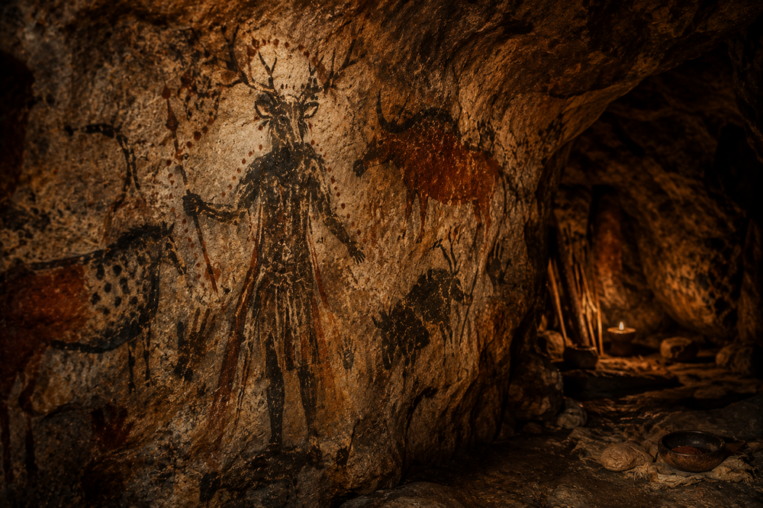
In the cave of Les Trois-Frères in the French Pyrenees, in a chamber that requires crawling through a tunnel to reach, there is a figure painted and engraved high on the wall. It has been called The Sorcerer since it was first documented in the early twentieth century, and the name has stuck. Not because we know what it was called by the people who made it, but because something in the image demands a word like that.
It has the antlers of a stag. The eyes of an owl or a feline. Human legs. A tail. It appears to be dancing, or moving – leading something, presiding over something, mediating between the world of the animals depicted around it and some other register of reality.
It is estimated to be over 13,000 years old.
The French archaeologist Henri Breuil, who first formally documented the image, believed it showed a shaman in ceremonial attire. Masked, costumed, in the midst of a ritual to ensure hunting success. Others have interpreted it as a deity, a spirit being, a figure from myth. But across these interpretations runs a consistent thread: this is not a naturalistic depiction of an animal or a person. It is a being that exists at the threshold between categories.
And it is not alone. Composite creature figures appear at Chauvet (one of the oldest decorated caves, with art dating back perhaps 36,000 years) and persist through Les Trois-Frères twenty thousand years later. The same symbolic grammar, the same threshold beings, across an almost incomprehensible span of time.
The Cave Wall as Portal
One of the most compelling theories about the deep cave paintings, developed by prehistorians Jean Clottes and David Lewis-Williams, is that the cave wall itself was understood as a membrane. A permeable boundary between the human world and the spirit world, through which a practitioner in trance could pass.
The images were not pictures of things the artists had seen in the ordinary world. They were maps of what had been seen in the altered state. The trance, the vision, the shamanic journey into the other side of reality. Painted onto the surface through which that journey had been made.
If this reading is correct, then what we are looking at in these deep caves is not art in the modern sense. It is the physical trace of spirit work. The marks left on the boundary between worlds by people who crossed it deliberately, who trained for the crossing, and who returned with something to report.
The inaccessibility of the deepest chambers makes more sense in this light. You do not stumble into a spirit-working space. You descend into it. The physical descent into the earth mirrors and enables the descent into the other world. The difficulty is the preparation.
The Costume of the In-Between
Among circumpolar peoples, the shamanic traditions of Siberia, northern Scandinavia, the Arctic, the shaman’s costume is one of the most significant objects they possess. It is assembled over years, each element added as a new spirit ally is acquired, each piece of bone or fur or feather marking a relationship with a particular power in the other world.
The shaman at the height of their working wears the deer antlers and the bear’s paws and the eagle feathers not as decoration but as identity. They are becoming, temporarily, the being at the threshold. They are putting on the form that allows them to move between worlds.
Look again at The Sorcerer. The deer antlers. The owl’s eyes. The horse’s tail. The bear’s paws.
This is a costume. This is a practitioner in the fullness of their working.
The tradition that produced this image and the tradition that produces the Siberian shaman’s costume are separated by thousands of years and thousands of miles. But they are speaking the same language. The language of the human-animal threshold being, the shape-shifter, the one who wears the skins of the other world in order to move through it.
What This Means for Practice
The evidence from the deep cave paintings does not give us a recoverable religion. We cannot reconstruct the cosmology, the specific rituals, the names and natures of the beings depicted. Too much time has passed and too much silence surrounds it.
But it gives us something perhaps more important. Confirmation that the fundamental impulse is as old as consciousness itself.
The impulse to go into the dark deliberately. To seek the place where the ordinary world thins and something else becomes accessible. To develop a working relationship with non-human powers. To wear the animal and become the threshold and return with what you found there.
These are not modern inventions. They are not recent spiritual fashions or New Age reconstructions. They are among the oldest attested human activities on the archaeological record.
When you go into the dark of your own practice, when you descend into the shadow, or sit at the altar at three in the morning, or enter the trance deliberately, you are doing something your species has been doing since before the word “religion” existed to describe it.
The Sorcerer on the cave wall at Les Trois-Frères is your elder. Older than any named tradition. Older than agriculture, older than cities, older than writing.
They knew the wall was permeable. So do you.