Before there were grimoires, before there were covens, before anyone wrote a word about the Wiccan Rede or the Law of Threefold Return, there was folk magic. It lived in kitchens and doorsteps. In the hands of grandmothers who would not have called themselves witches. In gestures so ordinary they had stopped looking like magic centuries ago. The pinch of salt thrown over the left shoulder, the coin placed under the doormat, the way a particular family always hung something upside down and nobody quite remembered why anymore but everyone knew not to change it. Folk magic is the oldest living tradition in the world. It does not belong to any one culture, and it does not require initiation, tools, a moon phase, or a spiritual lineage. It requires only the knowledge of what works. Passed down, adapted, borrowed, worn smooth by generations of hands using it until it became instinct. Folk magic is endless, geographically specific, and still evolving. The Logic Underneath All of It Folk magic does not operate on a single coherent theology. But it does operate on consistent underlying principles that appear across cultures and traditions worldwide: Like affects like. A thing that resembles another thing can be used to influence it. A poppet made in someone’s image, a written name, a photograph – these become the person in magical terms and can carry intention toward them. The part contains the whole. A lock of hair, a nail clipping, a worn piece of clothing, any part of a person or thing holds an energetic connection to the whole. Folk magic uses these as links. Words have power. The spoken word, especially in specific forms, the charm, the curse, the blessing, the sworn oath, carries force beyond its literal meaning. How something is named determines what it is. Reversal undoes. If something was done, it can be undone by doing the opposite. The logic of inversion, turning things backward, upside down, inside out, runs through folk magic across every tradition. Thresholds are powerful. Doorways, crossroads, the boundary between night and day, the edge of a body of water, these liminal spaces are charged with potential and are the natural location for folk magical practice. What you do at the beginning determines the whole. The first moment of any new thing, first day of the year, first customer of the day, first words spoken in the morning, carries disproportionate power and can be used to set the entire course. Hold these principles and most folk magic practices will make immediate sense. Protective Magic Turning Things Upside Down One of the most widespread and least understood folk practices: inverting an object to confuse, deflect, or reverse an unwanted influence. Shoes placed upside down on a doorstep in British and Appalachian tradition confused witches or ill-wishers trying to follow you home. An inverted shoe points in no useful direction. Bottles placed upside down in the garden (the witch bottle tradition, which we will come to) were turned to confuse and trap spirits. Brooms hung upside down at the door in multiple European and African-American folk traditions turned away evil and ill-wishers who could not cross the threshold while the broom was inverted. The logic is the logic of disorientation. A thing turned upside down has lost its orientation in the world. It cannot find its way. It cannot function. Applied to an unwanted influence, inversion makes it directionless and therefore harmless. You will still find this in practice: a broom bristles-up in the corner means company is not welcome to stay. A glass left upside down on the table in… …
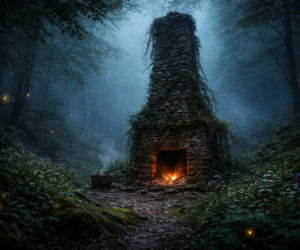
In the mountains of Appalachia, the old people knew things about chimneys that most of the modern world has forgotten. They knew that you did not whistle near the hearth after dark. That you never let the fire go out on certain nights of the year without speaking a word of protection over it first. That strange sounds in the chimney were not the wind – or not only the wind. That the smoke rising from a well-kept fire carried something upward with it, and that what came down the chimney could be something other than weather. These were not superstitions in the dismissive sense of that word. They were an inherited body of knowledge, passed down through generations of mountain families, about the nature of the home’s most important threshold: the chimney. About what it connected. About what it let in, and what it was the job of the household to keep out. To understand where this knowledge came from, and why it is so remarkably consistent with beliefs that predate America by thousands of years, you have to follow the smoke backward, across the Atlantic, into the Celtic-speaking communities of Scotland and Ireland and Wales from which so much of Appalachian culture descends. What you find when you get there is not a coincidence. It is a tradition. The Appalachian World and Where It Came From The culture of the southern Appalachian mountains, the region encompassing parts of Virginia, West Virginia, Kentucky, Tennessee, North Carolina, and Georgia, is one of the most distinctive regional cultures in North America, and one of the most misunderstood. The settlers who moved into these mountains from the late seventeenth century onward came predominantly from the British Isles, and specifically from the Celtic fringe. From the Scottish Highlands, from Ulster (the Scots-Irish who became the backbone of Appalachian settlement), from Ireland, from Wales, and from the border regions of Scotland and England where Celtic and Germanic traditions had been interweaving for centuries. They arrived in a landscape that was geographically isolated in ways that amplified rather than diluted their cultural inheritance. The mountains kept the outside world out and kept what was inside preserved. The result was a culture that retained elements of British and Celtic folk belief long after those beliefs had faded or modernized elsewhere. Folklorists who began collecting Appalachian material in the late nineteenth and early twentieth centuries, figures like Cecil Sharp, who came to collect ballads, and later the WPA workers who documented mountain life during the 1930s, found a world that in many respects resembled rural Britain several centuries earlier more than it resembled the contemporary United States surrounding it. This is the context for Appalachian chimney folklore. It is not an independently invented set of beliefs. It is a transplanted tradition, adapted to a new landscape and new circumstances, but carrying its roots in the Celtic understanding of fire, threshold, and the relationship between the domestic world and what lies beyond it. The Chimney as Threshold ~ Why It Matters In every tradition that takes the structure of the home seriously as a spiritual matter, and Celtic tradition does, deeply, the home has two primary thresholds: the door and the chimney. The door is the obvious one. Every folk magic tradition in the world has something to say about the door. What you hang above it, what you bury beneath it, what you speak over it, what you plant beside it. The door is where the visible world enters. Its protection is the most widely documented. But the chimney is the threshold that connects the home to… …
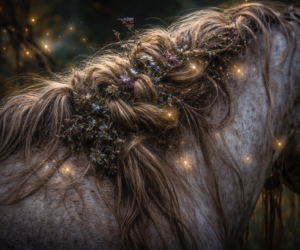
You wake in the morning to find your hair impossibly knotted – tight, twisted tangles that seem to have woven themselves in the night. No amount of tossing and turning could have produced something so intricate. You don’t remember dreaming. But something was here. In the folklore of the British Isles and Ireland, there is a name for this: fairy knots. Or elf-locks. Or witch tangles. The name changes by region, but the belief is the same. The knots were made by unseen hands, and their presence means something. What Are Fairy Knots? Fairy knots, also called elf-locks, hag-knots, witch-knots, and in Scottish Gaelic, cìr mhòr, are the unexplained tangles and matted sections found in hair (human or animal) upon waking. In folk tradition, they are understood as the physical evidence of nocturnal fairy activity: the marks left behind when the Fair Folk pass through the sleeping world and braid, twist, or tangle the hair of those they visit. They are not merely superstition about bad hair. In the magical tradition, fairy knots are considered intentional. A form of binding, a marking, or a message. The knot is one of the oldest magical acts in human history, and fairy knots are understood as fairy magic made visible on the body of the person (or animal) it has touched. The Lore Behind the Locks The Fair Folk and the Sleeping World In Irish, Scottish, and English folk belief, the boundary between the fairy realm and the human world grows thin at night. And especially thin at certain times of year. Midsummer and Samhain are well-known liminal periods, but in everyday folk practice, every night carries some degree of fairy danger. The Fair Folk move through the sleeping world freely, and humans, unconscious and unguarded, are more vulnerable to their attention. Fairies were not universally understood as benevolent. The tradition that modern culture sometimes softens into whimsy was, in its older form, a belief in powerful, unpredictable, deeply other beings who operated by their own rules. The Fair Folk could bless or harm, assist or obstruct, and their interest in a human was not always comfortable even when it wasn’t malicious. Finding fairy knots in your hair in the morning was proof that fairies had been present – and that they had taken an interest in you. The Hag-Riding Connection Fairy knots are closely tied to the older tradition of hag-riding. The experience of waking paralyzed in the night, feeling a presence, sometimes a weight on the chest, with no ability to move or cry out. What we now understand as sleep paralysis was explained in folk tradition as the Hag, the Mare, or a fairy being sitting astride a sleeping person. The tangled hair was the evidence left behind. Just as fairies were said to ride horses through the night (more on this shortly), they were also thought to ride sleeping humans. And the knots in the hair were where their fingers had gripped, braided, and woven to keep their mount in a tractable state. A knotted bridle made of hair, invisible in the morning light but present in the tangle. This is why the knots were taken seriously. They weren’t just cosmetic. They were a record of contact. Elf-Locks in Shakespearean England By the time Shakespeare was writing in the late sixteenth and early seventeenth centuries, elf-locks were a recognized piece of fairy lore familiar enough to work as a literary reference. In Romeo and Juliet, Mercutio’s famous Queen Mab speech describes the fairy queen traveling through the night and, among her many mischievous acts, tangling the manes of horses… …
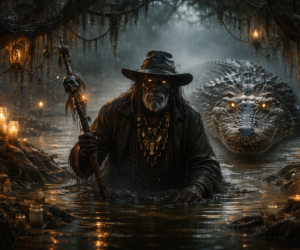
In the humid swamps of Florida, where Spanish moss drapes like curtains and alligators glide silently through dark waters, there lives a legend that refuses to die. His name is Uncle Monday, and his story weaves together African spiritual traditions, resistance to enslavement, Native American alliances, and the mysterious practice of shapeshifting. He is one of Hoodoo’s most compelling and enigmatic figures. A medicine man, a trickster, a protector, and quite possibly, an immortal alligator still swimming through Florida’s murky lakes. The Story Preserved by Zora Neale Hurston We know Uncle Monday’s tale primarily through the work of Zora Neale Hurston, the celebrated author, anthropologist, and initiated Voodoo priestess who collected folklore throughout the American South during the 1930s. Hurston gathered Uncle Monday’s story in her home state of Florida and included it in her writings, preserving this remarkable piece of African American folk tradition for future generations. In describing Uncle Monday, Hurston noted there was something about him that transcended ordinary Hoodoo practice – a deeper, more primal magic that connected him to forces beyond the typical conjure work of the time. From African Shaman to Escaped Captive According to the legends Hurston collected, Uncle Monday was born in Africa, where he was an accomplished shaman and medicine man. Some versions of the tale suggest he may have been a priest, sorcerer, or even a king. His specialty was crocodile medicine. A powerful form of magic deeply rooted in West African spiritual traditions. Captured during the slave trade, Uncle Monday was brought to the Carolinas (accounts vary between South Carolina and Georgia) to be sold into bondage. But Uncle Monday was not a man who would submit to enslavement. Using his considerable spiritual power, he escaped his captors and fled south, eventually arriving in Florida’s wild Seminole territory. Alliance with the Seminole People In Florida, Uncle Monday found refuge among the Seminole Indians, a tribe that actively resisted white colonization and welcomed escaped African slaves into their communities. This alliance between African Americans and Native Americans was not uncommon in Florida, where many Black Seminoles lived and fought alongside their Indigenous allies. The Seminoles recognized Uncle Monday’s gifts, and there was a natural compatibility between his African crocodile medicine and their own sacred relationship with alligators. Uncle Monday helped the Seminole people with herbal magic and medicines, and according to some accounts, he even helped lead resistance efforts against those who sought to conquer them. The Great Transformation As conflicts intensified during the Seminole Wars, Uncle Monday faced a crucial decision. The spirits told him that resistance against the white forces would ultimately prove futile, but Uncle Monday refused to accept either slavery or death at the hands of his enemies. Instead, he made a vow that would become the centerpiece of his legend. He would transform himself into an alligator and wait in the waters until better times arrived, when he could emerge in peace. The Seminoles prepared for a great ceremonial ritual. As drums thundered through the swamp, Uncle Monday began to dance. Witnesses watched in awe as his transformation unfolded before their eyes. His legs grew shorter and his face elongated into a reptilian snout. His skin became thick and scaly, darkening to the deep green-black of an alligator’s hide. His voice deepened into a powerful bellow that made the waters tremble. Uncle Monday became the largest alligator anyone had ever seen. He walked between two rows of alligators that had gathered to witness the transformation, then slid into the water with a thunderous roar. All the other alligators followed him into the depths, bellowing in… …
In the shadowy corners of Scottish folklore lives a figure both feared and revered, Nicnevin, described as a witch or fairy queen who rides the night sky at Samhain, leading spirits, witches, and the dead in her wake. She is Scotland’s dark goddess, the hag queen, the mother of witches. Yet her story has been nearly lost to time, fragmented across centuries of poetry, witch trials, and whispered warnings. The Mystery of Her Name The origins of Nicnevin’s name remain debated, with multiple theories emerging from the linguistic fog of history. Some scholars suggest it derives from the Scottish Gaelic Neachneohain, meaning “daughter(s) of the divine” or “daughter(s) of Scathach,” while others propose NicNaoimhein, meaning “daughter of the little saint.” Another interpretation links her name to the Gaelic Nic an Neamhain, “Daughter of Frenzy”. A fitting title for a goddess associated with the liminal chaos of Samhain night. Some scholars have even connected her to the Irish war goddess Neamhain, one of the Morrigan’s triple aspects, or to water spirits like the Nixie and Nokke. The multiplicity of her names reflects the complexity of her nature. She is not one thing, but many things at once. Her Earliest Appearance The first known mention of Nicnevin appears around 1580 in a work by Alexander Montgomerie, a court poet under King James VI of Scotland. The same king who would later become infamous for his obsession with witch-hunting and authoring the Daemonologie. In Montgomerie’s “Flyting” (a ritual exchange of poetic insults), Nicnevin appears accompanied by her nymphs, described as “venerable virgines whom the world call witches.” This early text portrays her not as a demon, but as a powerful figure who commands witches and possesses knowledge of charms and cunning. After this, silence. For over two hundred years, Nicnevin disappears from the written record. The Romantic Revival She resurfaces in the early 1800s, reimagined by Romantic writers who were busy collecting and reconstructing Scotland’s fading folklore. Sir Walter Scott referred to her as “a gigantic and malignant female, the Hecate of this mythology, who rode on the storm, and marshalled the rambling host of wanderers under her grim banner.” Later sources connected her to the Gyre-Carling, an old woman or ogress figure in Scottish tradition. And described her as wearing a long gray mantle and carrying a white wand with the power to transform water into stone and sea into dry land. By the 19th century, she was called “the mother of glamour, and near-a-kin to Satan himself,” presiding over the Hallowmass Rades. The ghostly processions that rode through Scottish skies during the darkest nights of the year. The Real Woman Behind the Legend? One of the most intriguing theories is that Nicnevin wasn’t originally a goddess at all, but a real woman whose story became mythologized. In May 1569, an accused witch named Marion Nicneven (or Nikniving) was condemned to death and burned at the stake at St. Andrews, claiming that apothecaries had caused her arrest due to her superior healing powers. Was she the origin of the legend? Or was she herself named after an already-existing mythological figure? The timeline is murky, complicated by the fact that “Nicneven” may have become a nickname for multiple women accused of witchcraft. A title bestowed upon those believed to possess extraordinary power. Who Is Nicnevin? A Synthesis of Shadows Drawing from the scattered fragments, a portrait emerges: Queen of the Unseelie Court: Nicnevin rules over the darker fairies of Scotland, the Unseelie. Spirits who are neither wholly malevolent nor wholly benevolent, but dangerous, unpredictable, and powerful. Leader of the Wild Hunt: She is… …
In the misty fields of Ireland, beneath the ordinary rhythms of rural life, a darker magic once thrived. While the word “piseóg” (pronounced “pish-ogue”) is sometimes used casually today to refer to any Irish superstition, its true meaning cuts much deeper. This is the name given to a uniquely Irish form of cursing that blended agricultural life, folk magic, and psychological warfare into something truly formidable. What Is a Piseóg? A piseóg is a type of Irish curse designed to cause misfortune, harm, or even death to its victim. Unlike other forms of folk magic that rely on summoning external forces or elaborate rituals, the piseóg operates on a simpler but more insidious principle: the power of intention combined with the terror it creates in the victim’s mind. The curse could be cast by a vengeful neighbor, a competitor with a grudge, or even, according to folklore, by the fairies themselves. What makes piseógs particularly fascinating is their dual purpose: they were cast either to simply cause ill fortune to an enemy, or more commonly, to steal someone else’s luck for yourself. In old Ireland, there was a pervasive belief that luck was a finite resource. If you wanted to improve your own fortunes, you could take someone else’s. In a land where resources were scarce and life was precarious, this belief made a certain desperate sense. The Power of May Eve Timing was everything with piseógs. While they could theoretically be cast at any time, they were believed to be most potent when performed on May Eve (the night before May 1st), particularly during the liminal hours between midnight and dawn. May Eve held special significance in Irish folklore as a time when the veil between worlds grew thin. The Otherworld drew closer, fairies became more active, and both malevolent charm-setters and protective counter-charms were at their most powerful. This was a night when the supernatural forces that governed luck, fertility, and prosperity could be manipulated – for good or ill. Fields, Farms, and the Agricultural Heart Piseógs were deeply rooted in Ireland’s agricultural economy. Most curses targeted the very things that meant survival: crops, cattle, and land. This made sense in a society where these resources represented not just wealth, but life itself. The curses were typically placed: ~ In fields where crops grew, to cause them to fail~ In hay or feed that livestock would consume~ On boundary stones or corners of newly acquired land~ Near the homes or property of the intended victim The practice was particularly associated with rural Ireland, where close-knit communities meant that everyone knew everyone else’s business. And where jealousy, competition, and grudges could simmer for years. The Craft of the Curse The mechanics of a piseóg were deceptively simple, yet psychologically devastating. The curse relied on a physical catalyst. Something that would rot, decay, or represent death and infertility. The most common items used were: Eggs By far the most popular choice. Raw eggs symbolized fertility and potential, so rotten eggs represented infertility and failure. A classic piseóg involved piercing an egg that had been rubbed on a stillborn calf, then hiding it in a neighbor’s hay to curse their livestock with disease and death. Raw Meat Placed in a field to ruin crops, the rotting flesh would supposedly drain the land’s fertility as it decomposed. Animal Remains Carcasses of ravens or other dead creatures could be buried in strategic locations. The Súgán This was perhaps the most elaborate method – a hand-twisted rope made of straw. Creating a súgán required significant time, skill, and effort. While weaving the rope, the… …
In the annals of New England folklore, few figures loom as large or as mysteriously as Eunice “Goody” Cole of Hampton, New Hampshire. Her story represents one of America’s most enduring tales of witchcraft accusations, community fear, and the tragic consequences of superstition in colonial society. A Life Marked by Suspicion Eunice Cole arrived in Hampton sometime in the 1640s with her husband William. From the beginning, she was viewed with suspicion by her neighbors. Perhaps it was her sharp tongue, her poverty, or simply the misfortune that seemed to follow in her wake. But Goody Cole quickly became the community scapegoat for any unexplained illness, crop failure, or maritime disaster. The accusations against her were typical of witch trials throughout New England: livestock dying mysteriously, butter failing to churn, children falling ill after encounters with the old woman. In a time when scientific explanations for natural phenomena were scarce, fear and superstition filled the void. Trial and Punishment In 1656, Goody Cole became New Hampshire’s only person to be tried and convicted of witchcraft. Unlike the more famous Salem witch trials that would follow decades later, Cole’s case resulted in imprisonment rather than execution. She spent years confined in a Boston jail, only to return to Hampton where she lived as an outcast until her death around 1680. Even in death, the community’s fear of Goody Cole persisted. Legend holds that she was buried at a crossroads with a stake driven through her heart to prevent her spirit from wandering. A practice reserved for those believed to be particularly dangerous even in death. Immortalized in Poetry The legend of Goody Cole captured the imagination of many writers, most notably John Greenleaf Whittier, who immortalized her in his poem “The Wreck of Rivermouth.” In vivid verses, Whittier painted a picture of the feared woman as sailors passed her cottage: As they rounded the point where Goody Cole Sat by her door with her wheel atwirl, A bent and blear-eyed poor old soul. “Oho!” she muttered, “ye’re brave to-day! But I hear the little waves laugh and say, The broth will be cold that waits at home; For it’s one to go, but another to come!’ “ “She’s cursed,” said the skipper; “speak her fair: I’m scary always to see her shake Her wicked head, with its wild gray hair, And nose like a hawk, and eyes like a snake.” Whittier’s portrayal captures the essence of how Goody Cole was perceived. A figure of dread whose very presence seemed to foretell doom for those who encountered her. A Legacy of Fear and Fascination The story of Goody Cole reflects the broader context of witch hysteria in colonial New England, where community tensions, religious extremism, and social anxieties manifested in accusations against vulnerable individuals. Particularly older women living on society’s margins. Modern historians view Goody Cole not as a practitioner of dark arts, but as a victim of her community’s fears and prejudices. Her sharp wit and refusal to conform to expected feminine behavior in Puritan society likely made her a target. Her poverty and outsider status made her an easy scapegoat when misfortune struck. Hampton’s Haunted Heritage Today, Hampton embraces its connection to Goody Cole as part of its historical identity. Local legends persist about her ghostly presence, and visitors often seek out locations associated with her life and death. The Tuck Museum in Hampton maintains exhibits about her story, helping separate historical fact from centuries of accumulated folklore. Her tale serves as a reminder of the dangers of mass hysteria and the importance of protecting society’s most vulnerable members. In… …
In the liminal spaces between worlds, where shadow meets light and the mundane brushes against the magical, dwell the creatures of myth and legend. For those who walk the pagan path, these beings are far more than folklore. They are teachers, guardians, and embodiments of the natural forces that shape our world. The Basilisk: Sovereign of Shadow and Transformation In the depths of medieval bestiaries and alchemical texts, the Basilisk reigns as the “King of Serpents.” This creature, born from a serpent’s egg incubated by a cockerel, represents the ultimate fusion of opposing forces – earth and air, creation and destruction. From a pagan perspective, the Basilisk embodies the shadow work essential to spiritual growth. Its deadly gaze that turns flesh to stone mirrors our own ability to become paralyzed by fear or rigid in our thinking. Yet this same petrifying power can be viewed as preservation, the ability to halt harmful energies in their tracks. In ritual work, the Basilisk serves as a guardian of thresholds, particularly those between the conscious and unconscious mind. Its association with alchemy makes it a powerful ally for practitioners working with transformation magic, helping to burn away what no longer serves while protecting the essential self during times of profound change. Fairies: The Wild Court of Nature’s Wisdom Perhaps no creatures are more misunderstood than the Fair Folk. Disney’s sanitized pixies pale in comparison to the complex, sometimes dangerous beings of Celtic and Germanic tradition. The Seelie and Unseelie courts represent the dual nature of wilderness itself, beautiful and nurturing, yet utterly indifferent to human comfort. In pagan practice, fairies serve as intermediaries between the human world and the realm of nature spirits. They remind us that magic is wild, unpredictable, and follows its own ancient laws. Working with fairy energy requires respect, offerings, and an understanding that these beings are neither servants nor pets. They are sovereigns in their own right. The traditional offerings of milk, honey, and shiny objects reflect deeper spiritual principles: ~ Milk represents nourishment and the feminine divine,~ Honey embodies the sweetness of life and the work of community~ Shiny objects symbolize the light of consciousness reflecting the divine spark within all things. Modern pagans often work with fairy energy for healing the land, communicating with plant spirits, and developing psychic abilities. However, such work requires clear boundaries and genuine respect for the natural world. Fairies have little patience for those who seek to exploit rather than collaborate. The Firebird: Phoenix of Slavic Skies The Firebird of Slavic mythology shares kinship with the Phoenix but carries its own unique wisdom. With feathers that glow like flames and songs that can heal the sick or drive mortals mad, the Firebird represents the dual nature of divine inspiration. In pagan symbolism, the Firebird embodies the creative fire that burns within every practitioner. The passion that drives us to seek truth, create beauty, and transform ourselves. Unlike the Phoenix’s cycle of death and rebirth, the Firebird represents sustained creative fire, the eternal flame that burns without consuming. Practitioners often invoke Firebird energy during creative endeavors, seeking inspiration for art, music, or writing. Its feathers, in meditation and visualization, can light the way through dark periods of the soul, offering hope without the need for complete destruction and rebuilding that the Phoenix requires. Vampires: Lords of the Liminal Long before Dracula donned his cape, vampiric entities existed in folklore worldwide. From the Greek vrykolakas to the Chinese jiangshi. These beings represent humanity’s complex relationship with death, sexuality, and the consumption of life force. From a pagan perspective, vampires symbolize the shadow aspects… …
The reverence for cats in Norse culture manifested in various ritual practices and sacred observances. Harming a cat, particularly one associated with a household or a religious practitioner, was considered not just cruel but spiritually dangerous, likely to bring curse and misfortune upon the perpetrator.

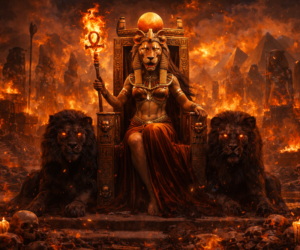
The ninth is Folkvangr, there Freyja rules / Over who shall have a seat in the hall; / Half of the slain, she choose each day, / The other half is Odin’s.” Grímnismál – Sayings of Grimnir | Poetic Edda