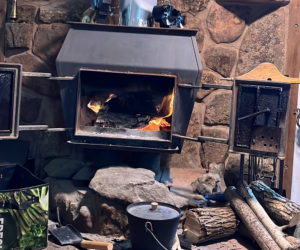
In the mountains of Appalachia, the old people knew things about chimneys that most of the modern world has forgotten. They knew that you did not whistle near the hearth after dark. That you never let the fire go out on certain nights of the year without speaking a word of protection over it first. That strange sounds in the chimney were not the wind – or not only the wind. That the smoke rising from a well-kept fire carried something upward with it, and that what came down the chimney could be something other than weather. These were not superstitions in the dismissive sense of that word. They were an inherited body of knowledge, passed down through generations of mountain families, about the nature of the home’s most important threshold: the chimney. About what it connected. About what it let in, and what it was the job of the household to keep out. To understand where this knowledge came from, and why it is so remarkably consistent with beliefs that predate America by thousands of years, you have to follow the smoke backward, across the Atlantic, into the Celtic-speaking communities of Scotland and Ireland and Wales from which so much of Appalachian culture descends. What you find when you get there is not a coincidence. It is a tradition. The Appalachian World and Where It Came From The culture of the southern Appalachian mountains, the region encompassing parts of Virginia, West Virginia, Kentucky, Tennessee, North Carolina, and Georgia, is one of the most distinctive regional cultures in North America, and one of the most misunderstood. The settlers who moved into these mountains from the late seventeenth century onward came predominantly from the British Isles, and specifically from the Celtic fringe. From the Scottish Highlands, from Ulster (the Scots-Irish who became the backbone of Appalachian settlement), from Ireland, from Wales, and from the border regions of Scotland and England where Celtic and Germanic traditions had been interweaving for centuries. They arrived in a landscape that was geographically isolated in ways that amplified rather than diluted their cultural inheritance. The mountains kept the outside world out and kept what was inside preserved. The result was a culture that retained elements of British and Celtic folk belief long after those beliefs had faded or modernized elsewhere. Folklorists who began collecting Appalachian material in the late nineteenth and early twentieth centuries, figures like Cecil Sharp, who came to collect ballads, and later the WPA workers who documented mountain life during the 1930s, found a world that in many respects resembled rural Britain several centuries earlier more than it resembled the contemporary United States surrounding it. This is the context for Appalachian chimney folklore. It is not an independently invented set of beliefs. It is a transplanted tradition, adapted to a new landscape and new circumstances, but carrying its roots in the Celtic understanding of fire, threshold, and the relationship between the domestic world and what lies beyond it. The Chimney as Threshold ~ Why It Matters In every tradition that takes the structure of the home seriously as a spiritual matter, and Celtic tradition does, deeply, the home has two primary thresholds: the door and the chimney. The door is the obvious one. Every folk magic tradition in the world has something to say about the door. What you hang above it, what you bury beneath it, what you speak over it, what you plant beside it. The door is where the visible world enters. Its protection is the most widely documented. But the chimney is the threshold that connects the home to… …
You wake in the morning to find your hair impossibly knotted – tight, twisted tangles that seem to have woven themselves in the night. No amount of tossing and turning could have produced something so intricate. You don’t remember dreaming. But something was here. In the folklore of the British Isles and Ireland, there is a name for this: fairy knots. Or elf-locks. Or witch tangles. The name changes by region, but the belief is the same. The knots were made by unseen hands, and their presence means something. What Are Fairy Knots? Fairy knots, also called elf-locks, hag-knots, witch-knots, and in Scottish Gaelic, cìr mhòr, are the unexplained tangles and matted sections found in hair (human or animal) upon waking. In folk tradition, they are understood as the physical evidence of nocturnal fairy activity: the marks left behind when the Fair Folk pass through the sleeping world and braid, twist, or tangle the hair of those they visit. They are not merely superstition about bad hair. In the magical tradition, fairy knots are considered intentional. A form of binding, a marking, or a message. The knot is one of the oldest magical acts in human history, and fairy knots are understood as fairy magic made visible on the body of the person (or animal) it has touched. The Lore Behind the Locks The Fair Folk and the Sleeping World In Irish, Scottish, and English folk belief, the boundary between the fairy realm and the human world grows thin at night. And especially thin at certain times of year. Midsummer and Samhain are well-known liminal periods, but in everyday folk practice, every night carries some degree of fairy danger. The Fair Folk move through the sleeping world freely, and humans, unconscious and unguarded, are more vulnerable to their attention. Fairies were not universally understood as benevolent. The tradition that modern culture sometimes softens into whimsy was, in its older form, a belief in powerful, unpredictable, deeply other beings who operated by their own rules. The Fair Folk could bless or harm, assist or obstruct, and their interest in a human was not always comfortable even when it wasn’t malicious. Finding fairy knots in your hair in the morning was proof that fairies had been present – and that they had taken an interest in you. The Hag-Riding Connection Fairy knots are closely tied to the older tradition of hag-riding. The experience of waking paralyzed in the night, feeling a presence, sometimes a weight on the chest, with no ability to move or cry out. What we now understand as sleep paralysis was explained in folk tradition as the Hag, the Mare, or a fairy being sitting astride a sleeping person. The tangled hair was the evidence left behind. Just as fairies were said to ride horses through the night (more on this shortly), they were also thought to ride sleeping humans. And the knots in the hair were where their fingers had gripped, braided, and woven to keep their mount in a tractable state. A knotted bridle made of hair, invisible in the morning light but present in the tangle. This is why the knots were taken seriously. They weren’t just cosmetic. They were a record of contact. Elf-Locks in Shakespearean England By the time Shakespeare was writing in the late sixteenth and early seventeenth centuries, elf-locks were a recognized piece of fairy lore familiar enough to work as a literary reference. In Romeo and Juliet, Mercutio’s famous Queen Mab speech describes the fairy queen traveling through the night and, among her many mischievous acts, tangling the manes of horses… …
Not every plant wants to help you flourish. Some of them want to strip things away. Some of them are drawn to what rots, what ends, what dissolves at the edges of ordinary life. Some of them grow precisely in the places that most people walk past quickly – the shadow of the wall, the disturbed earth at the margin, the place where something has recently died. These are the dark botanicals, and they have been the companions of shadow work long before shadow work had a name. In the contemporary practice of magic, plant work and inner work are often kept separate. Herbs for spells, therapy for the psyche. But in the older tradition, this division would have been incomprehensible. The plant you burned for clarity was also the plant that forced you to see what you had been avoiding. The herb you carried for protection was also the herb that showed you what you actually needed protecting from. The boundary between the inner and the outer was a working boundary, not a permanent wall. The dark botanicals are the plants that dissolve that wall most effectively. They are the allies for going down. What Makes a Botanical “Dark” Dark does not mean dangerous, though some of these plants are genuinely dangerous and will be handled accordingly. Dark, in the botanical sense, means belonging to the threshold. Growing in liminal territory, operating at the edges of ordinary perception, associated with transformation through dissolution rather than growth through accumulation. A dark botanical is a plant that understands endings. That has an affinity with the underworld, with the ancestor realm, with the places where what was solid begins to loosen. That works not by adding something to you but by removing what does not belong – the calcified belief, the inherited wound, the identity you have outgrown and are still carrying out of habit. These plants are not for everyday magic. They are not for the general altar, the daily practice, the spell for a parking space. They are for the serious inner descent. The deliberate, prepared, intentional work of going into your own depths and bringing back what you find there. Used with respect and clear intention, they are among the most powerful allies a practitioner can have for shadow work. Used casually or without preparation, they are likely to produce discomfort without integration, darkness without illumination. The difference is always the quality of the practitioner’s attention. The plant does not do the work. It accompanies you while you do the work. And for that to be useful, you have to be genuinely doing the work. Mugwort: The Dreaming Plant Artemisia vulgaris Mugwort is the gateway botanical for shadow work, and she is the safest place to begin. She does not force anything. She does not strip or dissolve or demand. She opens a door. Specifically the door between waking consciousness and the deeper layers of the mind where shadow material lives. And then she accompanies you through it. She grows everywhere she is not specifically cultivated, appearing in vacant lots, along roadsides, at the edges of fields, in the disturbed earth at the margin of the managed world. Her silvery-green leaves are unremarkable until you crush one between your fingers, at which point she releases an aroma that is simultaneously bitter, aromatic, and strangely familiar. As though you have smelled it before in a place you can’t quite locate in memory…. Membership Required You must be a member to access this content.View Membership LevelsAlready a member? Log in here...
“It’s just your imagination.” How many times have we heard this dismissal? As children, when we spoke of our visions or invisible friends. As adults, when we described the power of visualization or the tangible shifts that follow magical work. “Just” imagination! As if imagination were some lesser faculty, a trick of the mind, something to outgrow. But what if imagination isn’t the opposite of reality? What if it’s the blueprint? The Rehabilitation of Visualization For decades, if you told someone you were using visualization techniques, you’d be met with eye rolls and accusations of magical thinking. Visualization was relegated to the realm of New Age nonsense, something serious people didn’t waste time on. Then athletes started doing it. Olympic competitors visualized their performances in minute detail, the feel of the track beneath their feet, the trajectory of the javelin, the sound of the crowd. And they won medals. Studies showed that mental rehearsal activated the same neural pathways as physical practice. Suddenly, visualization wasn’t woo-woo anymore. It was “mental training.” Therapists began using guided imagery for trauma treatment. Doctors discovered that patients who visualized their immune systems attacking cancer cells showed measurable improvements. Neuroscientists found that the brain doesn’t significantly distinguish between vividly imagined experiences and real ones. Both create neural pathways, both trigger physiological responses. Visualization was never “just” imagination. It was always a technology – a magical technology that the mainstream is only now beginning to understand. What Witches Always Knew In magical practice, visualization has always been fundamental. It’s not a cute add-on to “real” spellwork – it IS the work. When you cast a circle, you’re not just walking in a circle and saying words. You’re visualizing a boundary of energy, seeing it with your mind’s eye, feeling it rise from the earth or descend from the cosmos. That act of visualization isn’t pretend. It’s an act of creation. When you light a candle for prosperity and visualize money flowing to you, you’re not engaging in fantasy. You’re doing several things simultaneously: ~ Programming your subconscious mind to recognize opportunities for abundance~ Activating your reticular activating system (the brain’s filter for what’s important) to notice resources you’d otherwise overlook~ Creating energetic coherence between your desire and your reality~ Shifting your electromagnetic field in ways we’re only beginning to measure The witch who visualizes has always understood something neuroscience is just now confirming: the mind doesn’t distinguish between vividly imagined experience and physical reality. Both create change. Both are real. The Mechanics of Spellwork ~ It’s Not What You Think Here’s where we need to get honest about how magic actually works, because there’s a lot of fluff out there that doesn’t serve practitioners. A spell is not a cosmic vending machine. You don’t put in ingredients, speak some words, and get exactly what you ordered delivered by the Universe. That’s a recipe, not magic. Magic is far more elegant and far more complex. A spell is a focused act of will that creates change in consciousness, which then creates change in reality. Let’s break that down: 1. Focused Will Magic requires intention – clear, concentrated, emotionally charged intention. This is why we use ritual. Not because the Universe needs us to light candles in a specific order, but because ritual focuses our scattered attention into a laser beam of will. When you cast a spell, you’re gathering all your mental, emotional, and energetic resources and pointing them in one direction. This is harder than it sounds. Most people’s attention is fragmented across a thousand concerns. The spell creates singular focus. 2. Change in Consciousness This… …
You have already met your shadow. It was there in the moment you heard yourself say something cruel and didn’t know where it came from. It was in the envy you felt and immediately pushed down, the one you told yourself you weren’t feeling. It was in the way you flinched from a compliment, or sabotaged something good, or found yourself doing the exact thing you promised yourself you’d never do. The shadow is not dramatic. It is not demonic. It is not even particularly unusual. It is simply the sum of everything you have decided, consciously or not, does not fit the version of yourself you are trying to be. And it lives in the dark precisely because you have looked away from it. Shadow work is the practice of turning back around. The Territory You’re Entering Carl Jung gave us the map, but the territory itself is ancient. Every culture that has ever wrestled honestly with what it means to be human has had some way of naming the parts of us that operate beneath the surface. The impulses that embarrass us, the fears that direct us without our permission, the wounds that never quite healed because we never quite looked at them. In the magical tradition, the shadow is not simply a psychological construct. It is the domain of the threshold. The place where the managed self meets the unmanaged self, where the face you show the world ends and the face you rarely show anyone begins. This is the territory that liminal magic knows well: the boundary place, the between space, where transformation becomes possible precisely because the usual rules don’t fully apply. Shadow work in a magical context is what happens when you bring a practitioner’s attention – deliberate, symbol-literate, ceremony-willing – to the work of honest self-confrontation. It takes the psychological insight that unexamined parts of ourselves drive our behavior in ways we don’t choose, and adds to it the tools of the craft: ritual, the working with symbol and archetype, the understanding that transformation requires genuine engagement with what is dark, not just what is light. You are not going into the dark to suffer there. You are going in to retrieve what you left behind. What You Will Actually Find Most people approach shadow work expecting monsters. What they find is much more human than that. You will find the parts of yourself that learned to disappear. The anger that was too dangerous to express as a child and became, over time, an absence. A flattening of your own presence, a habit of making yourself smaller to keep the peace. You will find the neediness that was shamed out of you and turned into its opposite: a fierce, exhausting self-sufficiency that never lets anyone close enough to help. You will find the ambition that you learned to call selfishness, the sexuality you learned to call wrong, the grief you learned to call weakness, the voice you learned to call too much. These are not the worst parts of you. They are the parts that were deemed unacceptable by the world around you before you were old enough to evaluate that judgment for yourself. And so you buried them, and they went on living underground, influencing everything from below. What you find in the shadow is often not darkness at all. It is light that was driven underground – vitality, passion, creativity, power – that you have been inadvertently suppressing along with the things you genuinely needed to grow past. This is why Jung called the integration of the shadow the retrieval of… …
You have already done candle magic. Every birthday cake you ever stood before, eyes closed, holding a wish in your chest before you blew out the candles – that was candle magic. The flame, the intention, the breath that carries the wish outward into the world. The structure is identical. The only difference between that and what we are going to discuss in this post is the degree of consciousness you bring to it. Candle magic is the most accessible form of working magic that exists. It requires no special lineage, no expensive tools, no years of training before you are permitted to begin. It asks for a flame, an intention, and your full attention. Most people already own everything they need. This will help you understand what transforms a lit candle from a simple mood-setter into a conscious act of intention. So that you know what you are doing and why, and what you do carries real weight. What Candle Magic Actually Is Candle magic is a form of sympathetic and elemental magic. It works on two levels simultaneously. On the elemental level, it calls on fire: the oldest of the transformative forces, the element that takes one thing and turns it into another. Fire does not merely move matter from place to place, the way water or wind does. It transforms it, changes its fundamental state. The ash that remains when a candle has burned is not what the candle was. Fire is the element of change, of becoming, of the irreversible transformation from one state into another. On the sympathetic level, candle magic works through the principle that like affects like. That by representing something symbolically (through color, through written intention, through carved words or symbols) and then directing energy toward it through the act of burning, you affect the actual thing. The candle becomes a stand-in for your intention, and what happens to the candle mirrors and amplifies what you are working toward in your life. These two levels together make candle magic particularly potent. The fire transforms the physical representation of your intention into energy and smoke, releasing it into the world. Into whatever forces you work with, into the wider field of possibility, into the channels through which manifestation moves. And practically speaking: the focused attention required to sit with a burning candle and hold an intention in mind is itself a form of concentration practice that aligns your whole system – mind, body, emotion – with what you are calling in. This alignment is, in many traditions, the actual mechanism of magic. The Basics: What You Need One of the most liberating things about candle magic is that it genuinely does not require much. The Candle Any candle can be used for candle magic. Taper candles are traditional in many folk magic systems because they burn completely in a single working and leave nothing behind . The candle is consumed by the working. Pillar candles can be burned in sections over multiple sessions, which suits longer-term intentions. Tea lights and votive candles are practical and accessible. Chime candles, small, slender candles about four inches long, are popular in contemporary practice because they burn relatively quickly and completely and come in a wide range of colors. The size of the candle is less important than the intention you bring to it. A single tea light held with full attention is more potent than an elaborate candle array approached distractedly. A note on beeswax: In the magical tradition, beeswax candles are considered particularly potent because beeswax is itself a substance associated with abundance, sweetness, and… …
There is a reason witches have always kept company with birds. Long before the cauldron and the broomstick became symbols of the craft, birds were already woven into the oldest layers of magical tradition. Soaring between the earthly realm and the spirit world, carrying omens on their wings, and serving as the eyes and voices of forces far older than human memory. In cultures spanning every continent, birds have been revered as messengers, oracles, and familiars: creatures that exist in two worlds at once, belonging fully to neither. If you’ve felt drawn to a particular bird – if one keeps appearing in your dreams, at your window, or on your altar – it may be worth listening. The Raven ~ Oracle of the Void Of all birds associated with witchcraft, the raven may be the most universally recognized. Its ink-black plumage, uncanny intelligence, and eerie vocalizations have made it a figure of profound magical significance across Norse, Celtic, Native American, and Greco-Roman traditions alike. In Norse mythology, Odin, the Allfather and master of seiðr magic, kept two ravens, Huginn (thought) and Muninn (memory), who flew across the nine worlds each day to bring him knowledge. The raven, in this tradition, is not merely a messenger but the embodiment of magical perception itself: the capacity to see what others cannot, to gather wisdom from the edges of existence. In Celtic lore, the raven is sacred to the Morrigan, the triple goddess of fate, sovereignty, and war. She took raven form to survey battlefields, not out of bloodlust, but because the raven sees the truth of endings, and endings are where transformation lives. Magical correspondences: Prophecy, transformation, mystery, protection, shadow work, communication with ancestors. As a familiar: The raven is thought to serve practitioners who work with divination, necromancy, and liminal magic. It favors those who are willing to look unflinchingly into the dark. The Owl ~ The Witch’s Eye in the Dark The owl is perhaps the most ancient familiar of all. Lilith, the primal feminine spirit of Jewish mysticism, is often depicted flanked by owls. In ancient Greece, the little owl was sacred to Athena and appeared on coins and temples as a symbol of hidden knowledge. In Aztec tradition, Tecolotl the owl was a herald of the underworld, associated with death and the god of darkness, Mictlantecuhtli. The owl sees through the dark. It hunts in silence. It perceives what daylight hides. For these reasons, the owl has long been associated with the witching hour. That liminal time between midnight and dawn when the veil between worlds grows thin. In European folk tradition, the cry of an owl near a home was considered an omen, sometimes of death, sometimes of a secret about to be revealed. The owl was thought to know things it should not know. And that knowing was the province of magic. Magical correspondences: Wisdom, clairvoyance, the hidden truth, death and rebirth, the crone aspect, night magic, secrets. As a familiar: Owls are associated with witches who work with dream magic, shadow work, and deep intuition. They are said to reveal what is being deliberately concealed. The Crow ~ The Trickster Messenger Where the raven is an oracle, the crow is a trickster. And in many traditions, the trickster is the most powerful magical figure of all. Crows are among the most intelligent birds on earth. They use tools, recognize individual human faces, hold what appear to be “funerals,” and pass knowledge between generations. In many Indigenous American traditions, Crow is a shapeshifter and a bridge between what is and what could be. In Hinduism, crows… …
Something has been watching you. Not with menace, with interest. You have felt it in the way a particular animal keeps appearing at the edges of your life, in the dream that recurs without resolution, in the presence you sense at the corner of a room you have just walked into. You have dismissed it, probably. Told yourself it was coincidence, pattern recognition, the human brain doing what it does – finding meaning in the noise. But the feeling persists. In the magical tradition, there is a name for what you are sensing. A familiar is not a pet with a witch. It is not a demonic servant from a medieval woodcut. It is not a totem animal you read about in a book and decided suited your personality. A familiar is a relationship. A sustained, specific, reciprocal connection between a practitioner and a spirit that has chosen to work alongside them. You do not fully choose your familiar. This is the first thing to understand. The familiar chooses too. What a Familiar Spirit Actually Is The word familiar comes from the Latin familiaris – of the household, intimate, belonging to the family. In its earliest uses it referred to the household spirits of Roman tradition, the Lares and Penates who inhabited the domestic space and protected those within it. By the medieval period the word had shifted to refer specifically to a spirit ally of a magical practitioner. A being that accompanied them, assisted their work, and was known to them in the intimate way the word’s root suggests. This is the essential nature of the familiar: not a tool or a servant but a companion. Not something you possess but someone you know. The tradition of familiar spirits is genuinely ancient and genuinely cross-cultural, though it takes different forms in different places. In British and European folk magic the familiar was often understood as a spirit that took animal form – a cat, a hare, a toad, a bird, a dog. In Indigenous shamanic traditions the concept of the spirit helper or power animal covers similar ground. In West African and Afro-diasporic traditions the relationship between practitioner and spirit being has its own vocabulary and its own protocols. In Japanese tradition the shikigami, spirit beings called and directed by practitioners of onmyōdō, occupy related conceptual space. What these traditions share is the understanding that certain practitioners develop specific, sustained relationships with spirit beings who assist their work. Not every practitioner has a familiar in this sense. But many do, and when the relationship is present it is unmistakable: not a general sense of spiritual connection but a specific, consistent presence with a recognizable character, a recognizable way of communicating, and a recognizable set of gifts it brings to the working. Types of Familiar Spirits Not all familiar spirits are the same, and the tradition recognizes several distinct types. Understanding which kind of familiar is present, or which kind you may be called to work with, shapes how the relationship is understood and how it is cultivated. Animal familiars are the most widely recognized in Western tradition. These may be physical animals with whom a special connection exists – a cat, a dog, a bird, a wild animal that appears repeatedly and behaves in ways that feel significant. Or they may be purely spirit presences that take animal form in dreams, visions, and the inner landscape of the practitioner. The distinction matters: a physical animal can be a beloved companion without being a familiar in the magical sense, and a familiar can be present without ever manifesting as a… …
The familiar does not knock. It does not wait to be introduced, does not announce itself with ceremony, does not send a calling card. It communicates the way the spirit world has always communicated – sideways, through the cracks in ordinary attention, in the language of sensation and symbol and the small strangeness of moments that should be unremarkable but aren’t. Most practitioners who have a familiar don’t miss the relationship. They miss the communication. They feel something, a chill, a pull of attention, a recurring image that surfaces at odd moments, and they talk themselves out of it before it has a chance to become information. The rational mind is fast, and it is merciless, and it has a hundred explanations for everything that does not require the word familiar. Learning to know when your familiar is speaking is the work of two things happening simultaneously: developing the sensitivity to receive the communication, and developing the trust to take it seriously when it arrives. This is about both. Why Familiar Communication Is Subtle Before getting into the specific signs, it is worth understanding why familiar communication tends toward the subtle rather than the dramatic. Because this understanding will save you from spending years waiting for something that was never going to arrive in the form you were waiting for. Crossing the boundary between the spirit world and the physical one requires energy. Significant energy. The dramatic manifestations of popular imagination, voices from nowhere, objects moved by invisible hands, unmistakable visual appearances, require a level of energetic force that is genuinely difficult to sustain and genuinely rare in ordinary circumstances. Most spirit communication, including familiar communication, operates at the level of least resistance: the subtle, the suggestive, the easily-overlooked-but-present-if-you-look. This is not the familiar being coy. It is the familiar being practical. It communicates through the channels that are actually available. Through the body’s sensitivity, through the permeability of the dreaming mind, through the electromagnetic field that surrounds and interpenetrates the physical world, through the orchestration of small coincidences that would each mean nothing in isolation but together constitute a clear and consistent signal. The familiar’s communication is subtle the way a whisper is subtle. Not weak – subtle. A whisper can carry as much meaning as a shout. But you have to be genuinely listening. The Body as First Receiver Your body knows before your mind does. This is not mysticism, it is straightforward phenomenology. The body is constantly processing information that the conscious mind has not yet reached. When a familiar is present, or when it is attempting to communicate, the body registers this before the analytical mind has had a chance to explain it away. Learning to read your body’s response to familiar presence is one of the most fundamental skills in this work. And it begins with paying attention to sensations you have probably been dismissing as meaningless for years. Sudden chills in warm environments. Not the general chill of a cold room, but a specific, localized chill that arrives abruptly, often running down the back of the neck, along the spine, or through one arm. This is among the most consistent physical signatures of spirit presence across cultures and traditions. When a chill arrives at a significant moment, when you have just asked a question, when you are thinking about something important, when you are at a threshold of some kind, it is worth treating as a response rather than a coincidence. Pressure or warmth. A sense of weight or warmth at specific locations on the body, the shoulders, the back of the head, the… …
Hiding in plain sight. On the windowsill of someone who has never cast a spell. In the terracotta pot beside the back door of a house where nobody believes in magic. At the edges of car parks and office courtyards, clipped into neat hedges by landscapers who think of it as hardy and low-maintenance. In the kitchen of every home that owns a roast chicken. Rosemary is perhaps the most quietly powerful plant in the Western magical tradition. And it is powerful precisely because it never stopped being ordinary. While other sacred plants retreated into the esoteric, into the apothecary cabinet and the grimoire, rosemary stayed in the kitchen garden. Stayed accessible. Stayed common. And in doing so, kept its magic alive in the hands of people who might not have called it magic at all. Who called it cooking, or remembrance, or habit. This plant has been with us for a very long time. And it knows things. The Names It Carries Rosmarinus officinalis, now reclassified by modern botanists as Salvia rosmarinus, though the old name refuses to die, means literally dew of the sea. From the Latin ros (dew) and marinus (of the sea). Rosemary grows wild on Mediterranean coastlines, its grey-green needles salt-tolerant and wind-hardened, its blue flowers visible from the cliff paths above the water. It smells, on a hot afternoon in the sun, like the distillation of everything the Mediterranean means: warmth, antiquity, something sacred hidden in the ordinary. In folk tradition rosemary has been called elf leaf, guardrobe (it was used to protect clothing from moths in wardrobes), compass weed, and incensier, incense plant, in French, a name that acknowledges its long history of burning in sacred spaces. In Spanish folk tradition it is romero, which carries an echo of romero meaning pilgrim. The plant of journeys, of those who travel toward something holy. Each name is a fragment of its history. Together they describe a plant that has been pressed into service for an enormous range of human purposes, magical and mundane, for thousands of years. What It Is: The Plant Itself Rosemary is a woody perennial shrub in the family Lamiaceae, the mint family, which also includes sage, lavender, thyme, basil, and oregano, giving some sense of the company it keeps. Native to the Mediterranean basin, it has been cultivated throughout Europe, Asia, and the Americas for centuries. Rosemary grows between two and six feet tall in favorable conditions, with narrow, needle-like leaves that are dark green on top and pale, almost silvery, beneath. The leaves are densely packed, intensely aromatic, and, unlike belladonna’s musty heaviness, they smell clean, resinous, and somehow optimistic. Small flowers in shades of blue, violet, pink, or white appear depending on variety, typically in late winter and spring, though in mild climates rosemary may flower almost year-round. Famously drought-tolerant and sun-loving, rosemary does better in poor, stony, well-drained soil than in rich garden earth. It is a plant of lean ground, of rocky coastlines, of places where the sun is fierce and the rainfall is sparse. Overwatering kills it far more reliably than underwatering. In this sense, it is a plant that has learned to thrive on very little, to find abundance in apparent scarcity. Worth noting in a plant so strongly associated with prosperity and flourishing. Rosemary is also extremely long-lived. A well-situated bush can live for decades, growing woody and complex and increasingly fragrant as it ages. Unlike annual herbs that complete their lives in a season, rosemary accumulates years. It is a plant of depth and duration. Rosemary in History: Memory, Medicine, and the… …