Every November 16th, practitioners of modern witchcraft and paganism gather to honor Hekate, the ancient Greek goddess of crossroads, magic, and the liminal spaces between worlds. But while Hekate herself is an ancient deity with roots stretching back thousands of years, the celebration of her “night” on this specific date is actually a contemporary innovation. One that beautifully demonstrates how spiritual traditions evolve and adapt over time. Understanding the Ancient Roots: Hekate’s Deipnon To understand the modern Night of Hekate, we must first look to its ancient inspiration: Hekate’s Deipnon (meaning “supper” in Greek). This was a monthly observance held by the ancient Greeks on the dark moon, the darkest night of the lunar cycle when the moon was entirely invisible in the sky. During the Deipnon, devotees would prepare special meals and leave them at crossroads as offerings to Hekate. These offerings typically included eggs, garlic, leeks, fish, bread, honey, mushrooms, and wine. The practice served multiple purposes – honoring the goddess, appeasing the restless spirits of the dead who were believed to roam with Hekate during this liminal time, and ritually purifying the home for the month ahead. The dark moon was considered a threshold moment. A time between times when the veil between worlds grew thin. It was a period for release, renewal, and transformation, all domains over which Hekate held dominion. The Modern Innovation: November 16th Here’s where things get interesting. November 16th as “Hekate’s Night” appears to be a modern creation, likely dating back only a few decades within contemporary pagan and witchcraft communities. No ancient Greek calendars or historical records identify November 16th as a special festival day for Hekate. So where did this date come from? The most plausible theory suggests that at some point, a practitioner celebrated the monthly Deipnon on a dark moon that happened to fall on November 16th. Over time, through word-of-mouth, online sharing, and the desire for a fixed annual celebration, that particular date became separated from its lunar origins and transformed into a yearly observance in its own right. Some sources also note that mid-November traditionally marked the closing of the veil between worlds (following the thinning that occurred at Samhain/Halloween), making it a spiritually significant time that aligned well with Hekate’s role as guardian of thresholds. The timing also coincides with the Leonid meteor showers, adding a celestial dimension to the celebration. Why This Matters (And Why It’s Okay) Understanding that the Night of Hekate is a modern tradition doesn’t diminish its significance or validity. In fact, it highlights something beautiful about living spiritual traditions – they grow, adapt, and respond to the needs of their practitioners. For many modern witches and pagans who observe the monthly Deipnon on each dark moon, November 16th has become something extra. A day to honor Hekate specifically as the Queen of Witchcraft, to gather with community (whether in person or in spirit), and to deepen their relationship with this complex and powerful deity. The fixed date also serves practical purposes. Unlike the shifting lunar calendar, it’s easy to remember and allows practitioners scattered across the globe to feel connected in their simultaneous observance. In a world where modern paganism is often a solitary practice, having these shared markers in time creates a sense of community and continuity. How the Night is Celebrated Today Modern practitioners celebrate the Night of Hekate in ways that honor both the ancient Deipnon traditions and contemporary spiritual needs: Offerings at the Threshold Many leave food offerings at their doorstep or at actual crossroads. The doorway represents a symbolic crossroads – the boundary between private… …

In the world of protective magic, few tools are as beautiful and effective as the legendary witch ball. These mesmerizing glass orbs have been guarding homes, deflecting negative energy, and trapping malevolent spirits for centuries. Whether you call them witch balls, spirit balls, or fairy orbs, these magical spheres represent one of the oldest forms of protective folk magic still actively used today. What Are Witch Balls? Witch balls are hollow glass spheres, traditionally blown by skilled craftspeople, designed to capture and neutralize negative energies, evil spirits, and harmful intentions directed toward a home or its inhabitants. The most traditional witch balls are made of dark colored glass, deep blues, forest greens, rich purples, or smoky blacks, though modern versions come in every color imaginable. Inside many witch balls, you’ll find delicate strands of glass, mirror fragments, herbs, salt, or other magical materials. These internal elements aren’t just decorative. They serve as a mystical web designed to trap unwanted energies that attempt to enter your sacred space. The Ancient History and Origins The tradition of witch balls spans centuries and crosses multiple cultures. Some of the earliest references date back to 17th century England, where they were hung in windows and doorways to protect against witchcraft and the “evil eye.” Interestingly, despite their name, witch balls were originally used against witches rather than by them. Though modern practitioners have gladly reclaimed this powerful protective tool. Similar protective glass spheres appear in various forms across different cultures: ~ Fishing float balls used by sailors for protection at sea~ Gazing balls in Victorian gardens to ward off negative spirits~ Nazar or evil eye amulets in Middle Eastern traditions~ Glass fishing floats repurposed for spiritual protection in coastal communities The connection between glass and protective magic runs deep in human consciousness. Glass, being made from sand transformed by fire, represents the marriage of earth and flame energies. Its transparent nature allows light to pass through while its reflective properties can send negative energies back to their source. How Witch Balls Work: The Magic Behind the Glass Witch balls operate on several magical principles that make them incredibly effective protective tools: Energy Trapping and Reflection The spherical shape creates a perfect energy vortex. When negative energy approaches your home, it becomes drawn into the ball’s swirling internal patterns, where it becomes trapped and neutralized. Any energy that isn’t captured is reflected back toward its source, following the magical principle of “return to sender.” Light Amplification When hung in windows or areas with natural light, witch balls act as prisms, breaking light into rainbow spectrums. This creates a natural cleansing energy that continuously purifies the surrounding space. The play of light through the glass also confuses and deters malevolent spirits who prefer shadows and darkness. Intention and Focus Like any magical tool, witch balls are most effective when charged with clear intention. The act of choosing, blessing, and positioning your witch ball creates a psychic link between you and the protective sphere, amplifying its defensive capabilities. Elemental Balance Traditional witch balls incorporate multiple elements: Air (the hollow interior), Fire (the glass-making process), Water (the fluid, flowing internal patterns), and Earth (sand as the base material). This elemental balance creates a stable, powerful protective matrix. Where to Hang Your Witch Balls for Maximum Protection The placement of your witch balls is crucial to their effectiveness. Here are the most powerful locations: Windows East-facing windows: Hang witch balls here to capture the first light of dawn and maintain positive energy throughout the day. Particularly effective for new beginnings and fresh starts. West-facing windows: Perfect for processing and… …
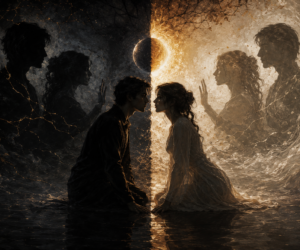
In the realm of human psychology, few concepts are as paradoxical, or as misunderstood, as the dark empath. They walk among us wearing the mask of compassion while wielding emotional intelligence as both shield and sword. We’ve all encountered them: ~ The friend who seems to understand your deepest pain yet somehow always leaves you feeling drained. ~ The colleague who offers perfect comfort in your moment of vulnerability, only to use that information against you later. ~ The partner who claims to feel your emotions so intensely that you end up managing their feelings instead of your own. Welcome to the complex world of dark empathy. Where emotional intelligence meets manipulation, and sensitivity becomes a weapon. What Exactly Is a Dark Empath? A dark empath represents one of psychology’s most fascinating contradictions. Unlike traditional empaths who use their emotional intelligence for healing and connection, or narcissists who lack empathy altogether, dark empaths possess genuine empathetic abilities but deploy them through a darker lens. Think of it as empathy without ethics. They can read your emotional state with laser precision, understand your triggers and vulnerabilities, and even genuinely feel what you’re feeling. But they use this gift to serve their own agenda rather than to truly help or heal. The term itself emerged from recent psychological research that identified this unique personality cluster: individuals who score high on cognitive empathy (understanding others’ emotions) and affective empathy (feeling others’ emotions) while simultaneously exhibiting traits from psychology’s “Dark Triad”, narcissism, Machiavellianism, and psychopathy. It’s emotional intelligence with a shadow side, sensitivity weaponized. The Telltale Signs: Recognizing Dark Empathy in Action Dark empaths are masters of disguise, often appearing as the most caring and intuitive people in your circle. However, certain patterns consistently emerge once you know what to look for: The Emotional Archaeologist They dig deep into your psyche with seemingly innocent questions, uncovering your fears, insecurities, and past traumas. While a healthy empath uses this information to offer genuine support, the dark empath catalogs it for future use. They remember exactly what words will hurt you most during an argument, which buttons to push when they need you to comply, and how to frame their own bad behavior in ways that make you question your reaction. The Selective Supporter Their empathy has conditions. They’re incredibly attuned to your emotions when it serves them – when they need something, when you’re useful, or when playing the hero benefits their image. But when you genuinely need support and it’s inconvenient for them, their empathetic abilities mysteriously vanish. Suddenly, they can’t understand why you’re upset or why their actions hurt you. The Energy Vampire with Boundaries Unlike traditional energy vampires who drain everyone indiscriminately, dark empaths are strategic. They know exactly how much emotional energy to take without completely depleting their source. They’ll leave you feeling slightly off-balance, questioning yourself, but not so obviously harmed that you’ll cut contact entirely. The Emotional Weather Reporter They constantly announce their ability to “feel” what others are experiencing, often making your emotions about them. “I can sense your anxiety, and now I’m anxious too.” “Your sadness is overwhelming me.” This serves dual purposes: it positions them as highly sensitive and special while simultaneously making you responsible for managing their emotional state. The Justified Manipulator When confronted about their behavior, they genuinely believe their actions are warranted because they “understand” the situation so deeply. They felt your emotions, they knew what you “really” needed, so their manipulation was actually help. Their empathy becomes their excuse for crossing boundaries. The Dance of Interaction: How Dark Empaths Engage with Others… …
The moment you took your first breath, the universe was aligned in a unique configuration that would never be repeated. Ancient wisdom traditions and modern personality psychology both suggest that the day you were born carries special significance. Not just astrologically, but in terms of the natural gifts and talents you brought into this world. Whether you view this through the lens of numerology, astrology, psychology, or simply as a fascinating framework for self-discovery, exploring the gifts associated with your birth day can reveal hidden aspects of your personality and untapped potential you may have never considered. The Science of Birth Day Personality Before diving into mystical interpretations, it’s worth noting that research has found some intriguing correlations between birth timing and personality traits. Studies have shown that people born in different seasons exhibit varying tendencies in mood, energy levels, and even career preferences. While the mechanisms aren’t fully understood, factors like seasonal light exposure, maternal nutrition during pregnancy, and early environmental conditions may all play a role. What’s most important isn’t whether you believe in cosmic influence, but whether these frameworks help you recognize and develop your authentic strengths. Gifts by Day of the Week The day of the week you were born is said to carry the energy of its ruling planet and associated qualities: Monday Children (Moon’s Day) Gift: Emotional Intelligence and Intuition Monday-born individuals possess extraordinary sensitivity to emotional undercurrents. You have a natural ability to sense what others are feeling, often before they recognize it themselves. Your gift lies in nurturing, healing, and creating emotional safety for others. You’re drawn to cyclical processes and understand that life has natural rhythms of growth and rest. How to develop it: Practice meditation, trust your first instincts, work in helping professions, and honor your need for emotional processing time. Tuesday Children (Mars’ Day) Gift: Leadership and Pioneering Spirit Tuesday-born people carry the warrior’s energy. Not in aggression, but in courage and initiative. You have a natural ability to take action when others hesitate, to stand up for what’s right, and to push through obstacles that stop others. Your gift is in mobilizing people and resources toward important goals. How to develop it: Take on leadership roles, start new projects, engage in physical challenges, and learn to channel your intensity constructively. Wednesday Children (Mercury’s Day) Gift: Communication and Mental Agility Wednesday children are the natural communicators and connectors of the world. You have an innate ability to understand and translate ideas, to see patterns and connections others miss, and to adapt quickly to new situations. Your gift lies in bridging different worlds through language, learning, and teaching. How to develop it: Write, speak publicly, learn new languages, study diverse subjects, and practice active listening. Thursday Children (Jupiter’s Day) Gift: Wisdom and Expansion Thursday-born individuals carry the energy of the teacher and philosopher. You have a natural ability to see the bigger picture, to understand how seemingly unrelated things connect, and to inspire others with vision and optimism. Your gift is in expanding horizons—your own and others’. How to develop it: Travel, study philosophy or religion, mentor others, engage in lifelong learning, and share your knowledge generously. Friday Children (Venus’ Day) Gift: Creativity and Harmony Friday children are born with an innate sense of beauty, balance, and creative expression. You have a natural ability to create harmony in relationships and environments, to see the aesthetic potential in everything, and to bring beauty into the world through various forms of creative expression. How to develop it: Engage in artistic pursuits, practice diplomacy, beautify your surroundings, and use your aesthetic sense in… …

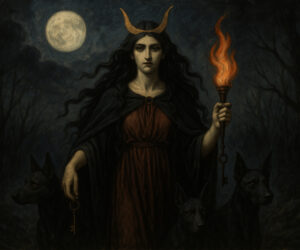
In the shadowed corners of ancient temples and the whispered traditions of modern witchcraft, few deities command as much reverence and caution as Hekate. Known as the Goddess of Witches, the Guardian of Crossroads, and the Keeper of Keys, Hekate stands as one of the most complex and powerful figures in the pantheon of ancient Greek religion and contemporary magical practice. Who is Hekate? Hekate (also spelled Hecate) is an ancient Greek goddess whose origins stretch back to Anatolia, possibly emerging from the goddess Hekataios mentioned in the works of Hesiod around the 8th century BCE. Unlike many Olympic deities who ruled from Mount Olympus, Hekate carved out her dominion in the liminal spaces, the thresholds, crossroads, and boundaries between worlds. She is traditionally depicted as a triple-form goddess, sometimes shown with three bodies or three faces, each looking in a different direction. This trinity represents her ability to see past, present, and future, as well as her dominion over the three realms: earth, sea, and sky. In her hands, she often carries torches, keys, daggers, or serpents as symbols of her roles as light-bringer, gatekeeper, protector, and wielder of ancient wisdom. What are Her Domains? Hekate’s influence spans multiple interconnected realms: Magic and Witchcraft: Perhaps her most famous association, Hekate is the patron goddess of witches, sorcerers, and those who practice the magical arts. She governs spells, divination, necromancy, and the knowledge of herbs and poisons. Crossroads and Boundaries: Every crossroads, especially three-way intersections, belongs to Hekate. She oversees transitions, decisions, and the liminal spaces between different states of being. Death and the Underworld: As a psychopomp, Hekate guides souls between the worlds of the living and the dead. She holds the keys to the underworld and can grant passage between realms. Protection and Purification: Paradoxically, this goddess of dark magic is also a fierce protector. Ancient Greeks placed her statue, called Hekataia, at their doorways to ward off evil spirits and malevolent magic. Moon and Night: Hekate is closely associated with the dark moon, the time when her power is strongest and when magical workings are most potent. Where Do We Find Her? Historically, Hekate was worshipped throughout the ancient Mediterranean world, but her cult was particularly strong in: Ancient Greece: Where she was honored with monthly Deipna offerings. Food left at three-way crossroads on the new moon. Asia Minor: Her likely place of origin, where she was worshipped as a powerful mother goddess. Rome: Where she was syncretized with Diana and Luna, maintaining her association with magic and the moon. Egypt: During the Hellenistic period, where she became associated with Isis and other goddess figures. In modern times, Hekate has experienced a remarkable revival. She appears in: ~ Contemporary Wiccan and pagan practices~ Greek polytheist reconstructionist religions~ Modern witchcraft traditions~ Feminist spirituality movements~ Urban folklore and popular culture A Word of Caution: Invoking Hekate Here lies the heart of what every practitioner must understand: be very careful invoking Hekate, you may not like what you get. Hekate is not a gentle, nurturing goddess who will coddle your feelings or grant easy wishes. She is a deity of truth, transformation, and sometimes harsh lessons. When you call upon her, you’re not just asking for magical assistance, you’re opening a door to profound change that may strip away illusions you’ve been comfortable living with. Those who work with Hekate often report experiences of:~ Intense shadow work and confrontation with hidden aspects of themselves~ Sudden life changes that, while ultimately beneficial, can be initially destabilizing~ Increased psychic sensitivity and otherworldly encounters~ A demand for authenticity and the dismantling of false… …
Shadow work is a powerful practice for anyone on a spiritual, magical, or self-healing path. If you’ve heard the term but aren’t quite sure what it means – or how to begin – this guide is for you. What Is Shadow Work? At its core, shadow work is the process of facing and integrating the hidden parts of yourself – your “shadow.” These are the aspects you’ve repressed, denied, or buried over time: old wounds, limiting beliefs, painful memories, or behaviors that make you uncomfortable. The term comes from the work of psychologist Carl Jung, who believed that the “shadow” is the unconscious part of the psyche that influences our actions, thoughts, and emotions. In spiritual or magical practice, shadow work becomes a form of deep inner alchemy. Why Does Shadow Work Matter in Witchcraft? For many witches and mystics, shadow work is essential because: ~ 🪞 You can’t heal what you don’t face.Ignoring your shadow keeps you stuck in patterns. Working with it brings awareness and transformation. ~ 🔮 It strengthens your magic.When you know yourself fully, including your fears, triggers, and desires, your intentions and spells become clearer and more aligned. ~ 🌑 It honors the whole self.Light and shadow coexist. Shadow work helps you become more compassionate with yourself and others. What Shadow Work Isn’t ~ It’s not about judging yourself. ~ It’s not instant or always comfortable. ~ It’s not about “fixing” what’s broken. Because you are not broken. Shadow work is about wholeness, not perfection. How to Begin Shadow Work Here are simple ways to start gently exploring your shadow: 1. Journal with Intention Use prompts like: ~ What parts of myself do I hide from others? ~ When do I feel jealous, angry, or ashamed, and why? ~ What triggers me, and what might that say about my own inner world? 2. Track Emotional Reactions Notice when you feel strong emotions, especially discomfort, judgment, or defensiveness. These can point to shadow material. 3. Use Tarot or Oracle Cards Ask your deck: ~ What aspect of my shadow needs my attention? ~ What am I not seeing clearly about myself?Write down the messages and reflect on them. 4. Work with the MoonThe dark moon and waning phases are perfect for shadow work. Set aside quiet time for reflection, ritual, or journaling. 5. Practice CompassionSpeak to yourself kindly, even when exploring painful or messy emotions. Your shadow is a part of you that once protected you. 🖤 Shadow Work Is a Lifelong Practice Shadow work isn’t something you do once and check off a list. It’s a cycle—an ongoing process of self-discovery, healing, and deeper connection with your truth. The more you face your shadows, the more light you bring into your life and magic…. Membership Required You must be a member to access this content.View Membership LevelsAlready a member? Log in here...