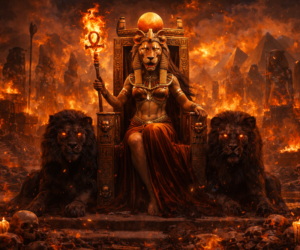
The desert heat is not metaphor. It is her breath.She comes with the sun at its most brutal. The white, annihilating noon of the Egyptian summer when the sand radiates upward and the air itself seems to burn and there is nowhere to hide and nothing to do but submit to it. She comes with the simoom, the poison wind that moves across the desert like a living thing, carrying plague and fever and the smell of something ancient and without mercy. She comes when the lioness bursts from the reeds at the watering hole, and the world reduces itself, in a single shocked instant, to the irreducible fact of power.
 Written by Keeper
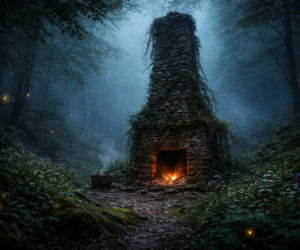
In the mountains of Appalachia, the old people knew things about chimneys that most of the modern world has forgotten.
They knew that you did not whistle near the hearth after dark. That you never let the fire go out on certain nights of the year without speaking a word of protection over it first. That strange sounds in the chimney were not the wind – or not only the wind. That the smoke rising from a well-kept fire carried something upward with it, and that what came down the chimney could be something other than weather.
These were not superstitions in the dismissive sense of that word. They were an inherited body of knowledge, passed down through generations of mountain families, about the nature of the home’s most important threshold: the chimney. About what it connected. About what it let in, and what it was the job of the household to keep out.
 Written by Keeper
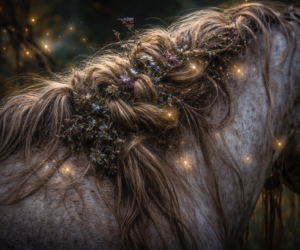
You wake in the morning to find your hair impossibly knotted – tight, twisted tangles that seem to have woven themselves in the night. No amount of tossing and turning could have produced something so intricate. You don’t remember dreaming. But something was here.
In the folklore of the British Isles and Ireland, there is a name for this: fairy knots. Or elf-locks. Or witch tangles. The name changes by region, but the belief is the same. The knots were made by unseen hands, and their presence means something.
What Are Fairy Knots?
Fairy knots, also called elf-locks, hag-knots, witch-knots, and in Scottish Gaelic, cìr mhòr, are the unexplained tangles and matted sections found in hair (human or animal) upon waking. In folk tradition, they are understood as the physical evidence of nocturnal fairy activity: the marks left behind when the Fair Folk pass through the sleeping world and braid, twist, or tangle the hair of those they visit.
 Written by Keeper
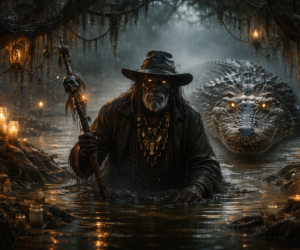
In the humid swamps of Florida, where Spanish moss drapes like curtains and alligators glide silently through dark waters, there lives a legend that refuses to die. His name is Uncle Monday, and his story weaves together African spiritual traditions, resistance to enslavement, Native American alliances, and the mysterious practice of shapeshifting. He is one of Hoodoo’s most compelling and enigmatic figures. A medicine man, a trickster, a protector, and quite possibly, an immortal alligator still swimming through Florida’s murky lakes.
The Story Preserved by Zora Neale Hurston
We know Uncle Monday’s tale primarily through the work of Zora Neale Hurston, the celebrated author, anthropologist, and initiated Voodoo priestess who collected folklore throughout the American South during the 1930s. Hurston gathered Uncle Monday’s story in her home state of Florida and included it in her writings, preserving this remarkable piece of African American folk tradition for future generations.
In describing Uncle Monday, Hurston noted there was something about him that transcended ordinary Hoodoo practice – a deeper, more primal magic that connected him to forces beyond the typical conjure work of the time.
From African Shaman to Escaped Captive
 Written by Keeper
In the misty fields of Ireland, beneath the ordinary rhythms of rural life, a darker magic once thrived. While the word “piseóg” (pronounced “pish-ogue”) is sometimes used casually today to refer to any Irish superstition, its true meaning cuts much deeper. This is the name given to a uniquely Irish form of cursing that blended agricultural life, folk magic, and psychological warfare into something truly formidable.
What Is a Piseóg?
A piseóg is a type of Irish curse designed to cause misfortune, harm, or even death to its victim. Unlike other forms of folk magic that rely on summoning external forces or elaborate rituals, the piseóg operates on a simpler but more insidious principle: the power of intention combined with the terror it creates in the victim’s mind.
The curse could be cast by a vengeful neighbor, a competitor with a grudge, or even, according to folklore, by the fairies themselves. What makes piseógs particularly fascinating is their dual purpose: they were cast either to simply cause ill fortune to an enemy, or more commonly, to steal someone else’s luck for yourself.
 Written by Keeper
In the liminal spaces between worlds, where shadow meets light and the mundane brushes against the magical, dwell the creatures of myth and legend. For those who walk the pagan path, these beings are far more than folklore. They are teachers, guardians, and embodiments of the natural forces that shape our world.
The Basilisk: Sovereign of Shadow and Transformation
In the depths of medieval bestiaries and alchemical texts, the Basilisk reigns as the “King of Serpents.” This creature, born from a serpent’s egg incubated by a cockerel, represents the ultimate fusion of opposing forces – earth and air, creation and destruction.
From a pagan perspective, the Basilisk embodies the shadow work essential to spiritual growth. Its deadly gaze that turns flesh to stone mirrors our own ability to become paralyzed by fear or rigid in our thinking. Yet this same petrifying power can be viewed as preservation, the ability to halt harmful energies in their tracks.
In ritual work, the Basilisk serves as a guardian of thresholds, particularly those between the conscious and unconscious mind. Its association with alchemy makes it a powerful ally for practitioners working with transformation magic, helping to burn away what no longer serves while protecting the essential self during times of profound change.
Fairies: The Wild Court of Nature’s Wisdom
 Written by Keeper
Today marks another Friday the 13th, and while most people shudder at the mention of this date, practitioners of the craft know there’s far more magic than misfortune woven into this mysterious day.
 Written by Keeper
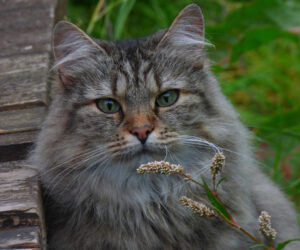
The reverence for cats in Norse culture manifested in various ritual practices and sacred observances. Harming a cat, particularly one associated with a household or a religious practitioner, was considered not just cruel but spiritually dangerous, likely to bring curse and misfortune upon the perpetrator.
 Written by Keeper
The ninth is Folkvangr, there Freyja rules / Over who shall have a seat in the hall; / Half of the slain, she choose each day, / The other half is Odin’s.” Grímnismál – Sayings of Grimnir | Poetic Edda