 Written by
Walk into any well-stocked occult bookshop and you will find rows of correspondence tables.
Which crystal corresponds to which intention. Which herb to which planet. Which color to which element. Which day of the week to which magical purpose. The tables are sometimes simple and sometimes extraordinarily elaborate – 777, Aleister Crowley’s correspondence compendium, lists associations across dozens of categories for every number from zero to thirty-two. Agrippa’s Three Books of Occult Philosophy fills hundreds of pages with the interconnected web of correspondences underlying Renaissance magic.
These tables are useful. They represent centuries of accumulated practical experience and theoretical reflection by practitioners who tested these associations and passed them forward. When you reach for a correspondence table to find which herb to add to a prosperity working, or which moon phase suits a working of release, the table you reach for is the distillation of a very long tradition of working answers to exactly those questions.
But there is a problem that most practitioners encounter somewhere between beginner and intermediate practice, and it is worth naming directly.
The tables often disagree with each other.
Why Correspondence Tables Conflict
Correspondence systems did not emerge from a single unified tradition. They emerged from many traditions – Greek, Roman, Egyptian, Jewish, Arabic, Celtic, Norse, medieval European, Renaissance humanist – that each developed their own associations based on their own cosmological frameworks, their own practical experience, and their own understanding of how the universe is structured.
The result is that different correspondence systems place different plants under different planets, assign different colors to different elements, and associate different qualities with the same stone or symbol. Rose quartz is associated with love and Venus in most modern systems; in others, rose quartz is primarily a stone of gentle healing. Green is the color of Venus and love in one system; in another it is the color of earth and prosperity; in another it is associated with the heart chakra; in another with faerie magic and the otherworld.
None of these associations are wrong. They are each right within the framework that generated them. The confusion arises when practitioners try to treat all the tables as chapters of one unified book rather than as separate documents from separate traditions.
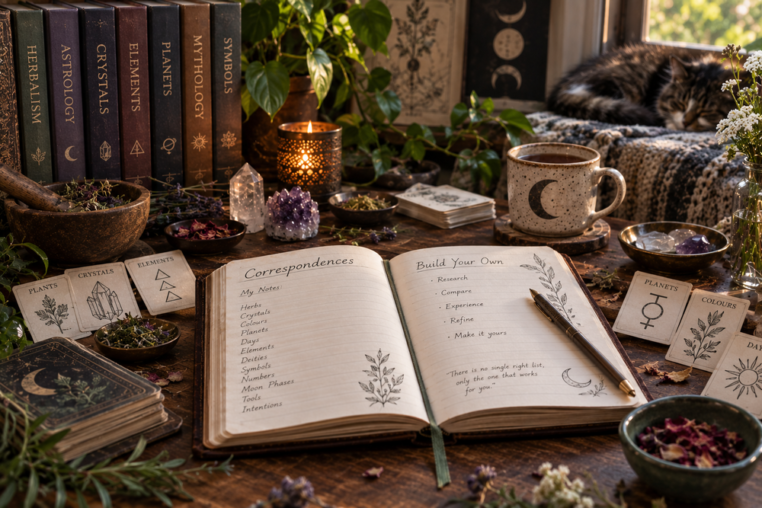
The solution is not to find the one correct table. It is to understand what you are working with and why, to test it in your own practice, and to build your own correspondence record based on accumulated experience.
The Three Layers of Correspondence
When building your own correspondence tables, it helps to think in three distinct layers.
The traditional layer is what the established sources say. This is the accumulated wisdom of the tradition, and it deserves respect and serious engagement before you begin modifying it. Traditional correspondences often have good reasons behind them that are not immediately obvious – reasons rooted in ancient cosmology, in the physical properties of the materials, in long chains of association that make sense once you understand the framework they come from. Learn the traditional tables before you start departing from them.
The personal layer is what your own experience establishes. This is built through practice, not through reading. It is the herb that consistently produces stronger results for you than tradition suggests it should. The color that feels protective rather than the color the books say is protective. The stone you keep reaching for in certain situations because it works, regardless of what it is supposed to correspond to.
The personal layer is not more important than the traditional one. But for your specific practice, it is more reliable. Your grimoire should contain both, clearly labelled so you know where each association came from.
The cultural layer is the correspondence system of the specific tradition you are drawing from, if you are working within a named tradition. A practitioner working within a specifically Norse framework will build different correspondence tables from a practitioner working within a Hellenistic one. These cultural layers are coherent internally, even when they conflict with each other externally.
Core Correspondence Categories to Build
Planetary correspondences
The seven classical planets – Sun, Moon, Mars, Mercury, Jupiter, Venus, Saturn – are the oldest and most consistently useful organisational system in Western magic. Each planet governs a range of qualities, plants, stones, colors, animals, body parts, metals, days, and magical purposes. Learning the planetary system in depth is one of the highest-leverage investments a practitioner of Western magic can make, because it underlies so much of the tradition.
Start with these core associations as a skeleton:
Sun: Gold, bay laurel, sunflower, frankincense, citrine, Sunday, success, vitality, identity, authority.
Moon: Silver, mugwort, willow, jasmine, moonstone, Monday, intuition, dreams, cycles, the unconscious.
Mars: Iron, nettle, pine, dragon’s blood resin, garnet, Tuesday, will, courage, conflict, protection.
Mercury: Quicksilver, lavender, fennel, benzoin, clear quartz, Wednesday, communication, travel, intelligence, trickery.
Jupiter: Tin, hyssop, oak, cedar, lapis lazuli, Thursday, abundance, expansion, law, spiritual authority.
Venus: Copper, rose, elderflower, rose quartz, malachite, Friday, love, beauty, pleasure, relationship, creativity.
Saturn: Lead, comfrey, yew, myrrh, obsidian, Saturday, boundaries, death, time, limitation, discipline.
These are starting points. The full planetary system is considerably richer. Add to these tables as you work and as you learn.
Elemental correspondences
Earth, Air, Fire, and Water as magical categories – not the physical substances but the energetic qualities they represent – organise a second layer of correspondence distinct from the planetary one.
Earth: North, midnight, winter, salt, green and brown, stability, grounding, the body, practical matters, the long-term.
Air: East, dawn, spring, incense smoke, yellow and white, thought, communication, new beginnings, travel, the mind.
Fire: South, noon, summer, candle flame, red and orange, will, transformation, passion, destruction, purification.
Water: West, dusk, autumn, a bowl of water, blue and silver, emotion, intuition, dreams, relationships, the unconscious.
Moon phases
New moon: Intention-setting, new beginnings, planting seeds, invisibility work.
Waxing crescent: Growth, building, calling in.
First quarter: Action, momentum, commitment.
Waxing gibbous: Refinement, adjustment, sustained effort.
Full moon: Peak power, illumination, manifestation, celebration, charging tools.
Waning gibbous: Gratitude, releasing what no longer serves.
Last quarter: Banishing, breaking habits, cord-cutting.
Waning crescent: Rest, reflection, surrender, preparation.
Dark moon: Shadow work, deep rest, working with what is hidden.
Colors
Color correspondence varies considerably across systems. These are broad traditional Western associations, to be tested and modified in your own practice:
Red: Passion, courage, vitality, Mars, fire, love and lust, blood and life force.
Orange: Creativity, attraction, enthusiasm, success, the Sun (in some systems).
Yellow: Intellect, communication, Mercury, Air, optimism, clarity.
Green: Growth, abundance, Venus, Earth, healing, the natural world, prosperity.
Blue: Peace, water, intuition, healing, truth, the Moon (in some systems).
Indigo/Deep blue: Jupiter, wisdom, depth, the night sky.
Violet/Purple: Spiritual authority, higher planes, transformation, ancestors.
White: Purity, the Moon, protection, new beginnings, clarity, all purposes.
Black: Protection, banishing, Saturn, the dark moon, shadow work, absorption of energy.
Gold: The Sun, success, wealth, divine power, solar working.
Silver: The Moon, intuition, the feminine divine, psychic work.
Building Your Personal Correspondence Record
The most useful part of your correspondence tables is the section you build yourself.
For each significant plant, stone, symbol, animal, or material in your practice, create a record that includes:
~ What the tradition says (with your source noted)
~ What your personal experience has established
~ Any specific workings in which you have used this material, and the results
~ Your overall sense of this material’s energy and purpose
Over time, this becomes a personal materia magica. A record of your working relationships with the materials of your practice. It is incomparably more useful than a borrowed table, because it reflects what actually happens when you work with these materials.
A Note on Testing
Correspondences are not dogma. They are working hypotheses, refined through practice.
When you use a correspondence and the working produces strong results, note that. When you use a correspondence and the working falls flat, note that too. When a material seems to work differently in your hands than the table suggests it should, note the discrepancy and investigate it rather than ignoring it.
The tradition has been tested by countless practitioners over centuries. Your personal experience is a continuation of that testing, not a departure from it. Trust what you learn. Write it down. Add it to the tables.
That is how the tradition stays alive – not by being copied unchanged from book to book, but by being tested and refined by each generation of practitioners who picks it up, works with it, learns from it, and adds what they have discovered to what was already there.
Your grimoire is your contribution to that process.
Write in it accordingly.