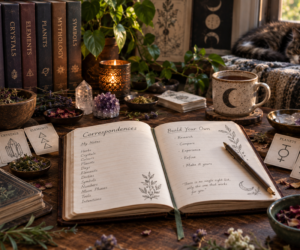
Walk into any well-stocked occult bookshop and you will find rows of correspondence tables. Which crystal corresponds to which intention. Which herb to which planet. Which color to which element. Which day of the week to which magical purpose. The tables are sometimes simple and sometimes extraordinarily elaborate – 777, Aleister Crowley’s correspondence compendium, lists associations across dozens of categories for every number from zero to thirty-two. Agrippa’s Three Books of Occult Philosophy fills hundreds of pages with the interconnected web of correspondences underlying Renaissance magic.
 Written by Keeper
Most practitioners are good at preparing for a working.
They research correspondences, choose materials, time the ritual to the moon phase or planetary hour, set up their space with care. The preparation receives attention and intention. And then the working happens. And then, often, life continues. The candle burns out. The circle is opened. And nothing gets written down.
 Written by Keeper
Step into any witchcraft tradition, any occult lineage, any corner of the magical world, and you will find it: a book. Not just any book, but the book – the one written in candlelight, filled with spells and symbols, secrets and ceremonies, the whispered knowledge of those who came before. This is the grimoire.
The word itself carries weight. Derived from the Old French grammaire, meaning grammar. The structured language of learning. The grimoire was once synonymous with any book of occult knowledge. Over centuries, it evolved into something far more intimate: a personal repository of magical practice, a map of one practitioner’s journey through the unseen world.
To hold a grimoire is to hold a record of transformation.
 Written by Keeper
Your Book of Shadows is a deeply personal grimoire, but having a clear structure helps you find what you need when you need it. Here are some essential categories to consider:
Core Sections
Dedications & Beliefs
Start with your personal dedication, spiritual philosophy, and the ethical guidelines you follow in your practice. This grounds your entire book in intention.
Sabbats & Esbats*
Document the Wheel of the Year sabbats and moon phases, including rituals, correspondences, recipes, and personal observations for each celebration.
Spellwork
Your collection of spells organized by purpose (protection, love, prosperity, healing, banishing). Include ingredients, timing, results, and notes on what worked.
Divination
Tarot spreads, rune meanings, pendulum techniques, scrying methods, and records of your readings and their accuracy.
 Written by Keeper
There’s a particular magic in the liminal space between one year and the next. The wheel turns, the darkness begins its slow retreat after the solstice, and we stand at a threshold looking both backward and forward. This isn’t just a calendar convention. It’s sacred time, the pause between breaths, the moment when we can see clearly what was and what might be.
For witches, this transition holds power that goes deeper than resolutions and goal-setting. This is when we take stock of our practice, honor what we’ve learned, release what no longer serves, and set intentions that align with the deeper currents of our magic and lives.
The Practice of Looking Back
Most people rush through the end of the year without actually examining it. They’re already focused on the next thing, the fresh start, the new goals. They miss the wisdom that only comes from genuine reflection.
 Written by Keeper
A comprehensive directory of miniature rituals, protection gestures, and subtle enchantments for the modern practitioner
The Lost Art of Small Magic
Before grimoires were bound in leather and spells required elaborate preparation, magic lived in the body. In gestures passed down through generations, in the instinctive movements we make when something feels wrong, in the small rituals that protect us from forces we sense but cannot name.
These are pocket spells. Micro-enchantments. The magic you can perform standing in line at the grocery store, sitting in traffic, or lying awake at three in the morning when the air feels too thick and your thoughts won’t settle.
This grimoire collects them. The whispered protections, the boundary markings, the release rituals that require nothing but your body and your intention.
Part I: Protection & Psychic Defense
The Knock of Refusal
 Written by Keeper
There’s something magical about opening a blank grimoire for the first time. All that potential, all those empty pages waiting to be filled with your wisdom and experience. But then reality hits: you’re staring at that first page, pen in hand, and your mind goes completely blank.
What should you actually write in this thing?
If you’ve ever felt stuck or overwhelmed about what to include in your grimoire, you’re not alone. While the traditional approach is to fill it with correspondence tables and spell recipes (and those are certainly valuable), your grimoire can be so much more than a magical cookbook. It’s a living document of your personal practice, a mirror of your spiritual growth, and a legacy you’re creating one page at a time.
Let’s explore dozens of creative ideas to help you fill those pages with meaningful, practical, and deeply personal magical content.
Getting Started: The Foundational Pages
These are the entries that give your grimoire structure and make it uniquely yours:
Your Magical Name and Origin Story
Written by Keeper
The practice of maintaining written records of magical knowledge spans millennia, yet confusion often arises between two primary forms of magical documentation: grimoires and Books of Shadows. While both serve as repositories of esoteric wisdom, they differ significantly in purpose, structure, and application. Understanding these distinctions is essential for any practitioner seeking to create meaningful magical records.
Historical Context and Origins
Grimoires derive their name from the Old French “grammaire,” meaning grammar or learning. These texts emerged during medieval times as systematic compilations of magical knowledge, often attributed to legendary figures like King Solomon or written by learned scholars. Traditional grimoires such as the Key of Solomon, Goetia, and Book of Abramelin established the format of comprehensive magical manuals containing detailed instructions for rituals, invocations, and ceremonial practices.
Books of Shadows, conversely, are a relatively modern concept popularized by Gerald Gardner in the mid-20th century within Wiccan traditions. The term itself suggests something hidden or secret, reflecting the personal and often private nature of these records. Unlike grimoires, which were often copied and distributed (albeit secretly), Books of Shadows were traditionally hand-copied by initiates and remained within specific covens or lineages.