Not every plant wants to help you flourish. Some of them want to strip things away. Some of them are drawn to what rots, what ends, what dissolves at the edges of ordinary life. Some of them grow precisely in the places that most people walk past quickly – the shadow of the wall, the disturbed earth at the margin, the place where something has recently died. These are the dark botanicals, and they have been the companions of shadow work long before shadow work had a name. In the contemporary practice of magic, plant work and inner work are often kept separate. Herbs for spells, therapy for the psyche. But in the older tradition, this division would have been incomprehensible. The plant you burned for clarity was also the plant that forced you to see what you had been avoiding. The herb you carried for protection was also the herb that showed you what you actually needed protecting from. The boundary between the inner and the outer was a working boundary, not a permanent wall. The dark botanicals are the plants that dissolve that wall most effectively. They are the allies for going down. What Makes a Botanical “Dark” Dark does not mean dangerous, though some of these plants are genuinely dangerous and will be handled accordingly. Dark, in the botanical sense, means belonging to the threshold. Growing in liminal territory, operating at the edges of ordinary perception, associated with transformation through dissolution rather than growth through accumulation. A dark botanical is a plant that understands endings. That has an affinity with the underworld, with the ancestor realm, with the places where what was solid begins to loosen. That works not by adding something to you but by removing what does not belong – the calcified belief, the inherited wound, the identity you have outgrown and are still carrying out of habit. These plants are not for everyday magic. They are not for the general altar, the daily practice, the spell for a parking space. They are for the serious inner descent. The deliberate, prepared, intentional work of going into your own depths and bringing back what you find there. Used with respect and clear intention, they are among the most powerful allies a practitioner can have for shadow work. Used casually or without preparation, they are likely to produce discomfort without integration, darkness without illumination. The difference is always the quality of the practitioner’s attention. The plant does not do the work. It accompanies you while you do the work. And for that to be useful, you have to be genuinely doing the work. Mugwort: The Dreaming Plant Artemisia vulgaris Mugwort is the gateway botanical for shadow work, and she is the safest place to begin. She does not force anything. She does not strip or dissolve or demand. She opens a door. Specifically the door between waking consciousness and the deeper layers of the mind where shadow material lives. And then she accompanies you through it. She grows everywhere she is not specifically cultivated, appearing in vacant lots, along roadsides, at the edges of fields, in the disturbed earth at the margin of the managed world. Her silvery-green leaves are unremarkable until you crush one between your fingers, at which point she releases an aroma that is simultaneously bitter, aromatic, and strangely familiar. As though you have smelled it before in a place you can’t quite locate in memory…. Membership Required You must be a member to access this content.View Membership LevelsAlready a member? Log in here...

There is a reason witches have always kept company with birds. Long before the cauldron and the broomstick became symbols of the craft, birds were already woven into the oldest layers of magical tradition. Soaring between the earthly realm and the spirit world, carrying omens on their wings, and serving as the eyes and voices of forces far older than human memory. In cultures spanning every continent, birds have been revered as messengers, oracles, and familiars: creatures that exist in two worlds at once, belonging fully to neither. If you’ve felt drawn to a particular bird – if one keeps appearing in your dreams, at your window, or on your altar – it may be worth listening. The Raven ~ Oracle of the Void Of all birds associated with witchcraft, the raven may be the most universally recognized. Its ink-black plumage, uncanny intelligence, and eerie vocalizations have made it a figure of profound magical significance across Norse, Celtic, Native American, and Greco-Roman traditions alike. In Norse mythology, Odin, the Allfather and master of seiðr magic, kept two ravens, Huginn (thought) and Muninn (memory), who flew across the nine worlds each day to bring him knowledge. The raven, in this tradition, is not merely a messenger but the embodiment of magical perception itself: the capacity to see what others cannot, to gather wisdom from the edges of existence. In Celtic lore, the raven is sacred to the Morrigan, the triple goddess of fate, sovereignty, and war. She took raven form to survey battlefields, not out of bloodlust, but because the raven sees the truth of endings, and endings are where transformation lives. Magical correspondences: Prophecy, transformation, mystery, protection, shadow work, communication with ancestors. As a familiar: The raven is thought to serve practitioners who work with divination, necromancy, and liminal magic. It favors those who are willing to look unflinchingly into the dark. The Owl ~ The Witch’s Eye in the Dark The owl is perhaps the most ancient familiar of all. Lilith, the primal feminine spirit of Jewish mysticism, is often depicted flanked by owls. In ancient Greece, the little owl was sacred to Athena and appeared on coins and temples as a symbol of hidden knowledge. In Aztec tradition, Tecolotl the owl was a herald of the underworld, associated with death and the god of darkness, Mictlantecuhtli. The owl sees through the dark. It hunts in silence. It perceives what daylight hides. For these reasons, the owl has long been associated with the witching hour. That liminal time between midnight and dawn when the veil between worlds grows thin. In European folk tradition, the cry of an owl near a home was considered an omen, sometimes of death, sometimes of a secret about to be revealed. The owl was thought to know things it should not know. And that knowing was the province of magic. Magical correspondences: Wisdom, clairvoyance, the hidden truth, death and rebirth, the crone aspect, night magic, secrets. As a familiar: Owls are associated with witches who work with dream magic, shadow work, and deep intuition. They are said to reveal what is being deliberately concealed. The Crow ~ The Trickster Messenger Where the raven is an oracle, the crow is a trickster. And in many traditions, the trickster is the most powerful magical figure of all. Crows are among the most intelligent birds on earth. They use tools, recognize individual human faces, hold what appear to be “funerals,” and pass knowledge between generations. In many Indigenous American traditions, Crow is a shapeshifter and a bridge between what is and what could be. In Hinduism, crows… …
Hiding in plain sight. On the windowsill of someone who has never cast a spell. In the terracotta pot beside the back door of a house where nobody believes in magic. At the edges of car parks and office courtyards, clipped into neat hedges by landscapers who think of it as hardy and low-maintenance. In the kitchen of every home that owns a roast chicken. Rosemary is perhaps the most quietly powerful plant in the Western magical tradition. And it is powerful precisely because it never stopped being ordinary. While other sacred plants retreated into the esoteric, into the apothecary cabinet and the grimoire, rosemary stayed in the kitchen garden. Stayed accessible. Stayed common. And in doing so, kept its magic alive in the hands of people who might not have called it magic at all. Who called it cooking, or remembrance, or habit. This plant has been with us for a very long time. And it knows things. The Names It Carries Rosmarinus officinalis, now reclassified by modern botanists as Salvia rosmarinus, though the old name refuses to die, means literally dew of the sea. From the Latin ros (dew) and marinus (of the sea). Rosemary grows wild on Mediterranean coastlines, its grey-green needles salt-tolerant and wind-hardened, its blue flowers visible from the cliff paths above the water. It smells, on a hot afternoon in the sun, like the distillation of everything the Mediterranean means: warmth, antiquity, something sacred hidden in the ordinary. In folk tradition rosemary has been called elf leaf, guardrobe (it was used to protect clothing from moths in wardrobes), compass weed, and incensier, incense plant, in French, a name that acknowledges its long history of burning in sacred spaces. In Spanish folk tradition it is romero, which carries an echo of romero meaning pilgrim. The plant of journeys, of those who travel toward something holy. Each name is a fragment of its history. Together they describe a plant that has been pressed into service for an enormous range of human purposes, magical and mundane, for thousands of years. What It Is: The Plant Itself Rosemary is a woody perennial shrub in the family Lamiaceae, the mint family, which also includes sage, lavender, thyme, basil, and oregano, giving some sense of the company it keeps. Native to the Mediterranean basin, it has been cultivated throughout Europe, Asia, and the Americas for centuries. Rosemary grows between two and six feet tall in favorable conditions, with narrow, needle-like leaves that are dark green on top and pale, almost silvery, beneath. The leaves are densely packed, intensely aromatic, and, unlike belladonna’s musty heaviness, they smell clean, resinous, and somehow optimistic. Small flowers in shades of blue, violet, pink, or white appear depending on variety, typically in late winter and spring, though in mild climates rosemary may flower almost year-round. Famously drought-tolerant and sun-loving, rosemary does better in poor, stony, well-drained soil than in rich garden earth. It is a plant of lean ground, of rocky coastlines, of places where the sun is fierce and the rainfall is sparse. Overwatering kills it far more reliably than underwatering. In this sense, it is a plant that has learned to thrive on very little, to find abundance in apparent scarcity. Worth noting in a plant so strongly associated with prosperity and flourishing. Rosemary is also extremely long-lived. A well-situated bush can live for decades, growing woody and complex and increasingly fragrant as it ages. Unlike annual herbs that complete their lives in a season, rosemary accumulates years. It is a plant of depth and duration. Rosemary in History: Memory, Medicine, and the… …
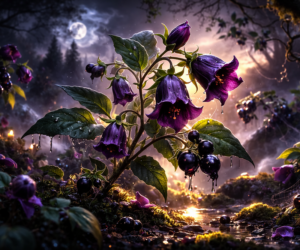
She grows at the edge of things. In the dappled shadow at the forest margin, in the rubble of old ruins, in the disturbed earth beside crumbling walls – belladonna chooses her ground carefully. She is not a plant that invites herself into the tidy cultivated garden. She arrives where something has been disrupted, where the ground has been turned over, where the boundary between the managed world and the wild one has become uncertain. This is appropriate. Belladonna has always lived at the edge. Atropa belladonna, deadly nightshade, is one of the most famous and most feared plants in the Western magical tradition. She appears in the literature of witchcraft, in the pharmacopoeia of medieval herbalists, in the records of poisoners and physicians alike. She has killed people. She has healed people. She has, according to centuries of folk tradition, carried people between worlds. She deserves to be understood properly. The Names She Carries The name belladonna is Italian, bella donna, beautiful lady, and its origin is usually explained by one of two stories, or both simultaneously. The first: that Italian women of the Renaissance used drops of belladonna juice in their eyes to dilate the pupils, creating the wide, dark gaze that was considered a mark of beauty. This is historically documented. Atropine, the active alkaloid in belladonna, causes pupil dilation, and the cosmetic use of the plant is well-attested. The second story is darker. The beautiful lady of the name is not a woman at all but the plant herself . And she is beautiful in the way that dangerous things are beautiful. The glossy black berries look like cherries. The soft, slightly furry leaves have a quality that invites touch. Even the smell, which is distinctly unpleasant to most people, has a strange heaviness that is difficult to ignore. Belladonna draws attention. This is part of her danger. Her scientific name carries equal weight. Atropa comes from Atropos, the eldest of the three Greek Fates, the one who cannot be turned, the one who cuts the thread of life. It was the eighteenth-century botanist Carl Linnaeus who assigned this name, and he was not being poetic. He was being accurate. Other names she has been called: dwale (an Old English word meaning stupor or trance), devil’s cherries, naughty man’s cherries, devil’s herb, banewort, and in German, Tollkirsche, mad cherry. Each name is a folk memory of what this plant does and what it has done. What She Is ~ The Plant Herself Belladonna is a perennial herb in the family Solanaceae, the nightshade family, which also includes tomatoes, potatoes, peppers, and tobacco. This family contains some of humanity’s most important food plants alongside some of its most toxic, and belladonna sits firmly at the toxic end of that spectrum. She grows to between one and five feet tall, with large, oval, softly hairy leaves that smell distinctly unpleasant when crushed, musty, slightly fetid, with a strange heaviness. The flowers are bell-shaped and pendulous, a muted purple-brown shading toward green at the base, and they hang in a way that is somehow both delicate and ominous. They bloom from June through September. The berries ripen from green to a shining, lacquered black. And this is where most of the danger lies in folk encounters with the plant. They are genuinely beautiful. They are the size and color of ripe cherries. They are said to taste sweet. Children have died eating them. Adults have died eating them. The berries are among the most dangerous parts of an already entirely dangerous plant. Every part of belladonna is toxic. Roots,… …
Stachys officinalis (formerly Betonica officinalis) There are herbs that whisper their secrets, and then there’s Betony – an herb that practically shouts its power from the hedgerows and meadows where it grows. Once considered so magically potent that it could protect against both evil spirits and lightning strikes, Betony has been somewhat forgotten in modern herbalism. But for those who know, Betony remains one of the most powerful allies in a witch’s garden. A Herb Steeped in Ancient Power The Romans held Betony in such high regard that they wrote entire treatises about its virtues. The physician Antonius Musa, personal doctor to Emperor Augustus, listed 47 different ailments that Betony could cure. But it wasn’t just the Romans who revered this humble plant. The Anglo-Saxons considered Betony one of their most sacred herbs, including it in the Lacnunga, an Old English collection of herbal remedies and charms. They believed it could protect against frightening nocturnal visions, shield against serpents, and guard against “monstrous nocturnal visitors.” In medieval Europe, Betony was planted in churchyards and around homes as a protective barrier. There was an old saying: “Sell your coat and buy Betony”, a testament to how valuable this plant was considered. The Italian proverb went even further: “He has as many virtues as Betony” was the highest compliment you could pay to someone. The Magical Properties of Betony Protection Above All Else If Betony had a magical specialty, it would be protection. This is not gentle, passive protection. Betony is an active guardian, a shield-maiden of the plant world. Psychic Protection: Betony is particularly powerful against psychic attacks, negative thought forms, and energetic intrusion. It strengthens your energetic boundaries and helps you maintain sovereignty over your own mental and spiritual space. Nightmares and Night Terrors: Since ancient times, Betony has been used to ward off bad dreams and protect sleepers from malevolent spirits. A sachet of dried Betony under the pillow or a sprig hung above the bed invites peaceful, protected sleep. Grounding and Banishing: Betony has a particularly strong connection to the earth element. It’s excellent for grounding scattered energy and banishing unwanted influences. When you need to clear a space or person of negative attachments, Betony is your ally. Breaking Hexes: In folk magic traditions, Betony was used to break curses and hexes. It doesn’t just deflect negative magic, it can help dismantle it entirely. Purification and Consecration Betony is one of the premier purification herbs. Use it to: ~ Cleanse ritual tools and sacred spaces~ Purify yourself before magical work~ Clear stagnant or heavy energy from your home~ Consecrate new magical tools or talismans Burn dried Betony as incense, add it to floor washes, or brew a strong tea to asperge (sprinkle) around your space. Mental Clarity and Psychic Opening Here’s where Betony gets interesting: while it provides powerful protection, it simultaneously opens psychic channels and enhances clarity of mind. This might seem contradictory, but it’s actually Betony’s genius. It protects you while you open, allowing you to safely explore psychic realms, receive visions, and enhance your intuition without becoming vulnerable to unwanted influences. Betony is particularly useful for:~ Meditation and trance work~ Divination (especially when you need clear, unbiased messages)~ Dream work and lucid dreaming~ Astral travel and hedge-riding~ Any work that requires you to be energetically open but protected Ancestor Work and Spirit Communication Betony has long been associated with the spirit world. Its ability to provide protection while opening psychic channels makes it ideal for ancestor work and spirit communication. Use Betony when:~ Working with ancestors or beloved dead~ Seeking wisdom from spirit guides~ Doing… …
Pour a glass of water. Hold it in your hands. What you’re holding is not simply H₂O molecules arranged in liquid form. You’re holding memory, adaptability, receptivity, and potential. Water is the universe’s most perfect carrier. It flows into every space, takes every shape, touches everything, and remembers what it encounters. When you understand that water carries intention, you unlock one of magic’s most fundamental and powerful tools. Water is not passive. It doesn’t merely exist. It responds, adapts, receives, and transmits. Scientists are beginning to discover what magical practitioners have always known water has memory. It holds information. It changes its structure based on what it encounters. Words spoken to it, emotions directed at it, energies it absorbs. Water is consciousness made liquid, intention given form that can flow anywhere, reach anything, penetrate everything. This is why water appears in virtually every magical tradition. Holy water. Wishing wells. Water offerings. Ritual baths. Potion-making. Scrying bowls. Across every culture and time, humans have recognized water as the element that can carry prayers to gods, intentions to manifestation, healing to the sick, and blessings to the people. Water doesn’t just symbolize emotions and intuition, it literally carries intention from your mind into material reality. The Science of Water’s Memory Modern science is catching up with ancient wisdom. Dr. Masaru Emoto’s controversial but influential research photographed water crystals after exposure to different words, music, and emotions. Water exposed to loving words formed beautiful, symmetrical crystals. Water exposed to hateful words formed chaotic, broken patterns. Whether or not you accept his exact methodology, the principle aligns with what magical practitioners have experienced for millennia water responds to intention. Other researchers have found that water’s molecular structure changes based on electromagnetic fields, sound vibrations, and even consciousness directed toward it. Water molecules form clusters and networks that can hold information patterns. These structures are temporary but reformable. Water can “remember” and “forget” and “remember again.” Homeopathy, whatever its efficacy debates, is built entirely on the premise that water retains information from substances it has contacted, even when those substances are no longer physically present. The mechanism matters less than the principle water holds imprints. On a quantum level, water exhibits properties that defy classical physics. Its anomalous behavior, expanding when frozen, having an unusually high specific heat, its role in quantum tunneling in biological systems, suggests water is far stranger and more complex than we typically acknowledge. Water bridges the quantum and classical worlds, making it the perfect medium for carrying intention from thought into manifestation. Water’s Nature as Universal Carrier Understanding why water carries intention so effectively requires understanding water’s essential properties Water is Universal Solvent Water dissolves more substances than any other liquid. Chemically, this means water molecules pull apart other molecules and hold them in solution. Magically, this translates to water’s ability to accept, hold, and carry anything you put into it – herbs, oils, salt, crystals, spoken words, visualized energy, emotional states, clear intentions. Water is Adaptable Water takes the shape of whatever contains it. Pour it into a cup, it becomes cup-shaped. Pour it into a bottle, it becomes bottle-shaped. This adaptability means water can conform to any intention you pour into it. It doesn’t resist; it receives and shapes itself to what you give it. Water Flows Unlike solid earth or airy smoke, water moves while maintaining coherence. It flows from one place to another, carrying what it holds. This makes it ideal for delivering intentions. To yourself through drinking, to your home through sprinkling, to the universe through pouring into moving water, to others through gifting or… …
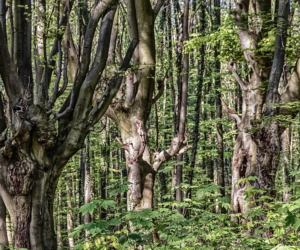
Stand beneath a beech tree and you’ll understand immediately why our ancestors revered it. The smooth, silvery bark seems to glow with its own light, even on cloudy days. The canopy spreads wide and generous, creating cathedral-like spaces beneath its branches. In autumn, copper leaves drift down like pages from ancient books. The beech has been called the tree of wisdom, the keeper of knowledge, the library of the forest. And for good reason. The Nature and Spirit of Beech The beech tree (Fagus) carries an energy distinct from other trees. Where oak is strength and willow is emotion, beech is intellect, memory, and the preservation of knowledge. This isn’t abstract. It’s rooted in the tree’s very nature and its relationship with humanity across millennia. Beech bark is uniquely smooth and pale, making it ideal for carving. For thousands of years, humans have carved messages, symbols, and records into beech bark and wood. The word “book” itself may derive from the Old English “bōc,” which also meant beech tree. Some scholars believe this connection arose because early Germanic peoples carved runes onto beech tablets. The tree literally became synonymous with the written word, with recorded knowledge, with learning preserved across time. Beech forests create a special environment. Their dense canopy allows little undergrowth, resulting in clean, open spaces beneath, natural halls perfect for study, contemplation, and teaching. The beech mast (nuts) that fall in autumn provided sustenance for both people and animals, linking the tree to abundance and provision as well as wisdom. Energetically, beech is cool, calm, and clarifying. It doesn’t have the fiery passion of rowan or the deep emotion of willow. Instead, beech offers mental clarity, enhanced memory, access to stored knowledge, and the patience required for true learning. It teaches that wisdom accumulates slowly, like rings in wood, and that knowledge preserved serves future generations. Beech in Mythology and Tradition Throughout European tradition, beech has been associated with learning, writing, and the preservation of knowledge. In Celtic tree lore, beech represents old knowledge, not the hidden mysteries of yew or the intuitive wisdom of willow, but accumulated learning, the kind found in libraries and passed through teaching. It’s the tree of scholars, scribes, and historians. The ogham symbol for beech is Phagos, though beech’s association with ogham is somewhat contested by scholars. Regardless of its technical placement in the ogham alphabet, folk tradition has long linked beech with written knowledge and the recording of information. Germanic peoples held beech sacred, using its wood for rune staves and magical inscriptions. The smooth bark and fine-grained wood made it ideal for carving symbols meant to last. When you wanted knowledge preserved, you carved it into beech. In later European tradition, beech groves were seen as natural schools. Places where children could be taught letters and numbers, where scholars could contemplate, where knowledge could be shared in the tree’s peaceful presence. Properties and Correspondences Element: Air (though some traditions assign it to Earth)Planet: Saturn or Mercury, depending on traditionGender: FeminineDeities: Odin (for runes and knowledge), Ogma (Celtic god of eloquence and writing), any deity associated with wisdom and learningMagical Properties: Wisdom, learning, memory enhancement, knowledge retention, literary pursuits, past-life recall, ancestor wisdom, patience, manifestation of wishes written on beech woodSeason: Late summer into autumnChakra: Third eye, for enhanced mental clarity and access to inner wisdom Harvesting Beech Respectfully When working with beech, approach with the respect you’d show a teacher or librarian. This tree guards knowledge, and accessing its gifts requires courtesy. Identification American beech (Fagus grandifolia) and European beech (Fagus sylvatica) are the primary species used in magical… …
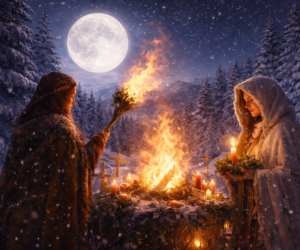
When: February 1-2 (traditional) or the astronomical midpoint between Winter Solstice and Spring Equinox (February 3-4) Also Known As: Imbolg, Oimelc, Brigid’s Day, St. Brigid’s Day, Candlemas (Christian), Lá Fhéile Bríde (Irish) Pronunciation: IM-olk, IM-bulk, or IM-bowlk Season: Cross-quarter day between Winter Solstice and Spring Equinox As February arrives with snow still blanketing the earth and cold winds howling, something shifts. The days have grown noticeably longer. The sun sits higher in the sky. Beneath the frozen ground, seeds begin to stir. Ewes heavy with lambs produce the first milk of the season. Life, dormant through the darkest months, begins its slow return. This is Imbolc, the festival that celebrates the first stirrings of spring while winter still holds the land in its grip. It’s a holiday of contradictions and hope: fire in the snow, milk from barren fields, light growing in darkness. For the ancient Celts and modern practitioners alike, Imbolc marks a sacred turning point in the wheel of the year. The Name and Its Meanings The word “Imbolc” carries layers of meaning, each revealing something about the festival’s significance: “I mbolc” – “In the belly” in Old Irish, referring to pregnant ewes and the seeds germinating beneath the earth. Life is literally “in the belly” of animals and the land, not yet visible but very much present. “Oimelc” – “Ewe’s milk,” acknowledging the lactation that begins as lambs are born or about to be born. In agricultural societies where winter food stores were dwindling, fresh milk was a literal lifesaver. “Imb-fholc” – “To wash or cleanse oneself,” connecting to the purification rituals traditional to this time. “Embibolgon” – A Proto-Celtic term meaning “budding,” the first signs of new growth. Each interpretation points to the same truth: Imbolc celebrates potential becoming reality, the hidden becoming manifest, the dormant awakening to life. The Historical Festival ~ Ancient Celtic Traditions Imbolc is one of the four Gaelic seasonal festivals, along with Beltane (May 1), Lughnasadh (August 1), and Samhain (November 1). These cross-quarter days marked the agricultural and pastoral year for the ancient Celts of Ireland, Scotland, and the Isle of Man. The Agricultural Reality The timing of Imbolc reflects practical farming cycles. In Celtic lands, sheep were bred to lamb in late winter, ensuring newborns arrived before the spring grass but while mothers could still survive on sparse winter vegetation. Cows, requiring better grazing, gave birth later in spring. This strategic timing meant that by Imbolc, ewes were lactating, providing fresh milk, butter, and cheese when winter food stores were dangerously low. The festival celebrated this critical transition from complete winter scarcity to the first abundance of the agricultural year. Early Irish texts mention Imbolc, though less frequently than Samhain. A 10th-century poem translated by scholar Kuno Meyer describes ritual practices: “Tasting of each food according to order, this is what is proper at Imbolc: washing the hands, the feet, the head.” This suggests purification and renewal rituals were central to the celebration. Weather Divination Like Groundhog Day (which actually derives from Imbolc traditions brought to America), ancient Celts practiced weather divination on this day. They listened for the song of the lark. If the bird sang, it meant the God had returned to the Goddess and spring would come early. If the lark remained silent, winter would continue for weeks more. This wasn’t superstition but practical observation. Migratory birds, plant budding, and animal behavior are all genuine indicators of coming weather patterns. The Celts were simply reading the natural signs that their survival depended on understanding. Brigid: Goddess and Saint Imbolc is inseparable from Brigid, one of the… …

Press your palm against ancient stone. Close your eyes. Beneath your hand lies rock that has witnessed millennia. Ice ages and tropical warmth, the footsteps of extinct creatures, the first humans to walk this land, countless births and deaths, joy and suffering beyond measure. The stone remembers. Not in words or images, but in the way all matter remembers – through imprint, through resonance, through the fundamental truth that nothing is ever truly lost. The Earth remembers everything. Every tear that has fallen and soaked into soil. Every drop of blood spilled in birth or death. Every footstep, every word spoken in anger or love, every spell cast, every prayer whispered. The planet is not inert matter but living memory, an archive beyond human comprehension, a witness to all that has ever occurred upon its surface and within its depths. This isn’t metaphor or poetry. It’s physics meeting mysticism. Matter holds memory. Water retains information about what it has contacted. Crystals store data. Soil contains the decomposed bodies of billions of organisms, each one having lived a life, each one now part of the earth itself. The Earth is built from memory, layered like sediment, compressed like coal, transformed like diamonds formed from ancient carbon. The Science of Earth’s Memory Modern science is beginning to catch up with what magical practitioners have always known. Researchers study how water molecules form structures based on their environment, how crystals hold electromagnetic patterns, how soil microbiomes contain genetic information from countless generations of life. Geologists read Earth’s history in stone layers. Each stratum a chapter, each fossil a word, each mineral deposit a sentence describing ancient conditions. The rocks remember when oceans covered continents, when mountains rose from flatlands, when the air itself was different. Paleontologists reconstruct entire ecosystems from fragments buried in earth. The soil remembers what lived here, what died here, what the climate was like, what the land looked like. Ground-penetrating radar reveals civilizations buried and forgotten by human memory but preserved in earth’s patient keeping. Even more remarkably, scientists have discovered that trauma can be encoded in DNA, passed through generations. If individual bodies remember, how much more does the Earth – the body that contains all bodies – remember? What the Earth Remembers The Earth holds memory of scales both vast and intimate. Geological Memory The planet remembers its own formation, the collisions that created it, the cooling of molten rock, the emergence of atmosphere and oceans. This memory lives in the oldest stones, in the structure of continents, in the magnetic field that has flipped poles multiple times across eons. Biological Memory Every organism that has ever lived has returned to earth. Your body contains atoms that were once dinosaurs, ancient trees, bacteria from the primordial soup. The Earth remembers every form life has taken, every adaptation, every extinction, every emergence of new species. This memory lives in soil, in oil deposits formed from ancient organisms, in limestone built from countless marine creatures. Human Memory The Earth remembers human history more completely than we do. It holds memory of civilizations we’ve forgotten, of peoples whose names are lost, of events no history book records. Buried cities, ancient roads, forgotten battlefields. The earth holds them all. Every human who has ever lived has walked upon the earth, bled into it, been buried in it. The planet is a graveyard and a cradle, and it forgets nothing. Emotional and Energetic Memory This is where science and magic most clearly intersect. Places hold the energy of what occurred there. Walk into a cathedral and feel the accumulated devotion of centuries…. …
There’s something almost otherworldly about mugwort. This hardy, silver-leafed plant grows wild across continents, thriving in forgotten corners and urban wastelands, yet it holds one of the most revered places in herbal magic and traditional medicine. Known as Artemisia vulgaris, mugwort has been called the “mother of herbs,” the “dream plant,” and a bridge between worlds. If you’ve been searching for ways to enhance your intuition, invite vivid dreams, or deepen your spiritual practice, mugwort might be the ally you’ve been seeking. The Cultural Legacy of Mugwort Mugwort’s name itself hints at ancient mysteries. The genus name Artemisia comes from the Greek goddess Artemis, the lunar deity of the hunt, wilderness, and childbirth. The connection to the moon is no accident. Mugwort has long been associated with feminine power, cyclical wisdom, and the realm of dreams that emerges when daylight fades. In medieval Europe, mugwort was known as the “mother of herbs” and was used extensively for women’s health issues, particularly menstrual problems and childbirth support. People believed it could protect travelers from fatigue, wild animals, and malevolent spirits. Roman soldiers reportedly placed mugwort in their sandals to prevent tired feet during long marches. Across Asia, mugwort holds equally sacred status. In Traditional Chinese Medicine, it’s called àicǎo and is the primary herb used in moxibustion. A practice where dried mugwort is burned near acupuncture points to enhance healing. Korean culture celebrates mugwort in culinary traditions, making rice cakes and soups with the herb during spring festivals. In Japan, mugwort baths are taken to purify the body and spirit. The Anglo-Saxon Nine Herbs Charm, a magical-medical text from the 10th century, lists mugwort first among nine sacred plants: “Remember, Mugwort, what you made known, what you arranged at the Great proclamation. You were called Una, the oldest of herbs, you have power against three and against thirty, you have power against poison and against infection, you have power against the loathsome foe roving through the land.” How Mugwort Works ~ The Spiritual and the Scientific Mugwort is classified as an oneirogen, a substance that produces or enhances dream-like states of consciousness. While scientific research on mugwort’s dream-enhancing properties remains limited, herbalists and practitioners have documented its effects for centuries through direct experience and traditional knowledge. The plant contains several active compounds, including thujone (a mild nervous system stimulant), various flavonoids, and aromatic volatile oils. These compounds may work together to create mugwort’s distinctive effects on consciousness and dreaming. Some herbalists suggest that mugwort doesn’t necessarily cause dreams but rather amplifies whatever dream state you naturally experience. Taking you “up a level” from your baseline. On a spiritual level, many practitioners describe mugwort as a plant that thins the veil between the conscious and unconscious mind. It doesn’t force visions or dreams but rather opens channels that may have been blocked, allowing your natural intuitive abilities to flow more freely. Mugwort for Lucid Dreams and Dream Recall Perhaps mugwort’s most celebrated use is for enhancing dreams. Users consistently report more vivid, colorful, and memorable dreams when working with this herb. The experiences range from simply remembering dreams upon waking (when you normally wouldn’t) to full lucid dreaming where you become aware you’re dreaming and can direct the dream’s events. Lucid dreaming isn’t just entertainment. Research suggests it may support mental health, emotional processing, and creative problem-solving. For people who suffer from recurring nightmares, lucid dreaming techniques combined with dream-enhancing herbs can provide a way to transform frightening dreams by gaining conscious control within them. However, it’s crucial to understand that mugwort alone won’t make you a lucid dreamer overnight. Think of… …