 Written by
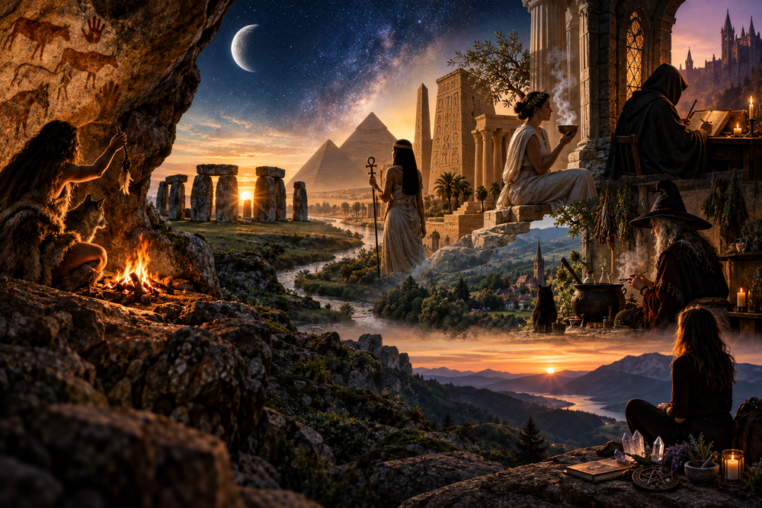
 Magic did not begin in a dusty library or a candlelit circle. It began at the edge of a fire, beneath an open sky, in the mind of a human being who looked at the world and sensed – knew – that something more lay just beneath its surface.
As Old as Humanity Itself
To trace the history of magical practice is to trace the history of human consciousness. Magic is not a footnote to civilisation. It is one of its oldest roots.
Long before temples were built, before writing was invented, before the first city rose from the earth, there were people who sought to understand and influence the forces that shaped their world. They watched the movements of stars with careful eyes. They observed which plants brought healing and which brought harm. They spoke to the spirits of rivers and forests, of ancestors and animals. They painted on cave walls in acts that were simultaneously art, prayer, and spell.
The cave paintings of Lascaux, created over 17,000 years ago, show animals rendered with extraordinary skill and intent. Many archaeologists believe these images were not merely decorative – they were magical. To paint the hunt was to call the hunt into being. To depict the animal was to invite its spirit into relationship. This is sympathetic magic in its most ancient form: the belief that like affects like, that the image carries the power of the thing it represents.
Magic, in other words, is older than history. And it has never truly left us.
The Ancient World: Magic as Sacred Technology
In the ancient civilisations of Mesopotamia, Egypt, Greece, and Rome, magic was not the province of outcasts and rebels. It was woven into the fabric of daily life, religious practice, and statecraft.
Mesopotamia
The civilisations of ancient Mesopotamia, Sumer, Akkad, Babylon, Assyria, produced some of the earliest written magical texts. Cuneiform tablets discovered at sites across modern Iraq record incantations against demons, rituals to protect the home, ceremonies to heal the sick, and prayers to invoke the favour of the gods.
The āšipu were specialist priests whose role was to diagnose magical afflictions and prescribe ritual cures. They worked alongside healers and physicians, understanding that illness could have both physical and spiritual causes. A holistic view of wellbeing that many modern practitioners would recognise immediately.
Ancient Egypt
In Egypt, magic – heka – was not merely permitted. It was a cosmic force, one of the fundamental principles through which creation was maintained. The god Heka personified this force, and all magical practice drew on his power.
Egyptian magical practice encompassed healing spells, love magic, protective amulets, funerary rites, and elaborate ritual ceremonies performed by trained priests. The famous Book of the Dead was, in essence, a grimoire for the afterlife. A collection of spells to guide the soul through the trials of death and into eternal life.
The Egyptians understood magic as a technology of consciousness, a way of working with the divine forces that permeated all of existence. To speak the right words, with the right intent, at the right time, was to create change in the world. This belief echoes through every magical tradition that followed.
Greece and Rome
The Greek magical tradition, recorded most completely in the extraordinary Greek Magical Papyri (a collection of texts from Greco-Roman Egypt, roughly 2nd century BCE to 5th century CE), blends Egyptian, Greek, Jewish, and later Christian elements into a rich, syncretic whole. These papyri contain spells, invocations, recipes, and rituals of remarkable sophistication, including practices for binding, healing, divination, and the invocation of deities.
The Greeks distinguished between goetia (often considered darker or lower magic, associated with the dead and with binding) and theurgy (higher magic, aimed at divine union and cosmic participation). This distinction, between magic that manipulates and magic that elevates, has echoed through Western occultism ever since.
In Rome, magic occupied a more ambiguous position. It was widely practiced, feared, and at various points legally persecuted. The defixiones, curse tablets inscribed on lead and cast into wells, springs, or graves, have been found in their thousands across the Roman world, testifying to a popular magical practice that thrived beneath the official disapproval.
The Medieval Period: Magic in the Shadow of the Church
With the rise of Christianity across Europe, the relationship between magic and official culture became fraught. The Church condemned magical practice in principle, yet magic continued to flourish . In the countryside, in the monasteries, in the courts of kings.
Medieval folk magic was pragmatic and earthy. Charms to protect livestock, spells to ensure a good harvest, remedies passed down through generations of healers and wise women. These practices drew on a deep well of pre-Christian tradition, now overlaid with Christian prayer and imagery. A healing charm might invoke the name of Christ alongside older, nameless powers.
At the same time, a sophisticated tradition of learned or ceremonial magic was developing among educated clergy and scholars. The grimoires, those great manuscript collections of magical instruction, were being written and copied. Works like The Key of Solomon and the Picatrix circulated among those with the learning to use them, blending Neoplatonism, Jewish Kabbalah, Arabic astrology, and Christian mysticism into a complex magical philosophy.
The Inquisition, intensifying from the 13th century onward, cast a long shadow over magical practice. The infamous Malleus Maleficarum (1487) systematized the persecution of witchcraft, conflating folk magic with diabolism and creating the template for the witch trials that would ravage Europe for two centuries. Thousands, the vast majority of them women, were executed.
Yet magic survived. It went underground, it adapted, it endured.
The Renaissance: A Magical Flowering
The Renaissance brought with it a remarkable flowering of magical thought. As classical texts were rediscovered and translated, scholars encountered the full richness of ancient Greek and Egyptian magical philosophy. The rediscovery of the Corpus Hermeticum, a collection of texts attributed to the mythical Hermes Trismegistus, sent a shockwave through European intellectual life.
Here was a magical philosophy that seemed to predate Christianity, that spoke of the divine spark within all things, of the human being as a microcosm of the macrocosm, of the possibility of ascending through the spheres of the planets to achieve union with the divine. This was Hermeticism, and it electrified a generation of thinkers.
Marsilio Ficino translated the Corpus Hermeticum into Latin in 1463. Giovanni Pico della Mirandola synthesised Hermeticism with Kabbalah and Christian theology. Heinrich Cornelius Agrippa wrote his monumental Three Books of Occult Philosophy (1531), the most comprehensive statement of Renaissance magical theory ever produced. John Dee, astrologer to Queen Elizabeth I, pursued angelic communication through a system of scrying that would later become the foundation of Enochian magic.
The Renaissance magician understood themselves as a philosopher, a scientist, a theologian, and a magical practitioner all at once. The boundaries between these disciplines had not yet hardened into the walls we know today.
The Early Modern Period: Persecution and Preservation
The witch trials of the 16th and 17th centuries represent one of the darkest chapters in the history of magical practice. A period of intense social fear in which the figure of the witch was constructed as the embodiment of everything threatening to the Christian social order.
The reality behind the persecution was complex. Some of those accused were indeed practicing some form of folk magic. Many were simply women who owned property, held unconventional views, or had made enemies. The image of the night-flying, devil-worshipping witch was largely a fantasy of the persecutors. But the deaths were entirely real.
Through it all, magical knowledge was preserved. Hidden in manuscripts, encoded in symbol systems, passed through unbroken chains of oral tradition. When the worst of the persecution had passed, magic emerged again – quieter, perhaps, more carefully guarded, but unbroken.
The 19th Century: The Occult Revival
The 19th century brought a remarkable resurgence of magical interest among educated Europeans and Americans. Industrialisation and scientific materialism had, for many, drained the world of mystery – and magic promised to restore it.
Spiritualism swept America and Britain from the 1840s onward, with millions attending séances and communicating with the dead through mediums. Theosophy, founded by Helena Blavatsky in 1875, synthesised Eastern and Western spiritual traditions into a comprehensive mystical worldview that influenced generations of occultists.
Most significantly, the Hermetic Order of the Golden Dawn, founded in London in 1888, brought together virtually all the strands of Western magical tradition into a single, systematic initiatory order. Its members included some of the most remarkable minds of the era: William Butler Yeats, Aleister Crowley, Dion Fortune, Arthur Edward Waite. The Golden Dawn developed a comprehensive magical curriculum drawing on Kabbalah, Hermeticism, tarot, astrology, and ceremonial ritual that still shapes Western magical practice today.
Aleister Crowley went on to found his own tradition, Thelema, and, whatever one thinks of his methods and personality, his influence on 20th-century magic cannot be overstated. His insistence on magic as a rigorous discipline of self-transformation, encoded in his famous axiom “Do what thou wilt shall be the whole of the Law,” remains a touchstone of modern ceremonial magic.
The 20th Century: Wicca and the Birth of Modern Witchcraft
The most significant development in 20th-century magic came not from the ceremonial lodges of London, but from a retired civil servant in the New Forest of England.
Gerald Gardner, initiated into what he claimed was a surviving coven of traditional witches in 1939, began publishing the religion that would become known as Wicca in the early 1950s. Drawing on ceremonial magic, folklore, and his own creative genius, Gardner presented Wicca as the survival of an ancient pre-Christian religion centered on the worship of a Goddess and a Horned God, the celebration of the seasonal cycles, and the practice of ritual magic within a consecrated circle.
Whether Gardner’s claims of ancient origin were literally true is debated. What is beyond debate is the extraordinary impact Wicca had on magical culture. Through figures like Doreen Valiente, who rewrote much of Gardner’s liturgy into the beautiful, poetic forms still used today, Wicca spread rapidly. By the 1980s it had crossed the Atlantic, and Starhawk’s The Spiral Dance (1979) brought it to a new generation of feminists and countercultural seekers.
The late 20th century saw an explosion of magical traditions: Alexandrian Wicca, the Feri Tradition, Reclaiming, various streams of ceremonial magic, chaos magic, and the beginnings of what would become the diverse, eclectic, fiercely individualized witchcraft scene of the present day.
Magic Today: A Living Tradition
We live in a time of extraordinary magical abundance. More books, courses, traditions, and communities are available to the seeker today than at any point in history. The internet has connected practitioners across continents, dissolved the barriers between traditions, and made ancient texts available to anyone with a connection.
Magic has also become more visible, more accepted, more discussed than perhaps ever before. The figure of the witch has been reclaimed – as a symbol of feminine power, of resistance, of ecological wisdom, of spiritual sovereignty. Millions identify as witches, pagans, Wiccans, occultists, or simply as people who practice magic.
And yet the essential experience at the heart of magical practice remains unchanged across all those millennia. The moment when you stand at your altar in the candlelight, when you feel the energy gathering in your hands, when the boundary between the seen and unseen worlds grows thin – this is the same experience that moved a human being to paint an animal on a cave wall 17,000 years ago.
Magic endures because the need it answers – to connect, to create, to understand the forces that move through the world – is as fundamental to human nature as the need to breathe.
Why This History Matters to Your Practice
Understanding the history of magical practice is not mere academic exercise. It is, itself, a form of magical work.
When you know where your practices come from, you understand them more deeply. When you trace the lineage of a ritual, you connect yourself to every practitioner who performed it before you. When you hold a grimoire in your hands, you are holding the accumulated wisdom of thousands of years of human magical experience.
You are not practicing in isolation. You are part of an unbroken chain stretching back to the first human who looked at the fire and sensed the sacred.
Honour that lineage. Learn from it. And then add your own voice to the long, shimmering song.
The roots of magic run deeper than history can measure. To practice is to join a conversation that began before writing, before cities, before the word “magic” itself existed – and that will continue long after we are gone.