
Walpurgis Night ~ A night of bonfires, old magic, and becoming

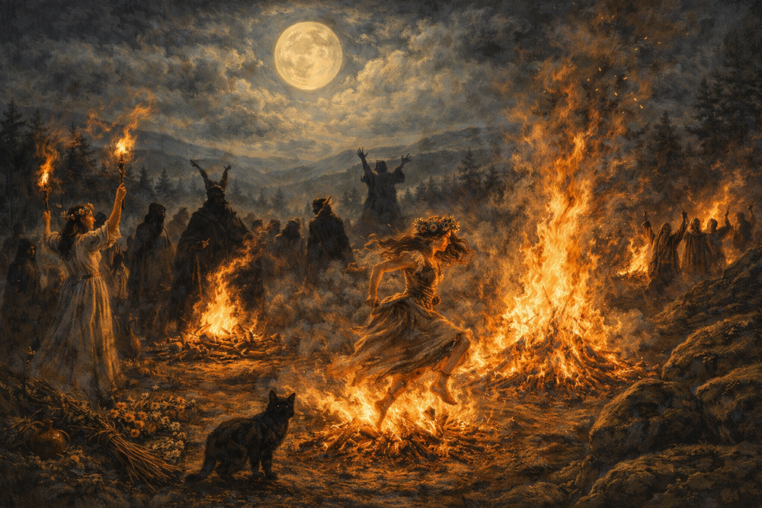
On the night of April 30th, something ancient stirs across northern and central Europe. Walpurgis Night, known in German as Walpurgisnacht, is a celebration that marks the midpoint between the spring equinox and the summer solstice. It is simultaneously the eve of the feast day of Saint Walpurga, an 8th-century English missionary canonized on May 1st, 870 CE, and the survival of something far older: pre-Christian Germanic and Celtic spring rites. The night sits on the edge of two worlds. In old folklore, the veil between the living and the spirit world thins, witches gather on mountaintops for their great sabbath, and chaos briefly reigns before summer takes hold. Think of it as the dark twin of Samhain. Both are liminal fire festivals at opposite ends of the year’s wheel. Walpurgis Night is sometimes called the “Witches’ Sabbath.” According to Germanic legend, witches and spirits convened at Brocken peak in the Harz Mountains, a tradition famously depicted in Goethe’s Faust. How it’s celebrated around the world Germany Bonfires light up villages, effigies of witches are burned to ward off evil, and people dress in costume. Towns in the Harz region draw thousands of revelers each year, particularly around the legendary Brocken peak. Sweden (Valborg) University students gather in city squares for outdoor choir singing, speeches, and champagne. A uniquely joyful, academic celebration of spring’s arrival. One of the most anticipated nights of the Swedish calendar. Finland (Vappu) One of Finland’s biggest holidays. Students don white graduation caps, picnic in parks, drink sparkling wine, and fill the streets with confetti and song. It is as much a civic celebration as a seasonal one. Czech Republic Bonfires are lit and effigies of witches burned to drive away evil spirits. Families gather outdoors to sing and mark the end of winter’s grip in a tradition that has continued for centuries. Pagan & witchcraft traditions Modern pagans and Wiccans celebrate Beltane on the same night . Lighting fires, dancing, leaving offerings, and honoring the earth’s fertility and abundance. The wheel of the year turns here toward its brightest point. The Harz Mountains The legendary epicenter of Walpurgis mythology. Villages like Thale and Schierke host massive festivals where thousands dress as witches and warlocks and dance through the night around the Brocken. The mythology behind the chaos The wild imagery of Walpurgis Night, witches astride broomsticks, demons at crossroads, storms summoned at mountaintops, has roots in a fascinating cultural collision. Early Christian missionaries in Germanic territories encountered deeply embedded spring rites. Unable to eradicate them, the Church overlaid the feast of Saint Walpurga atop April 30th. But the old beliefs persisted underneath, now charged with the transgressive energy of the forbidden. By the medieval period, the “witches’ sabbath” had become a projection of collective fear and fascination. Everything respectable society suppressed, feminine power, bodily freedom, knowledge outside clerical control, was imagined gathering on Brocken Mountain in a frenzy. Goethe captured this perfectly in the Walpurgisnacht scene of Faust, where chaos itself dances. What survives today is something more honest. A night that asks us to look at the wild, liminal, untameable parts of existence. And instead of fearing them, dance with them. — April 30 · Where winter ends and something brighter begins 🪄 Rituals for the night Whether you approach this night as folklore, spirituality, or simply seasonal ritual, there are meaningful ways to mark the threshold. These are drawn from both historical practice and modern pagan tradition. 1. Light a candle or bonfire Fire is the heart of Walpurgis. Even a single candle honors the tradition. Let it burn as you reflect on...

Membership Required

You must be a member to access this content.

View Membership Levels

Already a member? Log in here