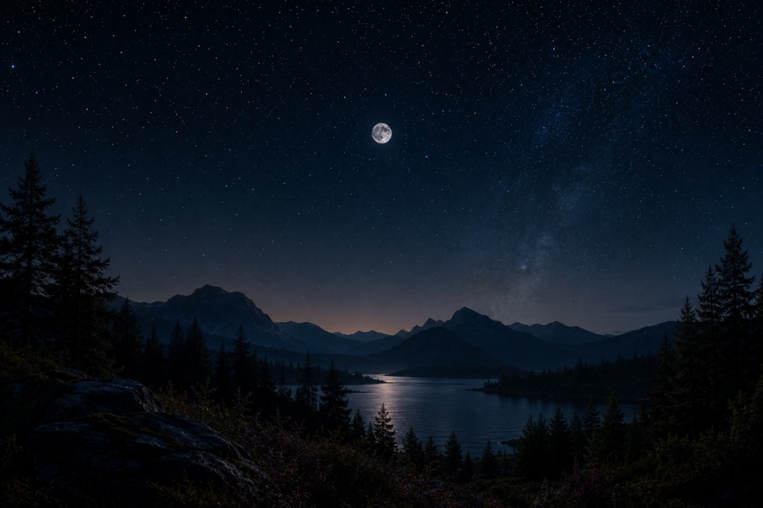

May gave us two full moons this year.The first, the Flower Moon on May 1st, arrived at the threshold of the month, bright and abundant, thick with the energy of everything that was beginning to open. And now, at the very end of May, a second full moon rises: a Blue Moon. The second full moon in a single calendar month, an event that happens only every two or three years. Hence the phrase.Once in a blue moon.This one falls on Sunday, May 31st, reaching its peak in the early hours of the morning. It is also a micromoon. The moon is at its furthest point from Earth in its orbit, which means it appears slightly smaller and more distant than usual. Not the overwhelming blaze of a supermoon. Something quieter. A moon that asks you to look carefully rather than simply being impossible to ignore.There is something fitting about that, for Blue Moon work. This is not the energy of expansion and overflow. It is the energy of the second chance – the revisit, the deeper look, the thing you almost missed. What a Blue Moon HoldsIn folk tradition, the Blue Moon was considered a time outside ordinary time. A liminal pocket in the calendar, a month that had more than it should, and therefore held more than usual.The second full moon in a month has no name in the traditional indigenous moon calendars, because those calendars did not organise themselves around the twelve-month Gregorian year. The Blue Moon is a glitch in the accounting system. A moon that fell between categories, that didn’t fit the expected pattern, that arrived when the month had already had its full moon and wasn’t officially due another one.In practice, this makes it excellent for:– Returning to what was left unfinished at the Flower Moon on May 1st – the intention you set but haven’t yet embodied, the question you asked but haven’t yet received an answer to– Working with what is between categories – the aspects of yourself, your practice, or your life that don’t fit the expected pattern, that fall between the definitions, that are harder to name and therefore often harder to honour– The long view – Blue Moons invite a different temporal scale, the kind of question you ask not about this month or this year but about the longer arc of a life and a lineageThe micromoon quality adds to this. Where a supermoon can feel almost overwhelming, all that reflected light, all that amplified pull, the micromoon is more inward. More precise. It rewards attention that goes deep rather than wide. Before You Write ~ Setting the SpaceThe full moon is not an occasion that requires elaborate ceremony, but it rewards intention. Before you sit with these prompts, take a few minutes to create the conditions for honesty.Light a candle – white for clarity, silver for lunar energy, or whatever colour your instinct reaches for tonight. Pour a glass of water and set it near you; water is receptive, lunar, the element most closely associated with the unconscious work the moon pulls toward the surface. If you work with an ancestor altar, spend a moment there first.Sit outside if you can, or near a window where the moonlight reaches you. Let your eyes go soft. Let your breath slow down.You are not doing this to produce good writing. You are doing this to find out what is true.Write in whatever way the words come. In sentences, in fragments, in lists, in images. Don’t correct or edit. The first things that arrive are usually the ones that matter....
