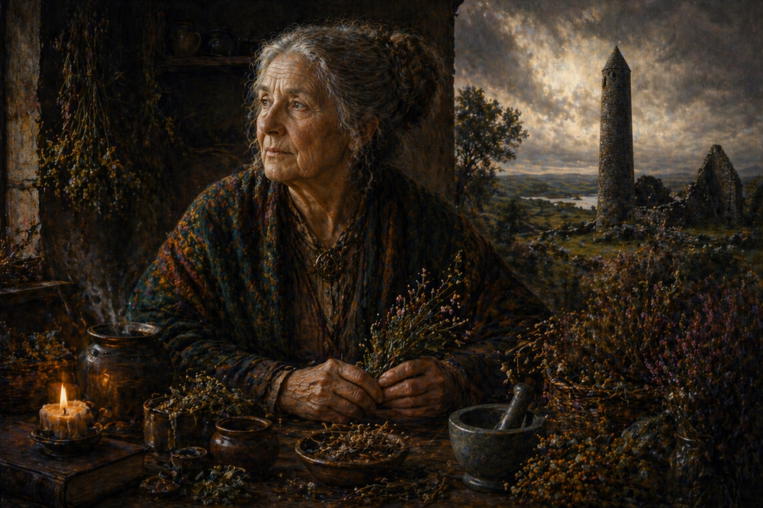
There is a two-roomed cottage in ruins on a hill above Kilbarron Lake in County Clare, Ireland. The roof is long gone. The walls are worn down by a century and a half of Atlantic weather. The lake below it is dark and still in winter, silver and unremarkable in summer. There is no marker. No plaque. No monument of any kind.But people still go there.They have been going since before the woman who lived there was in the ground. They walked miles across bog and mountain to get to that cottage. The sick, the desperate, the grieving, the merely curious, the powerful who needed to know which way the wind was blowing. They brought whiskey and poitín and food they could barely spare. They knocked on the door beyond the little humpy bridge and they waited, and eventually they were seen.The woman who saw them was red-haired, sharp-tongued, and entirely her own. She had outlived four husbands, survived the Great Famine, and been tried for witchcraft in the town of Ennis. A charge that collapsed because every single witness called against her refused to testify when the moment came.She kept a dark bottle that she said came from the fairy world, and she would gaze into it to know what she needed to know. She accepted no money. She refused no one who came in genuine need. She smoked a pipe, drank poitín with considerable enthusiasm, and could still put, by all accounts, a glamour on young men when she was in her seventies.Her name was Biddy Early. W.B. Yeats called her “the wisest of the wise women.” The parish priest, at her funeral, called her “a saint who walked in our midst.”She died in poverty in 1874, in the cottage above the lake, with a rosary around her neck and her bottle, some say, in her hand.She was never anything other than what she was. In nineteenth-century Catholic Ireland, during the worst catastrophe the country had ever known, that was the bravest possible thing to be. Who Was Biddy Early?Biddy Early was born Bridget Ellen Connors in 1798 in the townland of Faha, Kilanena, County Clare. The only child of John Thomas Connors and his wife Ellen, who went by her maiden name Early. That Biddy would eventually take her mother’s name rather than her father’s, or the names of any of her four husbands, is telling. She believed her gifts descended through the matrilineal line. The name was an inheritance.The year of her birth was one of the bloodiest in Irish history. The rebellion of the United Irishmen, the uprising inspired by the American and French revolutions and the dream of an independent Irish republic, was crushed in 1798 with savage Crown reprisals across the country. Biddy arrived into a world of violence, poverty, and a people accustomed to having their hopes destroyed.Her family lived on the perpetual edge of destitution, as most of County Clare did. By sixteen both her parents had died of malnutrition and disease. Her mother, before she died, passing on to Biddy what she knew of herbal medicine. This knowledge, transmitted mother to daughter in the last hours before death, was the seed of everything that followed.Orphaned and without means, Biddy was sent to work as a servant girl, first in Feakle, then for a Doctor Dunne in Kilbarron. She spent some time in a workhouse. The grim institution of last resort that nineteenth-century Ireland used to house its most destitute. None of this broke her. It is tempting to speculate that it did something else entirely. Sharpened her, grounded her in...
