 Written by
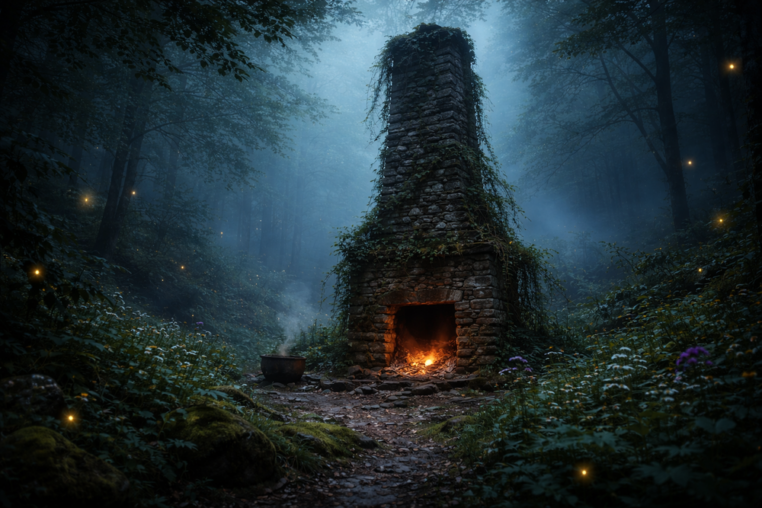
 In the mountains of Appalachia, the old people knew things about chimneys that most of the modern world has forgotten.
They knew that you did not whistle near the hearth after dark. That you never let the fire go out on certain nights of the year without speaking a word of protection over it first. That strange sounds in the chimney were not the wind – or not only the wind. That the smoke rising from a well-kept fire carried something upward with it, and that what came down the chimney could be something other than weather.
These were not superstitions in the dismissive sense of that word. They were an inherited body of knowledge, passed down through generations of mountain families, about the nature of the home’s most important threshold: the chimney. About what it connected. About what it let in, and what it was the job of the household to keep out.
To understand where this knowledge came from, and why it is so remarkably consistent with beliefs that predate America by thousands of years, you have to follow the smoke backward, across the Atlantic, into the Celtic-speaking communities of Scotland and Ireland and Wales from which so much of Appalachian culture descends.
What you find when you get there is not a coincidence. It is a tradition.
The Appalachian World and Where It Came From
The culture of the southern Appalachian mountains, the region encompassing parts of Virginia, West Virginia, Kentucky, Tennessee, North Carolina, and Georgia, is one of the most distinctive regional cultures in North America, and one of the most misunderstood.
The settlers who moved into these mountains from the late seventeenth century onward came predominantly from the British Isles, and specifically from the Celtic fringe. From the Scottish Highlands, from Ulster (the Scots-Irish who became the backbone of Appalachian settlement), from Ireland, from Wales, and from the border regions of Scotland and England where Celtic and Germanic traditions had been interweaving for centuries. They arrived in a landscape that was geographically isolated in ways that amplified rather than diluted their cultural inheritance. The mountains kept the outside world out and kept what was inside preserved.
The result was a culture that retained elements of British and Celtic folk belief long after those beliefs had faded or modernized elsewhere. Folklorists who began collecting Appalachian material in the late nineteenth and early twentieth centuries, figures like Cecil Sharp, who came to collect ballads, and later the WPA workers who documented mountain life during the 1930s, found a world that in many respects resembled rural Britain several centuries earlier more than it resembled the contemporary United States surrounding it.
This is the context for Appalachian chimney folklore. It is not an independently invented set of beliefs. It is a transplanted tradition, adapted to a new landscape and new circumstances, but carrying its roots in the Celtic understanding of fire, threshold, and the relationship between the domestic world and what lies beyond it.
The Chimney as Threshold ~ Why It Matters
In every tradition that takes the structure of the home seriously as a spiritual matter, and Celtic tradition does, deeply, the home has two primary thresholds: the door and the chimney.
The door is the obvious one. Every folk magic tradition in the world has something to say about the door. What you hang above it, what you bury beneath it, what you speak over it, what you plant beside it. The door is where the visible world enters. Its protection is the most widely documented.
But the chimney is the threshold that connects the home to what is above and below simultaneously. Fire ascends through it, carrying smoke upward. Rain and wind descend through it, the outside forcing its way down into the domestic interior. And in the folk cosmology that underlies both Celtic and Appalachian belief, the chimney is a passage. An opening in the roof of the protected world through which spirits, both benevolent and otherwise, can travel.
This understanding has an ancient root. In the earliest domestic architecture, the round houses of the Iron Age Celts, the longhouses of their contemporaries, the central fire was the heart of the home, and the hole in the roof through which its smoke escaped was the home’s primary connection to the sky world. The hearth was the axis of the domestic cosmos. What rose through the smoke-hole and what came down through it were matters of genuine spiritual concern.
The chimney is a sophistication of that smoke-hole, but it carries the same symbolic weight. In Appalachian tradition, as in the Celtic tradition from which it descends, the chimney is not simply a flue. It is a door.
The Celtic Hearth ~ Fire as Sacred Relationship
To understand why the chimney holds such significance in Appalachian folk belief, you first have to understand what the Celts believed about fire itself.
The hearth fire in Celtic tradition was not merely functional. It was the home’s sacred center – the embodiment of the family’s continuity, the place where the boundary between the physical and spiritual worlds was thinnest, and the dwelling place of the household spirits who protected those within.
In Ireland, the teine, the hearth fire, was kept burning as a matter of spiritual as much as practical necessity. Extinguishing the fire entirely was considered deeply inauspicious, an act that invited misfortune and broke the connection between the household and its protective spirits. In Scottish Highland tradition, the smooring of the fire at night, the ritual banking of the coals so they would survive until morning, was accompanied by specific prayers and invocations, often addressing the fire as a living presence and asking for its continued protection through the hours of darkness.
The Carmina Gadelica, the extraordinary collection of Scottish Gaelic oral tradition compiled by Alexander Carmichael in the late nineteenth century, preserves many of these smooring prayers. In them, the fire is addressed as a companion, a guardian, an ally whose cooperation is sought and whose absence is feared. The Gaelic practitioner did not simply manage a fire. They maintained a relationship with it.
This understanding of the hearth as a living, relational presence, something that both requires tending and offers protection in return, is precisely what appears in Appalachian mountain tradition, transposed into the English vernacular but structurally identical.
The Smooring Tradition and Its Appalachian Echo
The Scottish practice of smooring the fire, banking the coals at night with ash and speaking protective words over them, has a direct counterpart in Appalachian practice that most people who grew up in mountain households would recognize, even if they never had a name for it.
Mountain families spoke over their fires. Specific phrases, often passed from grandmother to grandchild without explanation of their origin, were said at the last tending of the fire each night. The coals were covered. Protection was invoked. Not always in explicitly spiritual language, but in the particular phrasing that meant the same thing the Gaelic prayers meant:
Stay with us through the dark, protect what is within these walls, do not let what should not enter come through this opening while we sleep.
The chimney was specifically addressed in some traditions. Windows could be shuttered, doors could be locked and charmed, but the chimney was open. There was no way to close it without stopping the fire. And so the fire itself became the guardian of the opening. A well-tended, spoken-over fire in a mountain home was understood to protect the chimney passage in both directions: keeping the household’s warmth and spirit within, and keeping whatever traveled through chimneys at night from coming fully in.
What traveled through chimneys at night? In Appalachian tradition, the answers are specific and consistent.
What Comes Down the Chimney ~ The Spirit Traffic
The chimney in Appalachian folklore is a documented entry point for several categories of unwanted spiritual visitor, and the beliefs surrounding these visitors are strikingly parallel to Celtic traditions that predate the settlement of America by centuries.
Witches and the Night Ride
In both Appalachian and Scottish folk tradition, witches were understood to travel at night through chimneys. This is the same tradition that underlies the European flying-witch-on-a-broomstick image, but in both mountain Appalachian and Scottish Highland versions it is considerably more grounded and more specifically chimney-focused than the popular image suggests.
In the Appalachian tradition, a witch who wanted to enter a sleeping household undetected would come down the chimney. This was the entry point that had no lock, no visible protective charm (unlike the door, which the careful householder might have protected with iron or a written charm), and the natural darkness and smoke that concealed movement.
Protection against this entry was therefore specifically chimney-directed. Iron implements placed in or near the chimney, a horseshoe hung inside the fireplace, iron tongs placed crosswise in the chimney throat, were understood to block entry. In the Scottish tradition this is almost identical: iron was considered the most reliable barrier to supernatural passage, and its placement at the chimney was specific and intentional.
The salt tradition overlaps here as well. Salt thrown into a fire, a practice found in both Celtic and Appalachian households, was understood to purify the chimney passage and make it inhospitable to supernatural traffic. The crackle and spark of salt in flames has an immediate and satisfying violence to it that makes it easy to believe it is doing something definitive.
The Fetch and the Death Sign
In Scottish and Irish tradition, the fetch is an apparition of a living person that appears as an omen of their death. Most often seen at dusk by someone the dying person is close to. In Appalachian tradition, the equivalent figure goes by various regional names but the belief is identical: if you see the shape of a living person in a place that person is not, particularly at the threshold moments of dusk and dawn, that person is in danger.
The chimney connection here is specific: in several regional traditions, the fetch or its equivalent was said to appear at the chimney top. Seen against the sky by someone looking up, or seen coming down, before the death it augured. The chimney, as the connection between the home and the sky world, was understood as the route the death sign took to deliver its message.
This belief almost certainly connects to the older Celtic understanding of the smoke-hole as the axis between worlds. The point through which communications between the living and the dead, the earthly and the spirit world, could travel in both directions.
The Ancestor Traffic
Not everything that traveled the chimney in Appalachian and Celtic belief was threatening. The hearth was also the gathering point for the dead of the family. The ancestors who maintained a connection to the household after death, who had sat at this same fire when alive, and who were understood to return to it.
In Scottish and Irish tradition, the fire was often left burning not just for warmth but as a beacon. Kept alight as a sign that the dead were welcome in the household, that the connection between the living family and its ancestors was being maintained. The smooring prayers address this explicitly in some versions, invoking the protection of specific ancestors alongside the protection of the fire itself.
In Appalachian tradition, this appears in the belief that the dead come back to the hearth. That the sounds in the chimney on particular nights, particularly around Halloween (which the mountain communities retained as a significant turning-point, consistent with its Celtic origin as Samhain), were the returning dead. Some families left a plate of food beside the fire on these nights. Some left the chair of a recently deceased family member pulled up to the hearth, for them to sit in. The fire was the gathering place of both the living and the dead, and the chimney was how the dead found their way back.
Specific Appalachian Chimney Beliefs and Their Celtic Parallels
The Whistling Prohibition
In Appalachian tradition, whistling inside the house, and particularly near the chimney or fire, was considered to call something in. The specific content of what might be called varies by region: bad weather, the devil, witches, spirits. But the prohibition itself is consistent and widespread.
In Scottish and Irish tradition, whistling was understood to call the wind. And the wind, in Celtic cosmology, is frequently a vehicle for spirit travel. Whistling indoors, near the fire, near the chimney, was understood as an inadvertent invocation, an invitation issued without knowing to what.
Smoke Omens
The behavior of chimney smoke was read as omen in both traditions with remarkable consistency. Smoke that fell rather than rising was an ill sign, something was pressing down on the house from above, or the passage between the home and the sky world was disrupted. In the Celtic tradition this was associated with coming hardship or death. In Appalachian tradition the same reading of falling smoke appears in virtually identical form.
Smoke that rose straight and clean meant the home was in good order, spiritually as well as physically. A fire that burned unusually bright or that produced unusual colors in the flame was read as meaningful. Blues and greens could indicate the presence of a spirit, sudden brightness could indicate supernatural visitors.
The New Year Fire
In both Celtic and Appalachian tradition, the fire at the turning of the year held particular significance. In Scottish Highland practice, the Oidhche Challain, Hogmanay, the New Year, involved specific fire traditions including the extinction and relighting of all fires from a single communal source, and the careful management of what crossed the threshold first in the new year.
In Appalachian tradition, a related set of beliefs governed New Year fire management. The fire should not be allowed to go out on New Year’s Eve, nothing should be removed from the house (including ash from the fire) on New Year’s Day, and the first person to cross the threshold in the new year should ideally be a dark-haired man bringing gifts. The equivalent of the Scottish first-footing tradition, which itself connects to older beliefs about what the chimney and threshold let in at the year’s vulnerable turning point.
The Chimney Swallow and the Protected Bird
In both Appalachian and British folk tradition, certain birds nesting in chimneys were understood as protective presences. Bringing luck to the household and connecting the fire below to the natural world above. Swallows and swifts, which historically nested in chimney tops, were considered particularly lucky and were never deliberately disturbed.
The Welsh tradition specifically held that swallows nesting in a building protected it from fire and lightning. A belief that connects directly to the bird’s position at the chimney, the fire’s threshold with the sky. Appalachian mountain families held a closely parallel belief, that chimney swallows brought good fortune and that disturbing their nest would bring bad luck or fire to the house.
The Hagstone at the Chimney
One of the most specific and interesting connections between Appalachian and Celtic chimney magic is the use of the hagstone. A naturally holed stone, also called an adder stone, elf stone, or in Scots Gaelic clach nathrach, as a chimney protection.
In Scottish, Irish, Welsh, and English folk tradition, naturally perforated stones were considered powerful apotropaic objects, things of protection and warding. They were hung at stable doors to protect horses, above beds to prevent nightmare, at thresholds to prevent harmful magic. Looking through the hole in the stone was said to allow you to see the fairy world as it actually was, without glamour or illusion.
The specific use of hagstones at chimneys, hung on a cord inside the chimney, or placed on the chimney breast, to prevent witches and harmful spirits from descending appears in both British and Appalachian folk practice. The logic is consistent: the natural hole in the stone is itself a threshold, and thresholds that occur naturally in stone are considered particularly potent in blocking supernatural passage. Like catches like. A hole catches and holds what tries to pass through it.
The Living Tradition ~ What Was Kept and Why
Appalachian chimney folklore is not a dead tradition. It is alive. Sometimes in modified form, sometimes barely recognizable from its origins, but present in the practices of mountain families who light a candle beside the hearth on Samhain, who speak words over the fire before banking it for the night, who maintain a careful awareness of what the chimney in their home represents.
That survival is remarkable, because it happened without the support of the institutions that usually maintain folk tradition. Without the church’s sanction, without academic preservation, without any deliberate effort to transmit the tradition as tradition. It survived because it was useful. Because families who understood the chimney as a spiritual threshold and acted accordingly felt the difference between a protected home and an unprotected one. Because the practices – speaking over the fire, placing iron at the hearth, attending to smoke as omen – were embedded in the daily rhythms of household management in ways that made them almost invisible as separate practices at all.
They looked like habits. They were inheritance.
The Celtic beliefs that crossed the Atlantic with the Scots-Irish settlers of the eighteenth century did not arrive as a formal spiritual system with a name and a doctrine. They arrived as the accumulated practical wisdom of people who had lived in relationship with fire, threshold, and the spirit world for generations before they ever set foot on a ship. The mountains of Appalachia simply gave that wisdom a new landscape to inhabit.
The smoke still rises the same way. The chimney still connects the same worlds. And in the oldest mountain households, the careful householder still speaks a word over the fire before the lights go out.
Just as their grandmothers’ grandmothers did. On the other side of an ocean. In a language most of them no longer remember.
Working with This Tradition ~ The Chimney in Contemporary Practice
For the practitioner who feels called to this intersection of Appalachian and Celtic hearth magic, here are some practices rooted in the tradition described above.
The fire blessing. Before banking or extinguishing your fire, stove, or even your candle flame for the night, speak a brief blessing over it. Not an elaborate ritual, just the acknowledgment that this flame is a companion and a guardian, and your gratitude for its presence and its protection. This is the direct descendant of the smooring prayer, and it requires nothing except the intention and the words.
Iron at the hearth. A horseshoe hung inside or above the fireplace (ends pointing upward to hold the luck), iron tongs placed beside the fire, or a simple iron nail pressed into the mortar at the chimney breast – any of these continue the tradition of iron as chimney guardian. If you have no fireplace, the stovetop or the kitchen is the hearth’s contemporary equivalent.
The salt offering. A pinch of salt thrown into a candle flame or a fire, with the intention of purifying the chimney passage and making it unwelcoming to what should not enter, is a simple and powerful act that carries the full weight of the tradition behind it.
The hagstone guardian. A naturally holed stone hung near the fireplace or the chimney, found on a beach, a riverbank, or anywhere stones are moved by water, is both a beautiful object and a genuine protective presence in the tradition of both Britain and Appalachia.
The ancestor fire. On Samhain, or at any time of ancestor work, leave a candle burning at the hearth with the explicit intention of making the home’s central fire a beacon for your returning dead. Speak the names of those you are inviting to gather at the warmth. This is perhaps the oldest use of the hearth fire that we have record of, and it requires only the fire, the intention, and the willingness to make the dead welcome.
What the Chimney Keeps
There is something that moves me about this particular thread of continuity. The way a set of beliefs about fire and threshold and what travels through the smoke-hole of a round house in Iron Age Scotland survived well enough to be present in the chimney practices of a mountain family in Tennessee two thousand years later.
Not in a museum. Not in a book. In the actual practices of actual people who were simply doing what their families had always done, without necessarily knowing why, without knowing what language those practices had originally been spoken in, without knowing anything about the Iron Age or the Gàidhealtachd or the long journey from Scotland to Ulster to the Blue Ridge Mountains.
They knew what the fire needed. They knew what the chimney was. They knew what to say before the lights went out.
That knowledge is worth recovering. Worth understanding in its depth, its connections, its beautiful long history. And worth practicing – in whatever form fits your hearth, your home, your own working relationship with the fire that keeps you warm.
Tend it well. Speak to it kindly. Know what it guards.
The smoke still carries things upward. And the chimney is still open.