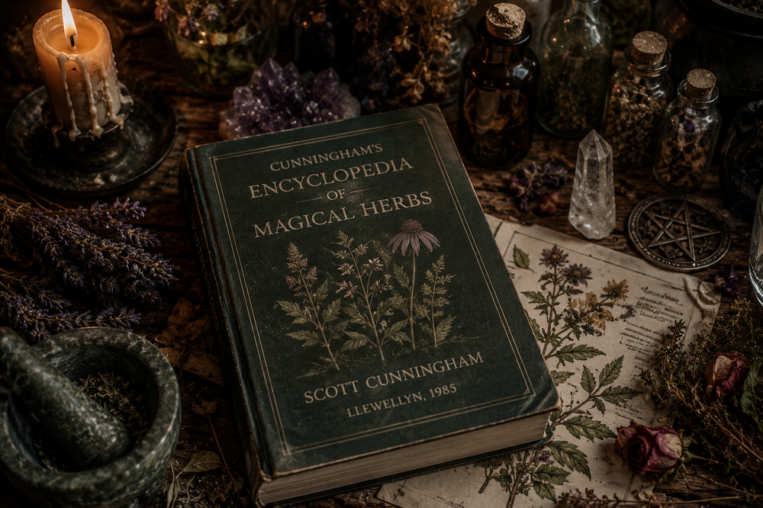

The image depicted here is an AI-generated representation of Cunningham’s Encyclopedia of Magical Herbs. As I do not have permission to republish any image of the book. There is a particular kind of book that becomes furniture. Not in the dismissive sense. In the sense that it is simply always there, always open, always consulted, until its spine breaks and you buy another copy because you cannot imagine working without it. Scott Cunningham’s Encyclopedia of Magical Herbs is that kind of book. It has been in print for over forty years. There are practitioners who have worn through five copies. The book does not teach you how to work magic. Cunningham is honest about this from the introduction – it is a reference, not a course. What it gives you is the accumulated folk knowledge of centuries, distilled into accessible entries for over 400 herbs, each noting the plant’s common and scientific names, planetary and elemental associations, gender, deity correspondences, magical powers, and practical uses. There are hand-drawn illustrations throughout, a comprehensive index organised by folk name as well as by application, and a cross-reference section that solves one of the most persistent practical problems in historical craft. If a spell calls for “bat’s wings,” what does that actually mean? (Holly. It means holly.) The folk name index alone is worth the cover price. Many older charms and recipes used euphemistic or coded names for plants, partly for secrecy, partly because naming conventions varied wildly by region, and without a key, a practitioner working with historical material can lose hours. Cunningham provides the key, carefully assembled from sources across traditions and centuries. His approach across the book is warm, practical, and genuinely respectful of the plants themselves. He does not treat herbs as interchangeable magical ingredients to be swapped in and out according to a spreadsheet. He encourages practitioners to develop their own direct relationships with plants, to work with what grows locally and what responds to their particular energy, and to treat the folk knowledge in the encyclopedia as a starting point for personal experimentation rather than a fixed authority. The main limitation is one Cunningham himself would probably acknowledge: this is a reference, not an explanation. The entries tell you what is associated with each herb and how it has been used, but not always why. The mythological and historical reasoning behind the associations is largely absent. A practitioner who wants to understand the underlying logic of, say, why bay laurel is associated with protection and prophecy, or why elder has the fraught, liminal quality it carries across European folk traditions, will need to look elsewhere. The Encyclopedia maps the territory without always explaining how the map was drawn. But the map is excellent. No practitioner working with herbs needs more than this and a willingness to spend time in the actual plants. For over forty years, people have been consulting it with their hands still dirty from the garden, and the book has not let them down. Who it’s for: Every practitioner, at any level, who works with plants in any capacity. The reference book that belongs on every craft shelf. Pair with: direct work with your local plant allies, and any good history of herbal folk magic for the reasoning behind the correspondences....
