 Written by
 You wake in the morning to find your hair impossibly knotted – tight, twisted tangles that seem to have woven themselves in the night. No amount of tossing and turning could have produced something so intricate. You don’t remember dreaming. But something was here.
In the folklore of the British Isles and Ireland, there is a name for this: fairy knots. Or elf-locks. Or witch tangles. The name changes by region, but the belief is the same. The knots were made by unseen hands, and their presence means something.
What Are Fairy Knots?
Fairy knots, also called elf-locks, hag-knots, witch-knots, and in Scottish Gaelic, cìr mhòr, are the unexplained tangles and matted sections found in hair (human or animal) upon waking. In folk tradition, they are understood as the physical evidence of nocturnal fairy activity: the marks left behind when the Fair Folk pass through the sleeping world and braid, twist, or tangle the hair of those they visit.
They are not merely superstition about bad hair. In the magical tradition, fairy knots are considered intentional. A form of binding, a marking, or a message. The knot is one of the oldest magical acts in human history, and fairy knots are understood as fairy magic made visible on the body of the person (or animal) it has touched.
The Lore Behind the Locks
The Fair Folk and the Sleeping World
In Irish, Scottish, and English folk belief, the boundary between the fairy realm and the human world grows thin at night. And especially thin at certain times of year. Midsummer and Samhain are well-known liminal periods, but in everyday folk practice, every night carries some degree of fairy danger. The Fair Folk move through the sleeping world freely, and humans, unconscious and unguarded, are more vulnerable to their attention.
Fairies were not universally understood as benevolent. The tradition that modern culture sometimes softens into whimsy was, in its older form, a belief in powerful, unpredictable, deeply other beings who operated by their own rules. The Fair Folk could bless or harm, assist or obstruct, and their interest in a human was not always comfortable even when it wasn’t malicious.
Finding fairy knots in your hair in the morning was proof that fairies had been present – and that they had taken an interest in you.
The Hag-Riding Connection
Fairy knots are closely tied to the older tradition of hag-riding. The experience of waking paralyzed in the night, feeling a presence, sometimes a weight on the chest, with no ability to move or cry out. What we now understand as sleep paralysis was explained in folk tradition as the Hag, the Mare, or a fairy being sitting astride a sleeping person.
The tangled hair was the evidence left behind. Just as fairies were said to ride horses through the night (more on this shortly), they were also thought to ride sleeping humans. And the knots in the hair were where their fingers had gripped, braided, and woven to keep their mount in a tractable state. A knotted bridle made of hair, invisible in the morning light but present in the tangle.
This is why the knots were taken seriously. They weren’t just cosmetic. They were a record of contact.
Elf-Locks in Shakespearean England
By the time Shakespeare was writing in the late sixteenth and early seventeenth centuries, elf-locks were a recognized piece of fairy lore familiar enough to work as a literary reference. In Romeo and Juliet, Mercutio’s famous Queen Mab speech describes the fairy queen traveling through the night and, among her many mischievous acts, tangling the manes of horses and the hair of slovenly maids. The elf-lock, in this tradition, was specifically a mark of fairy attention: those who were careless, or those who were noticed, received them.
The association with Queen Mab is significant. She is a fairy of dreams, of the liminal sleep-world, of the night-time passages between what is waking and what is not. Her knots are the residue of her dreaming work.
Horses in the Wild: The Elf-Locked Mane
Of all the creatures said to bear fairy knots, horses hold a special place in the tradition.
In British and Irish folk belief, horses were considered uniquely susceptible to fairy attention. Perhaps because they were so valuable, so intimately connected to human life, and so clearly powerful in their own right. A horse that was found exhausted, sweating, and trembling in its stable in the morning, despite having been locked in all night, was said to have been fairy-ridden. Taken out by the Fair Folk to serve as their mount while the human world slept.
And the evidence, always, was in the mane.
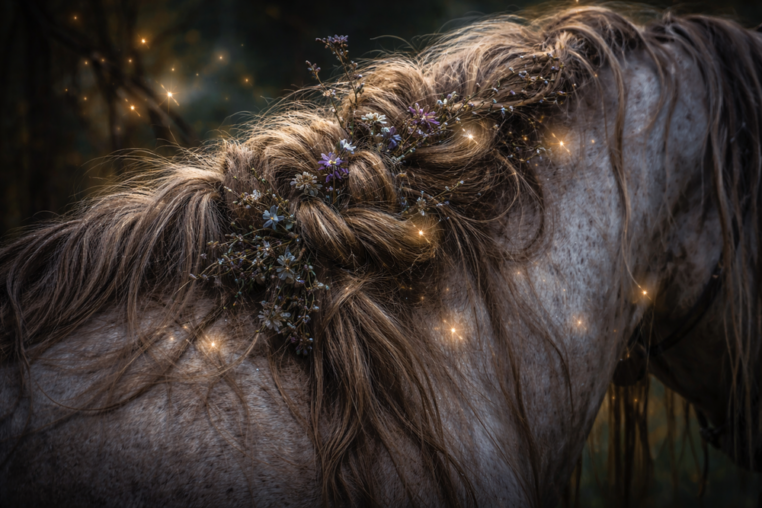
Fairy knots in a horse’s mane, called elf-locks or fairy stirrups in various regional traditions, were tight, intricate tangles that appeared overnight with no explanation. In the wild, horses occasionally develop similar matted sections through natural movement and weather, but the folk explanation was never mundane. Wild horses with tangled, knotted manes were understood as horses the fairies had used, marked by their passing, still carrying the evidence of a night’s riding in their coats.
This was not necessarily harmful. In some traditions, a horse that had been fairy-ridden was considered touched by magic. A little fey, perhaps, more sensitive than ordinary horses, more difficult to manage, but also more capable of perceiving what humans could not. The knot in the mane was a sign that something other had found the animal worth riding.
Farmers and stable hands across Ireland, Scotland, and northern England took fairy knots in horse manes seriously enough to develop protective practices: iron horseshoes (iron being famously repellent to fairies), rowan branches hung in the stable, and spoken charms said over the animals at nightfall. Some traditions held that you should not untangle a fairy knot from a horse’s mane without the proper protections in place, lest you offend the fairy who made it.
The wild horse in the landscape, the free-roaming, unowned horse on the moors and highland, was in some ways even more deeply connected to this tradition. Wild horses were understood as existing closer to the fairy world than domestic ones, less managed by human will, more permeable to other influences. A wild horse with a knotted mane was simply living in a landscape where the Fair Folk also lived, and the knots were natural evidence of that shared territory.
How Are Fairy Knots Made?
The Folk Explanation
According to folk tradition, fairy knots are made deliberately. The fairies braid and twist the hair (or mane) while the human or animal is sleeping, using techniques that defy easy unraveling. In some accounts, they use specific knot patterns. Magical bindings that serve a purpose beyond mere mischief. The knot is intended.
What purpose? Tradition offers several answers, depending on the relationship between the fairy and the human:
Marking. A fairy knot may simply mark the person as one who has been noticed. Flagged by the Fair Folk as being of interest. Not necessarily benevolent, not necessarily threatening. Simply: we see you.
Binding. In more explicitly magical interpretations, the knot is a binding. It ties something to the person, or ties the person to something. This could be a curse, but it could also be a connection, even a form of fairy favor. The same technology that binds a curse also binds a blessing.
Bridling. In the hag-riding tradition specifically, the knots are a bridle. A means of control, woven into the hair to make the sleeping person tractable to fairy purposes. This is the more threatening interpretation, and the one most closely associated with the exhausted-on-waking experience of sleep paralysis in folk tradition.
As a gift of skill. In some Scottish traditions, particularly those connected to the Sìth (fairy folk), a person who woke with elf-locks might also find themselves in possession of new knowledge. A song they’d never heard, the solution to a problem, unusual skill at something they’d struggled with. The knot, in this reading, was the price of the knowledge: the fairies had taken a little of the person’s hair-energy in exchange for what they gave.
The Actual Mechanics (For the Practically Minded)
From a physical standpoint, the formation of tangles and matted sections in hair during sleep has a clear mundane explanation: friction, movement, the texture of certain hair types, and humidity all contribute. Fine hair, naturally curly hair, and hair with a rough cuticle structure are more prone to overnight tangling. Sleeping on cotton pillowcases generates more friction than silk or satin. Moving in sleep produces the mechanical action that creates tangles.
This is not, of course, the magical explanation. But for the folk practitioner, knowing the mechanics doesn’t dissolve the meaning. A tangle formed by the friction of a restless night can still carry the message that your sleep was disturbed by something unseen. The physical and the magical are not mutually exclusive. Many witches work with the understanding that the spirit world operates through the physical world, not instead of it.
What Do Fairy Knots Mean? Magical Interpretations
If you find fairy knots in your hair, or if you’re working with their symbolism in practice , here are the traditional and contemporary magical interpretations:
You are being watched. The first and most universal interpretation is that you have attracted fairy attention. This is not inherently bad, but it calls for awareness. The Fair Folk noticing you is a bit like a powerful stranger making eye contact across a crowded room. It could mean anything, and it deserves acknowledgment.
A threshold has been crossed in sleep. Fairy knots can indicate that your dreaming self has traveled somewhere significant. That you’ve touched something in the liminal world during the night, even if you don’t consciously remember it. Pay attention to any fragments of dream that remain.
Something is being bound to you, or you to something. Magical knots are binding magic. If you’re experiencing a run of unexplained fairy knots and also noticing other signs of fairy presence. Objects moved, strange sounds, unusual animal behavior. It may be worth considering what kind of tie is being formed and whether it’s one you want.
A message is being left. In some traditions, the pattern of the knots matters. Their number, their placement, how tightly they’re wound. This is more intuitive than systematic, but if you’re inclined, you can sit with the knot before untangling it and see if anything comes to you.
Working With Fairy Knot Magic
The tradition of knot magic is one of the oldest in recorded human history. Sailors tied knots to hold the wind, healers tied knots to bind illness, witches tied knots to bind both blessings and curses. The fairy knot is simply this ancient magic attributed to its appropriate makers.
If you want to work with fairy knot energy in your own practice:
The intentional knot. Create a knot in thread, cord, or your own hair with a specific magical intention. A binding, a protection, a commitment. As you tie it, hold the intention clearly. Some practitioners speak the intention aloud into the knot.
Offerings for safe passage. If you’re concerned about fairy interference in your sleep, traditional protections include iron (a needle under the pillow, an iron nail beside the bed), rowan, and a small offering of cream or honey left on the windowsill. Acknowledging the Fair Folk while making clear that the night is yours.
The untying. Just as tying a knot binds something, untying one releases it. When untangling a fairy knot, real or symbolic, you can set the intention of releasing something that has been bound: an old pattern, a grief, a constraint you’ve been carrying.
Braiding as invocation. Intentional braiding of hair or cord while thinking of the Fair Folk can be a way of inviting their presence. Of entering into the tradition deliberately rather than waking to find they’ve arrived on their own terms.
The Knot as Relationship
What strikes me most about the fairy knot tradition is that it frames the relationship between humans and the Fair Folk as physical, embodied, and mutual. The fairies don’t just exist in some separate realm we might occasionally glimpse. They move through our world at night, they touch our bodies, they leave evidence.
The knot is relationship made visible. It says: something was here, and it touched you, and now there is a tie between you.
Whether you interpret that as a warning, a blessing, or simply an acknowledgment that the world is far more inhabited than it appears at first glance. The fairy knot is an invitation to pay closer attention to the liminal spaces in your own life. The places between sleeping and waking. The hours that belong to neither day nor night.
Something moves there.
And sometimes, it braids your hair.