
The Crooked Path by Kelden

The image depicted here is an AI-generated representation of The Crooked Path by Kelden. As I do not have permission to republish any image of the book and I honestly don’t need any copyright issues. The Crooked Path: An Introduction to Traditional Witchcraft by Kelden · Published by Llewellyn Worldwide, 2020 · ISBN 978-0738762036 · Available everywhere books are sold If you have spent any time in witchcraft spaces online, you have probably noticed a growing divide. On one side: Wicca and its many eclectic descendants, the tradition most people encounter first. On the other: Traditional Witchcraft. Older, thornier, less codified, and significantly harder to find a clear entry point into. Most of the serious books on the subject are either dense academic texts, obscure small-press publications, or written by British practitioners working from a very specific regional lineage that can feel remote to a newcomer. The Crooked Path by Kelden was written to close that gap. Published in 2020 by Llewellyn and introduced by Gemma Gary, author and co-founder of Troy Books, one of the most respected publishers in the Traditional Craft world. It is exactly what it says it is: an introduction. Not a grimoire, not an initiation manual, not a comprehensive theological treatise. A doorway. And as doorways go, it is a good one. Who Is Kelden? Kelden (who writes under a single name) is a practitioner based in Minnesota who has been working in Traditional Witchcraft for over a decade. He runs a blog called By Athame and Stang on the Patheos Pagan channel, and his writing has appeared in The Witch’s Altar, The New Aradia: A Witch’s Handbook to Magical Resistance, and This Witch magazine. He is also the co-creator of The Traditional Witch’s Deck and has since published The Witches’ Sabbath: An Exploration of History, Folklore, and Modern Practice and All Them Witches: Folktales and Rhymes. He comes across, both on the page and in his wider work, as someone who takes this seriously without taking himself too seriously. That matters in a genre that can slide easily into either pomposity or superficiality. What Is Traditional Witchcraft, and Why Does It Need Its Own Book? This is the question the first chapter addresses head-on, and it is worth understanding before you decide whether this book is for you. Traditional Witchcraft is not Wicca. That distinction is important, and Kelden makes it clearly without being dismissive of Wicca. Wicca is a mid-20th century religious tradition primarily developed by Gerald Gardner, with a specific theology (the God and Goddess, the Wiccan Rede, a particular ritual structure) and initiatory lineages. It is a genuine spiritual path. But it is relatively new. Traditional Witchcraft draws from something older and less tidy. The folk magic traditions, cunning craft, hedge-riding, and witch lore that existed in rural European communities for centuries before anyone wrote a handbook about it. It is rooted in the land, in animism, in the spirits of specific places and ancestral lines, in practices that were never meant to be systematised into a coherent religion. It does not have a fixed theology or a central authority. It does not necessarily involve worshipping a God and Goddess duality. And it is considerably less comfortable than the wellness-friendly version of witchcraft that dominates social media. What Kelden is doing in this book is offering a framework, not the framework, for beginning to engage with this territory. What the Book Covers The structure is logical and moves from foundation to practice. Kelden begins with the cosmological and philosophical underpinnings of Traditional Witchcraft, the nature of the witch, the role of… …

Membership Required

You must be a member to access this content.

View Membership Levels

Already a member? Log in here

The Egyptian Book of the Dead ~ What It Is, What It Does, and How to Work With It

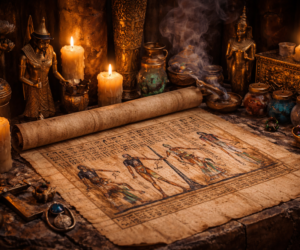
The image depicted here is an AI-generated representation of The Book of The Dead. It is not a book of death. It is a book of becoming. The title was coined by a German Egyptologist in 1842 – Das Todtenbuch – and it stuck, even though it misses the point entirely. The ancient Egyptians called it Reu Nu Peret Em Hru: “The Chapters of Coming Forth by Day.” A manual not for dying, but for moving through darkness and emerging on the other side transformed. That distinction matters. It shapes everything about how you read it. What It Is The Book of the Dead is a collection of spells, prayers, hymns, and ritual instructions used in ancient Egypt from roughly 1550 BCE through the first century BCE. A span of over 1,500 years. It is not one fixed text. It is a living tradition: a pool of around 200 spells from which individual copies were assembled, personalized, and commissioned for specific people. No two copies are identical. Some versions were painted on papyrus scrolls up to 40 metres long. Others were inscribed directly onto tomb walls, coffins, linen wrappings, and amulets placed against the body. The wealthiest Egyptians commissioned elaborate illustrated copies with their name written into every spell. The less wealthy got shorter versions, sometimes with the name left blank to be filled in. The equivalent of a spiritual template you customised yourself. It evolved from two older traditions: ~ The Pyramid Texts (c. 2400–2300 BCE) ~ the oldest religious writings in the world, carved into the walls of royal pyramids, reserved exclusively for pharaohs~ The Coffin Texts (c. 2100–1650 BCE) ~ adapted from the Pyramid Texts and extended to the nobility, written on the interior of wooden coffins By the New Kingdom period (1550 BCE onward), the tradition had democratised further. Any Egyptian who could afford it could commission their own Book of the Dead. The afterlife was no longer the exclusive property of kings. The Spells The word “spell” is a reasonable translation, though heka, the Egyptian concept of magic, carries far more weight than our modern understanding allows. Heka was not superstition. It was the fundamental creative force of the universe, present before the gods themselves. To speak heka was to participate in creation. Words, properly spoken, properly written, were not symbols of power. They were power. The spells of the Book of the Dead operate across several categories: Navigation and Protection Spells to guide the deceased through the Duat, the Egyptian underworld, safely. The Duat was not a simple place. It had gates guarded by serpents, lakes of fire, corridors that shifted, and beings who could destroy a soul entirely. These spells functioned as passwords, maps, and shields. Spell 125 requires the deceased to name each of 42 divine judges and declare their innocence before them. Knowing the name of something gave you power over it. One of the most consistent principles running through all Egyptian magic. Transformation Some of the most striking spells describe the deceased transforming into other forms – a falcon, a heron, a lotus flower, a crocodile, a swallow. Spell 77 allows transformation into a falcon of gold. Spell 83 transforms the soul into a phoenix (bennu bird). These were not metaphors. They described genuine metamorphosis, the soul learning to move through different states of being, gathering different kinds of power and perception. Preservation of the Body and Soul The Egyptians believed the soul had multiple components. The ba (personality and individual essence, often depicted as a human-headed bird) needed to be able to return to the body. The ka (life… …

Membership Required

You must be a member to access this content.

View Membership Levels

Already a member? Log in here

The Carmina Gadelica ~ What It Is and Where to Find It

The Carmina Gadelica, also known as Charms of the Gaels, is a compendium of prayers, hymns, charms, incantations, blessings, folk poems, songs, proverbs, and miscellaneous lore gathered in the Gàidhealtachd regions of Scotland between 1860 and 1909. (Wikipedia) Alexander Carmichael was a civil servant and exciseman whose work took him throughout the Highlands and Islands, and he spent those decades sitting with people in their homes, listening, and recording what was being said and sung in a tradition that was already beginning to disappear. The Original Six-Volume Set Carmichael himself was responsible for the first two volumes, published in 1900. His daughter Ella re-edited them in 1928. Further volumes were edited by his grandson James Carmichael Watson and published in 1940 and 1941. A fifth volume was edited by Professor Angus Matheson in 1954, and the series was completed in 1971 with a sixth volume containing a lengthy glossary and indices.( Wikipedia) So the complete work spans seventy years and three generations of Carmichael’s family to finish. The original six volumes are bilingual, Gaelic and English on opposite pages. Internet Archive They are the scholarly definitive edition, and they are extraordinary, but also dense and not the easiest entry point. The One-Volume English Edition (Best Starting Point) In 1992, Floris Press published a one-volume English-language edition with a valuable introduction by Dr John MacInnes. (Wikipedia) Previously only available as a bilingual text in six volumes, this one-volume edition in English only is an important contribution to the wider awareness of Celtic literature. This is the most accessible version of the original collection and the one most practitioners reach for first. It’s available on Amazon and through most booksellers. The Celtic Vision ~ The Most Accessible Version If you want to start somewhere gentler, The Celtic Vision edited by Esther de Waal is the best gateway. Assembled from the original six volumes of Alexander Carmichael’s Carmina Gadelica by noted Celtic author Esther de Waal, this rich array includes elements of piety that address every side of life. De Waal curated the most beautiful and accessible prayers and blessings into a single slim volume that reads beautifully and is widely available in paperback. It includes the smooring prayers, milking songs, blessing prayers, and protective charms.. This is the version many practitioners keep on their altar rather than their bookshelf. Free Online Access The Carmina Gadelica is fully available online, with each contributor listed with their occupation and location. Goodreads The Sacred Texts website – hosts the full bilingual text of all six volumes for free, including Carmichael’s original English translations and his extensive notes on customs and dying traditions. This is genuinely one of the most useful free resources in Celtic folk tradition available anywhere. A Note on Carmichael’s Editing It is worth knowing that Carmichael’s editing methods were challenged in 1976, with accusations that he had meddled with, altered, and polished original texts. The Gaelic scholar John Lorne Campbell conceded that much of the first three volumes must be taken as a literary rather than a literal presentation of Gaelic folklore. (Soundyngs) The Carmichael Watson Project at the University of Edinburgh has since published his original field notebooks online, allowing comparison between what was recorded and what was printed. This doesn’t diminish the beauty or the value of the collection . It simply means approaching it as a curated literary work as much as a verbatim folk record, which is what the best folklore collectors have always produced. In short: Start with Esther de Waal’s The Celtic Vision for a beautiful, readable introduction. Move to the Floris Press one-volume English edition… …

Membership Required

You must be a member to access this content.

View Membership Levels

Already a member? Log in here