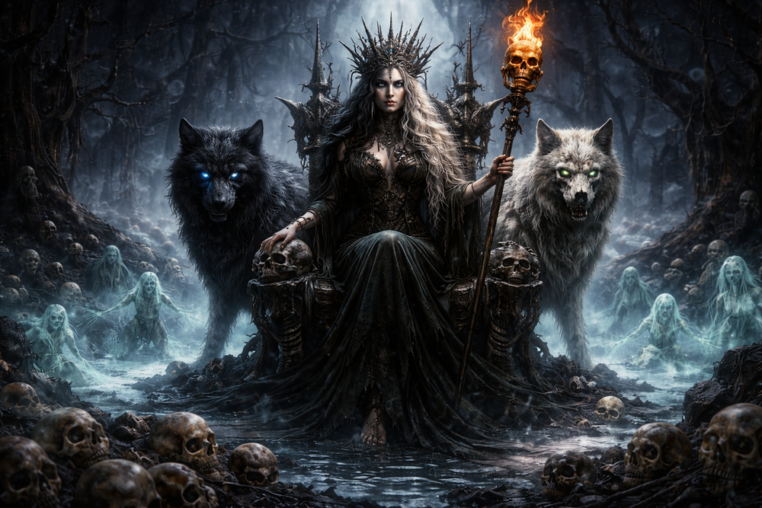
Half her face is living flesh. Warm, pink, the face of a woman in the fullness of her years. The other half is the blue-black of a corpse left in winter ground, or the pale grey of bone from which all warmth has long departed. She does not hide either side. She does not turn her living face toward you and keep the dead one in shadow. She stands before you whole, and she watches you with both sets of eyes, and she waits to see whether you will flinch.Most people flinch.Hel is the goddess of the dead in Norse tradition. Not the dramatic dead, not the glorious battle-slain who ride to Valhöll with their wounds still bleeding and their glory still fresh. Those belong to Odin. Hel receives everyone else. The ones who died in bed, shivering with fever. The ones who drowned at sea. The ones who grew old and slow and let go quietly in the dark. The ones who died by their own hand. The ones the world forgot before they were even cold.She receives them all. Without judgement. Without ceremony. Without the performance of heroism as a prerequisite for entry.Her hall is called Éljúðnir, the Damp One, the one sprayed with sleet. Her dish is Hunger. Her knife is Famine. Her threshold is Fallanda Forad, Stumbling Block. Her bed is Kor – Sick Bed. Every object in her home bears a name that speaks to what it is to be mortal and exhausted and done.And yet, in that terrible hall, there is something else. Something that the sources do not say directly but that every practitioner who has worked with her knows in their bones – she is kind. Hel is one of the kindest gods in the Norse pantheon. Not soft. Not comfortable. But genuinely, quietly, implacably kind. In the way that only someone who has received ten thousand years of suffering without turning away could be.She is waiting for all of us. She always has been. Who is Hel?Hel is the daughter of Loki. The great shape-shifter, the trickster, the agent of chaos who is simultaneously the gods’ most dangerous enemy and their most indispensable companion. And Angrboða, the giantess of the Iron Wood, whose name means She Who Offers Sorrow or the One Who Bodes Anguish. From her father she inherits liminality, the capacity to exist between categories that should exclude each other. From her mother she inherits the iron and the sorrow and the deep, patient endurance of the giant-kind who were old before the gods were young.She is one of three extraordinary children born to this union. Her brothers are Fenrir, the wolf whose jaws will swallow Odin at Ragnarök, and Jörmungandr, the World Serpent who encircles Midgard in the deep ocean and will rise at the end of days to drown the world. The gods of Ásgarðr, disturbed by prophecy, acted against all three. Fenrir was bound with the magical ribbon Gleipnir. Jörmungandr was thrown into the sea. And Hel was cast, kastaði is the Old Norse word, meaning thrown, hurled, into the realm of Niflheim, the world of mist and cold and primordial darkness, and given dominion over those who die of illness, age, and all causes other than battle.The Prose Edda of Snorri Sturluson, our most complete source for Norse mythology (written in Iceland in the thirteenth century, and treating the old myths with a mixture of preservation and Christian-era editorialising), describes her thus: half blue-black and half flesh-colored, by which she is easily recognized, and rather downcast and fierce-looking.Downcast and fierce. It is not the description...
