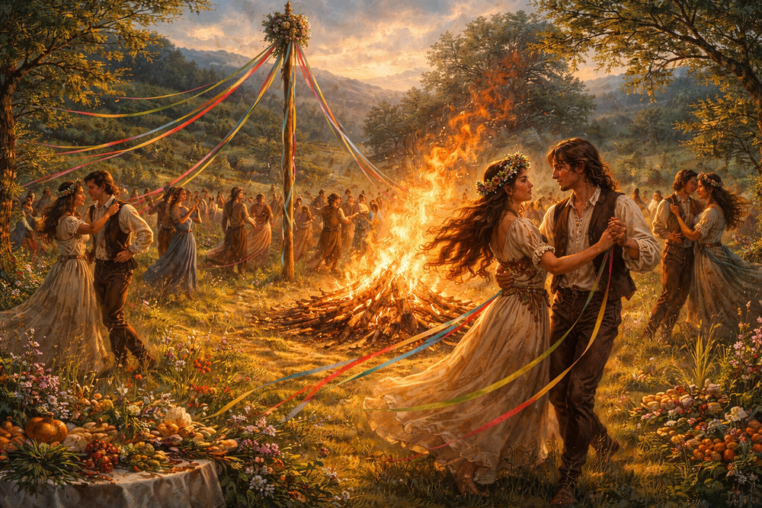

The fire festival at the height of spring. When the world tips toward abundance and the veil goes thin again. May Day has a problem with its reputation. Most people associate it with either bank holidays or Soviet parades. But underneath both of those is something far older and considerably more interesting . A fire festival that the Celts considered one of the four hinge points of the year, a night when the world cracked open between winter’s end and summer’s beginning, and everything felt possible and a little dangerous all at once.That festival is Beltane. And it deserves a proper introduction. What is Beltane?Beltane, from the Gaelic Bealtainn, possibly meaning “bright fire”, falls on May 1st, and it is one of the four great Celtic seasonal festivals alongside Samhain (October 31), Imbolc (February 1), and Lughnasadh (August 1). Together they mark the turning points of the agricultural year. If Samhain is the festival of endings and the dark half of the year, Beltane is its mirror: the festival of beginnings, abundance, and the light half.In the old Celtic calendar, the year was divided not into four seasons but into two halves: the dark half (winter, beginning at Samhain) and the light half (summer, beginning at Beltane). May 1st was not the middle of spring – it was summer’s first day. The warmth had won.Historically, Beltane was primarily observed in Ireland, Scotland, and the Isle of Man, with echoes across Wales and other Celtic regions. The earliest written references appear in Irish literature from the 10th century, but the practices described are clearly far older. Remnants of an oral tradition that predates Christianity by centuries.At its heart, Beltane is about three things: fire, fertility, and the threshold. The world is at its most alive. The veil between the human world and the otherworld, the realm of the Aos Sí, the fairy folk, is considered permeable again, just as it is at Samhain. The difference is that at Samhain the spirits are the dead. At Beltane they are something else entirely – older forces, not threatening exactly, but wild. The history and mythologyThe most famous mythological dimension of Beltane is the Sacred Marriage. The union of the May Queen and the Green Man (or the Goddess and the God in later pagan tradition). This isn’t just symbolic decoration. In the older layers of the mythology, the land’s fertility was directly linked to the fertility of its people and their ruler. The king’s union with the goddess of sovereignty was the act that caused crops to grow and cattle to prosper. It’s an idea so embedded in pre-Christian cosmology that it survived, heavily sanitized, into the maypole traditions that persist to this day.The Aos Sí, the spirits of the Irish otherworld, were believed to be particularly active at Beltane, crossing into the human world with unusual ease. People took precautions. They decorated their homes and doorways with yellow flowers (particularly rowan and gorse), which were thought to discourage unwanted supernatural attention. They drove their cattle between two bonfires before moving them to summer pasture, purifying the herd and protecting it for the season ahead.The need-fire, a fire ritually kindled from scratch, often by friction rather than a carried flame, was the centerpiece of the celebration. All household fires in a community might be extinguished and relit from the Beltane bonfire, symbolically renewing the warmth and protection of the home for the coming season.In Irish mythology, Beltane has a particular resonance. The Lebor Gabála Érenn, the medieval “Book of Invasions”, records that the mythological peoples who settled Ireland often arrived at Beltane or...
