 Written by
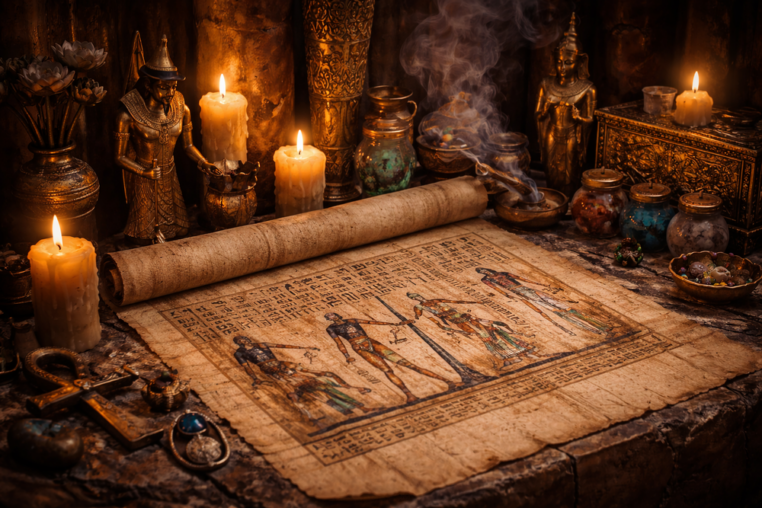
 The image depicted here is an AI-generated representation of The Book of The Dead.
It is not a book of death. It is a book of becoming.
The title was coined by a German Egyptologist in 1842 – Das Todtenbuch – and it stuck, even though it misses the point entirely. The ancient Egyptians called it Reu Nu Peret Em Hru: “The Chapters of Coming Forth by Day.” A manual not for dying, but for moving through darkness and emerging on the other side transformed.
That distinction matters. It shapes everything about how you read it.
What It Is
The Book of the Dead is a collection of spells, prayers, hymns, and ritual instructions used in ancient Egypt from roughly 1550 BCE through the first century BCE. A span of over 1,500 years. It is not one fixed text. It is a living tradition: a pool of around 200 spells from which individual copies were assembled, personalized, and commissioned for specific people.
No two copies are identical.
Some versions were painted on papyrus scrolls up to 40 metres long. Others were inscribed directly onto tomb walls, coffins, linen wrappings, and amulets placed against the body. The wealthiest Egyptians commissioned elaborate illustrated copies with their name written into every spell. The less wealthy got shorter versions, sometimes with the name left blank to be filled in. The equivalent of a spiritual template you customised yourself.
It evolved from two older traditions:
~ The Pyramid Texts (c. 2400–2300 BCE) ~ the oldest religious writings in the world, carved into the walls of royal pyramids, reserved exclusively for pharaohs
~ The Coffin Texts (c. 2100–1650 BCE) ~ adapted from the Pyramid Texts and extended to the nobility, written on the interior of wooden coffins
By the New Kingdom period (1550 BCE onward), the tradition had democratised further. Any Egyptian who could afford it could commission their own Book of the Dead. The afterlife was no longer the exclusive property of kings.
The Spells
The word “spell” is a reasonable translation, though heka, the Egyptian concept of magic, carries far more weight than our modern understanding allows. Heka was not superstition. It was the fundamental creative force of the universe, present before the gods themselves. To speak heka was to participate in creation. Words, properly spoken, properly written, were not symbols of power. They were power.
The spells of the Book of the Dead operate across several categories:
Navigation and Protection
Spells to guide the deceased through the Duat, the Egyptian underworld, safely. The Duat was not a simple place. It had gates guarded by serpents, lakes of fire, corridors that shifted, and beings who could destroy a soul entirely. These spells functioned as passwords, maps, and shields. Spell 125 requires the deceased to name each of 42 divine judges and declare their innocence before them. Knowing the name of something gave you power over it. One of the most consistent principles running through all Egyptian magic.
Transformation
Some of the most striking spells describe the deceased transforming into other forms – a falcon, a heron, a lotus flower, a crocodile, a swallow. Spell 77 allows transformation into a falcon of gold. Spell 83 transforms the soul into a phoenix (bennu bird). These were not metaphors. They described genuine metamorphosis, the soul learning to move through different states of being, gathering different kinds of power and perception.
Preservation of the Body and Soul
The Egyptians believed the soul had multiple components. The ba (personality and individual essence, often depicted as a human-headed bird) needed to be able to return to the body. The ka (life force) required sustenance. The akh (the transfigured spirit, the merged and radiant form) was the goal, the thing you were working toward. Spells protected the physical body, ensured the ba could travel freely, and guided the soul toward becoming an akh.
The Weighing of the Heart
The central drama of the entire text. In Spell 125, the deceased stands in the Hall of Two Truths before Osiris and 42 divine assessors. Their heart is placed on a scale against the feather of Ma’at – the feather of truth, justice, and cosmic order. The heart must be lighter than the feather. If it is not, Ammit – part lion, part hippopotamus, part crocodile – devours it, and the soul ceases to exist entirely. Not hell. Annihilation.
The deceased speaks the Negative Confession: a declaration of 42 sins they did not commit. I have not stolen. I have not killed. I have not caused suffering. I have not spoken lies. They address each of the 42 judges by name, in their specific domain. This was not empty ritual, it was a reckoning. You had to have lived accordingly, or the words carried no weight.
The History and Meaning Behind It
Death as Transformation, Not Ending
Egyptian cosmology was cyclical. The sun god Ra descended each night into the Duat and was consumed, transformed, and reborn at dawn. Just as Osiris was killed by Set, dismembered, reassembled by Isis, and resurrected. Death was not the end of the story. It was the transformation at the centre of it.
The Book of the Dead is the human version of that journey. You die. You enter the Duat. You navigate its trials. You are weighed. If your heart is light, you are transfigured into an akh – a luminous, immortal spirit – and you join the company of the gods in the eternal cycle.
The Role of Knowledge
What is striking about the Egyptian system is that the afterlife was not purely earned through virtue, it required knowledge. You had to know the names of the gatekeepers. You had to know the right words. You had to know the geography of the Duat. This is why the Book of the Dead was physically placed with the body. The deceased needed it available for reference.
This makes it something rare: a spiritual tradition where literacy, study, and memorisation are themselves sacred acts. Knowing is not separate from being good. Knowing is part of being good.
Ma’at: The Principle That Makes It Work
Everything in the Book of the Dead rests on the concept of Ma’at – truth, justice, balance, cosmic order. Ma’at was both a goddess and a principle, the force that kept the universe functioning. The opposite of Ma’at was isfet: chaos, disorder, falsehood.
To live in Ma’at, to act justly, speak truthfully, maintain balance in your dealings with others, was the preparation for the weighing. The spells mattered, but they operated in concert with a life lived. The magic was real, and so was the ethics.
Key Spells Worth Knowing
Spell 1 ~ The day of burial. Entry into the Duat. The opening of the journey.
Spell 17 ~ One of the oldest and most complex spells in the collection, describing the nature of the gods and the structure of the cosmos. Interpretive commentary was added to this spell across generations, making it a palimpsest of Egyptian theological thought.
Spell 64 ~ Said to have been discovered beneath the feet of the god Thoth himself, inscribed on a slab of iron. Considered one of the most powerful single spells. It encapsulates the entire journey in one text.
Spell 77 ~ Transformation into a golden falcon.
Spell 89 ~ Allowing the ba to return to the body at night.
Spell 125 ~ The Weighing of the Heart. The Negative Confession. The central and most significant text in the entire collection.
Spell 175 ~ Osiris argues with Atum about the fate of the dead. One of the most philosophically rich passages in the text.
How to Work With It in Witchy Practice
The Book of the Dead is not a spell book in the way modern practitioners use the term. It is a cosmological text, a map of the soul’s journey through transformation. But that is exactly why it is so rich for practice. Here is how to approach it meaningfully.
Read It First, Cover to Cover
Before you work with any of it, read it as a whole. The Faulkner translation (published by Chronicle Books with the original papyrus illustrations) is the standard. Clear, scholarly, and beautiful to look at. Reading it straight through gives you the architecture. You begin to feel the logic underneath.
Note what lands. The spells that arrest you, disturb you, or make something shift in your chest – those are yours to work with.
Use It for Shadow Work
The Weighing of the Heart is one of the most honest shadow work frameworks that exists. Pull out Spell 125 and read the full Negative Confession slowly. All 42 declarations.
Where do you flinch? Where does the declaration feel hollow? Where do you feel clear?
This is not about guilt. It is about honest inventory. The Egyptians believed you could not reach the light side of the transformation until you had genuinely reckoned with what weighed on you. Use the 42 assessors as a structured audit of how you are living relative to your own values.
Work With the Transformation Spells
The shape-shifting spells – 77, 83, 86 and others – can be used as guided visualisations. Choose a form that corresponds to something you need: the falcon for clarity and perspective, the swallow for freedom and quick movement, the lotus for emergence from murky conditions.
Read the spell aloud. Sit with the image. Allow it to inform your meditation or intention work. The Egyptians used these literally. You can use them as deep symbolic engagement with qualities you are cultivating.
Invoke Ma’at
Before any spell or ritual work, calling on Ma’at as a principle grounds you in right alignment. She is not just a goddess of justice. She is the force that makes your work coherent. Inviting her presence is a way of checking that what you are asking for is genuinely in alignment with your own truth, not fear or ego talking.
Her symbols: the white ostrich feather, the scales, the colour gold, the hieroglyph of a seated woman with a feather on her head.
Work With the Deities
The Book of the Dead introduces you to a full cast of Egyptian deities in their functional roles. These are not peripheral figures, they are the active forces of the afterlife journey:
~ Osiris ~ lord of the dead and resurrection, the god who died and was reborn; patron of transformation
~ Isis ~ the great magician, the one who reassembled what was scattered; patron of protection, spellwork, and grief
~ Thoth ~ the scribe god, keeper of divine law and cosmic knowledge; patron of writing, magic, and truth-speaking
~ Anubis ~ the guide of souls, the one who holds the scales; patron of transitions and sacred passage
~ Ma’at ~ truth and cosmic balance, the feather and the principle
~ Sekhmet ~ the destroyer and healer, the force that burns away what is not true
Working devotionally with any one of these deities benefits from reading the Book of the Dead. You understand them in context, not as isolated archetypes but as living parts of an interconnected system.
Use It at Liminal Times
The Book of the Dead is a liminal text. It was written for the threshold between lives. Use it at your own thresholds: endings, bereavements, major transitions, the dark moon, Samhain, the space between years.
Reading Spell 1 or Spell 125 aloud at a death altar – for an ancestor, a loved one, or a part of yourself you are consciously releasing – is a way of offering the old knowledge as a guide. You are not casting a spell on someone else’s behalf. You are holding the light of the tradition in the space where it has always belonged.
A Note on Respect
The Book of the Dead belongs to a continuous human tradition that is nearly 4,000 years old. The people who wrote it, commissioned it, painted it, and were buried with it were real people navigating one of the most fundamental human questions: what happens when we die, and how should we live in light of that?
Working with it is an act of genuine engagement with one of the deepest bodies of spiritual knowledge humanity has produced. That is worth bringing your full seriousness to.
Learn the context. Read the history. Understand the cosmology before you extract from it. The magic is in the whole system, not just the pieces.
Recommended reading
- The Egyptian Book of the Dead translated by Raymond Faulkner (Chronicle Books)
- The Ancient Egyptian Book of the Dead edited by Carol Andrews
- Egyptian Magic by E.A. Wallis Budge (historical, dated but foundational)
- Magic in Ancient Egypt by Geraldine Pinch