
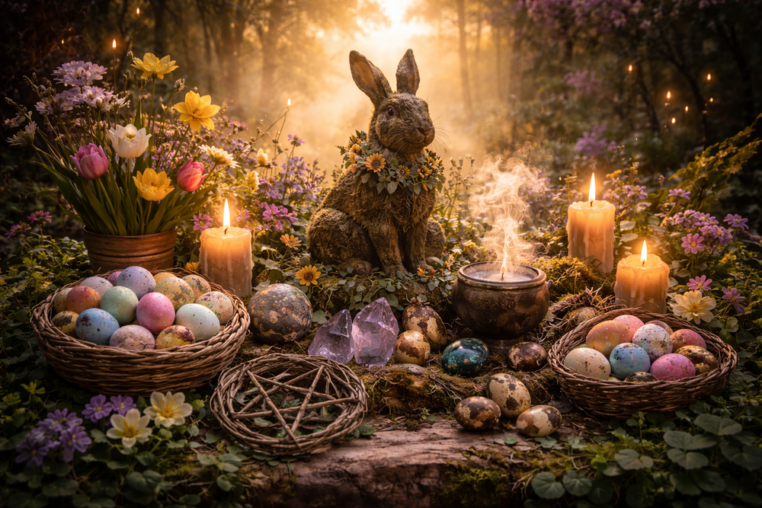

Before the Cross ~ The Pagan Roots of Easter

Every spring, millions of people hide decorated eggs, give baskets of chocolate, watch children chase a mythical rabbit, and celebrate the resurrection of a god. Half of these people would describe themselves as Christian. Most of them have no idea that the symbols they are using are thousands of years older than Christianity.This is not a conspiracy. It is how religious traditions have always worked. They absorb, adapt, and carry forward the seasonal wisdom of what came before. Understanding the pagan roots of Easter does not diminish the Christian meaning. It deepens the whole picture. Ostara ~ The Spring EquinoxThe festival that gave Easter most of its symbolic vocabulary is Ostara, the spring equinox celebration observed by Germanic and Norse peoples, falling on or around March 20–23 when day and night are briefly equal and light begins to win.The name comes from the goddess Eostre (also spelled Ostara). A goddess of spring, dawn, and fertility whose name, scholars believe, is linguistically connected to the words east (the direction of the rising sun) and estrogen. She is the goddess of the light that returns. Her season was marked by the lengthening of days, the thawing of the earth, the return of birdsong and blossom.The Venerable Bede, an 8th-century Christian monk and one of our primary sources for early English religious history, wrote that the month of April was called Eosturmonath, Eostre’s month, and that feasts were held in her honour. When Christian missionaries moved through Germanic territories, they followed the policy of Pope Gregory I: do not destroy the festivals. Repurpose them. Give the people the same sacred time with new meaning layered on top.Easter absorbed Ostara’s calendar, her symbols, and her essential theme – the death of winter and the resurrection of light. The SymbolsThe EggThe egg is one of the oldest sacred symbols on earth. Long before Easter, it represented the entire universe in miniature – potential, creation, the mystery of life emerging from apparent stillness.In ancient Egypt, the primordial egg was said to contain Ra, the sun god, before creation began. In Norse cosmology, the world itself emerged from an egg. The Orphic tradition of ancient Greece described a cosmic egg from which Phanes, the first god, the god of light, hatched at the beginning of time.For Ostara specifically, eggs represented the return of fertility after winter. The earth had been frozen, closed, seemingly dead. Now it cracked open. The egg was spring made physical, the miracle of something living breaking through a sealed surface into light.The tradition of decorating eggs predates Christianity by thousands of years. Decorated ostrich eggshells have been found in African graves dating back 60,000 years. The Ukrainian tradition of pysanky, intricately painted eggs used in spring ritual, traces its roots directly to pre-Christian practice.When Christianity adopted the egg, it reframed the symbolism: the sealed tomb, the stone rolled back, life emerging where death seemed final. The image works because the underlying truth is the same. Something breaks open. Something that appeared finished is not finished.The Hare and the RabbitThis one surprises people most.The Easter Bunny has no biblical origin whatsoever. The rabbit enters through Eostre directly.In Germanic and Celtic spring traditions, the hare was sacred to the goddess of the dawn and spring. Hares are creatures of the threshold. They are most active at dusk and dawn, the in-between times. They are associated with the moon, with fertility, with magic and transformation. The hare was Eostre’s companion animal, or in some tellings, her earthly form.One of the most enduring folk legends describes Eostre finding a wounded bird in the snow. To save it...

Membership Required

You must be a member to access this content.

View Membership Levels

Already a member? Log in here