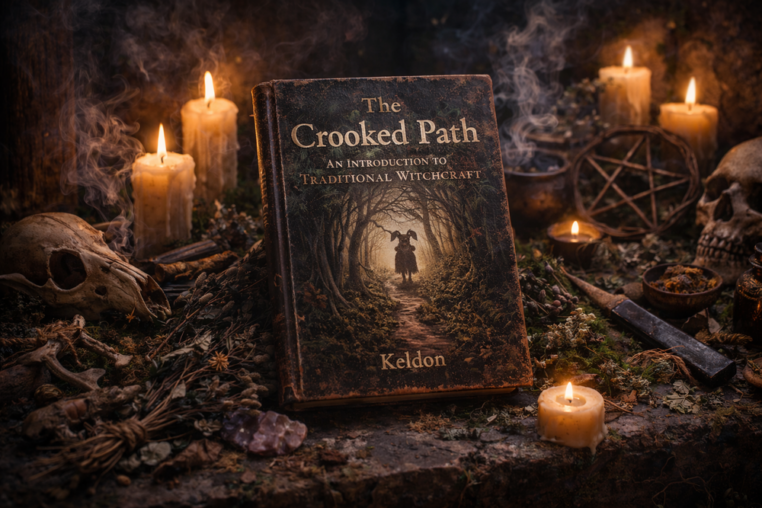

The image depicted here is an AI-generated representation of The Crooked Path by Kelden. As I do not have permission to republish any image of the book and I honestly don’t need any copyright issues.The Crooked Path: An Introduction to Traditional Witchcraft by Kelden · Published by Llewellyn Worldwide, 2020 · ISBN 978-0738762036 · Available everywhere books are sold If you have spent any time in witchcraft spaces online, you have probably noticed a growing divide. On one side: Wicca and its many eclectic descendants, the tradition most people encounter first. On the other: Traditional Witchcraft. Older, thornier, less codified, and significantly harder to find a clear entry point into. Most of the serious books on the subject are either dense academic texts, obscure small-press publications, or written by British practitioners working from a very specific regional lineage that can feel remote to a newcomer.The Crooked Path by Kelden was written to close that gap. Published in 2020 by Llewellyn and introduced by Gemma Gary, author and co-founder of Troy Books, one of the most respected publishers in the Traditional Craft world. It is exactly what it says it is: an introduction. Not a grimoire, not an initiation manual, not a comprehensive theological treatise. A doorway. And as doorways go, it is a good one.Who Is Kelden?Kelden (who writes under a single name) is a practitioner based in Minnesota who has been working in Traditional Witchcraft for over a decade. He runs a blog called By Athame and Stang on the Patheos Pagan channel, and his writing has appeared in The Witch’s Altar, The New Aradia: A Witch’s Handbook to Magical Resistance, and This Witch magazine. He is also the co-creator of The Traditional Witch’s Deck and has since published The Witches’ Sabbath: An Exploration of History, Folklore, and Modern Practice and All Them Witches: Folktales and Rhymes.He comes across, both on the page and in his wider work, as someone who takes this seriously without taking himself too seriously. That matters in a genre that can slide easily into either pomposity or superficiality.What Is Traditional Witchcraft, and Why Does It Need Its Own Book?This is the question the first chapter addresses head-on, and it is worth understanding before you decide whether this book is for you.Traditional Witchcraft is not Wicca. That distinction is important, and Kelden makes it clearly without being dismissive of Wicca. Wicca is a mid-20th century religious tradition primarily developed by Gerald Gardner, with a specific theology (the God and Goddess, the Wiccan Rede, a particular ritual structure) and initiatory lineages. It is a genuine spiritual path. But it is relatively new.Traditional Witchcraft draws from something older and less tidy. The folk magic traditions, cunning craft, hedge-riding, and witch lore that existed in rural European communities for centuries before anyone wrote a handbook about it. It is rooted in the land, in animism, in the spirits of specific places and ancestral lines, in practices that were never meant to be systematised into a coherent religion. It does not have a fixed theology or a central authority. It does not necessarily involve worshipping a God and Goddess duality. And it is considerably less comfortable than the wellness-friendly version of witchcraft that dominates social media.What Kelden is doing in this book is offering a framework, not the framework, for beginning to engage with this territory.What the Book CoversThe structure is logical and moves from foundation to practice. Kelden begins with the cosmological and philosophical underpinnings of Traditional Witchcraft, the nature of the witch, the role of the land and genius loci (spirits of place), the relationship between the...
