 Written by
 Before Confucius. Before the dynasties that gave China its recognisable historical shape. Before the texts that would define Chinese philosophy and religion for millennia – there were the Wu.
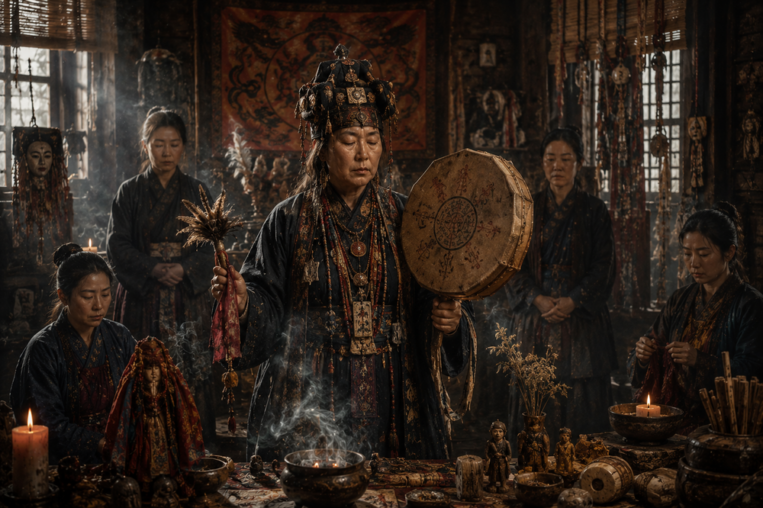
They danced in long-sleeved robes until the spirits entered them. They spoke in the language of gods and communicated the will of the dead to the living. They performed rain ceremonies, healed the sick, drove off malevolent forces, interpreted dreams, and predicted the future through divination. They were called to the oracle bones, the ancient Chinese practice of writing questions and submitting them to flame. And their voices were recorded in the inscriptions that survive as some of the oldest writing in the world.
And they were, predominantly, women.
The wu (巫) ~ the word translates as shaman, sorceress, spirit-medium, or ritual specialist depending on context and century, represents one of the oldest and most thoroughly documented traditions of female spiritual power on Earth. It is also a tradition that has been systematically suppressed, marginalised, and written out of the dominant narrative of Chinese history. The patriarchal Confucian orthodoxy that came to define Chinese culture had little use for women who spoke with the authority of heaven itself, and so it attempted to reduce them. First to subordinate roles in official religion, then to figures of suspicion and ridicule, then to invisibility.
They did not entirely disappear. They never do.
What the Oracle Bones Remember
The earliest evidence for the Wu comes from the Shang Dynasty, which ruled central China from roughly 1600 to 1046 BCE. The oracle bones, tortoise shells and ox scapulae used for divination, inscribed with questions and answers, contain some of the oldest Chinese writing in existence, and they mention the Wu with striking frequency.
Divination: the Wu proclaims… reads one inscription. Others mention groups of Wu performing ceremonial dances before sacrifices, or being summoned – bring the Wu – for specific ritual purposes. Several inscriptions name individual female Wu: Yang, Fang, Fan, recorded as performing rain-making ceremonies at moments of drought and crisis.
Old sources show the Wu performing invocation, divination, dream interpretation, healing, exorcism, driving off evil spirits, and performing ecstatic rain dances. Dramatic descriptions recount the powers of the Wu in their ecstasies. They could become invisible, slashed themselves with knives and swords, cut their tongues, swallowed swords, and spat fire, were carried off on a cloud that shone as if with lightning. The female Wu danced whirling dances, spoke the language of spirits, and around them objects rose in the air and knocked together.
This is not the cautious language of historical distance. This is eyewitness description – or as close to eyewitness as texts from three thousand years ago allow. The Wu were present. They were visible. They were doing something that people around them experienced as genuinely extraordinary.
The oldest Chinese dictionary, the Shuowen Jiezi, defines Wu unambiguously: “a zhu (invoker or priest), a woman who is able to render herself invisible, and with dance invoke gods to come down.” The character itself, some scholars suggest, depicts a person with outstretched arms in long sleeves, in the posture of the trance dance. The gesture preserved in the written language long after the practice it recorded had been pushed to the margins.
The Body as Instrument
The central technology of Wu practice was the body itself.
Not the body as metaphor. The body as literal instrument of spirit communication. As the vessel that, in the right conditions, through the right preparation, through the long trained discipline of the trance dance, could be entered by the divine and used to speak.
Many scholars see Chinese shamanism as underlying what developed into Taoism. The Taoist word for ecstasy, kuei-ju, meaning “coming in of a spirit,” was derived from shamanic possession. “For it was said of a sorceress in trance and speaking in the name of a shen – ‘this body is that of the sorceress, but the spirit is that of the god.'”
The Wu’s dance was not performance. It was preparation. The systematic alteration of consciousness through rhythmic movement, drumming, specific physical disciplines, and ritual context, until the ordinary self stepped aside and something else arrived. What arrived spoke. What it said was recorded. What it prescribed was enacted.
This is the same technology described in the deep cave paintings of the Palaeolithic, in the spirit-medium traditions of the Shona, in the shamanic practices of circumpolar peoples. The body as threshold. The dance as the mechanism of crossing. The woman as the vessel through which the other world communicates with this one.
Xi Wangmu ~ The Queen Mother of the West
The most significant mythological figure associated with the Wu tradition is Xi Wangmu, the Queen Mother of the West. One of the oldest goddesses in the Chinese pantheon and the divine patron of shamanic practice.
The title Wu figures in legendary place-names. “Snake Wu mountain” appears in the ancient Shanhai Jing as the home of the shamanic goddess Xi Wangmu. This book also says that Wu live on Mount Divinepower, “where the hundred drugs are to be found.” Another passage describes them as possessing the herb of immortality.
Xi Wangmu is not a benign garden goddess. She is powerful, liminal, and genuinely frightening in her earliest forms. Associated with plague and death as well as healing and immortality, dwelling on the western mountain at the edge of the known world, presiding over a community of female spirit-workers who guard the herbs that can defeat death itself.
She is the divine face of what the Wu do in the human world. Move between life and death, hold the threshold, keep the knowledge of what exists on the other side of the ordinary. Her mountain is where the hundred drugs are found. Her practitioners know their names.
The Long Suppression
The history of the Wu after the Shang Dynasty is largely the history of a tradition being pushed further and further from official recognition.
The Confucian texts that became the foundation of Chinese state ideology from the Han Dynasty (206 BCE–220 CE) onward had little use for ecstatic female shamans whose authority derived from direct spirit contact rather than from the social hierarchy. The official state religion developed its own ritual specialists, male priests, following prescribed forms, operating within sanctioned institutions. The Wu were gradually reclassified. From legitimate spiritual authorities to mere entertainers, folk practitioners, suspicious women who claimed powers they should not claim.
The strong pattern of female shamans in eastern Asia has been erased from the history that most people know. Yet women predominated in shamanism of ancient China, Japan, and Korea, and have persisted into modern times in eastern Siberia, Korea, Manchuria, Okinawa, Vietnam, Indonesia, and the Philippines.
The erasure was never complete. Folk religion is harder to control than official religion because it does not require institutions. It requires people who carry the knowledge in their bodies and transmit it person-to-person, generation-to-generation, in the same way that the practice itself was transmitted. Through apprenticeship, through initiation, through the hard-won personal development of the capacity to work at the threshold.
In Korea, the mudang, direct descendants of the same shamanic tradition, continue to practice today. In Okinawa, the noro and yuta maintain female spirit-medium traditions with traceable roots in the same ancient current. In Vietnam, the bà đồng, the female mediums who serve as vessels for spirits in the Đạo Mẫu tradition, practice openly and are respected. The tradition persisted at the margins, in the places where official culture’s attention is less.
What the Wu Knew
The Wu understood several things that the dominant culture around them struggled to accept.
That the boundary between the living and the dead is permeable, and that permeability is not a supernatural anomaly but a fundamental feature of reality that can be worked with by those who develop the capacity to do so.
That the natural world is alive with intelligence. That plants hold knowledge, that certain places hold more power than others, that the cosmos is not indifferent to human affairs.
That women’s bodies are not obstacles to spiritual authority but instruments of it. That the capacity to be a vessel, to set the self aside and make space for something else, is not weakness but the most demanding form of spiritual discipline there is.
And that this knowledge, once transmitted, cannot be fully suppressed. It goes underground. It persists in folk practice, in women who know things the official culture says they shouldn’t know, in the herbs on the mountain that the hundred Wu guard, in the dances that encode in the body what the texts have tried to erase.
The Wu are your ancestors, regardless of your ethnic lineage, if you do the kind of work this space describes. They are among the oldest named practitioners of the craft of crossing. The women who danced until the spirits entered, and then spoke on behalf of those the living could not reach themselves.
Their name is in the oldest Chinese writing. Their bodies are in the oldest definitions. They were there before the erasure began, and something of what they carried persisted through it.
The Wu. Documented from the Shang Dynasty, 1600 BCE. Dancing at the threshold between the human and the divine. Still here, in the traditions that descended from them, in the folk practices that would not stay suppressed, in everyone who has ever danced until something arrived.