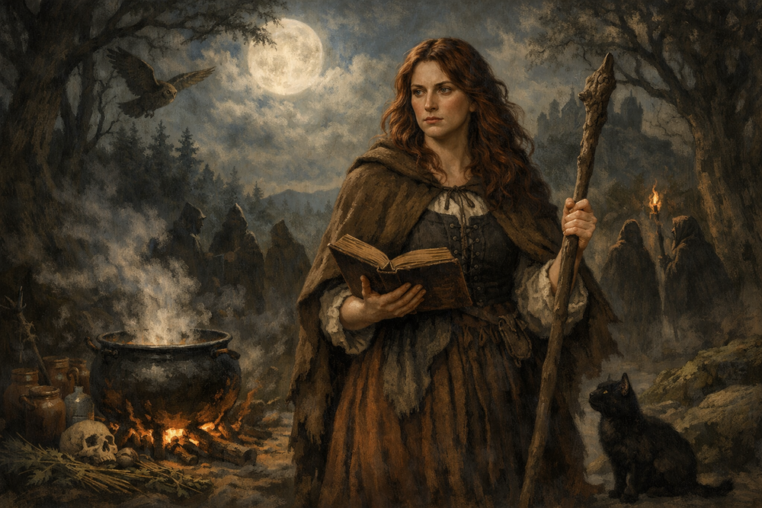
On 13 April 1662, in the village of Auldearn in the Scottish Highlands, a woman walked in from her ordinary life, the milking, the bread-making, the weaving of yarn, and confessed to everything.She confessed to making a pact with the Devil at Auldearn Kirk, where he stood at the reader’s desk with a black book and baptised her in her own blood, giving her the new name Janet. She confessed to flying through the night sky on corn stalks, crying Horse and Hattock in the Devil’s name! She confessed to feasting in the halls of the Queen of Elfhame beneath the Downy Hills. She confessed to transforming herself into a hare, a crow, a cat. Slipping out of her human skin with a rhyme and returning to it with another. She confessed to making elf arrows, those sharp flint points whittled by elf-boys in the fairy world, and shooting them at the people of Auldearn.She confessed to all of it. Freely, in extraordinary detail, with eloquence and precision and a quality of narrative that scholars have been marvelling at and arguing over for more than three and a half centuries.No one knows why.That is the most haunting thing about Isobel Gowdie. Not what she said. Though what she said is extraordinary enough. But that she said it at all, apparently without being tortured into it. That she walked in and began to speak and did not stop for six weeks, filling the record with charms and visions and names and rhymes and the full, vivid, impossible architecture of a spiritual world that the prosecutors who recorded her words were hearing as diabolism and that we, centuries later, hear as something else entirely.She is the most famous witch in Scottish history. She is one of the most remarkable figures in the entire history of European witchcraft. And almost nothing about her – not why she spoke, not what she believed, not what happened to her in the end – is certain. Who Was Isobel Gowdie?The honest answer is: very little is known.The records give us almost nothing of her life before April 1662. Her birth date is unrecorded. Her maiden name is unknown. She is recorded as Isobel Gowdie rather than Isobel Gilbert because married women in Scotland retained their maiden names, but when and where she was born, who her parents were, what her childhood was like – these things have not survived. She was probably somewhere between her late twenties and her fifties at the time of her confession. She was childless. She could not read or write.She was the wife of John Gilbert, a cottar, a farm laborer who worked the land of the Laird of Park and Lochloy in return for a cottage and a small parcel of ground about two miles north of Auldearn, on the edge of what was then a larger sea loch surrounded by woodland, hills and sand dunes. The loch is now largely sand. In the years before Isobel’s confession, advancing dunes had begun covering the surrounding estate, an eerie slow catastrophe that she may well have interpreted as a sign of supernatural power at work in the landscape. Her daily life was the life of the very poor in seventeenth-century rural Scotland: milking, baking, weeding, spinning yarn, the endless cycle of subsistence labour with no margin for error and no protection from disaster.This was not a comfortable existence. The historian Emma Wilby, whose comprehensive study The Visions of Isobel Gowdie is the most serious scholarly engagement with her confessions, compares the material conditions of Isobel’s life with those of present-day developing...
