
 Written by
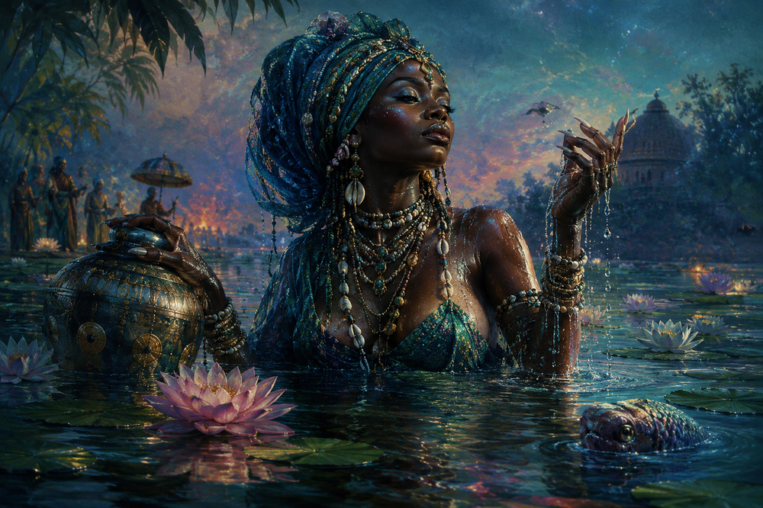
 She rises from the water at night.
She is impossibly beautiful. Her hair is long and falls loose around her shoulders. Her eyes hold the particular quality of deep water, dark, reflective, suggesting depths that the surface does not reveal. She may wear a snake coiled around her body like living jewellery. She may have the tail of a fish where her legs should be, or she may appear entirely human, more human than any human you have ever seen, which is itself the sign.
She is Mami Wata. Mother Water. And she has been present in the spiritual life of West and Central Africa, and the African Atlantic world, for longer than any written record can reach.
She is not a goddess in the distant, untouchable sense. She is immediate. Capricious. Generous and dangerous in equal measure. She takes lovers and brings them fortune, or she takes them entirely. She heals. She curses. She appears to those she chooses, often without being asked, and the encounter changes the person forever.
To be chosen by Mami Wata is not comfortable. It is an invitation into a relationship that will demand everything and transform everything, and there is no polite way to decline.
A Spirit Without a Single Origin
Most deities have a mythology that traces them to a single source, a founding story, a point of origin. Mami Wata resists this.
The name is in pidgin English – mama and water, the lingua franca of West African trade – and this already tells you something important. Mami Wata is not a spirit that belongs to a single ethnic tradition or a single pre-colonial culture. She is a spirit that emerged from the meeting of worlds. The ancient African water spirit traditions that pre-date any European contact, the complex encounters of the Atlantic coast from the fifteenth century onward, the absorption of images and iconography from Hindu traders, European mermaid mythology, Catholic iconography, and the spiritual creativity of African peoples navigating the catastrophe of the slave trade and colonialism.
The earliest documented references to the specific figure of Mami Wata appear in the fifteenth and sixteenth centuries, coinciding with European exploration of the African coast. But water spirits with similar characteristics existed in African religions long before that . The Yoruba deity Yemoja, the Igbo water spirit Ogbuide, the river spirits of the Congo basin, countless local manifestations of the deep and generative power of water as a threshold between the human world and the world of the spirits.
What is remarkable about Mami Wata is not that she was invented at a specific point in history, but that she could not be destroyed. Through the middle passage, through slavery, through colonialism, through the forced imposition of Christianity and Islam, she survived. Not by hiding but by absorbing. She took in the new imagery and the new influences and made them hers. The snake charmer iconography from a German chromolithograph that circulated across West Africa in the late nineteenth century became one of her most persistent visual forms. The Catholic imagery of the Virgin became another lens through which she was understood and depicted. The Hindu goddess imagery brought by Indian Ocean traders made its way into her shrines.
She is a syncretist by nature. A threshold being. She carries in herself the history of every collision and crossing that has shaped the African Atlantic world.
What She Is and What She Does
Mami Wata is a goddess of water and fertility, beauty and wealth, healing and destruction. But these categories flatten something that is better understood through the logic of the liminal.
Water, in virtually every human symbolic system, is the threshold element. It is what separates land from land. It is what you cross to reach the other side. It is what surrounds the island, the continent, the known world. It is what the dead cross. It is what the shaman descends into. It is what erases footprints and washes clean and drowns and purifies.
A spirit of water is a spirit of the threshold. Mami Wata governs not only the water itself but what the water represents: the capacity to move between states, to dissolve the boundaries that separate one condition from another, to be transformed by immersion and return changed.
She holds the power to manipulate the oceans and rivers, and possesses the ability to transform in order to seduce and mesmerize. She is a goddess of wealth because wealth, in the West African coastal communities where her influence was strongest, came from trade, from the sea, from crossing, from the encounter with what lives on the other side. She is a goddess of healing because healing, in the framework she inhabits, is about restoring right relationship between the physical and the spiritual, and that is precisely the threshold she governs.
She is dangerous for the same reason she is powerful: threshold beings are not safe. The water that sustains life also drowns. The crossing that brings wealth also capsizes. The encounter with Mami Wata that transforms a person can transform them in directions they did not choose and cannot control.
She takes lovers from the water. Men who are pulled under and returned, changed, carrying gifts and a prohibition: they must remain faithful to her, or lose everything she gave them. The man who accepts the bargain and keeps it becomes wealthy, talented, fortunate beyond ordinary explanation. The man who breaks it loses his mind, or his health, or his life.
This is not the capriciousness of a cruel deity. It is the logic of a genuine relationship with a power that is not interested in your comfort, only in your transformation.
The Priestesses and the Shrines
Mami Wata is not only worshipped. She is worked with. In the specific sense of an active, ongoing relationship between a human practitioner and a non-human power that makes demands and gives gifts.
Her worship takes a variety of forms across the African continent and the diaspora, and the variety is itself part of her nature. There is no single orthodox tradition. There are priestesses who maintain shrines to her across Nigeria, Benin, Togo, Ghana, Cameroon, and the Congo basin. There are practitioners in Haiti, Brazil, Trinidad, and the United States who work with her within Vodou, Candomblé, and related traditions. Her shrines contain mirrors – water made solid, the surface that reflects and shows what is otherwise invisible. They contain combs, jewellery, perfume. The objects of beauty and adornment that attract her presence.
Mami Wata is an important part of the modern Vodun religion, a West African spiritual tradition that has spread around the world with the African diaspora. Many modern Vodun groups have incorporated Mami Wata as a prominent household spirit, with families and priestesses offering tribute in an attempt to increase the prosperity of the family. The worship often incorporates elements of Christianity and Islam, demonstrating Mami Wata’s adaptability to changing religious landscapes.
Her initiation is not gentle. Those who are called to her service often experience a period of illness, confusion, or crisis. The threshold experience that marks the beginning of the relationship. The would-be priestess may be taken in a vision, carried underwater, shown the world as Mami Wata sees it. She may be brought gifts, money, jewellery, fish, and told what is required of her in return.
What is required is, consistently, devotion. Not worship in the abstract sense of declaration. Devotion in the concrete sense. The maintenance of a living relationship, the tending of the shrine, the regular offering, the keeping of the agreements made in the moment of encounter.
The Diaspora and the Crossing
To understand why Mami Wata is so central to African Atlantic spiritual life, you have to understand what the Atlantic slave trade was to the people who survived it.
It was a crossing. A forced passage across the threshold water, from the world they knew into a world that had no place for them. Everything they carried – their names, their languages, their social structures, their religious frameworks – was systematically attacked on the other side. What survived, survived in fragments, in disguise, in the spaces that the institution of slavery could not fully colonise.
Mami Wata survived because she was already a spirit of the crossing. She was already at home in the water between worlds. She was already the being who accompanied those who went under and might, if they maintained right relationship with her, return.
The enslaved Africans who crossed the Atlantic did not leave their water spirits behind. They carried them in their bodies, in their understanding of what the ocean was and what it meant, in the cosmological framework that made sense of catastrophe. On the other side, in Haiti, in Brazil, in the Caribbean islands and the American South, these spirits adapted. Absorbing new imagery, new names, new forms – and persisted.
Mami Wata in the diaspora is not a diluted version of an African original. She is the water spirit who crossed with her people and was changed by the crossing, as they were, and who continued to offer what she had always offered: the possibility of transformation, the dangerous gift of her favour, the threshold itself as a place of power.
What Mami Wata Carries for Practitioners
For practitioners working within an animist or spirit-centred framework, Mami Wata offers something specific and important: a model of a spirit who does not fit within neat categories.
She is not a benevolent helper. She is not a malevolent force to be feared and propitiated. She is a power. Real, present, capable of extraordinary generosity and extraordinary destruction. Who can be worked with in relationship if the practitioner is willing to be honest about what the relationship requires.
She is also a model of survival. The fact that she exists at all, that she has persisted through the Atlantic slave trade, through centuries of colonialism, through the forced imposition of monotheistic religions that denied her existence. Is itself a statement about the nature of spiritual powers that are deeply rooted in the communities that carry them. They do not need a temple that can be burned or a text that can be suppressed. They live in the water, in the crossing, in the dreams that come at night and the encounters that happen at the threshold.
She is, perhaps above all, the spirit of what cannot be fully domesticated. The water that will not be contained. The beauty that seduces without apology. The power that gives on its own terms and takes when the terms are broken.
You do not approach Mami Wata looking for safety. You approach her looking for transformation, and you accept that transformation on the water’s terms, not yours.
Mami Wata. Mother Water. She was here before the first European ship touched the African coast, and she crossed with her people when they were taken, and she is here now. The water is always threshold. She is always in the water.