
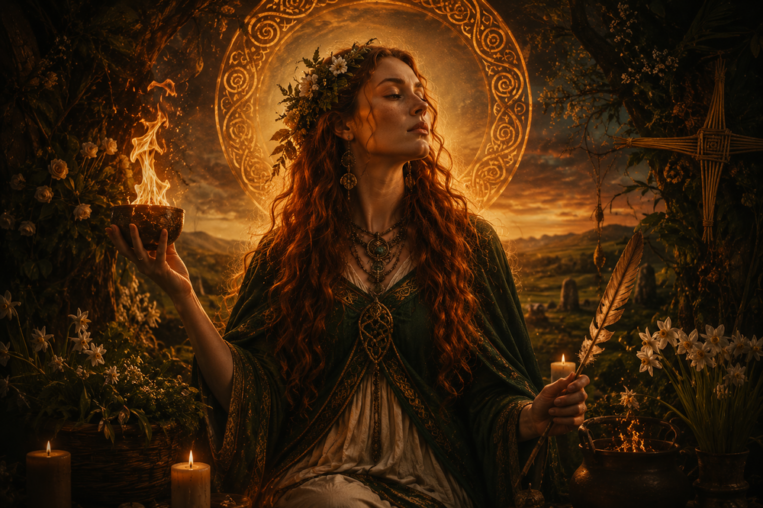
She arrives before the light does.In the deep, iron cold of January’s end, when the ground is still locked and the trees are still bare and it seems, as it always seems at this point in the year, that spring is a rumor rather than a promise. She comes. Not dramatically. Not with thunder or storm or the kind of announcement that the harder goddesses make when they arrive. She comes the way the first morning light comes – quietly, from the edge, a brightening that you notice is already happening before you can name the moment it began.The snowdrops are up. The ewes have milk. The days are longer, just barely, just enough to feel. Something is stirring in the ground that was frozen solid a month ago. Something is stirring in the creative self that went dormant in the dark.That is Brigid arriving. And she has been arriving at this moment, at this precise hinge point in the year between the deep winter and the first breath of spring, for as long as there has been anyone in the Celtic world to notice it and give the arriving a name.She is one of the oldest, most beloved, and most continuously honored presences in the Irish and broader Celtic tradition. A goddess who has survived every attempt to contain, convert, or suppress her, who travelled through the Christianization of Ireland not by being defeated but by being absorbed, who emerged on the other side as a saint with the same feast day, the same sacred fire, the same healing wells, the same domains of poetry and craft, and the same quality of warmth and light that she had always carried.She did not lose. She simply changed her robe. Who Is Brigid?Brigid, also written Brighid, Brigit, Brìd, Bride, Bríg, is one of the Tuatha Dé Danann, the divine race of Irish mythology, and the most beloved of their female figures. Her name derives from the Old Irish Breo-Saighead, meaning fiery power or fiery arrow, and from Brigh, meaning exalted one. Both names tell you what she is: fire, given personhood. Elevation, made present.She is the daughter of the Dagda, the great father god of the Tuatha Dé Danann, the lord of abundance and wisdom, whose name means good god, which places her at the very centre of the Irish divine family, a figure of central rather than peripheral importance. The 9th-century Cormac’s Glossary describes her directly:“The female seer, or woman of insight. The goddess whom poets used to worship, for her cult was very great and very splendid.”It goes on. She had two sisters, also called Brigid, one of healing, one of smithcraft, so that “from these sisters, all the Irish have a goddess called Brigid.” The implication is that Brigid is not just one goddess. She is the quality of a whole class of divine power. The power of the skilled, the inspired, the transformative. Her name may be more title than personal name. An indication of a whole category of sacred excellence.Her Triple NatureBrigid is typically understood as a triple goddess, not in the Maiden-Mother-Crone sense, but in the triple sense of her three domains:~ Brigid of Poetry – goddess of inspiration, of the imbas (the fire of poetic knowledge), of sacred speech and the power of the well-made word. In the Irish tradition, poetry was not art for art’s sake. It was memory, prophecy, power, and praise. The filid, the poet-seers, were second only to the druids in social standing, because the person who controlled the language of a thing controlled the thing itself. Brigid presided over...
