
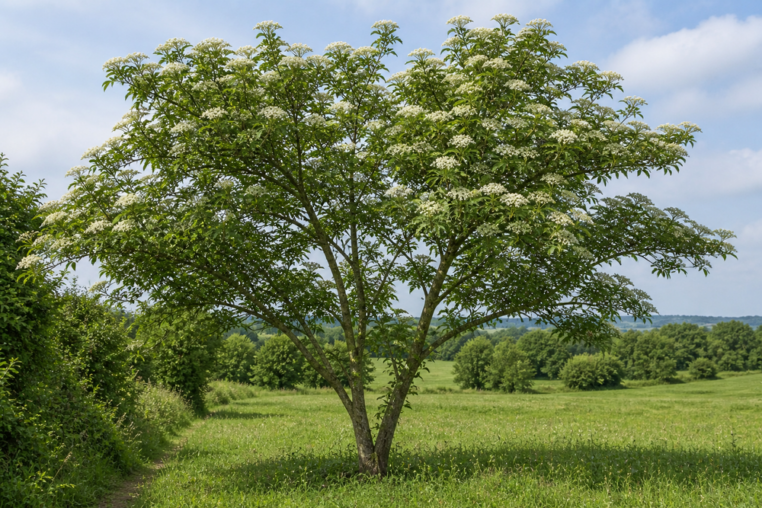

She is not an impressive tree. She has none of the oak’s grandeur, none of the yew’s dark magnificence. She is scrubby, quick-growing, almost weedy, her stems pithy and hollow, her bark corky and rough. She appears at the edges of gardens, in the gaps between buildings, along the margins of paths that no one maintains. She establishes herself in rubble, in neglected corners, in the places where the ground has been disturbed and no one has bothered to plant anything else. She seems, at first encounter, to be exactly the kind of plant you step around on your way to something more significant.This has been her disguise for a very long time.Sambucus nigra, the elder tree, is one of the oldest and most deeply embedded magical plants in the European tradition. She has been the companion of witches, healers, midwives, and cunning folk since before recorded history. She has been called the Elder Mother, the Queen of the Herbs, the Witch Tree. She has been credited with powers of protection and harm in equal measure. She has been used in medicine, in magic, in dye-making, in wine-making, in folk ritual, and in the kind of quiet, informal hedgerow witchcraft that never called itself anything at all.She blooms at midsummer. Flat-topped clusters of creamy white flowers, hundreds of tiny blossoms packed onto each head, releasing a fragrance that is simultaneously sweet, slightly musky, and unmistakably itself. No other plant smells quite like elder in flower. You know it when you encounter it. Something in the body recognizes it as ancient, as significant, as deserving of attention.This is not imagination. This is accumulated ancestral knowing, encoded in ways that run deeper than conscious knowledge. The Elder Mother ~ Who Lives in This TreeIn northern European folk tradition, the elder was understood not to be merely a tree but to be inhabited. The Elder Mother, Hyldemor in Danish, Ellhorn in German folk tradition, called by various names across Scandinavia and the British Isles, was a spirit, a presence, an entity that lived within the tree and that had to be reckoned with before anything was taken from it.You did not simply cut elder wood without first asking permission. The Scandinavian tradition was specific: you stood before the tree, told it what you needed and why, and waited. If the tree seemed to consent, through some quality of stillness or movement in the leaves, through an internal sense of assent, you proceeded. If it did not, you came back another time, or you went to a different tree.In some traditions, this permission-asking was accompanied by a spoken formula. In others, it was purely internal – a matter of relationship and attention. But the practice was consistent across a broad geographic area and a long period of time, suggesting it reflected something genuine in the practitioner’s experience of this plant.The Elder Mother was understood to be protective of her tree and also protective of those who treated her with respect. Elder planted near the door of a cottage would guard the household. Elder grown near the dairy would protect the milk and prevent it from souring through malevolent influence. Elder branches laid across the threshold would keep out harm.But she was also understood to be easily offended. Elder furniture was widely avoided. Babies rocked in elder cradles might be pinched by the Elder Mother. Burning elder wood indoors was considered very ill-advised. Even cutting it without asking was understood to bring consequences.This is not superstition. It is the codified practice of a relationship that took the non-human world seriously. What She Is ~ The...
