 Written by
 There is a reason witches have always kept company with birds.
Long before the cauldron and the broomstick became symbols of the craft, birds were already woven into the oldest layers of magical tradition. Soaring between the earthly realm and the spirit world, carrying omens on their wings, and serving as the eyes and voices of forces far older than human memory. In cultures spanning every continent, birds have been revered as messengers, oracles, and familiars: creatures that exist in two worlds at once, belonging fully to neither.
If you’ve felt drawn to a particular bird – if one keeps appearing in your dreams, at your window, or on your altar – it may be worth listening.
The Raven ~ Oracle of the Void
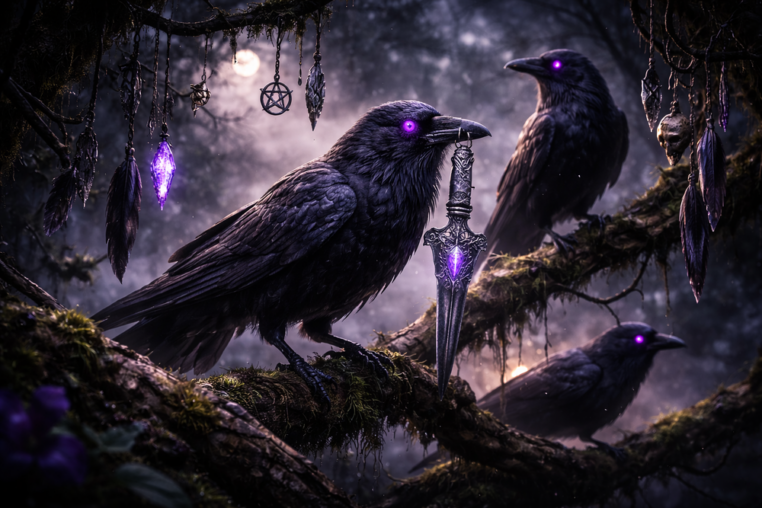
Of all birds associated with witchcraft, the raven may be the most universally recognized. Its ink-black plumage, uncanny intelligence, and eerie vocalizations have made it a figure of profound magical significance across Norse, Celtic, Native American, and Greco-Roman traditions alike.
In Norse mythology, Odin, the Allfather and master of seiðr magic, kept two ravens, Huginn (thought) and Muninn (memory), who flew across the nine worlds each day to bring him knowledge. The raven, in this tradition, is not merely a messenger but the embodiment of magical perception itself: the capacity to see what others cannot, to gather wisdom from the edges of existence.
In Celtic lore, the raven is sacred to the Morrigan, the triple goddess of fate, sovereignty, and war. She took raven form to survey battlefields, not out of bloodlust, but because the raven sees the truth of endings, and endings are where transformation lives.
Magical correspondences: Prophecy, transformation, mystery, protection, shadow work, communication with ancestors.
As a familiar: The raven is thought to serve practitioners who work with divination, necromancy, and liminal magic. It favors those who are willing to look unflinchingly into the dark.
The Owl ~ The Witch’s Eye in the Dark
The owl is perhaps the most ancient familiar of all. Lilith, the primal feminine spirit of Jewish mysticism, is often depicted flanked by owls. In ancient Greece, the little owl was sacred to Athena and appeared on coins and temples as a symbol of hidden knowledge. In Aztec tradition, Tecolotl the owl was a herald of the underworld, associated with death and the god of darkness, Mictlantecuhtli.
The owl sees through the dark. It hunts in silence. It perceives what daylight hides. For these reasons, the owl has long been associated with the witching hour. That liminal time between midnight and dawn when the veil between worlds grows thin.
In European folk tradition, the cry of an owl near a home was considered an omen, sometimes of death, sometimes of a secret about to be revealed. The owl was thought to know things it should not know. And that knowing was the province of magic.
Magical correspondences: Wisdom, clairvoyance, the hidden truth, death and rebirth, the crone aspect, night magic, secrets.
As a familiar: Owls are associated with witches who work with dream magic, shadow work, and deep intuition. They are said to reveal what is being deliberately concealed.
The Crow ~ The Trickster Messenger
Where the raven is an oracle, the crow is a trickster. And in many traditions, the trickster is the most powerful magical figure of all. Crows are among the most intelligent birds on earth. They use tools, recognize individual human faces, hold what appear to be “funerals,” and pass knowledge between generations.
In many Indigenous American traditions, Crow is a shapeshifter and a bridge between what is and what could be. In Hinduism, crows are considered vehicles for the ancestors. Leaving food for crows (bali) during Pitru Paksha is still practiced today as a way of feeding the spirits of the dead.
The crow in Western magical tradition has a dual role: it carries messages between the living and the dead, and it serves as a warning. When crows gather in unusual numbers or behave strangely, folk tradition says to pay attention.
Magical correspondences: Communication, intelligence, cunning, ancestral connection, change, threshold magic.
As a familiar: Crow familiars are associated with witches who are adaptable, clever, and skilled at navigating change. They are said to bring the messages the witch most needs to hear – not always the ones they want to.
The Magpie ~ Between Luck and Sorrow
One for sorrow, two for joy. The magpie holds a unique place in British and European folk magic as a bird of dual omen. Its meaning always dependent on context, number, and circumstance. The old counting rhymes (and their many regional variants) speak to a bird that sits precisely on the edge: it could bring fortune or misfortune, and knowing which requires attention and discernment.
In Chinese tradition, the magpie is overwhelmingly auspicious. A symbol of happiness, good luck, and marital bliss. In Korean folklore, the magpie is a sacred messenger. In contrast, European tradition has treated the magpie with wariness, associating its chattering with gossip, its thievery with mischief, and its black-and-white plumage with a dual nature that straddles good and evil.
This duality is precisely what makes the magpie a powerful magical symbol. It refuses to be one thing. It lives between.
Magical correspondences: Duality, omens, communication, trickster energy, luck (both forms), perception.
As a familiar: Magpie familiars are said to serve witches who work with divination and omen-reading, particularly those who understand that magic rarely works in absolutes.
The Hawk ~ The High Messenger
While crows and ravens deal in shadow and mystery, the hawk is a solar bird. Sharp-eyed, swift, and associated with the clear light of truth. In ancient Egypt, Horus was depicted as a falcon-headed god of the sky. The hawk was considered a divine messenger who carried prayers between the human and divine realms.
In many shamanic traditions, hawk medicine is associated with perspective: the ability to rise above ordinary perception and see the full pattern of a situation. The hawk circles high, observing everything, missing nothing. In this tradition, a hawk sighting is often interpreted as a call to pay attention – something important is in motion.
Hawk feathers, where legally obtained, have long been used in magical practice for clarity work, spirit communication, and divination. The hawk is a bird of active, directed magic. Not passive receiving, but deliberate seeing.
Magical correspondences: Vision, clarity, focus, solar magic, divine messages, speed, truth.
As a familiar: Hawk energy is associated with witches who work magic with intention and precision. Those who set clear goals and direct their energy purposefully.
The Heron and the Crane ~ Keepers of the Threshold
Herons and cranes appear in magical traditions worldwide as guardians of thresholds . Liminal creatures that stand between the water and the land, the seen and the unseen. In Celtic lore, the heron was associated with the Otherworld and with secrets that should not be spoken aloud. The crane, in particular, was so sacred in Ireland that killing one was considered deeply taboo.
In Japanese tradition, the crane is one of the most sacred birds in existence. A symbol of longevity, good fortune, and the divine. In Chinese mythology, cranes carry the souls of the enlightened to heaven.
In magical practice, heron and crane energy is associated with patience, stillness, and the wisdom of waiting. These birds will stand motionless for extraordinary lengths of time before striking with sudden, precise action. This models a powerful approach to magic: deep stillness, attentiveness, and then decisive movement.
Magical correspondences: Liminality, patience, longevity, transition, mystery, sacred knowledge.
As a familiar: Heron and crane familiars are associated with witches who practice patience and timing. Those who understand that the moment of action is as important as the action itself.
The Vulture ~ Sacred to the Great Mother
The vulture is perhaps the most misunderstood magical bird in Western culture, and one of the most ancient. In ancient Egypt, the vulture goddess Nekhbet was one of the most powerful divine figures, serving as the protective mother goddess of Upper Egypt. Vulture imagery adorned the crowns of pharaohs.
Why a vulture? Because the vulture is the master of transformation. It takes what is dead and dying and returns it to life. Not through miracle, but through the sacred work of decay and renewal. The vulture sits at the still point of the cycle, doing the work that makes all new life possible.
In Zoroastrian tradition, vultures and sky burials are part of sacred funerary rites. In many Indigenous traditions, Condor (a relative of the vulture) is a deeply sacred figure associated with the heavens and the spirit world.
Magical correspondences: Purification, transformation, death and rebirth, the Great Mother, cycles, the sacred work of endings.
As a familiar: Vulture energy is associated with witches who work with deep transformation magic, grief, and the alchemical process of turning loss into new life.
Working with Bird Familiars and Messengers
A familiar, in the traditional sense, is a spirit that takes animal form to assist a practitioner. Not necessarily a physical animal, but a spiritual presence with a specific relationship to a specific witch or magical worker. When a bird becomes your familiar, it is less about the animal itself and more about the spirit energy that bird represents coming into relationship with your practice.
Some ways to deepen your connection with a bird familiar or messenger:
Observation. Spend time learning the actual behavior, habitat, and sounds of the bird you feel called to. Magical relationship deepens through real knowledge, not just symbolism.
Altarwork. Create a small space on your altar for your bird . A feather (legally obtained), an image, or a carved or sculpted figure. Leave offerings appropriate to the bird’s nature.
Dream incubation. Before sleep, set the intention to meet your bird familiar in the dream space. Keep a journal nearby to record what comes.
Meditation and pathworking. Visualize yourself in the bird’s natural environment. Practice seeing through its eyes. What does the world look like from that vantage point?
Paying attention to signs. When your bird appears in unusual ways – in dreams, in waking life, in art or media at meaningful moments – take note. Consider what you were thinking, feeling, or facing at that moment.
Birds have always known something we forgot. They exist in the upper air. Close to the stars and the unseen forces that move through the world . While remaining tethered enough to earth to bring messages back. Every tradition that has honored birds as sacred has recognized this: that there are creatures who stand in the in-between places, who see what we cannot, and who, if we pay attention, will show us.
Your familiar doesn’t announce itself with fanfare. It arrives quietly, consistently, at the edges of your attention, asking only that you notice.
Listen.