
 Written by
 Hiding in plain sight.
On the windowsill of someone who has never cast a spell. In the terracotta pot beside the back door of a house where nobody believes in magic. At the edges of car parks and office courtyards, clipped into neat hedges by landscapers who think of it as hardy and low-maintenance. In the kitchen of every home that owns a roast chicken.
Rosemary is perhaps the most quietly powerful plant in the Western magical tradition. And it is powerful precisely because it never stopped being ordinary. While other sacred plants retreated into the esoteric, into the apothecary cabinet and the grimoire, rosemary stayed in the kitchen garden. Stayed accessible. Stayed common. And in doing so, kept its magic alive in the hands of people who might not have called it magic at all. Who called it cooking, or remembrance, or habit.
This plant has been with us for a very long time. And it knows things.
The Names It Carries
Rosmarinus officinalis, now reclassified by modern botanists as Salvia rosmarinus, though the old name refuses to die, means literally dew of the sea. From the Latin ros (dew) and marinus (of the sea). Rosemary grows wild on Mediterranean coastlines, its grey-green needles salt-tolerant and wind-hardened, its blue flowers visible from the cliff paths above the water. It smells, on a hot afternoon in the sun, like the distillation of everything the Mediterranean means: warmth, antiquity, something sacred hidden in the ordinary.
In folk tradition rosemary has been called elf leaf, guardrobe (it was used to protect clothing from moths in wardrobes), compass weed, and incensier, incense plant, in French, a name that acknowledges its long history of burning in sacred spaces. In Spanish folk tradition it is romero, which carries an echo of romero meaning pilgrim. The plant of journeys, of those who travel toward something holy.
Each name is a fragment of its history. Together they describe a plant that has been pressed into service for an enormous range of human purposes, magical and mundane, for thousands of years.
What It Is: The Plant Itself
Rosemary is a woody perennial shrub in the family Lamiaceae, the mint family, which also includes sage, lavender, thyme, basil, and oregano, giving some sense of the company it keeps. Native to the Mediterranean basin, it has been cultivated throughout Europe, Asia, and the Americas for centuries.
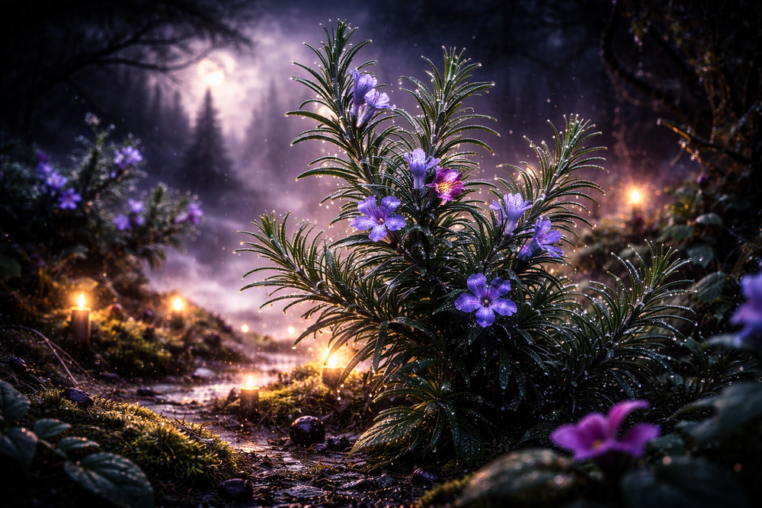
Rosemary grows between two and six feet tall in favorable conditions, with narrow, needle-like leaves that are dark green on top and pale, almost silvery, beneath. The leaves are densely packed, intensely aromatic, and, unlike belladonna’s musty heaviness, they smell clean, resinous, and somehow optimistic. Small flowers in shades of blue, violet, pink, or white appear depending on variety, typically in late winter and spring, though in mild climates rosemary may flower almost year-round.
Famously drought-tolerant and sun-loving, rosemary does better in poor, stony, well-drained soil than in rich garden earth. It is a plant of lean ground, of rocky coastlines, of places where the sun is fierce and the rainfall is sparse. Overwatering kills it far more reliably than underwatering. In this sense, it is a plant that has learned to thrive on very little, to find abundance in apparent scarcity. Worth noting in a plant so strongly associated with prosperity and flourishing.
Rosemary is also extremely long-lived. A well-situated bush can live for decades, growing woody and complex and increasingly fragrant as it ages. Unlike annual herbs that complete their lives in a season, rosemary accumulates years. It is a plant of depth and duration.
Rosemary in History: Memory, Medicine, and the Sacred
The Ancient World
Rosemary’s relationship with humanity stretches back at least to classical antiquity, and almost certainly further. It appears in Egyptian records, in Greek and Roman texts, and in the earliest European herbals. In ancient Greece and Rome, rosemary was associated with memory and with the dead. Students wore rosemary garlands while studying to aid recall, and the plant was burned at funerals and placed on graves.
The Greek physician Dioscorides included rosemary in his De Materia Medica, the foundational text of Western herbalism, as a warming, strengthening, and stimulating herb. Galen, writing in the second century CE, considered it a tonic for the brain and the memory. The Roman physician Pliny the Elder noted its use in garlands and its sacred associations.
The connection between rosemary and memory is not merely symbolic. Modern pharmacological research has found that rosemary contains compounds, particularly 1,8-cineole, that measurably affect cognitive function. Studies have found that simply being in a room diffused with rosemary essential oil improves performance on memory tests. The folk association between rosemary and remembrance turns out to have a biochemical basis. This is one of those moments where the plant’s traditional magical use and modern science arrive at the same conclusion by different roads.
The Medieval and Renaissance Period
Through the medieval period, rosemary was one of the most important plants in the European garden, medicinal, culinary, aromatic, and ceremonial. It was used in aqua vitae preparations (early distilled spirits used medicinally), in plague preventatives, in preparations for the preservation of meat, and in the great multi-purpose herbal preparations that were the primary medicine of the pre-pharmaceutical world.
Rosemary was specifically associated in medieval medicine with the heart, the brain, and the circulation. All understood, in that tradition, as the seats of memory, emotion, and vital force. Herbalists recommended it for “weakness of the brain,” for lethargy, for cold and damp constitutions that needed warming and activating.
It appears in virtually every significant herbal of the period. John Gerard’s Herball (1597) lists its properties at length. Nicholas Culpeper’s Complete Herbal (1653) associates rosemary with the Sun and with Leo. Fitting for a plant that loves heat and light and grows stronger under direct sunlight. Culpeper recommends it for a striking range of complaints from poor digestion to dimness of sight to “drowsy evil”. His term for the kind of deep lethargy that we might now recognize as depression.
Rosemary and the Queens
Two queens are consistently associated with rosemary in European tradition, and both associations deserve mention.
The first is the Virgin Mary, in Christian folk tradition. One of the most widespread folk stories about rosemary claims that it received its blue flowers when the Virgin Mary, fleeing to Egypt with the infant Jesus, spread her blue cloak over a white-flowering rosemary bush. The plant’s flowers turned blue in honor of the act, and it became known in some traditions as Rose of Mary. A name that, despite its apparent Christian origin, almost certainly layered over much older associations with goddesses of a different kind.
The second is Queen Elizabeth of Hungary, in whose name an extremely famous preparation, Hungary Water, is attributed. The story, which is more legend than verifiable history, holds that an elderly, partially paralyzed queen received a recipe for a rosemary-based tonic from an angel (or, in some versions, from a hermit), which restored her youth and health so dramatically that the King of Poland proposed marriage to her. Hungary Water, a distillation of rosemary in spirits, sometimes with additional botanicals, became the most famous cosmetic and restorative preparation of the Renaissance and remained in use for centuries.
The point of both stories, mythological as they may be, is consistent: rosemary restores. It renews. It is associated with queens because it is associated with the kind of power that does not age. With memory that outlasts the forgetting, with vitality that reasserts itself against decline.
The Folklore: What People Have Always Known
Rosemary for Remembrance
There’s rosemary, that’s for remembrance. Ophelia’s words in Shakespeare’s Hamlet are the most famous expression of an association that was universal in his time. So understood as to need no explanation. Rosemary was carried at funerals and pressed into the hands of mourners as a remembrance of the dead. It was also carried at weddings as a remembrance of the living. A promise that the day would not be forgotten.
The dual use, for both funerals and weddings, speaks to something important about rosemary’s nature. It does not distinguish between joyful and sorrowful memory. It is simply the plant of memory itself, of the persistence of connection across time and change. Given at the beginning of things and at the ending of things, because memory belongs to both.
In some regional traditions, rosemary sprigs were pressed into the hands of the dying, and branches were placed in the coffin, so that the dead would remember who they had been and who had loved them. This is a tender and profound use of the plant. An offering of continuity to those crossing into the forgetting.
Rosemary as Protector
Rosemary’s protective role in folk magic is ancient and widespread. It was planted at the gate or door of the home to prevent evil from entering. Hung in bundles over the cradle to protect infants. Placed under the pillow to ward off nightmares. Burned to purify a space after illness or conflict.
In Mediterranean folk tradition particularly, rosemary was considered one of the most powerful protective plants available. More reliable than many more exotic preparations, because it was always there, always accessible, always fresh. Its protection is not dramatic or esoteric. It is steady, everyday, and available to anyone who grows it.
The protective quality is connected to its scent, the volatile oils that give rosemary its characteristic aroma are genuinely antimicrobial and insect-repellent, which gave the folk tradition of hanging rosemary in sickrooms and near the cradle a practical dimension that reinforced its magical one. As with so many plant traditions, the magical and the practical are two descriptions of the same thing.
Rosemary at the Door
There is a piece of folk wisdom, particularly associated with Wales and the west of England, that says where rosemary grows well, the woman rules. The context of this saying matters: it was not intended as a complaint. In households where rosemary thrived, it was understood as a sign that the woman of the house had a strong character, good judgment, and authority in her domain. Rosemary’s flourishing was a reflection of her flourishing.
In the same tradition, husbands who resented this association would sometimes secretly uproot rosemary plants in the garden. Which, given rosemary’s considerable determination as a plant, was rarely effective for long. It came back. It usually does.
Rosemary and the New Year
In many European folk traditions, particularly Spanish and Italian, rosemary is associated with the New Year and with the luck of the household going forward. Branches given as gifts at the new year carry the wish for the recipient’s flourishing. For health, for memory, for the steady green growth that rosemary itself embodies.
This is connected to its evergreen nature: rosemary does not lose its leaves in winter. It stays green, stays fragrant, stays alive through the cold months when many other plants retreat. This persistence made it a natural symbol of life continuing through difficulty. Of the vital force that does not yield to season or circumstance.
Rosemary in Witchcraft: The Universal Substitute
Here is something that every practicing witch who works with herbs learns eventually: rosemary can stand in for almost any other herb in a magical working.
This is not a modern shortcut. It is an old piece of practical magical knowledge. Rosemary’s magical potency is so broad-spectrum, its associations so wide-ranging, and its availability so consistent that it was understood in folk magic as a reliable substitute when a more specific herb was unavailable. Need protective herbs and only have rosemary? Use rosemary. Need something for a love working and the specific herbs called for are out of season? Rosemary. Purification? Memory? Clarity? Healing? Yes, yes, yes, and yes.
This quality of being the universal herb is, in magical terms, an expression of its extraordinary range. Rosemary spans an enormous number of the domains that herbal magic touches – protective and loving and clarifying and stimulating and purifying, all at once, in the same plant, from the same kitchen pot.
It is, in this sense, a remarkable inheritance.
Rosemary for Purification and Cleansing
Rosemary is one of the primary purification herbs in European magical tradition. Often paired with sage but, in many folk practices, used on its own as a sufficient and powerful clearing agent. Burning dried rosemary to cleanse a space, adding it to a floor wash, or using rosemary-infused water to wipe down thresholds and windowsills are all traditional practices with long histories.
The purification works on multiple levels simultaneously: the antimicrobial properties of its oils clear the physical air, the smoke or scent signals the clearing intention to whatever is present in the space, and the historical weight of the plant’s use for this purpose makes it a potent ally for anyone working within or connected to European folk tradition.
A simple rosemary cleanse: tie a bundle of fresh rosemary, light one end until it catches and then blow it out so it smokes, and move through your space with it. Particularly through corners, across thresholds, and around doorways. Speak or think your intention for the space as you move.
Rosemary for Memory and Mental Clarity
Used in study spaces, in meditation practice, and in any working where mental clarity is needed, rosemary is a plant of sharpness and focus. A sprig on your desk while you write or study, rosemary essential oil diffused while you work on something that requires sustained concentration, or simply crushing a leaf between your fingers and inhaling before sitting down to difficult work. All of these are practical applications of its traditional association with the mind.
In magical workings for memory specifically, spells to help you remember something important, to honor the memory of someone who has died, or to strengthen your connection to the past, rosemary is the primary plant. It holds what would otherwise be lost.
Rosemary for Love and Fidelity
Rosemary’s presence at weddings points to an association with love that is as old as its association with memory. In many European folk traditions it was given to the beloved as a pledge of fidelity. And the connection between memory and love is not coincidental. To be faithful is to remember. To remember fully is to remain in right relationship with what you have promised.
Love workings involving rosemary tend toward the domain of established love, sustained love, love that deepens over time. As opposed to the fiery new-love plants like rose or the magnetism of venus-associated herbs. Rosemary is for the love that becomes part of the architecture of a life.
Rosemary for Protection
Place rosemary at thresholds. Grow it at the gate. Tuck a sprig above the door. Place it in the corners of rooms you want to clear and guard. Hang it over the bed of someone vulnerable. Carry it in a small cloth bundle in your bag or pocket. These are all traditional uses with roots in folk practice across the Mediterranean, Britain, and beyond.
A protective rosemary charm: take three sprigs, tie them together with red or white thread, and speak your protective intention into the bundle. Place it above the front door. Replace it at each new moon or whenever the rosemary begins to dry and lose its scent.
Rosemary’s Magical Correspondences
Element: Fire – warming, activating, stimulating. Rosemary also carries an element of Air in its association with the mind and with memory.
Planet: The Sun, in Culpeper’s system. Sometimes also associated with the Moon in traditions that emphasize its funeral and death associations. In this sense, a plant of both luminaries. The light that warms and the light that illuminates the dark.
Deities: In folk tradition, the Virgin Mary, but beneath and before that: Aphrodite (rosemary was said to have grown first on the shores where Aphrodite was born from the sea foam. And ros marinus, dew of the sea, speaks to exactly this origin). Also associated with Persephone in her role as keeper of memory and of the relationship between the living and the dead.
Magical uses: Memory, remembrance, protection, purification, love and fidelity, mental clarity, healing, honoring the dead, new beginnings, anti-nightmare, prosperity, universal magical ally.
Traditional associations: Funerals and weddings, the threshold of the home, the sickroom, the wedding bouquet, the scholar’s desk, the Queen’s garden.
Working with Rosemary: Simple Practices
The Rosemary Kitchen
If you cook with rosemary, and you should, it is magnificent with roasted vegetables, with lamb, with bread, with potatoes, with chicken, you are already working with its magic. The intention you bring to cooking is the oldest form of kitchen witchery, and rosemary in your food carries its protective, clarifying, memory-strengthening qualities into the body of everyone who eats it.
Before you add rosemary to a dish, take a moment to run your fingers along a sprig and smell the oil on your fingertips. Hold a brief intention: this meal nourishes and protects the people who eat it. This is not a complicated spell. It is simply paying attention to what you are already doing.
The Rosemary Bath
Rosemary added to bath water, either as a strong infusion or as a bundle held under the tap while the bath runs, is a traditional preparation for clarity, energy, and purification. A rosemary bath is particularly useful when you are coming out of a difficult period and want to mark the transition, or when you are preparing for something significant and want to be clear-headed and energetically present.
Some practitioners add sea salt for additional cleansing, or a few drops of rosemary essential oil if fresh plant is not available.
Rosemary for the Ancestors
On Samhain or at any time of ancestor veneration, fresh rosemary on the ancestor altar is both an offering and a bridge. It helps the living remember with love, and in folk tradition it helps the dead remember who they were. A cup of water, a candle, a sprig of rosemary, and a few minutes of genuine remembrance – this is a complete and sufficient ancestor practice, and the rosemary carries the weight of thousands of years of exactly this use.
Growing It
If you can grow rosemary, and in most climates you can, either outdoors or in a sunny window, grow it. The relationship between a practitioner and a living plant is different from the relationship with a dried herb or an essential oil. It becomes a presence in your space, a daily reminder of what it embodies, a living expression of its own qualities.
Talk to it. It is not strange. Plants respond to attention. Rosemary, in particular, seems to grow more vigorously in homes where it is noticed and appreciated. This may be entirely explained by the fact that someone who notices the plant is more likely to water it appropriately and put it in the right light. Or it may be something else. Either way, it thrives with attention.
A Note on Safety
Unlike the plants of the poison path, rosemary is safe in culinary quantities for the vast majority of people. It has been a food plant for millennia, and its safety profile is excellent.
That said, a few cautions are worth noting. Rosemary essential oil is highly concentrated and should not be ingested. In large quantities, significantly more than culinary use, rosemary can stimulate uterine contractions, and pregnant women are traditionally advised to use it only in normal food amounts rather than as a medicinal herb or supplement. People with epilepsy are sometimes advised to use rosemary with care, as in very high doses it may lower the seizure threshold.
These cautions apply to medicinal concentrations – teas, tinctures, essential oil preparations. Cooking with rosemary is simply cooking with rosemary, and it is safe and delicious.
The Magic That Never Left
What is most worth saying about rosemary is that it never became exotic.
It was never locked away. Never lost to persecution or suppression or the slow retreat of plant knowledge from ordinary life. It stayed in the kitchen. Stayed on the windowsill. Stayed in the pasta sauce and in the garden and in the pot of infused olive oil on the counter of every Italian grandmother who ever lived.
And in staying ordinary, it preserved something extraordinary. Every time someone cooked with rosemary and thought of a person they missed, or tucked a sprig into their bag without quite knowing why, or grew a bush beside the door because their own grandmother had one – they were participating in something far older than they knew. They were keeping a thread alive.
Rosemary teaches something important about how magic survives: not always by being kept sacred, kept separate, kept in the hands of specialists. Sometimes it survives by becoming so familiar that nobody thinks to take it away.
It has been with us. It is with us. It will be here long after we’ve gone, growing beside whatever walls stand in our wake, fragrant and needle-green and quietly, stubbornly alive.