 Written by
 She grows at the edge of things.
In the dappled shadow at the forest margin, in the rubble of old ruins, in the disturbed earth beside crumbling walls – belladonna chooses her ground carefully. She is not a plant that invites herself into the tidy cultivated garden. She arrives where something has been disrupted, where the ground has been turned over, where the boundary between the managed world and the wild one has become uncertain.
This is appropriate. Belladonna has always lived at the edge.
Atropa belladonna, deadly nightshade, is one of the most famous and most feared plants in the Western magical tradition. She appears in the literature of witchcraft, in the pharmacopoeia of medieval herbalists, in the records of poisoners and physicians alike. She has killed people. She has healed people. She has, according to centuries of folk tradition, carried people between worlds.
She deserves to be understood properly.
The Names She Carries
The name belladonna is Italian, bella donna, beautiful lady, and its origin is usually explained by one of two stories, or both simultaneously. The first: that Italian women of the Renaissance used drops of belladonna juice in their eyes to dilate the pupils, creating the wide, dark gaze that was considered a mark of beauty. This is historically documented. Atropine, the active alkaloid in belladonna, causes pupil dilation, and the cosmetic use of the plant is well-attested.
The second story is darker. The beautiful lady of the name is not a woman at all but the plant herself . And she is beautiful in the way that dangerous things are beautiful. The glossy black berries look like cherries. The soft, slightly furry leaves have a quality that invites touch. Even the smell, which is distinctly unpleasant to most people, has a strange heaviness that is difficult to ignore. Belladonna draws attention. This is part of her danger.
Her scientific name carries equal weight. Atropa comes from Atropos, the eldest of the three Greek Fates, the one who cannot be turned, the one who cuts the thread of life. It was the eighteenth-century botanist Carl Linnaeus who assigned this name, and he was not being poetic. He was being accurate.
Other names she has been called: dwale (an Old English word meaning stupor or trance), devil’s cherries, naughty man’s cherries, devil’s herb, banewort, and in German, Tollkirsche, mad cherry. Each name is a folk memory of what this plant does and what it has done.
What She Is ~ The Plant Herself
Belladonna is a perennial herb in the family Solanaceae, the nightshade family, which also includes tomatoes, potatoes, peppers, and tobacco. This family contains some of humanity’s most important food plants alongside some of its most toxic, and belladonna sits firmly at the toxic end of that spectrum.
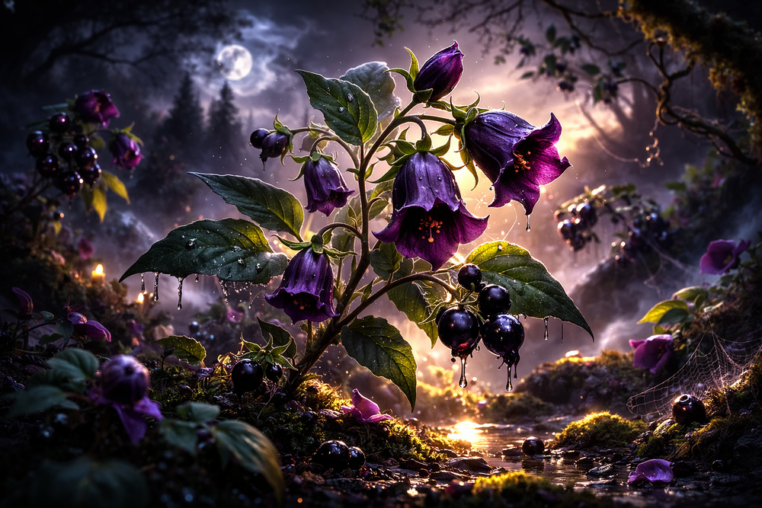
She grows to between one and five feet tall, with large, oval, softly hairy leaves that smell distinctly unpleasant when crushed, musty, slightly fetid, with a strange heaviness. The flowers are bell-shaped and pendulous, a muted purple-brown shading toward green at the base, and they hang in a way that is somehow both delicate and ominous. They bloom from June through September.
The berries ripen from green to a shining, lacquered black. And this is where most of the danger lies in folk encounters with the plant. They are genuinely beautiful. They are the size and color of ripe cherries. They are said to taste sweet. Children have died eating them. Adults have died eating them. The berries are among the most dangerous parts of an already entirely dangerous plant.
Every part of belladonna is toxic. Roots, leaves, flowers, berries, seeds. The toxicity is present throughout, though it varies in concentration. The berries are particularly dangerous because of their appealing appearance and reportedly sweet taste. The roots are the most concentrated source of alkaloids.
Her native range is central and southern Europe, western Asia, and North Africa. She has naturalized across much of the Northern Hemisphere, appearing in disturbed ground, woodland edges, and the ruins of old habitations. The association with ruins is older than botanical science. People noticed that belladonna grew where buildings had fallen, where the earth had been turned, where something had ended.
The Alkaloids ~ What She Contains
The chemistry of belladonna explains everything about her history. She contains a suite of tropane alkaloids, primarily atropine, scopolamine, and hyoscyamine, that act on the human nervous system in profound and far-reaching ways.
These alkaloids block the neurotransmitter acetylcholine, which is responsible for an enormous range of bodily functions: heart rate regulation, salivation, digestion, pupil size, muscle control, and the boundary between conscious and unconscious processing. When the alkaloids interfere with acetylcholine, the results are systemic and dramatic.
At low doses, doses that are extremely difficult to calibrate safely without pharmaceutical preparation, the tropane alkaloids produce dry mouth, rapid heart rate, flushing, and pupil dilation. At higher doses, they produce vivid hallucinations, delirium, and a specific kind of altered state that is distinct from the effects of other hallucinogenic plants: not a dreamy dissolution but a convinced, inhabited alternate reality in which the person is fully present and active. People under the influence of belladonna-family alkaloids do not know they are hallucinating. They believe entirely in what they are experiencing.
At toxic doses, the alkaloids cause seizures, respiratory failure, and death.
This is the plant. She is not metaphorically dangerous. She is chemically, demonstrably, historically dangerous. Any engagement with her, physical, medicinal, or magical, needs to begin with this understanding.
Belladonna in History ~ Poison and Medicine
The Poisoners
Belladonna’s reputation as a poison is ancient and well-documented. In classical antiquity she appears in association with Hecate, the Greek goddess of witchcraft, crossroads, and the underworld, and with Circe, the sorceress of Homer’s Odyssey. The fly agaric mushroom and the nightshades were considered plants of Hecate’s garden, grown in the shadow of the underworld.
In Renaissance Italy, the Borgia family is traditionally associated with poison practices that likely involved belladonna and related nightshades, though the historical record is murkier than the legend suggests. What is clear is that a general class of knowledge about plant poisons, including the nightshades, existed among certain practitioners and was sometimes used for what we might diplomatically call political chemistry.
The poisoner’s use of belladonna was not indiscriminate. The plant’s effects, the confusion, the delirium, the inability to accurately report what had happened, made it useful in situations where the victim’s own behavior could be made to appear responsible for their fate. This is a dark history, and it is part of what belladonna is.
The Physicians
At the same time that belladonna was being used by poisoners, it was being used by physicians. The same alkaloids that kill at high doses have genuine medical applications at very carefully controlled low doses, and practitioners throughout European history were aware of this.
Belladonna preparations were used historically as anaesthesia before surgery. Often combined with other sedative plants like mandrake and henbane in preparations sometimes called “dwale” or “soporific sponge.” Patients would be rendered unconscious, or at least significantly insensible to pain, before procedures that would otherwise be unendurable.
The plant was used for pain management in conditions ranging from gout to neuralgia to menstrual cramps. It was used for asthma, the smoke of burning belladonna leaves was inhaled to relax the bronchial passages, and this practice was still occasionally recommended into the early twentieth century. It was used for gastric complaints, for excessive sweating, for what was then called “spasms” across a wide range of presentations.
Modern medicine has not abandoned the tropane alkaloids. Atropine is on the World Health Organization’s list of essential medicines. It is used in eye examinations to dilate pupils, in surgery to reduce secretions, and as an antidote to certain types of poisoning. Scopolamine is used for motion sickness and nausea, including post-operative nausea. The pharmaceutical industry extracts these alkaloids from belladonna and related plants for ongoing medical use.
The beautiful lady saved lives. She still does, in controlled pharmaceutical form.
The Midwives and the Hedge Witches
Between the poisoner and the physician lived a third kind of practitioner: the healer-witch, the midwife, the cunning woman, the herbalist who worked at the edges of official medicine and official religion. And in this tradition, belladonna’s role was neither killing nor curing – it was crossing.
Belladonna in Witchcraft ~ The Flying Ointment
This is the part of belladonna’s history that is most fascinating and most misunderstood, and it begins with a question: why does so much of the historical record about witchcraft describe flight?
The witches flew to the Sabbath. They rode on broomsticks, on pitchforks, on the backs of demons. They traveled through the night sky to gather in wild places. This imagery runs through centuries of witch trial testimony, demonological treatises, and folk accounts, and it has been easy to dismiss as pure fantasy, the projection of fearful inquisitors and coerced confessions.
But there is another explanation that takes both the testimony and the botany seriously.
The flying ointment, also called witch’s salve or unguent, is one of the most consistently documented elements of European witchcraft. Multiple historical sources, from the demonologist Johann Weyer in the sixteenth century to modern ethnobotanists, describe a preparation made from fat (usually animal fat, which serves as a carrier for fat-soluble compounds) and various plant ingredients, applied to the body, particularly to pulse points and mucous membranes, to produce the sensation and, subjectively, the experience of flight.
The plants most consistently listed in historical formulations of the flying ointment are members of the nightshade family: belladonna, henbane (Hyoscyamus niger), mandrake (Mandragora officinarum), and in some accounts, datura. All of these plants contain tropane alkaloids. All of them, at sub-lethal doses applied transdermally, can produce vivid altered states including the specific quality of hallucination associated with anticholinergic compounds, inhabited, convincing, not dream-like but experienced as entirely real.
The flying was not metaphorical. It was a genuine subjective experience produced by a genuine chemical interaction between plants and nervous system. The practitioners who used these ointments were engaging in a form of chemical journeying. Induced altered states for the purpose of accessing other realms of consciousness, gathering information, and communing with powers beyond ordinary perception.
This is not a minor detail in the history of witchcraft. It suggests that at least some of what the witch trials were persecuting was a genuine practice . A real shamanic technology, rooted in deep botanical knowledge, used by real practitioners for purposes they understood within their own spiritual framework.
The broomstick, by the way, is also not a fanciful detail. Several historical accounts describe the ointment being applied to a staff or broom handle that was then pressed against the body, which would provide efficient transdermal delivery to sensitive areas. The image of the witch astride a broomstick flying through the night is a distorted but not entirely inaccurate representation of a real practice.
The Mythology Around Belladonna
The Plant of Hecate
The association between belladonna and Hecate is among the oldest in Western magical tradition. Hecate governs crossroads, transitions, and liminal spaces. The places between here and there, between life and death, between the known world and what lies beyond it. Belladonna, as a plant that chemically dissolves the boundary between ordinary consciousness and altered states, is an almost perfect botanical expression of Hecate’s domain.
In Greek mythology, the garden of Hecate contained all the plants associated with transformation, poison, and underworld passage, the nightshades, the hellebores, the aconite. This mythological garden is the ancestor of what later traditions call the poison garden or the witch’s garden, a concept that survives in contemporary herbalism and magical practice.
The Three Fates and Atropos
As mentioned in belladonna’s name: Atropos is the Fate who cuts. She is the inevitable one, the one who cannot be turned or appealed to. The alkaloid atropine is named for her, and the botanical name of the genus carries her name, and this is not coincidence. The people who named this plant, who formalized its classification and its chemistry, understood that they were dealing with something that stood in direct relationship with mortality.
This mythological frame is useful for practitioners who work with belladonna in a ritual or devotional sense. She is not a plant of growth and flourishing. She is a plant of the threshold. She belongs to the end of things, to transformation through dissolution, to the wisdom that only comes from understanding that nothing lasts.
The Devil’s Herb
In Christian folk mythology, belladonna is consistently associated with the Devi. And this association, though framed in a theological lens that many practitioners today don’t share, points to something real. The plant was understood as belonging to the powers of the Other: the forces outside the managed, sanctioned, daylight world. The powers that operate at the crossroads, in the ruins, at the edge of the forest.
Whether you understand those powers as Hecate, as the Fair Folk, as the wild forces of nature, or as something else entirely, the folk association with the outsider powers is consistent and old. Belladonna is not a plant of the center. She is a plant of the edge.
Working with Belladonna in Contemporary Practice ~ Symbolism and the Garden
Here is the essential caution, stated clearly: belladonna is not safe to ingest, infuse, smoke, or apply to the skin in any form that you have prepared yourself. The margin between a sub-lethal and a lethal dose of tropane alkaloids is extremely narrow, varies significantly between individuals, and cannot be reliably calibrated without pharmaceutical equipment. People die from belladonna every year, most of them unintentionally. This is not a plant to experiment with chemically in any form.
This does not mean that belladonna has nothing to offer the contemporary practitioner. It means that the relationship must be approached differently.
Belladonna as Altar Plant
Growing belladonna in a dedicated garden space, particularly one associated with a poison garden, a death-and-rebirth practice, or work with underworld deities, is a meaningful and legitimate form of working with the plant’s energy. The living plant, observed in its growing cycle, tends through the seasons, learned from as a living being, offers a genuine relationship with belladonna’s qualities without requiring any dangerous physical contact.
If you grow her, be aware of the risks to children and animals, who are far more susceptible to alkaloid poisoning than adults and who may be attracted to the berries. Wearing gloves when handling the plant is sensible. Washing hands thoroughly after any contact is essential.
Belladonna in Spellwork ~ The Dried Plant
Dried belladonna, commercially available from reputable herbalists, can be used in spellwork involving crossing work, shadow work, death and rebirth practices, and work with chthonic deities. Used in a sachet, burned on charcoal as incense in a well-ventilated space, or incorporated into a poppet or charm, dried belladonna carries its traditional magical associations without the same level of risk as fresh plant material.
Even with dried material, care is warranted. Do not handle it without washing hands afterward. Do not burn it in an enclosed space. Do not allow children or pets access to it. The alkaloids are present even in the dried plant, and while the risk is lower without direct physical contact, it is not zero.
Belladonna in Dream Work and Pathworking
Belladonna’s traditional associations with the flying ointment and underworld travel make her a natural correspondence for dream work, astral projection, and pathworking, all forms of internal journeying that operate in the space she is mythologically associated with. Working with belladonna imagery, keeping a small amount of dried plant near (but not handled during) dream work, or using her as a focal point for pathworking into the underworld or liminal spaces are all ways of engaging with her energy without the risks of direct physical contact.
Belladonna’s Magical Correspondences
Element: Water and Earth – the dissolving and the chthonic.
Planet: Saturn, and in some traditions, the Moon. Saturn governs boundaries, time, death, and transformation. The Moon governs the unconscious, the hidden, and the liminal.
Deity associations: Hecate, Circe, the Morrigan, Persephone, Atropos, and in some contemporary traditions, Nyx (goddess of night).
Magical uses: Crossing work, underworld pathworking, shadow work, work with death and rebirth, trance, visionary practice, binding magic, protection through concealment, work with the ancestors and the dead.
Traditional associations: The Witch’s Sabbath, the flying ointment, liminal spaces, the poison garden, the crossroads.
The Cautions, Stated Plainly
No post about belladonna would be complete without these:
Do not eat any part of the plant. The berries are particularly dangerous because of their appealing appearance. A child can die from eating as few as two or three berries. Adults have died eating the leaves, the roots, or large quantities of berries. There is no safe edible dose.
Do not apply preparations made from the plant to your skin. The alkaloids are absorbed transdermally, and home preparations cannot be reliably dosed. The historical flying ointments were produced by practitioners with deep botanical knowledge and considerable experience – and some of them still killed people.
Do not smoke the leaves. Smoking belladonna causes rapid and severe alkaloid intoxication and is genuinely dangerous.
Do not give any belladonna preparation to another person. This is both ethically and legally serious.
If you or someone else has ingested any part of the plant, contact poison control immediately. Do not wait for symptoms. Do not try to manage it at home. Belladonna poisoning can be treated effectively if caught early. Left untreated, it can be fatal.
Know what she looks like before you forage. Belladonna is sometimes confused with other plants, including bittersweet nightshade (which is less toxic but still dangerous), elderberry (which the berries can resemble in clusters), and occasionally cherry or blackberry in bad light. If you forage, learn the identifying features with certainty before handling any nightshade-family plant.
Respect as the Foundation of Relationship
Belladonna is not a plant to be romanticized without understanding, or feared without understanding. Both responses, the glamorizing and the reflexive horror, reduce her to something she is not.
She is a plant with a genuine and profound relationship with human consciousness, human medicine, human magic, and human mortality stretching back thousands of years. She has killed. She has cured. She has carried people across boundaries that ordinary life does not cross. She has a coherent mythological identity rooted in the deepest layers of Western spiritual tradition.
She deserves respect. Not in the abstract, comfortable way we sometimes use that word – but in the original sense, which is to look again. To look carefully. To look without the filters of projection, whether that projection is glamour or fear.
To know her truly is to know something true about the edge of things: that it is always present, that it cannot be managed away, and that there is wisdom available at the boundary between one state of being and another that cannot be found anywhere else.
She grows there, at the edge.
She always has.
A note on safety: This post is written for educational and historical purposes. Nothing in this post constitutes medical advice. Belladonna is a dangerous plant. If you have questions about plant safety, consult a qualified herbalist or medical professional. If you suspect poisoning, contact Poison Control immediately.
US, call 1-800-222-1222.
In England, Scotland and WalesThe NPIS does not provide poisons information directly to members of the public – so, for routine poisons advice you should contact your general practitioner or telephone NHS 111 (England) or NHS 24 (Scotland) on 111.