 Written by
 When: February 1-2 (traditional) or the astronomical midpoint between Winter Solstice and Spring Equinox (February 3-4)
Also Known As: Imbolg, Oimelc, Brigid’s Day, St. Brigid’s Day, Candlemas (Christian), Lá Fhéile Bríde (Irish)
Pronunciation: IM-olk, IM-bulk, or IM-bowlk
Season: Cross-quarter day between Winter Solstice and Spring Equinox
As February arrives with snow still blanketing the earth and cold winds howling, something shifts. The days have grown noticeably longer. The sun sits higher in the sky. Beneath the frozen ground, seeds begin to stir. Ewes heavy with lambs produce the first milk of the season. Life, dormant through the darkest months, begins its slow return.
This is Imbolc, the festival that celebrates the first stirrings of spring while winter still holds the land in its grip. It’s a holiday of contradictions and hope: fire in the snow, milk from barren fields, light growing in darkness. For the ancient Celts and modern practitioners alike, Imbolc marks a sacred turning point in the wheel of the year.
The Name and Its Meanings
The word “Imbolc” carries layers of meaning, each revealing something about the festival’s significance:
“I mbolc” – “In the belly” in Old Irish, referring to pregnant ewes and the seeds germinating beneath the earth. Life is literally “in the belly” of animals and the land, not yet visible but very much present.
“Oimelc” – “Ewe’s milk,” acknowledging the lactation that begins as lambs are born or about to be born. In agricultural societies where winter food stores were dwindling, fresh milk was a literal lifesaver.
“Imb-fholc” – “To wash or cleanse oneself,” connecting to the purification rituals traditional to this time.
“Embibolgon” – A Proto-Celtic term meaning “budding,” the first signs of new growth.
Each interpretation points to the same truth: Imbolc celebrates potential becoming reality, the hidden becoming manifest, the dormant awakening to life.
The Historical Festival ~ Ancient Celtic Traditions
Imbolc is one of the four Gaelic seasonal festivals, along with Beltane (May 1), Lughnasadh (August 1), and Samhain (November 1). These cross-quarter days marked the agricultural and pastoral year for the ancient Celts of Ireland, Scotland, and the Isle of Man.
The Agricultural Reality
The timing of Imbolc reflects practical farming cycles. In Celtic lands, sheep were bred to lamb in late winter, ensuring newborns arrived before the spring grass but while mothers could still survive on sparse winter vegetation. Cows, requiring better grazing, gave birth later in spring.
This strategic timing meant that by Imbolc, ewes were lactating, providing fresh milk, butter, and cheese when winter food stores were dangerously low. The festival celebrated this critical transition from complete winter scarcity to the first abundance of the agricultural year.
Early Irish texts mention Imbolc, though less frequently than Samhain. A 10th-century poem translated by scholar Kuno Meyer describes ritual practices: “Tasting of each food according to order, this is what is proper at Imbolc: washing the hands, the feet, the head.” This suggests purification and renewal rituals were central to the celebration.
Weather Divination
Like Groundhog Day (which actually derives from Imbolc traditions brought to America), ancient Celts practiced weather divination on this day. They listened for the song of the lark. If the bird sang, it meant the God had returned to the Goddess and spring would come early. If the lark remained silent, winter would continue for weeks more.
This wasn’t superstition but practical observation. Migratory birds, plant budding, and animal behavior are all genuine indicators of coming weather patterns. The Celts were simply reading the natural signs that their survival depended on understanding.
Brigid: Goddess and Saint
Imbolc is inseparable from Brigid, one of the most beloved figures in Celtic spirituality. The complexity is that Brigid exists as both pagan goddess and Christian saint, and the line between them is deliberately blurred.
Brigid the Goddess
In Celtic mythology, Brigid (also spelled Brigit, Brighid, Bríd) was the daughter of the Dagda, the chief god of the Tuatha Dé Danann (the mythological race of gods and heroes). She appears in ancient sagas including Cath Maige Tuired.
Brigid as Triple Goddess
Brigid embodies three aspects, sometimes described as three sisters all named Brigid, more likely representing the multifaceted nature of one goddess:
Brigid of Poetry and Inspiration – Patroness of poets, bards, and the Filid (the ancient class of Irish poet-historians). She governs eloquence, prophecy, and divine inspiration. When words flow effortlessly, when truth emerges in verse, when the veil thins and we speak what we didn’t know we knew – this is Brigid’s gift.
Brigid of Healing – Goddess of medicine, herbal lore, and the healing arts. She knows the properties of plants, the rhythms of the body, and the connection between physical and spiritual wellness. Midwives, herbalists, and healers called on her for wisdom and skill.
Brigid of Smithcraft – Patroness of blacksmiths, metalworkers, and all who work with fire and transformation. The forge’s flame that turns raw ore into tools and art is her sacred fire. She governs all crafts and the creative transformation of material into something new.
Brigid’s Associations
– Fire – She is a fire goddess, and eternal flames burned in her honor
– Water – Despite being a fire deity, she also governs holy wells and healing waters
– Fertility – Both agricultural abundance and human/animal reproduction
– The Hearth – The domestic fire that warms, cooks, and protects the home
– Springtime – The returning warmth and light after winter darkness
– Protection – Guardian of home, livestock, and women in childbirth
According to the saga Cath Maige Tuired, Brigid was the one who brought keening, the traditional Irish practice of wailing in grief, to Ireland after the death of her son. This connects her to the full cycle of life, death, and mourning.
St. Brigid of Kildare
When Christianity came to Ireland in the 5th century, the figure of Brigid transitioned seamlessly from goddess to saint. St. Brigid is said to have been born around 450 AD in Faughart, County Louth, the daughter of a druid and a Christian slave woman.
The Historical Saint (Maybe)
St. Brigid’s biography reads remarkably like the goddess’s mythology. She founded a monastery at Kildare (meaning “Church of the Oak,” a site likely sacred to the pagan Brigid). She was renowned for:
– Her charity to the poor (multiplying food and resources miraculously)
– Her healing powers (curing illnesses and performing miracles)
– Her connection to dairy and livestock (she was patroness of dairymaids and cattle)
– Her sacred flame (tended by nineteen nuns in an exclusively female priesthood)
Sound familiar? These are precisely the goddess Brigid’s domains.
The Perpetual Flame
At Kildare, a sacred flame burned continuously for centuries, first tended by pagan priestesses of the goddess, then by Brigidine nuns honoring the saint. The flame was extinguished during the Suppression of the Monasteries under Henry VIII but was ceremonially relit in 1993 by the Brigidine Sisters. It burns to this day at Solas Bhríde Centre in Kildare.
One Brigid or Two?
Most scholars believe St. Brigid is either:
1. A priestess of the goddess Brigid who converted to Christianity and was later canonized
2. A complete invention by the Church to Christianize the beloved pagan goddess
3. A real Christian woman whose life was deliberately mythologized with goddess attributes to ease conversion
Irish folklorist Dolores Whelan notes that to understand Celtic spirituality, “you must understand Brigid as both goddess and saint.” The Irish people never really distinguished between them. Brigid is Brigid, sacred, powerful, beloved, whether you approach her as deity or saint.
February 1st is both Imbolc (the pagan festival) and St. Brigid’s Day (the Christian feast day), and in Ireland, they’re celebrated together. In 2023, Ireland made “Imbolc/St. Brigid’s Day” an official public holiday, the first Irish holiday named after a woman.
Traditional Imbolc Celebrations
How did the ancient Celts celebrate this festival? Many traditions survived into the modern era and were documented by folklorists:
Fire Rituals
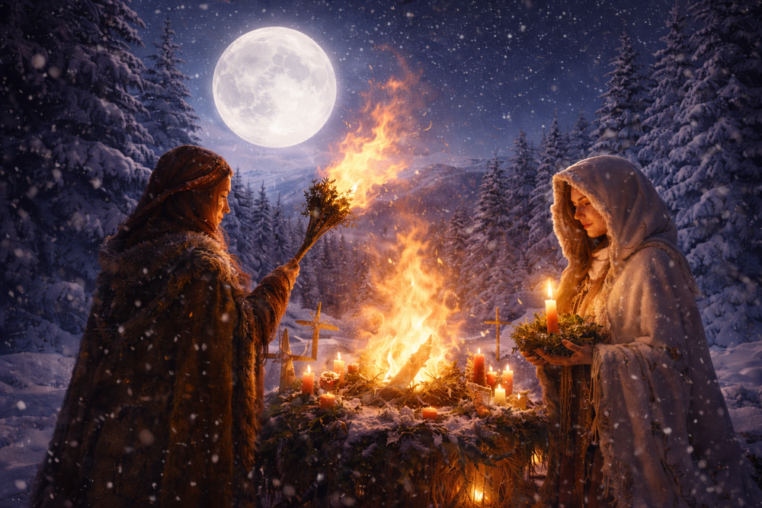
Fire was central to Imbolc celebrations. The connection to Brigid the fire goddess and the symbolism of light returning to the world made flames essential to the festival.
Lighting the Land
Communities lit bonfires and torches to symbolically warm the frozen earth and encourage the sun’s return. Homes were thoroughly cleaned, and fires were lit in every room just after sunset to honor the sun’s rebirth.
Sacred Flames
Brigid’s eternal flame was a living connection to the goddess/saint. Tending a fire through the night of Imbolc, keeping it burning from sunset to sunrise, replicated this sacred practice.
Candles
With Christianization, the fire tradition transformed into Candlemas (February 2), when all the candles for the church year were blessed. Many pagans continue this practice, blessing and consecrating candles for the year ahead.
Brigid’s Cross
One of the most recognizable symbols of Irish culture, Brigid’s Cross is traditionally made on Imbolc/St. Brigid’s Day.
The Design
Brigid’s Cross consists of a woven square center with four arms radiating outward, made from rushes, reeds, or straw. Each cross is unique, but the basic structure remains the same.
The Purpose
Crosses were hung above doors, in windows, and in rafters to protect the home from fire, lightning, illness, and evil spirits. They stayed in place for a year, then were replaced the following Imbolc.
The Making
Creating Brigid’s Crosses was a communal activity. Families and communities gathered, soaking rushes to make them pliable, then weaving while sharing stories and prayers. The repetitive motion became meditative, and the finished crosses carried the intention of protection woven into every strand.
The Brídeóg (Brigid Doll)
Another widespread tradition involved creating a corn doll or effigy representing Brigid herself.
Creating the Doll
The last sheaf of grain from the previous harvest (carefully saved for this purpose) was fashioned into a female figure, dressed in cloth or flowers, and sometimes adorned with shells, ribbons, or a crown.
The Procession
Young girls (representing Brigid’s maiden aspect) carried the Brídeóg door-to-door throughout the community, sometimes accompanied by “strawboys” or other costumed figures. Households welcomed Brigid, offered food and drink, and received blessings in return.
Brigid’s Bed
On St. Brigid’s Eve (January 31), families prepared a small bed for Brigid, complete with bedding and sometimes a wooden wand or brat (cloth). The Brídeóg was placed in the bed, and items were left outside for Brigid to bless as she passed through the land.
Morning Divination
In the morning, the family examined the ashes of the hearth fire or the ground where Brigid’s bed had been for marks, footprints, wand impressions, or other signs. Finding them meant Brigid had visited and blessed the home.
Ritual Cleansing
Imbolc was a time of purification, both physical and spiritual.
Spring Cleaning
Though spring hadn’t yet arrived, Imbolc marked the time to clean house thoroughly. This wasn’t just practical but deeply symbolic – clearing out the old and stagnant energies of winter to make room for spring’s new growth.
Personal Cleansing
Ritual washing of hands, feet, and head (as mentioned in ancient texts) prepared people to enter the new season pure and renewed. Visiting holy wells for healing and purification was common.
Setting Out Cloth
People hung ribbons, pieces of cloth, or items of clothing outside on Brigid’s Eve to be blessed by the goddess/saint as she passed. These blessed items gained healing and protective properties and were treasured throughout the year.
Weather Watching and Divination
As a cross-quarter day, Imbolc was a liminal time when the veil between worlds thinned, making divination more accessible.
Natural Signs
Observing nature for signs of spring’s timing, bird songs, plant budding, animal behavior, and weather patterns, was both practical and sacred.
Prophecy and Vision
As Brigid governs prophecy, Imbolc was an auspicious time for divination, dream work, and seeking visions about the year ahead.
Feasting
Despite being deep winter when food was scarce, Imbolc feasting celebrated the first abundance.
Traditional Foods
– Fresh dairy – Milk, butter, cheese (the first of the season from lactating ewes)
– Bread and bannocks – Grain products honoring Brigid’s connection to abundance
– Lamb – If livestock needed to be culled
– Colcannon – Traditional Irish dish of potatoes and greens
– Butter and honey – Left as offerings for Brigid
Poetry and Storytelling
As Brigid is patroness of poetry, Imbolc was a time for bards to share new compositions, for stories to be told around the fire, and for the oral tradition to continue.
How Imbolc is Celebrated Today
Modern practitioners draw from ancient traditions while adapting celebrations to contemporary life and diverse spiritual paths.
Wiccan and Neopagan Observances
For Wiccans, Imbolc (pronounced IM-olk or IM-bulk) is one of the eight sabbats on the Wheel of the Year. Modern celebrations include:
Altar Decoration
– White, yellow, or red candles representing fire and the returning sun
– Brigid’s Cross or Brigid doll
– White flowers (snowdrops if available)
– Milk, butter, or cream honoring lactation and abundance
– Seeds representing potential
– Representations of fire and water (Brigid’s dual elements)
Ritual Work
– Lighting candles in every room at sunset
– Dedicating the year’s candles
– Invocations to Brigid
– Fire meditations
– Creative work in Brigid’s honor
Timing Variations
Some pagans celebrate on February 1 (traditional date), others on the astronomical midpoint between Winter Solstice and Spring Equinox (February 3-4). Still others observe the full moon closest to February 1, or wait for natural signs like specific plants blooming.
Celtic Reconstructionist Approaches
Celtic Reconstructionists aim to revive ancient Celtic practices based on historical research while adapting them thoughtfully to modern contexts.
They typically:
– Celebrate at the beginning of spring (as the Celts understood seasons)
– Use traditional Gaelic prayers and songs from sources like The Carmina Gadelica
– Honor Brigid specifically (avoiding syncretism with deities from other cultures)
– Focus on historically documented practices
– Create Brigid’s Crosses and dolls
– Maintain a flame or candles through the night
– Make offerings to Brigid
Irish Cultural Celebrations
In Ireland, Imbolc/St. Brigid’s Day is experiencing a modern revival as both religious festival and cultural heritage celebration.
County Kildare
The largest celebration happens in Kildare, where St. Brigid founded her monastery. The “Brigid, Spirit of Kildare Festival” runs for five days, blending Christian, pagan, and cultural Irish traditions through concerts, workshops, processions, and ceremonies.
Public Holiday
Since 2023, the first Monday of February is a public holiday honoring both Imbolc and St. Brigid. The first Irish public holiday named after a woman.
Community Traditions
Schools teach children to weave Brigid’s Crosses. Communities gather for storytelling, music, and dance. Holy wells throughout Ireland see visitors seeking healing and leaving offerings.
Modern Secular Observances
You don’t have to be pagan or Christian to find meaning in Imbolc. The themes, hope, purification, potential, and the returning light, resonate universally.
Nature Connection
– Taking walks to observe early spring signs
– Starting seeds indoors for spring planting
– Photographing the changing landscape
– Documenting daylight hours increasing
Creative Renewal
– Beginning new creative projects
– Visiting art museums or galleries
– Writing poetry
– Learning a craft
Home and Hearth
– Deep cleaning and decluttering
– Lighting candles and enjoying firelight
– Baking bread
– Gathering family for a special meal
Imbolc Rituals and Practices You Can Do
Whether you’re a dedicated pagan, culturally connected to Celtic traditions, or simply drawn to the season’s symbolism, these practices can help you honor Imbolc:
Make a Brigid’s Cross
You’ll need:
– 16-20 pieces of straw, rush, or wheat stalks (can use pipe cleaners, paper, or straws)
– String or twine
– Water (to soak natural materials)
Instructions:
1. Soak rushes or straw in water for several hours until pliable
2. Hold one piece vertically
3. Fold a second piece in half over the center of the first
4. Rotate 90 degrees clockwise
5. Fold another piece over the center
6. Rotate 90 degrees clockwise
7. Continue folding and rotating until all pieces are used
8. Tie the ends of each arm
9. Trim ends to even length
10. Hang above your door
As you weave, reflect on protection, blessing, and the cycles of the year.
Light a Brigid Flame
The Practice
At sunset on Imbolc Eve (January 31) or Imbolc itself, light a candle with the intention of honoring Brigid and the returning light.
If safe and possible, keep the candle burning through the night. This requires:
– A stable, fireproof surface
– No flammable materials nearby
– Water nearby
– Never leaving the flame unattended (stay in the same room or have someone else watch it)
If keeping a flame all night isn’t safe, light your candle at sunset and extinguish it when you go to bed, relighting it at sunrise.
As you light the flame, say:
“Brigid of the sacred flame, I kindle your fire in my home and heart. Bless this space with your warmth, protection, and inspiration.”
Create a Brigid Altar
Elements to Include:
– White, yellow, or red altar cloth
– Candles (especially white and red)
– Brigid’s Cross or image of Brigid
– Small bowl of milk
– Fresh bread or bannock
– White flowers (real or artificial)
– Seeds or bulbs
– Your creative work (poetry, art, crafts)
– Representations of fire and water
Using Your Altar:
Spend time at your altar throughout the Imbolc season (late January through early February). Meditate, journal, create, or simply sit in contemplation. Leave offerings for Brigid, milk, butter, bread, honey, coins, or your creative work.
Spring Cleaning Ritual
Transform mundane cleaning into sacred ritual:
1. Set Intention: Before you begin, clarify your purpose. You’re not just cleaning dirt but clearing stagnant energy, making space for new growth.
2. Start at the Hearth: Begin with your fireplace, stove, or wherever you cook and gather. Clean thoroughly while visualizing warmth and abundance.
3. Move Through Each Room: Clean clockwise (sunwise) through your home. As you clean, visualize light filling each space, driving out heaviness and darkness.
4. Windows and Doors: Pay special attention to thresholds. Clean window panes to let more light in. Wash doorways and thresholds.
5. Finish with Smoke or Sound: After physical cleaning, use incense, herbs, bells, or singing bowls to clear remaining energy.
6. Brigid’s Cross: Once everything is clean, hang a newly made Brigid’s Cross above your door.
Imbolc Divination
Fire Scrying
Light a candle and gaze into the flame. Soften your focus and let your mind drift. Notice any images, feelings, or messages that arise. What does the fire reveal about your path forward?
Water Scrying
Fill a dark bowl with water. Light a white candle behind it so the flame reflects in the water. Gaze into the water’s surface, noticing any visions or insights.
Tarot or Oracle Reading
Pull cards asking
1. What am I ready to release from winter?
2. What seeds am I planting for spring?
3. How can I honor my creative fire?
4. What does Brigid want me to know?
5. How can I serve the returning light?
Brigid’s Bed
The Practice
On Imbolc Eve, create a small bed for Brigid:
– Use a small basket or box
– Line it with white cloth or fabric
– Add a small pillow
– Place the bed near your hearth, altar, or front door
Create a simple Brigid doll (even a small corn husk figure or peg doll works) and place it in the bed. Set out a small offering of milk, bread, or honey.
Invite Brigid
“Brigid, sacred mother, healer, poet, smith, you are welcome in my home. Bless this house and all who dwell here. I honor you on this sacred night.”
Leave the bed overnight. In the morning, look for signs of Brigid’s presence – sometimes this is an internal knowing, a dream, or simply a sense of peace.
Creative Offering to Brigid
Brigid is patroness of poets and all creators. Honor her with your creativity:
Write a Poem
Compose verses in Brigid’s honor or about the themes of Imbolc. Don’t worry about quality, the act of creating is the offering.
Make Art
Paint, draw, color, sculpt, or craft something inspired by fire, spring, or Brigid herself.
Learn a Craft
Begin learning something new – knitting, woodworking, pottery, whatever calls to you. The learning process honors Brigid of the smithcraft.
Perform Your Work
Read your poem aloud, display your art, or demonstrate your new skill. Brigid’s gifts are meant to be shared.
Milk and Honey Bath
Ingredients
– 1-2 cups whole milk or coconut milk
– ¼ cup honey
– Optional: dried lavender, rose petals, or chamomile
The Ritual
Draw a warm bath. As it fills, add the milk and honey, stirring clockwise to blend.
Before entering, state your intention
“By Brigid’s blessing, I purify body and spirit. I wash away winter’s heaviness and prepare for spring’s renewal.”
Soak for at least 20 minutes, visualizing white light infusing the water, cleansing you of anything that no longer serves.
When finished, drain the bath, imagining all you’ve released flowing away.
Plant Seeds
Even if it’s too early to plant outdoors, Imbolc is perfect for starting seeds indoors.
The Practice
– Choose seeds for plants you want to grow
– Fill pots with soil
– As you plant each seed, set an intention. What are you “planting” in your life?
– Water and place in a sunny window
– Tend your seeds throughout late winter, watching your intentions grow
Brigid’s Blessing
On Imbolc Eve, set out items you want Brigid to bless:
– A piece of cloth or ribbon (keep it for healing)
– Jewelry or amulets
– Tools for creative work
– Anything that would benefit from sacred blessing
Leave them on your doorstep, window sill, or beside Brigid’s bed overnight.
In the morning, retrieve them and keep them as blessed objects throughout the year.
Community Celebration
If you’re part of a coven, circle, or spiritual community:
Group Ritual
– Cast circle and invoke Brigid
– Each person lights a candle from a central Brigid flame
– Share poetry or creative work
– Make Brigid’s Crosses together
– Feast on traditional foods
– Share music and song
Charity in Brigid’s Name
St. Brigid was known for charity to the poor. Honor this by:
– Donating to food banks
– Volunteering at a shelter
– Performing acts of service
– Sharing your abundance with those in need
Imbolc Foods and Recipes
Traditional Imbolc foods celebrate the first abundance while acknowledging the season’s scarcity.
Bannock (Scottish Griddle Bread)
Ingredients:
– 2 cups flour
– 1 tsp baking powder
– Pinch of salt
– 2 tbsp butter
– ¾ cup milk
Mix dry ingredients, cut in butter, add milk to form dough. Shape into round, flatten slightly, cook on griddle until golden on both sides.
Colcannon (Irish Potatoes and Greens)
Ingredients:
– 2 lbs potatoes
– 1 cup kale or cabbage, chopped
– ½ cup milk
– 4 tbsp butter
– Salt and pepper
Boil potatoes until tender. Cook greens separately. Mash potatoes with milk and butter. Fold in greens. Season to taste.
Seed Cakes
Ingredients:
– 1 cup flour
– ½ cup butter
– ¼ cup sugar
– 1 tbsp caraway seeds
– 1 egg
Cream butter and sugar. Add egg, then flour and seeds. Shape into rounds. Bake at 350°F until golden.
Brigid’s Crown Bread
Braid bread dough into a circle (representing Brigid’s crown or the wheel of the year). Brush with butter and honey before baking.
The Spiritual Meaning of Imbolc
Beyond the specific rituals and traditions, Imbolc carries profound spiritual significance:
Hope in Darkness
Imbolc celebrates finding hope in the bleakest time. Winter is not yet over, in fact, statistically, February is often the coldest, snowiest month. Yet Imbolc says: “Look, the light is returning. Have faith. Spring is coming.”
This is hope not based on current conditions but on trust in the cycles, in nature’s promise, in the inevitability of renewal.
Fire in the Belly
The “fire in the belly” isn’t just about pregnant ewes. It’s about the inner fire that sustains us through hard times – passion, creativity, life force, and will.
When external resources are scarce, when the world is cold and dark, we must tend our inner flame. Imbolc asks: Is your fire still burning? What feeds it? What threatens to extinguish it?
Hidden Growth
Not all growth is visible. Seeds germinate in darkness. Roots extend underground. Animals carry new life in their wombs.
Imbolc honors the invisible, the potential, the “not yet” that is nonetheless real and powerful. What is growing in your life that isn’t yet visible? What are you gestating in the darkness?
Purification and Preparation
The spring cleaning, the ritual washing, the clearing of space, all prepare us for the abundance to come. We can’t plant new seeds in last year’s debris. We can’t welcome the new while clinging to the old.
Imbolc asks: What needs to be cleansed, cleared, or released? What are you ready to let go?
The Creative Spark
Brigid’s connection to smithcraft, poetry, and all creative arts reminds us that creation is sacred. Whether forging iron, composing verses, healing the sick, or crafting with our hands, we participate in the divine act of bringing new things into being.
Imbolc invites us to honor our creativity, to make things, to express what’s inside us, to shape our lives as the smith shapes metal – with intention, skill, and sacred fire.
Thoughts
Imbolc stands at the edge of two worlds. One foot still in winter, one reaching toward spring. It’s a liminal time, a threshold, a moment of transition when change is happening but not yet complete.
In our modern world of instant gratification and climate-controlled environments, Imbolc teaches patience. The seeds won’t sprout today. Spring won’t arrive tomorrow. But the light IS returning. Growth IS happening. Life IS renewing itself, in its own time, according to its own rhythms.
Brigid, whether you understand her as goddess or saint, embodies this moment. She is the sacred flame that never goes out, the healing that comes from within, the poetry that speaks truth, the craft that transforms the ordinary into art. She is the midwife attending the birth of spring, the fire that warms the cold earth, the inspiration that strikes when we need it most.
As you celebrate Imbolc, remember:
– Tend your inner fire
– Trust the hidden growth
– Welcome the returning light
– Create with sacred intention
– Clean and clear space for the new
– Have patience with the process
– Honor both goddess and season
The wheel turns. Winter yields to spring. Darkness gives way to light. Death is always followed by rebirth.
This is Imbolc’s promise, Brigid’s gift, and the earth’s eternal truth.
Beannachtaí na Féile Bríde ort (Blessings of Brigid’s Feast upon you)
—
May Brigid’s flame warm your hearth, her poetry inspire your spirit, her healing touch restore your wholeness, and her presence bless your home. May the light return, the earth awaken, and spring find you ready.