
 Written by
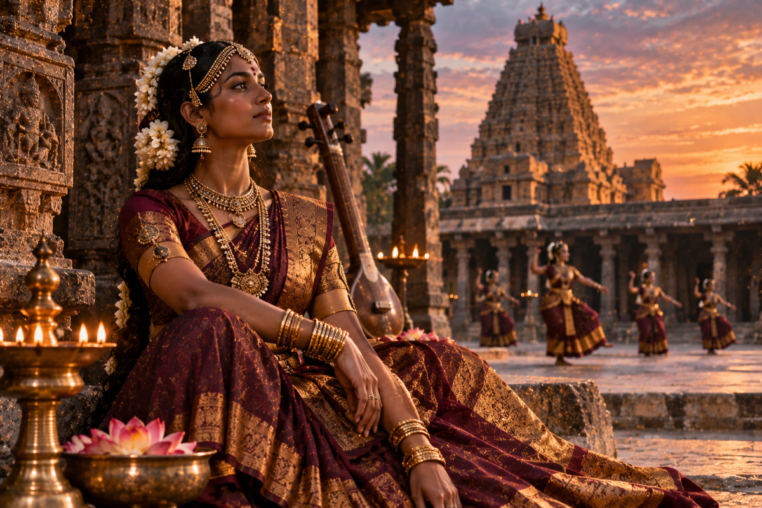
At the height of the Chola dynasty in the ninth century CE, when Raja Raja I built the great Brihadeesvara temple at Tanjore. One of the architectural masterpieces of the ancient world, a structure so vast and precisely oriented that its shadow falls inward at noon. He gifted four hundred women to the temple alongside it. They were not slaves. They were not merely entertainers. They were devadasis: women whose lives, from the moment of their dedication, belonged to the god who dwelled in the temple’s inner sanctum.
The term derives from the Sanskrit words deva (God) and dasi (servant): the servants of God. But the translation flattens what the role actually was. A devadasi was not a servant in the way that a kitchen maid or a temple sweeper was a servant. She was a dedicated woman. A woman given to the divine, married to the deity, bound to a life of artistic and spiritual practice in the temple’s service. She was, in the understanding of her tradition, nityasumangali: eternally auspicious, eternally married, and therefore free from the grief of widowhood that shaped so much of ordinary Indian women’s lives.
She was also, for most of the tradition’s long history, one of the most educated, artistically accomplished, and socially significant women in Indian society.
This is the story of how that became something else entirely . And what was almost lost in the process.
The Origins and the Structure of the Tradition
The devadasi tradition dates back to around the sixth century CE, where women were dedicated to the service of deities in Hindu temples. Earlier references exist. The tradition is thought to be as old as the third century BCE, with some references in Kautilya’s Arthashastra. But it was in the great medieval temple complexes of South India, particularly under the Chola dynasty, that the tradition reached its fullest institutional expression.
The devadasi tradition is believed to have deep connections to Tantric ritual, which required the presence of consecrated female practitioners in temple worship. The Agamas, the canonical texts governing temple ritual in the Shaiva tradition, specified that dance and music were essential aspects of daily puja. The deity needed to be entertained, awakened, bathed, fed, put to sleep. The devadasi danced at the threshold between the sacred and the human. Not for the audience of worshippers, but for the god in the inner sanctum, the one who could not be seen but who was understood to be watching, and to be moved.
The tradition was attached to temples across India. In Tamil Nadu, Andhra Pradesh, Karnataka, Maharashtra, Rajasthan, Gujarat, Bengal, Orissa, and Kashmir . Taking different forms in different regions, under different names. In Orissa, devadasis were called Maharis. In Andhra, they were Kalavantulu. In Karnataka they were associated with the Yellamma cult, in which girls were dedicated to the goddess Renuka-Yellamma. The specific practices differed, but the underlying structure was consistent. Consecrated women, dedicated to a deity from childhood or early adolescence, living within or near the temple, serving the god through art.
The tradition was internally stratified. There were distinct roles: Alankara (the ornamented dancer) and Rudraganika (the musician), among others. There were Dutta devadasi (offered by their parents to the temple) as well as Bhrutya devadasi, who entered voluntarily. The reasons for dedication ranged from religious devotion to economic necessity. In a world of limited options for women, the temple offered food, shelter, education, and social standing that was otherwise difficult to access.
What the Devadasi Actually Did
The devadasi was not simply a dancer. She was a comprehensive practitioner. A woman whose life was organized around a set of artistic and spiritual disciplines that were understood as inseparable from one another.
As sacred dancers, devadasis were the bearers of divine art forms, using their talents to please the deities and the devotees. Their performances were not just artistic expressions but were imbued with spiritual significance, acting as a bridge between the divine and the mortal world. The dance was prayer. The music was offering. The woman’s trained body was the medium through which the divine was made visible and the human was elevated toward it.
Classical dance forms like Bharatanatyam, Mohiniyattam, Kuchipudi, and Odissi have their origins linked to the devadasis, who were the custodians of these art forms. This is not a minor historical footnote. Every classical Indian dance form that is today recognized as high art. The forms that fill concert halls in Chennai and London, that are performed in Indian diaspora communities across the world, was developed, preserved, and transmitted within the devadasi tradition. The artistry that the broader world eventually celebrated was held in the bodies and the lineages of these women for centuries before anyone outside the temple thought to look.
The devadasi was also educated in ways that most women of her time and class were not. She learned Sanskrit, studied classical texts, trained in music theory and composition alongside dance. She was sophisticated and knowledgeable and respected in the community, as she represented culture and the arts. Her matrilineal community – the tradition passed from woman to woman, from mother or guru to student – was one of the few contexts in pre-modern India in which female intellectual and artistic authority was genuinely structurally embedded rather than exceptional.
The tradition also, in many of its historical forms, included what might be called sexual freedom: the devadasi was not bound by the conjugal norms that governed ordinary women’s lives. She was not under pressure to marry a mortal being; instead, the devadasi had sexual freedom in choosing her partners. This was understood, within the tradition, as a consequence of her divine marriage – she was already the god’s wife, and therefore outside the system of human matrimony. How this played out in practice varied enormously across regions, periods, and individuals. From genuine freedom to patronage relationships that were more or less exploitative depending on circumstances. The tradition was never simple, and it was never uniform.
Balasaraswati: The Last Flowering
Into the long arc of this tradition, in Madras in 1918, a girl was born who would become its greatest modern expression. And, in some ways, its final chapter.
T. Balasaraswati was born into the community of female temple servants, devadasis, who maintained the Bharatanatyam tradition. She started training at the age of five under the renowned nattuvanar Kandappa Pillai. She came from a family of at least five generations of musicians and dancers, her mother and grandmother legendary for their skill. Her family’s heritage was closely associated with a royal court, and they had handed down their art within their own clan across generations.
As a young teenager, she was seen by the internationally known dancer and choreographer Uday Shankar, who became an ardent promoter of her performances, and throughout the 1930s she captured the imagination of audiences across India. She was celebrated before she was thirty years old as one of the greatest living exponents of traditional Bharatanatyam. Recognized by the very national culture that was, simultaneously, outlawing the tradition she embodied.
What set Balasaraswati apart ~ what made her not merely a great dancer but a figure of genuine importance to this lineage, was her absolute refusal to sanitize what she did. The shringara elements of Bharatanatyam , the erotic depictions of divine love, the sensual expression of the devotee’s longing for the god, were, in her understanding, not a problem to be solved or an embarrassment to be excised. They were the heart of the practice. Belonging to the devadasi lineage, she preserved the traditional form of Bharatanatyam that embraced shringara, viewing it as beautiful and spiritual rather than immoral.
She condemned what she called “tawdry eroticism” (cheap, secular performance devoid of devotional content) while insisting that the genuine shringara of the tradition was sacred precisely because it was erotic. The body’s longing, directed toward the divine, was not a lesser form of devotion than the austere or the abstract. It was, in her view, one of the most powerful forms available to a practitioner. She had learned this from her body, in the temple, in a lineage that had known it for generations.
The Suppression and What Was Lost
The devadasi tradition was not suppressed by time and irrelevance. It was actively, deliberately dismantled. By British colonial authority, by Indian reformers shaped by Victorian morality, and by a newly independent nation anxious about its international image.
The British viewed Indian dance traditions as inferior and discouraged their practice. The Anti-Nautch Movement, which emerged in the late nineteenth and early twentieth centuries, led by British missionaries and Indian social reformers, aimed to abolish the devadasi system and suppress temple dances, wrongly equating them with immorality.
The mechanism of that equation is worth understanding clearly. Reformers presented the Hindu temple dancer as a “prostitute” in order to do away with her, while simultaneously the revivalists presented her as a “nun” in order to incarnate her afresh. Both framings erased who she actually was. The “prostitute” framing stripped her of dignity and spiritual authority to justify her suppression. The “nun” framing stripped her of her sensual, erotic, fully embodied practice to make her acceptable to the new middle-class moral order. In neither version did the tradition survive intact. The woman who had danced for the god, in the full, complex, difficult reality of what that meant, was written out of both stories.
The Madras Devadasis (Prevention of Dedication) Act of 1947 further criminalized the tradition, pushing it to the brink of extinction. The community strongly opposed the legislation, saying they were respectable and learned artistes and that laws such as these would put them out of work as well as give a negative connotation to their profession. They were not wrong. Between the anti-nautch movement of the early 1900s and the Devadasi Abolition Act, the community was crushed.
What emerged from the rubble was Bharatanatyam. The sanitized, stage-adapted, upper-caste-acceptable version of the art that the tradition had always carried. As the dance of the traditional practitioners was sanitized, the modern version of Bharatanatyam was born. A dance suited to a newly independent nation anxious about its morals. As dance became acceptable for upper-caste maidens to practice, Bharatanatyam became hugely popular.
The art survived. The lineage that had held it did not.
Balasaraswati danced through all of it. Although the Act prevented public performances in the devadasi tradition, Balasaraswati took advantage of the revivalist movement to perform and teach Bharatanatyam in its traditional form for nearly five decades. She died in 1984, having received India’s highest civilian honors and having trained generations of students worldwide. Her grandson still carries the lineage today.
She was, as one account put it, the last great flowering of the tradition. Whether the tradition itself can be said to continue, in any form that would be recognizable to the women of Raja Raja’s Tanjore, is a question that has no comfortable answer.
For the Practitioner
The devadasi tradition raises questions that go to the centre of how we think about the body in spiritual practice.
The body, in this tradition, was not an obstacle to devotion. It was not a lesser vehicle that the spirit had to transcend. It was the instrument – the specific, trained, disciplined, sensual human body – through which the divine was made present and the devotee’s longing was expressed. The erotic and the sacred were not in tension. They were, in the deepest reading of the tradition, the same thing. The body’s capacity for surrender, for being moved, for expressing what cannot be said in any other register.
That understanding was exactly what the colonial suppression could not tolerate. It was too far outside the framework of Victorian morality, in which the body and the sacred were separated by definition. The sacred was what happened when you overcame the body, not what the body expressed at its most alive.
The tragedy of the devadasi tradition is not only what was lost. It is the mechanism of the loss. The way a community of women who were educated, artistically sovereign, spiritually serious, and culturally indispensable was systematically recast as either prostitutes or nuns, either degraded or etherealized, because the reality of what they were could not be accommodated by the frameworks being imposed on them.
Balasaraswati spent her life insisting on that reality. That insistence is the most important thing she left behind.
The Devadasi tradition: South Asian temple culture, c. 3rd century BCE–1947 CE (formal legal suppression). T. Balasaraswati, 1918–1984, Madras. Greatest modern exponent of the Bharatanatyam tradition in its traditional devadasi form; recipient of the Padma Vibhushan. The tradition she embodied is extinct in its historical form; the art it carried survives, transformed.
References
Srinivasan, Amrit. “Reform and Revival: The Devadasi and Her Dance.” Economic and Political Weekly, vol. 20, no. 44, 1985, pp. 1869–1876. The foundational scholarly paper examining the colonial context of the anti-nautch movement and the paradox of simultaneous suppression and revival.
Knight, Douglas M. Balasaraswati: Her Art and Life. Wesleyan University Press, 2010. The definitive biography of T. Balasaraswati, written by her son-in-law; essential for understanding the devadasi tradition as it was lived from the inside.
Kersenboom-Story, Saskia C. Nityasumangali: Devadasi Tradition in South India. Motilal Banarsidass, 1987. The primary scholarly study of the devadasi tradition drawing on fieldwork with practitioners; covers the spiritual, artistic, and social dimensions in depth.
Marglin, Frédérique Apffel. Wives of the God-King: The Rituals of the Devadasis of Puri. Oxford University Press, 1985. Ethnographic study of the Mahari devadasi tradition at the Jagannath temple in Puri, Orissa.
Government of India. Madras Devadasis (Prevention of Dedication) Act, 1947. Primary legislative document; the instrument of formal suppression of the tradition in Madras Presidency.
Encyclopaedia Britannica. “T. Balasaraswati.” britannica.com. Factual biography including training, career, and relationship to the devadasi tradition.
Indian Culture, Government of India Portal. “Classical Dances of India: Bharatanatyam.” indianculture.gov.in. Overview of the transition from devadasi-held Sadir Attam to modern Bharatanatyam, including the role of the anti-nautch movement.