 Written by
 He has been misunderstood, oversimplified, feared. The divine masculine in magical tradition is not the distant, punishing patriarch of monotheism – he is the wild stag, the dying and rising sun, the lover and the laughing stranger, the fire in the oak. He is as present in the turning seasons as the Goddess herself.
Reclaiming the Sacred Masculine
In an era that has rightfully examined the harm caused by toxic expressions of masculine power, it can be easy to lose sight of what the sacred masculine actually is – or to mistake one for the other. The divine masculine in magical tradition is not domination or control. It is the principle of active love, the warmth of the sun that asks nothing but gives freely, the courage to die willingly so that something may be reborn.
Where the Goddess is often associated with cyclical time – the waxing and waning moon, the turning seasons, the spiral – the God is associated with linear time: born at Yule, growing through spring, fully potent at Litha, beginning to diminish, and dying at Samhain, only to be reborn again at the winter solstice. His life is the year’s life, told as a story of willing sacrifice and joyful rebirth.
This is a masculine energy that nourishes rather than controls, that gives rather than takes, that finds its fullest expression in service to the cycle of life.
The Horned God
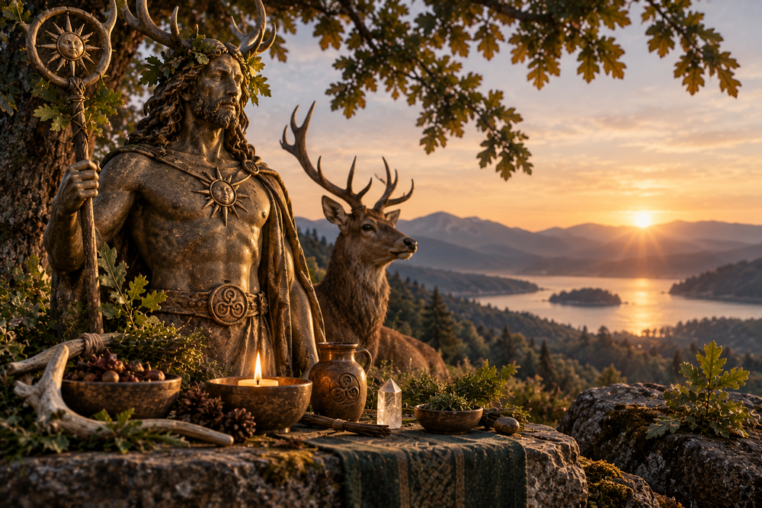
The Horned God is the most central figure of the masculine divine in contemporary witchcraft – wild, earthy, antlered, and ancient. He is lord of the forest and the hunt, keeper of the old dark mysteries, the untamed masculine that civilization has tried and failed to domesticate.
He appears in many forms across many cultures: as Cernunnos, the antlered Celtic deity of wild things. As Pan, the goat-legged Greek god of wildness and fertility. As Herne the Hunter, the spectral antlered figure of British folklore who leads the Wild Hunt through winter skies. As the Green Man, the foliate face that appears in medieval church carvings throughout Europe.
The Horned God teaches us about the sacred wildness in ourselves – the part that cannot be fully tamed, that longs for the forest, that moves by instinct as much as reason. He is not the enemy of civilization but its necessary counterbalance.
Working with the Horned God often involves time in nature, particularly in wild or wooded places. He speaks through the behavior of animals, through the quality of light in trees, through the primal intelligence of the body.
Solar Deities
The sun has been worshipped as divine across virtually every human culture. Source of light, warmth, and life itself, the great wheel that drives the cycle of the year.
Apollo: Greek god of the sun, prophecy, music, poetry, and healing. Apollo is perhaps the most complete expression of the solar masculine – brilliant, creative, artistic, and also precise, orderly, and occasionally ruthless in the pursuit of truth.
Ra: Egyptian sun god, creator and sustainer of existence. Ra journeys through the sky by day and through the underworld by night, battling chaos so that the sun can rise again.
Lugh: Celtic god of light, skill, and craftsmanship. Lugh is the “many-skilled one” – a god of excellence who excels at everything he turns his hand to. His festival, Lughnasadh, marks the first harvest and the beginning of autumn.
Belenos: Gaulish sun god associated with the radiance of Beltane, healing springs, and the cleansing fire that drives away disease.
Baldur: Norse god of light, beauty, joy, and peace. The most beloved of the Aesir, whose death at the hands of the mistletoe marks the beginning of winter’s darkness. Baldur’s story is the Norse expression of the solar sacrificial cycle.
Seasonal God Aspects
Many practitioners understand the God through his seasonal mythology – a cycle of birth, growth, love, sacrifice, and rebirth that mirrors the turning year:
Birth at Yule: At the winter solstice, the God is born as the returning light – the sun child, full of potential, promising the return of warmth.
Youth at Imbolc and Ostara: The young God grows alongside the waxing year, filled with the energy of spring.
Lover at Beltane: At the height of spring, the God and Goddess unite – the union of solar and lunar, active and receptive, that drives all generation.
King at Litha: At the summer solstice, the God is at his peak – golden, powerful, generous.
Harvest King at Lughnasadh: The first harvest begins. The God starts to decline; the grain king is cut with the corn.
Sacrifice at Samhain: The God passes into the underworld, completing the sacrifice that sustains the cycle.
Rebirth at Yule: And again, the wheel turns. The sun is reborn from the darkness.
Patron God Relationships
Many practitioners develop deep, sustained relationships with specific gods. Not as distant divine powers, but as living presences who become genuine companions in the magical life.
A patron god relationship typically develops over time, through repeated encounter, study, and devotion. The god makes himself known through his symbols, through the qualities he embodies appearing in your life, through the work he brings you.
Working with a patron god means studying his mythology deeply, honoring him at your altar, bringing him offerings of what he loves, and being willing to do the inner work his energy demands. Odin demands intellectual honesty and the willingness to sacrifice comfort for wisdom. Pan demands access to wildness and the body’s instinctive wisdom. Apollo demands excellence and clarity. Cernunnos demands respect for wildness and for death’s place in the cycle.
The god will ask something of you. That asking is the relationship.
Balancing Divine Masculine Energy
In both external practice and inner work, the divine masculine offers a counterbalance to the divine feminine – not as its opposite in a combative sense, but as its complement. Light and shadow, action and receptivity, structure and flow, the focused beam and the diffuse radiance.
A practice that works only with the feminine may become too inward, too yin, too focused on receiving and not enough on acting. A practice that works only with the masculine may become too outward, too forceful, losing access to the intuitive depths and the receptive wisdom of the soul.
The goal is not balance as a fixed point, but balance as a living dance. The ability to move fluidly between the qualities, bringing the right energy to the right moment.
The God is the sun that warms without burning, the king who serves, the hunter who knows himself to be hunted. In his willing return to the dark, he teaches us the only lesson worth learning: that what is given freely returns transformed.