 Written by
 The world is not empty. Beyond the range of ordinary perception, beyond the threshold of waking consciousness, there are presences – beings of many kinds, natures, and intentions, as real in their way as the solid earth beneath your feet. The practitioner who learns to navigate this world discovers that they have never truly been alone.
A World Full of Presence
One of the most fundamental shifts that comes with deepening magical practice is a change in how the world feels. What once seemed like an inanimate backdrop – trees, stones, rivers, the wind – begins to feel inhabited, aware, present. This is not delusion. It is the recovery of a perception that human beings have maintained across most of our history. The animist understanding that the world is alive, and that many different kinds of beings share it with us.
Different traditions map the spirit world differently, using different names, different hierarchies, different protocols for interaction. What is consistent across traditions is the basic recognition: we are not alone.
Working with spirits and otherworldly beings is a significant undertaking One that requires preparation, discernment, clear ethical principles, and considerable self-knowledge. It is not dangerous if approached wisely. It is not safe if approached carelessly.
Elemental Spirits
The four elements – Earth, Air, Fire, Water – are not merely symbolic categories. In magical tradition, each element has associated spiritual beings that embody and express its essential nature.
Gnomes (Earth): The elemental spirits of Earth are often called gnomes, though this name encompasses a range of beings. They are the intelligence within the mineral kingdom, the slow wisdom of stone, the patient energy of soil and crystal. Earth elementals tend to be solid, reliable, somewhat heavy in energy, and deeply connected to the physical world. Working with them supports grounding, manifestation, and the patient labor of building something lasting.
Sylphs (Air): The spirits of Air are swift, intellectual, and easily distracted. Lke the element they embody. They are the intelligences within the wind, within inspiration, within the communication of ideas. Air elementals support mental clarity, creative thinking, and the movement of information.
Salamanders (Fire): The salamanders are spirits of Fire. Not the amphibians, but elemental beings of living flame. They are passionate, transformative, somewhat unpredictable, and intensely powerful. Fire elementals support courage, transformation, and the burning away of what is no longer needed.
Undines (Water): The spirits of Water move in currents, responding to emotional and tidal forces. They are associated with dreams, intuition, the depths of the unconscious, and the flow of feeling through the human psyche. Water elementals support healing, emotional work, and the development of psychic perception.
Calling the elementals into your circle invites their energy and participation into your work. Treating them respectfully, acknowledging them, thanking them, releasing them properly, creates the foundation for genuine ongoing relationships.
Ancestor Veneration
Of all the spirit relationships available to a practitioner, the ancestors are perhaps the most immediately accessible and the most personally meaningful. They are connected to us by blood, by history, by the deep continuity of family lineage stretching back through time.
Ancestor veneration is practiced in some form in virtually every human culture. From the elaborate ancestor altars of Chinese tradition to the Day of the Dead celebrations of Mexico to the ancestor work within African diaspora religions to the Samhain practices of Celtic tradition. Honoring the dead is among the most ancient of human spiritual behaviors.
Who are “the ancestors”? In practice, the ancestors include your immediate recently deceased (grandparents, parents, loved ones), the longer chain of biological ancestors stretching back through generations, ancestors of the tradition or practice you follow (the beloved dead of your spiritual lineage), and ancestors of the land you inhabit.
Ancestor altars: A dedicated space for the ancestors is a beautiful and powerful practice. Photographs of the beloved dead, objects that belonged to them, their favorite foods or drinks offered respectfully. These create a physical home for the relationship. more…
Speaking to the ancestors: Many practitioners find that direct address, spoken aloud or in writing, is the most effective way to communicate with ancestors. Tell them what is happening in your life. Ask for their wisdom, their protection, their presence. Light a candle for them. more…
Healing the ancestral line: Not all ancestor relationships are comfortable ones. Family lines carry trauma as well as wisdom, wounds as well as gifts. Some of the most profound ancestor work involves consciously healing and releasing ancestral patterns that have been passed down through generations. Engaging with ancestors who were troubled or harmful, with compassion and clear boundaries, can shift patterns that have shaped your family for decades. more…
Spirit Guides and Familiars
Spirit Guides
Most traditions recognize the existence of helping spirits – beings who are committed to supporting a particular practitioner’s development and work. These may be ancestors, divine messengers, beings of light, elemental intelligences, or entities that defy easy categorization.
Spirit guides typically make themselves known gradually and undramatically, through a recurring sense of presence, through dreams, through synchronicities, through the quiet inner voice that seems to come from somewhere both inside and outside the self.
Working with spirit guides is a relationship, not a transaction. It develops over time through genuine attention, honest communication, and the willingness to do the inner work they point toward. They do not solve your problems for you. They accompany you as you solve them yourself.
Familiars
The familiar is a spirit, traditionally often taking animal form, or inhabiting an actual animal, that works closely with a witch in their magical practice. The popular image of the witch’s black cat draws on this tradition, and while it has been wildly distorted (familiars were not demonic servants, as the persecution narrative suggested), there is genuine truth at its root.
A familiar relationship is one of the closest forms of spirit partnership available. An ongoing bond of mutual respect, trust, and magical collaboration. Many practitioners have a living animal whose relationship with them carries clear spiritual dimensions – the cat who always appears during ritual, the crow who seems to track your movements, the dog whose behavior changes when energies shift.
Whether the familiar relationship is with a spirit being, an animal companion, or both simultaneously, it is characterized by genuine mutual recognition. You see each other, and the seeing itself is part of the magic. more…
Faeries and Nature Spirits
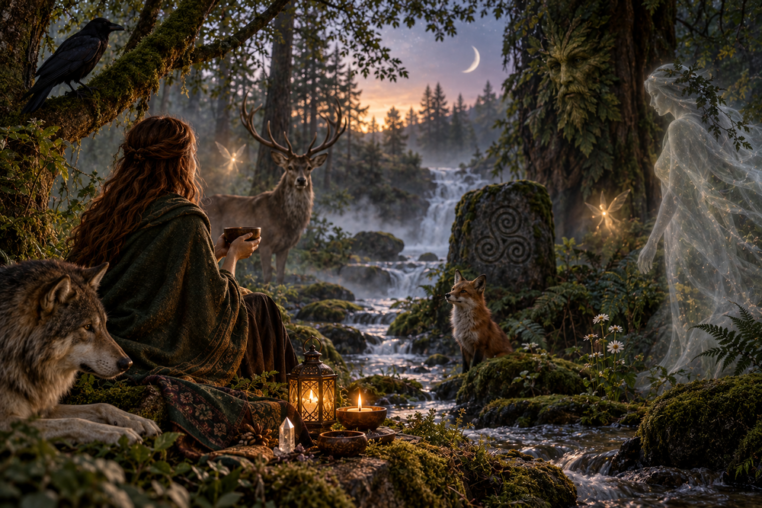
The fairy world, the realm of nature spirits, land spirits, and the fair folk, is one of the most ancient and persistent elements of European (and many other) magical traditions. Every culture that has lived close to the natural world has recognized the existence of beings that inhabit and animate specific places: the spirit of a river, the intelligence of an old tree, the wild beings of the forest and the moor.
In Celtic tradition, the fairy world (the sídhe or Otherworld) is not separate from ordinary reality but overlapping with it. Most accessible at liminal times (dawn, dusk, the cross-quarter festivals) and liminal places (boundaries, thresholds, bodies of water, ancient hills).
Working with nature spirits requires:
Respect: They are not servants and not pets. They are beings with their own nature, their own purposes, and their own expectations.
Protocol: Traditional fairy lore is full of guidance about how to interact with the fair folk without giving offense. Do not make promises you cannot keep, do not give unsolicited thanks (in some traditions), do not take without asking, do not speak of your dealings carelessly.
Discernment: Not all spirit presences encountered in the natural world are benevolent, particularly without preparation. Grounding, centering, and shielding before any intentional spirit contact is essential.
Building relationships with the spirits of your local land (the particular place you inhabit) is one of the most grounding and enlivening practices available. Learn the names of the waters near you. Visit the old trees. Leave offerings at thresholds. Listen.
Angels and Higher Beings
Many magical practitioners, regardless of their religious tradition, work with angels. Beings of pure light often understood as messengers and servants of the divine.
Angelology is a rich and complex tradition, most developed in Judaic, Christian, and Islamic frameworks but present across many others. Major archangels include:
Michael: Angel of protection, courage, and divine justice. Call on Michael for protection in dangerous situations, for the clearing of negative entities, for the strength to face what must be faced.
Gabriel: Angel of communication, prophecy, and divine messenger. Call on Gabriel for clarity of communication, for creative inspiration, for guidance at major transitions.
Raphael: Angel of healing and of travelers. Call on Raphael for healing work, for yourself, for others, for the healing of situations as well as bodies.
Uriel: Angel of wisdom and of the earth. Call on Uriel for intellectual clarity, for understanding difficult situations, for connection with earth energy.
Working with angels tends to raise the vibration of whatever space or working they are present in. Their energy is often experienced as profoundly peaceful and luminous.
Protection from Negative Entities
Any practitioner who opens consistently to the spirit world will, at some point, encounter presences that are not benevolent. This is neither a reason to avoid spirit work nor a reason to fear it. But it is a reason to practice robust spiritual hygiene.
Prevention is preferable to remedy: Regular cleansing, strong shielding, grounding before and after spirit contact, and the conscious establishment of clear energetic boundaries will prevent most unwanted encounters.
Never make agreements with unknown entities: An unknown spirit that offers great gifts in exchange for something is always cause for caution. Entities that apply pressure, create urgency, or play on fears are not helpers.
Call on protective powers: When a presence feels threatening, call immediately on your protective deities, archangels, or highest helping spirits. State clearly: Only beings of the highest good and clearest light are welcome here.
Banishing: A simple, firm verbal banishing “I release you and send you where you belong. You are not welcome here.”, combined with energetic shielding and a thorough space cleansing will deal with most unwanted presences.
Trust your instincts: If something feels wrong, something is wrong. The practitioner who has developed good grounding, centering, and discernment will typically feel the difference between a high-vibration presence and a lower one. Trust that feeling.
The spirit world is not somewhere else. It is here, interpenetrating the world we walk through daily, its presences and patterns woven through the fabric of everything. To develop relationship with this world is to discover that the apparent emptiness was always full. And that you were always accompanied.