 Written by
The chakras are everywhere in contemporary spiritual culture.
On candles, on meditation apps, on yoga class schedules, in crystal descriptions, in the vocabulary of practitioners who work across traditions so different that the word chakra seems to be the one thing they share. The rainbow column of energy centres running from base to crown has become one of the most recognisable symbols in modern spiritual practice. And one of the most misunderstood.
Before you work with the chakra system – and it is a genuinely useful system, worth working with seriously – it is worth understanding what it actually is, where it comes from, and how the version most Western practitioners encounter relates to the older systems it is drawn from.
Where the Chakra System Comes From
The chakra system as most Western practitioners know it is primarily drawn from the Hindu tantric tradition, particularly from texts of the Shakta Tantra school, with the most widely referenced classical source being the sixteenth-century Sanskrit text Sat-Chakra-Nirupana (Description of and Investigation into the Six Chakras), translated into English by Arthur Avalon (John Woodroffe) in 1919 under the title The Serpent Power.
The classical Hindu tantric system describes six or seven primary chakras, energy centers located along the central channel of the subtle body (the sushumna nadi). Each associated with specific qualities of consciousness, with a Sanskrit bija (seed) mantra, with a specific deity, with a geometric yantra, with a specific number of lotus petals, and with the ascending movement of kundalini energy through the system.
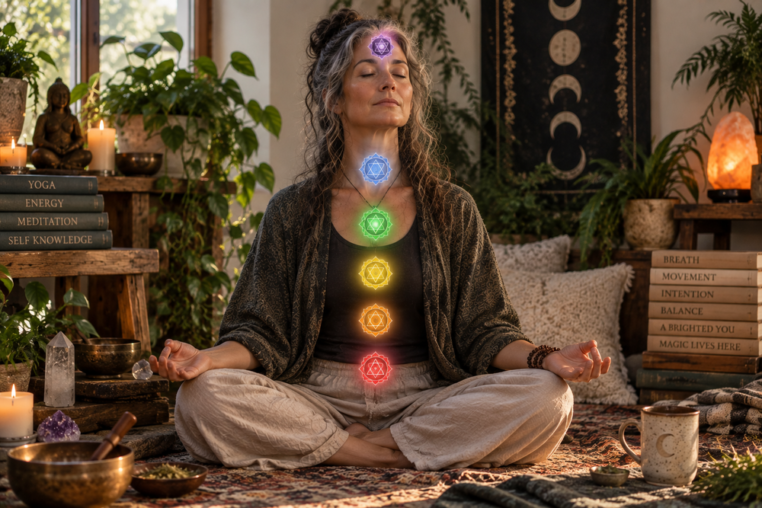
This is a sophisticated and internally coherent system that has been developed and refined over centuries within a specific philosophical and cosmological framework. The qualities it associates with each centre – grounding and survival at the base, creativity and relationship at the sacral, will and power at the solar plexus, love and connection at the heart, communication at the throat, perception and intuition at the third eye, and unity consciousness at the crown – reflect a coherent map of human experience from the most physical and instinctual to the most transcendent.
What most contemporary Western practitioners are working with is a significantly simplified version of this system, filtered through the Theosophical movement of the late nineteenth and early twentieth centuries, through the New Age movement of the 1970s and 1980s, and through the enormous popular synthesis that has occurred since. The rainbow colour associations – red, orange, yellow, green, blue, indigo, violet – do not appear in the classical Sanskrit texts. They were added by Western interpreters, primarily C.W. Leadbeater in his 1927 book The Chakras.
This does not make the contemporary system invalid. But it means you are working with a synthesis. A useful and functional tool that has been shaped by multiple hands over the past century. Not a direct transmission of an ancient system. Knowing this allows you to work with it more clearly and to explore the classical sources if you want to go deeper.
The Seven Centres and What They Govern
Muladhara – The Root (Base of the Spine)
The foundation of the system. Associated with survival, physical safety, belonging, the body’s most basic needs, and the sense of being held and supported by the earth. When this centre is functioning well, you feel stable, grounded, and at home in your body and your life. When it is disrupted, through trauma, chronic insecurity, or the chronic stress of not having basic needs reliably met, the disruption tends to manifest as anxiety, hypervigilance, difficulty feeling safe, and disconnection from the physical world.
Working with the root: Physical movement, time in nature, grounding practices, working with red, using earthy scents (patchouli, vetiver, cedarwood), working with red or black stones (garnet, red jasper, haematite, black tourmaline).
Svadhisthana – The Sacral (Lower Abdomen)
Associated with pleasure, creativity, emotional fluidity, sexuality, and relationship. The centre of how you feel, how you create, and how you relate to others at the level of intimacy and desire.
~ When functioning well: emotional resilience, creative flow, comfort with pleasure and intimacy.
~ When disrupted: emotional volatility or numbness, creative blockage, difficulty with intimacy or with healthy desire.
Working with the sacral: Creative practice of any kind, time near water, working with orange, using warm and sensual scents (orange, ylang ylang, sandalwood), working with orange stones (carnelian, orange calcite).
Manipura – The Solar Plexus (Upper Abdomen)
Associated with will, personal power, self-worth, the capacity to act in the world and to believe in your own authority to do so. The centre of confidence. Not the performed kind, but the quiet internal knowing that you have the right to be here and the capacity to do what you are here to do.
~ When functioning well: clear will, confidence, healthy boundaries.
~ When disrupted: people-pleasing, difficulty making decisions, either collapsed self-worth or overcompensating dominance.
Working with the solar plexus: Working with fire and candle magic, breathwork (particularly the energising breath), working with yellow, using warm and spicy scents (ginger, black pepper, citrus), working with yellow stones (citrine, tiger’s eye, yellow jasper).
Anahata – The Heart (Centre of the Chest)
The bridge between the lower three centres (which are primarily concerned with physical and personal experience) and the upper three (which are concerned with communication, perception, and transcendence). Associated with love. Both the love directed outward and the self-love that is its prerequisite. With compassion, with grief, with the capacity to remain open even after being hurt.
~ When functioning well: genuine warmth, the capacity to give and receive love freely, the ability to grieve and remain open.
~ When disrupted: closure, difficulty trusting, unprocessed grief, either withholding or desperate attachment.
Working with the heart: Practices of gratitude and appreciation, working with green (or pink for the softer aspect), using floral and heart-opening scents (rose, jasmine, neroli), working with green and pink stones (rose quartz, green aventurine, malachite).
Vishuddha – The Throat (Throat and Neck)
Associated with communication, authentic expression, the ability to speak your truth and to be heard. Also associated with listening – genuine listening, not just waiting for your turn to speak.
~ When functioning well: clear, honest expression, the ability to say what is true for you without excessive qualification or self-censorship.
~ When disrupted: difficulty speaking authentically, swallowing what needs to be said, or conversely speaking without consideration.
Working with the throat: Singing, chanting, toning (even if only quietly), journalling and other writing practices, working with blue, using cooling and clarifying scents (peppermint, eucalyptus, chamomile), working with blue stones (blue lace agate, aquamarine, sodalite).
Ajna – The Third Eye (Centre of the Forehead)
Associated with intuition, inner sight, pattern recognition, and the perception of what is not immediately visible to ordinary senses. The centre of the practitioner’s perceptive faculty.
~ When functioning well: clear intuition that you trust and that proves reliable, the capacity to see through surfaces to what underlies them, vivid and meaningful dreaming.
~ When disrupted: inability to trust your own perceptions, over-reliance on external authority, or conversely, untethered imagination that cannot be distinguished from reality.
Working with the third eye: Meditation, dream journalling, scrying and divination practices, working with indigo or deep purple, using clarifying and visionary scents (frankincense, mugwort, clary sage), working with purple and dark blue stones (amethyst, lapis lazuli, labradorite).
Sahasrara – The Crown (Top of the Head)
The centre associated with connection to something beyond the individual self – to the divine, to universal consciousness, to the wider field of which each person is a part.
~ When functioning well: a genuine sense of connection to something larger, spiritual experience that is grounding rather than dissociating, the ability to hold both the ordinary and the sacred simultaneously.
~ When disrupted: spiritual bypassing (using spiritual frameworks to avoid ordinary human challenges), disconnection from the body and ordinary life, or conversely, the closure that comes from never allowing in the possibility of anything beyond the material.
Working with the crown: Meditation and prayer (in whatever form these take for you), spending time in awe. In places or situations that produce a genuine sense of scale. Working with violet or white, using ethereal and elevating scents (lotus, frankincense, sandalwood), working with clear or violet stones (clear quartz, amethyst, selenite).
A Simple Daily Chakra Practice
You do not need a complex ritual to work with the chakra system. The simplest effective daily practice takes ten minutes.
Sit comfortably. Close your eyes. Take a few settling breaths.
Begin at the base of your spine. Bring your attention there. Breathe into it. Notice what you find. Not what you expect to find, but what is actually there. Tension, warmth, numbness, a sense of openness or constriction. Spend a breath or two simply witnessing.
Move your attention upward through each centre in sequence, spending a few breaths at each. When you reach the crown, sit for a moment with a sense of your whole energy body – the full column from base to crown – and then breathe down through it again, returning your attention to the body and to the room.
That’s the practice. Done daily, this simple check-in develops your sensitivity to your own energy body considerably faster than occasional elaborate chakra healings. You learn your own patterns. Which centers tend to be contracted under what conditions, which open naturally, what the difference feels like between a centre functioning well and one that is struggling.
The system is a map. Like all maps, it is not the territory – but it is a useful map, drawn from genuine observation of how human consciousness and energy function. Work with it honestly, record what you find, and let your own experience show you what it actually means for you.
🪄 Ritual
What you need:
~ A fire-safe container
✍️ Journal Prompts:
Grab your journal and write by candlelight. Let